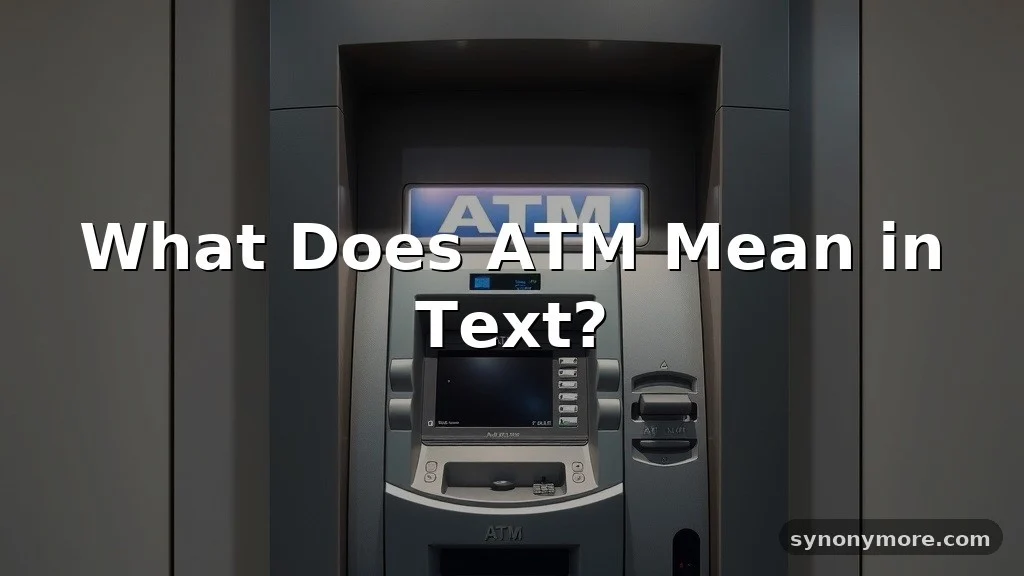
A short text can sometimes carry more meaning than it seems. ATM Meaning in Text usually refers to “at the moment,” a common abbreviation people use when they want to describe what is happening right now. It appears frequently in casual chats, social media messages, gaming conversations, and everyday texting.
Understanding ATM Meaning in Text is useful because the abbreviation can sound different depending on the sentence around it. In most modern chats, it simply means “at the moment” and helps make messages shorter and more conversational. For example, someone might write, “I’m busy ATM,” meaning “I’m busy at the moment.” It is generally informal and is better suited to texting than formal emails, academic writing, or professional documents.
This guide explains the meaning, full form, tone, examples, common uses, and context of ATM in text messages. You will also learn when it sounds natural and when writing the complete phrase is a better choice.
Definition & Meaning
ATM in text usually means “at the moment.”
It is an informal texting abbreviation used to describe something that is happening right now or around the present time.
Example:
“I can’t talk ATM.”
This means:
“I can’t talk at the moment.”
The meaning is usually clear from the surrounding sentence. In casual digital communication, ATM helps people express a current situation quickly without typing the full phrase.
Full Form and Meaning
ATM Full Form in Text: At The Moment
Meaning: Right now, currently, or at this particular time.
Example:
“I’m working ATM.”
Meaning: “I’m working at the moment.”
Quick Context
| Term | Meaning | Usage |
|---|---|---|
| ATM | At the moment | Casual texting |
| Full form | At The Moment | Informal communication |
| Tone | Casual and conversational | Chats and messages |
| Example | “I’m busy ATM.” | “I’m busy right now.” |
| Formal writing | Usually avoid | Write “currently” or “at the moment” instead |
Note: In other contexts, ATM can also mean Automated Teller Machine, but in texting and chat conversations, “at the moment” is the common intended meaning when the context is about time or a current situation.
Defining the Term ATM
At its most basic level, the abbreviation ATM is a classic example of how a single set of letters can represent wildly different concepts depending on the setting. In the traditional, formal sense, it stands for automatic teller machine. This is the device you visit when you need to get cash or check your balance.
Most people recognize this definition immediately because it has been a part of our daily lives for decades. However, in the realm of texting and social media, the term has shifted to mean “at the moment.”
When someone types “I am busy ATM,” they are not referring to their banking habits. They are simply saying they are occupied at this specific point in time. This usage is extremely common among teens and young adults who want to save time while typing.
By using this shorthand, they can keep their messages brief and fast. It is a functional way to communicate status updates without needing to write out longer phrases. Understanding this definition is key to avoiding confusion.
If a friend sends you a message with this acronym, they are almost certainly referring to their current state or what they are doing right now. It is a simple, effective piece of slang that helps streamline digital chatter.
The Evolution and History of the Term
The transition of the term from a banking machine to a temporal indicator is a fascinating look at how language changes. The automatic teller machine concept rose to prominence in the late 1960s and 1970s. As these machines became fixtures in every bank branch and grocery store, the abbreviation became a household name.
It was one of the first widely adopted tech-based abbreviations that most people learned by heart. Because the term was so ubiquitous, it was only a matter of time before it was repurposed by the digital generation.
As text messaging became the primary way for people to talk, the need for brevity became paramount. People started looking for ways to cut down their character counts. The existing, well-known acronym was the perfect candidate for a new, secondary life.
It did not take long for “at the moment” to become the dominant way the term was used in informal chat rooms and early instant messaging platforms. Over the last two decades, this shift has solidified. While the banking definition remains the primary formal meaning, the slang usage has effectively taken over the digital landscape.
Today, it is a standard part of internet lexicon. This history shows us that abbreviations often follow a path from formal, technical usage to widespread, informal shorthand. It is a natural process of linguistic efficiency that continues to shape how we interact with technology.
Usage in Various Digital Contexts
You will encounter this term in almost every corner of the internet. It appears in text messages, on platforms like Twitter or TikTok, and even in gaming chat boxes.
Because it is so versatile, it fits into almost any conversation where timing is the focus. Let us look at a few examples of how this looks in practice.
“Hey, can you talk right now?”
“Sorry, I am in a meeting ATM. Call you later?”
In this dialogue, the person is using the term to set a boundary regarding their current availability. It is polite, quick, and gets the point across without needing extra words. In a gaming context, you might see something like this:
“Is the server down?”
“Yeah, it seems to be having issues ATM. Maybe try again in ten minutes.”
Here, the player is using the term to provide an update on a situation that is currently unfolding. It is efficient for players who are in the middle of a match and need to communicate quickly with their team. Whether you are chatting with a friend or checking in on a community forum, the term serves as a reliable marker of the present.
It helps frame the timeline of the conversation, making it easier for everyone to stay on the same page. The key is to notice how the acronym is framed within the rest of the sentence.
Common Misconceptions and Clarifications
One of the biggest issues with using this acronym is the potential for confusion between the banking definition and the slang definition. If you tell someone, “I am at the ATM,” they will assume you are standing in front of a bank machine.
If you say, “I am busy ATM,” the context of the sentence makes it clear you mean “at the moment.” However, if a message is poorly phrased, it can lead to funny or awkward misunderstandings.
Another misconception is that the term is universally understood by all generations. While younger people and digital natives use it constantly, someone from an older generation might genuinely think you are talking about banking. This is why tone and clarity are essential.
You should also be aware that in some very specific, edgy online subcultures, the acronym has been used for other, more vulgar meanings. While these are not the standard definitions, it is helpful to be aware that the internet can sometimes twist simple words into something else. If you are ever in doubt, the best approach is to stick to the most common usage or simply spell out the phrase.
By being mindful of who you are talking to, you can avoid any unintentional confusion. Always consider your audience before choosing your shorthand.
Similar Terms and Alternatives
If you want to avoid the ambiguity of the acronym, there are plenty of other ways to express the same idea. Depending on the formality of your conversation, you might choose different words to convey that you are doing something right now.
* Right now: This is the most common and clear alternative.
* Currently: This is a great, slightly more professional option.
* At this time: This works well in formal or semi-formal emails.
* At the present moment: A bit long, but very clear.
* Just now: Useful for describing something that has happened in the last few seconds.
Using these alternatives can make your writing feel more polished and less like shorthand. If you are worried that your friend might not understand your slang, just using “right now” is the safest bet. There is no rule that says you must use acronyms in every message.
Sometimes, full sentences are actually more effective at conveying your personality and tone. You can view these alternatives as tools in your communication kit. Just like a professional writer chooses the right word for the right mood, you can pick the best phrasing based on the person you are chatting with.
How to Respond to This Term
Knowing how to respond to this acronym depends entirely on the context of the conversation. If a friend tells you they are busy, you can keep your response casual and low-pressure. If a colleague uses it in a chat, you might want to be a bit more professional.
For a casual response, you could say: “No worries! Just hit me up when you are free.”
If you want to be funny, you could play on the dual meaning: “Oh, are you at the bank? Can you withdraw some money for me?”
If you are in a professional setting, it is usually best to avoid the acronym entirely.
Instead, acknowledge their message with: “Understood. Please let me know when you are available to discuss this further.”
By tailoring your response, you show that you are paying attention to the nuance of the message. If someone is clearly busy, respecting their time by keeping your reply brief is the best way to maintain a good rapport.
You do not need to overthink it. Most of the time, a simple acknowledgment is all that is required to keep the flow of the conversation moving forward smoothly.
Regional and Cultural Differences
The usage of this acronym is largely tied to English-speaking digital culture, but it has spread globally due to the nature of the internet. Because so many global platforms rely on English shorthand, users in countries where English is a second language often adopt these same terms. You might see the acronym used in chat apps in Europe, Asia, or South America, often paired with local slang.
However, it is important to remember that not every culture uses the same shorthand. In some regions, people might prefer to use their own local slang to describe the present moment. If you are traveling or chatting with someone from a different culture, it is always a good idea to pay attention to the terms they use first.
Do not assume that everyone on the internet shares the same digital vocabulary. While the term is very common in the United States, Canada, and the UK, it might be less frequent in other places. Being culturally aware makes you a better communicator and helps prevent the accidental misuse of terms that might not land the way you intend.
Usage in Online Communities and Dating Apps
In the world of dating apps like Tinder or Bumble, the acronym is frequently used to manage expectations. You might see a profile that says, “Not looking for anything serious ATM.”
This is a quick way to communicate current relationship goals without writing a long paragraph. It helps people filter for others who are on the same page.
In gaming communities, the term is used to coordinate actions. “I need help at mid lane ATM” is a common call for assistance. It is fast, efficient, and fits the high-speed nature of gaming.
On platforms like Twitter, it is used to comment on breaking news or live events. “The energy in this stadium is wild ATM!” This usage helps create a sense of shared experience, allowing users to feel connected to others who are watching the same event.
In all these cases, the term acts as a bridge. It connects the user to their community by providing a common language for describing the present. If you are participating in these communities, learning how to use these terms effectively can help you integrate and communicate more clearly with your peers.
Suitability for Professional Communication
One of the most important questions to ask is whether this term belongs in a professional email or a work Slack channel. The short answer is that it depends on your workplace culture.
If you work in a very casual startup environment where emojis and slang are common, using the acronym might be perfectly acceptable. It fits the pace of fast-moving teams who value efficiency above all else.
However, if you are in a more traditional or formal office, you should avoid it. Using slang in a formal report or an email to a client can make you appear unprofessional or lazy. It is always better to err on the side of caution.
If you are unsure, spell out your words. Using “at the moment” instead of the acronym takes only a fraction of a second more but communicates a higher level of respect and attention to detail. Professionalism is about clarity, and sometimes acronyms can cloud that clarity.
Stick to standard English in formal documents and save the shorthand for your personal messages. You can find more information on digital communication standards through the Nielsen Norman Group, which offers deep insights into user experience and effective digital interaction.
Frequently Asked Questions
1. Is it rude to use ATM in a text?
It is not rude, but it can be informal. Use it with friends or people you know well, but avoid it in professional or serious conversations.
2. Does ATM always mean “at the moment”?
No.
It is still the primary abbreviation for an automatic teller machine. Context is the only way to tell the difference.
3. Can I use it in an email to my boss?
Generally, no. It is better to use “at the moment” or “currently” to maintain a professional tone.
4. Is this term used by children?
Yes, many teens and younger people use it as part of their daily digital vocabulary.
5. Are there other meanings for this acronym?
Yes, in some niche online communities, it can have different, sometimes inappropriate meanings. Always be aware of the context of the conversation.
6. Is ATM used outside of the United States?
Yes, it is common across many English-speaking online communities globally, though local slang might be preferred in some areas.
7. Should I capitalize the letters?
It is common to write it in all caps, but in casual texting, many people use lowercase letters as well. Both are acceptable in informal settings.
Final Thoughts
Language is a living, breathing thing. The way we communicate today is vastly different from how we did even ten years ago, and terms like this are a perfect example of that change. Whether you are using it to save a few seconds while texting a friend or simply trying to understand what your teen is talking about, the key is to stay flexible and aware of your surroundings.
Context is the anchor that keeps our conversations from drifting into confusion. By observing how others use the term and remaining mindful of your own audience, you can navigate the digital world with confidence.
Remember that while slang is fun and efficient, there is always a time and a place for clear, full-sentence communication. Keep these tips in mind, and you will never be left feeling out of the loop when you see a familiar acronym in a new light.
Read More Related Articles:
- Sn meaning in text – SynonyMore.com
- AFK Meaning in Text: From Gaming Slang to Everyday Chats …
- Iykyk meaning in text – SynonyMore.com