
Good manners can change the way people experience you. A thoughtful response, respectful conversation, or graceful way of handling an awkward moment can leave a strong impression. English has a word for this kind of social refinement: couth. The couth meaning is polite, cultured, refined, or socially well-mannered. It describes behavior that shows an understanding of how to act appropriately around others.
Although the word is real, it is much less common than polite, refined, or well-mannered. You may encounter it in playful conversations, word discussions, informal writing, or as a deliberate contrast with uncouth. Understanding this unusual adjective helps you recognize its tone, choose the right synonym, and use it naturally without making an ordinary sentence sound unnecessarily formal.
What Does Couth Mean?
Couth means polite, refined, cultured, or socially well-mannered. It describes a person, manner, or behavior that shows social awareness and an understanding of appropriate conduct.

For example:
- His couth response helped calm an uncomfortable conversation.
- She remained couth and respectful throughout the formal dinner.
- The host’s couth behavior made every guest feel welcome.
In these examples, the word suggests more than simply following rules. It points to behavior that feels considerate, appropriate, and socially polished.
The word is particularly interesting because many English speakers know uncouth but rarely use couth by itself. Uncouth usually describes someone who behaves rudely, awkwardly, or without refinement. Couth expresses the positive opposite, although it can sound unusual or playful in modern conversation.
If you want the simplest possible definition, think of couth as the opposite of uncouth.
Couth Meaning in Simple English
In simple English, couth means behaving with good manners and showing respect for other people.
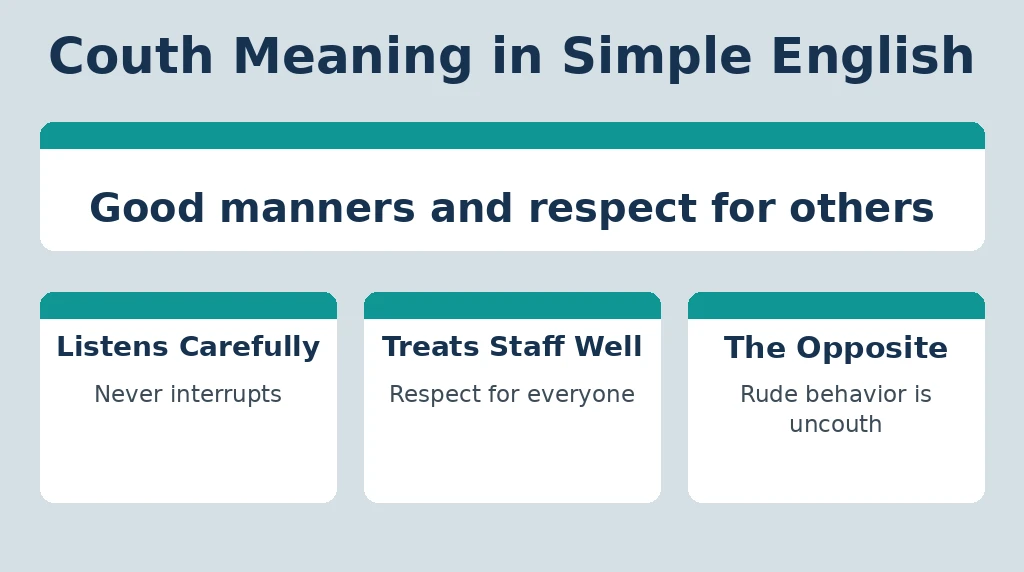
Imagine attending a dinner with people you have never met. One guest listens carefully, avoids interrupting, treats the staff respectfully, and includes quieter people in the conversation. You could describe that guest as couth.
Now imagine someone speaking rudely to the staff, interrupting everyone, and making insulting comments. You would be more likely to call that person uncouth.
Here is a simple comparison:
| Word | Simple Meaning | Example |
|---|---|---|
| Couth | Polite and socially refined | He spoke in a couth manner. |
| Uncouth | Rude or lacking social refinement | His uncouth remark offended the guests. |
| Polite | Showing good manners | She politely thanked the host. |
| Refined | Showing cultivated manners or taste | He has a refined way of speaking. |
| Respectful | Showing consideration for others | They remained respectful during the disagreement. |
One useful distinction is that couth often describes someone’s overall manner, while polite can refer to one specific action. Saying “she was polite” is ordinary and natural. Saying “she was couth” makes the sentence more unusual and may draw attention to the word itself.
Is Couth a Real Word?
Yes, couth is a real English word. It is an adjective meaning socially refined, cultured, or well-mannered. It is uncommon, but it is not simply a spelling mistake or an invented internet expression.
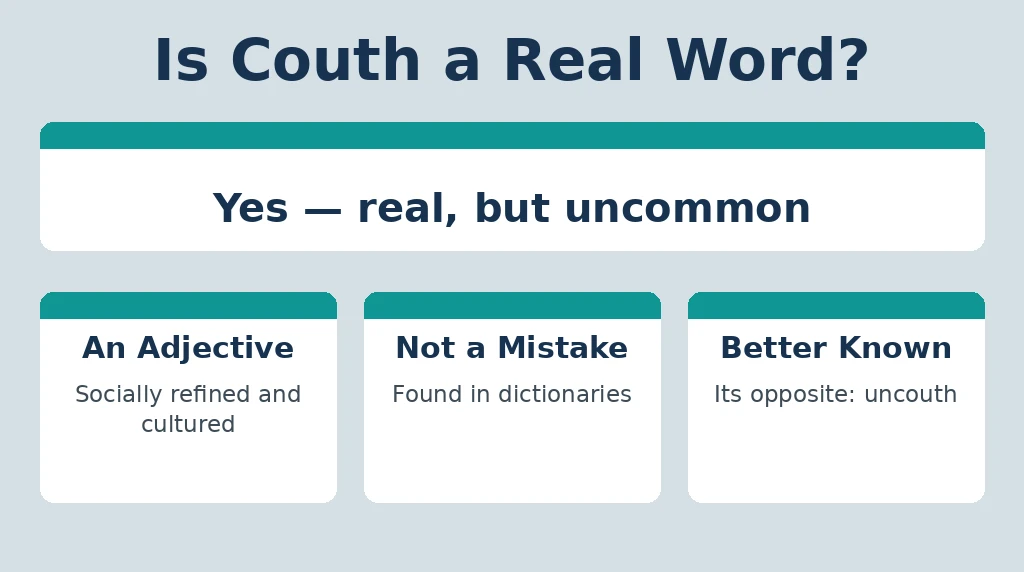
Its rarity is one reason people search for the couth definition. Many English speakers recognize uncouth from books, movies, or everyday descriptions but have little experience seeing the positive form used independently.
The word can appear in dictionaries, literary discussions, humorous writing, and conversations about vocabulary. Its uncommon status means that readers may need context to understand it.
For everyday communication, polite, courteous, cultured, and well-mannered are usually clearer choices. However, couth can be useful when discussing the relationship between the word and its opposite, uncouth, or when a writer deliberately wants an unusual adjective.
A word does not have to be common to be valid. The more important question is whether the audience will understand it in the sentence where it appears.
Couth Pronunciation
The usual pronunciation of couth is kooth, with a hard k sound at the beginning and a final th sound, as in tooth.
It has one syllable.
A simple pronunciation guide is:
- C: Sounds like the k in kind.
- outh: Sounds like the ending of tooth in accents that pronounce those words with the same vowel.
The pronunciation is useful to know because the spelling may initially look unfamiliar.
Example: The speaker’s couth manner impressed the audience.
When speaking to someone who may not recognize the word, polite or well-mannered will usually communicate the idea more quickly.
What Part of Speech Is Couth?
Couth is an adjective. An adjective describes a person, place, thing, action, or quality.
It can appear before a noun:
- A couth guest
- A couth response
- A couth manner
- A couth conversation
It can also follow a linking verb:
- His behavior was couth.
- Her response seemed couth.
- The guests remained couth throughout the event.
These grammatical patterns are similar to those used with adjectives such as polite, courteous, and refined.
Can Couth Describe a Person?
Yes. It can describe a person whose behavior shows good manners, social awareness, or refinement.
Example: Although he was new to the company, he was couth and respectful during meetings.
The sentence focuses on how he behaves, not on his wealth, education, appearance, or social position. A person does not need expensive clothes, a prestigious background, or formal education to behave considerately.
Can Couth Describe Behavior?
Yes. It can describe speech, conduct, responses, and manners.
Example: Her couth response prevented a small disagreement from becoming an argument.
Here, the word highlights a measured and socially appropriate reaction.
Can Couth Describe an Object or Place?
It is primarily associated with people and their manners, or with behavior and social presentation. Describing a room, building, or object as couth is less natural unless the writer is using the word creatively to suggest refinement or cultivated style.
For a well-designed room, elegant, tasteful, or refined is usually more precise.
Couth Synonyms: Words With Similar Meanings
A synonym is a word with the same or a closely related meaning. The best synonym for couth depends on the quality you want to emphasize.
Some alternatives focus on manners, others on social sophistication, and others on consideration for people.
| Synonym | Meaning | Best Use |
|---|---|---|
| Polite | Showing good manners | Everyday conversation |
| Courteous | Showing consideration and respect | Professional and formal settings |
| Well-mannered | Behaving according to accepted standards of conduct | Describing a person’s behavior |
| Refined | Showing cultivated manners, taste, or style | Formal writing and social presentation |
| Cultured | Showing knowledge of or appreciation for arts and cultural practices | Education, interests, and social refinement |
| Civil | Calm and respectful, especially during disagreement | Difficult conversations |
| Gracious | Kind, courteous, and considerate | Hospitality and responses to praise |
| Respectful | Showing regard for other people | Work, school, and personal relationships |
| Sophisticated | Showing social awareness, experience, or complexity | Style, behavior, and social settings |
| Tactful | Expressing something carefully to avoid unnecessary offense | Sensitive conversations |
| Urbane | Polished and confident in social situations | Formal or literary descriptions |
| Diplomatic | Handling disagreement or sensitive matters skillfully | Workplace and public communication |
These words overlap, but they are not identical.
For example, someone can be polite without being particularly sophisticated. A person can be tactful during a difficult discussion without having extensive cultural knowledge. A gracious host may go beyond basic manners by making others feel comfortable.
Use couth when you specifically want to convey social refinement, but consider a more familiar synonym if clarity is your main goal.
Couth Antonyms: Words With Opposite Meanings
An antonym expresses the opposite or a contrasting meaning. Because couth relates to manners and refinement, its antonyms describe rude, crude, or socially inappropriate behavior.
| Antonym | Meaning | Example |
|---|---|---|
| Uncouth | Lacking refinement or good manners | His uncouth comments upset the guests. |
| Rude | Showing little respect or consideration | It was rude to interrupt her. |
| Crude | Lacking polish, restraint, or refinement | He made a crude joke at dinner. |
| Impolite | Not showing proper manners | Her response sounded impolite. |
| Discourteous | Failing to show respect or consideration | The employee was discourteous to the customer. |
| Vulgar | Crude or offensive in taste, language, or behavior | The conversation became vulgar. |
| Boorish | Behaving in a rude and insensitive way | His boorish conduct embarrassed his friends. |
| Tactless | Failing to consider how words may affect others | The tactless comment hurt her feelings. |
| Ill-mannered | Behaving without good manners | The ill-mannered guest interrupted repeatedly. |
| Uncivil | Disrespectful or lacking courtesy | The discussion became uncivil. |
Uncouth is the closest and most useful antonym to learn alongside couth. The other words describe particular kinds of behavior, so the best choice depends on what actually happened.
For instance, tactless may be more accurate than rude when someone makes an insensitive remark without intending to insult anyone.
Couth vs. Uncouth: What Is the Difference?
The difference is straightforward: couth describes social refinement, while uncouth describes a lack of refinement or socially inappropriate behavior.
The contrast becomes clearer in practical situations.
| Situation | Couth Behavior | Uncouth Behavior |
|---|---|---|
| At dinner | Listening and allowing others to speak | Interrupting and talking with food in your mouth |
| At work | Disagreeing respectfully | Insulting a colleague |
| In public | Giving others space | Pushing ahead without consideration |
| During a disagreement | Explaining your position calmly | Using personal attacks |
| As a guest | Thanking the host | Complaining rudely and showing no appreciation |
| Online | Criticizing an idea respectfully | Mocking or insulting the person who shared it |
These examples are about behavior, not a person’s permanent character. Someone may behave thoughtfully in one situation and poorly in another.
It is also important not to confuse social refinement with social class. A person can have excellent manners without being wealthy, highly educated, or familiar with elite social customs. Respect, consideration, and awareness of others are practical behaviors that people can develop in everyday life.
Why Is Uncouth More Common Than Couth?
One reason the contrast attracts attention is that uncouth is far more familiar in modern English than couth. Speakers often learn the negative word first and then discover that its positive counterpart exists.
The positive form may also feel unnecessary in ordinary conversation because English already has several common words for good manners, including polite, courteous, and well-mannered.
For example, most people would naturally say, “She is polite and considerate,” rather than “She is couth.”
The word can still be effective when the contrast itself matters, especially in vocabulary explanations, playful remarks, or writing that deliberately uses uncommon language.
Couth vs. Polite: Are They the Same?
Couth and polite are closely related, but they do not always communicate exactly the same idea.
Polite usually refers to behavior that follows accepted standards of courtesy. Saying thank you, waiting your turn, and addressing people respectfully are common examples.
Couth suggests a broader sense of social refinement or cultivated manners. Because it is rare, it can also carry a humorous or self-conscious tone.
Compare these examples:
- Polite: He politely thanked the interviewer for their time.
- Couth: He maintained a couth manner throughout the formal interview.
Both sentences suggest appropriate conduct. The first sounds natural in everyday English, while the second sounds more unusual and formal.
In most practical writing, polite is the better choice. Use couth when its uncommon quality serves a purpose, such as explaining vocabulary or making a deliberate contrast with uncouth.
Couth Meaning in Modern English and Slang
People sometimes search for couth meaning in slang because the word can appear in jokes, casual online discussions, and humorous descriptions of manners.
However, couth is not generally recognized as a major slang term with a separate, widely established meaning. Its central meaning remains social refinement or good manners.
Its unusual sound can make it useful in playful expressions. For example:
After years of joking about his uncouth habits, his friends finally admitted that he had become surprisingly couth.
The humor comes partly from using a rare word where a common one would normally appear.
Another example:
That was a remarkably couth way to handle a difficult customer.
Here, the speaker may be sincere, playful, or slightly formal. The surrounding tone determines how the remark is understood.
Do not assume that every online use gives couth a new slang definition. Sometimes people are simply using the standard word in a humorous or unexpected way.
Couth Word Origin: Where Does It Come From?
Couth is historically connected with the idea of knowing or being familiar with something. It is related to the older English verb cunnan, meaning to know or be able to do something, and to the word family associated with uncouth.
Historically, uncouth developed with a sense of something unknown, unfamiliar, or strange, before becoming strongly associated with a lack of manners or refinement. The positive form couth is now used to express familiarity with social conventions and cultivated behavior.
This history helps explain why the two words are connected, but their modern meanings should not be confused with every older sense of their word roots.
For a modern reader, the most useful point is simple: couth is a legitimate but uncommon adjective, and uncouth is the more familiar member of the pair.
How to Use Couth in a Sentence
The easiest way to learn an unfamiliar word is to see how it works in realistic situations.
Here are examples across different contexts.
Couth Examples at Work
1. Her couth response to the client’s criticism kept the meeting productive.
The adjective describes a composed and socially appropriate response.
2. He was couth enough to disagree without embarrassing his colleague.
The sentence emphasizes tact and respect during a disagreement.
3. The manager appreciated the employee’s couth behavior during a tense negotiation.
The word suggests professional conduct and social awareness.
Couth Examples in Everyday Life
4. It was couth of him to thank the hosts before leaving.
5. She remained couth when the conversation turned uncomfortable.
6. His couth manners made a positive impression on the other guests.
These examples show how the word can describe small actions that help people interact respectfully.
Couth Examples in Writing
7. The author portrays the character as couth, thoughtful, and attentive to others.
8. Her couth manner contrasted sharply with the rude behavior of the other guests.
9. The article praised his couth handling of a sensitive public issue.
These sentences work in explanatory or formal writing, though more familiar synonyms may sound smoother in many publications.
Couth Examples With a Humorous Tone
10. He managed to be couth for the entire dinner, much to his friends’ surprise.
11. One polite apology later, his friends declared him officially couth.
12. She corrected his uncouth joke with such a couth response that nobody felt embarrassed.
The unusual word choice adds a playful touch. This is one reason couth may appear in discussions about language and wordplay.
Common Mistakes When Using Couth
Because couth is uncommon, writers can easily make it sound unnatural. A few practical guidelines help avoid that problem.
Mistake 1: Assuming Everyone Knows the Word
A sentence such as “His couth demeanor impressed everyone” may be understandable from context, but some readers may pause at the adjective.
Better approach: Use polite, courteous, or well-mannered when writing for a broad audience. Reserve couth for contexts where the unusual word adds value.
Mistake 2: Treating Couth as a Synonym for Wealthy
Social refinement is not the same as wealth. A person does not need expensive clothes, a prestigious job, or an elite background to be considerate and well-mannered.
Better approach: Use wealthy or affluent to describe financial status. Use couth to describe behavior.
Mistake 3: Confusing Couth With Cultured
The words overlap, but cultured often suggests knowledge of art, literature, music, or cultural traditions. Couth focuses more directly on manners and social refinement.
Better approach: Choose the word that matches the quality you mean.
Mistake 4: Using Couth to Describe Every Positive Quality
Someone can be intelligent, honest, generous, or hardworking without necessarily being couth. The word relates specifically to social conduct and refinement.
Better approach: Select a more precise adjective when describing qualities unrelated to manners.
Mistake 5: Assuming Couth Is Always Serious
Because it is rare, the word can sound humorous or deliberately formal. Its effect depends on the sentence and the relationship between the speaker and audience.
Better approach: Consider the tone before using it in a professional email, academic essay, or casual conversation.
When Should You Use Couth Instead of a Synonym?
The right word depends on your audience and purpose.
| Your Goal | Best Word Choice | Reason |
|---|---|---|
| Communicate clearly in everyday conversation | Polite | Familiar and easy to understand |
| Describe respectful professional conduct | Courteous | Emphasizes consideration |
| Describe socially polished behavior | Refined | Highlights cultivated manners |
| Describe considerate handling of a sensitive issue | Tactful | Focuses on avoiding offense |
| Explain the positive opposite of uncouth | Couth | Makes the contrast explicit |
| Describe knowledge of arts and culture | Cultured | Focuses on cultural awareness |
| Describe behavior that lacks refinement | Uncouth | Directly expresses the opposite |
For most readers, clarity is more important than choosing an unusual word. If couth communicates exactly what you want and fits the tone, use it. If it distracts from your message, a familiar synonym will usually work better.
Frequently Asked Questions
What does couth mean in simple terms?
Couth means polite, refined, or well-mannered. It describes someone who behaves appropriately and shows consideration for others.
Is couth a real word?
Yes. Couth is a recognized English adjective. It is uncommon in modern everyday speech, but it is not an invented word or a misspelling of uncouth.
What is the opposite of couth?
The closest opposite is uncouth, which describes behavior that is rude, awkward, or lacking social refinement. Other antonyms include impolite, discourteous, and ill-mannered.
What is a synonym for couth?
Common synonyms include polite, courteous, refined, cultured, gracious, and well-mannered. The best alternative depends on the context.
How do you pronounce couth?
Couth is pronounced “kooth,” with one syllable and a final unvoiced th sound, similar to the ending of tooth.
Is couth slang?
Not primarily. Couth is an uncommon English adjective. It can be used humorously or casually, but its core meaning is polite, refined, or socially well-mannered.
What is the difference between couth and uncouth?
Couth describes good manners and social refinement. Uncouth describes a lack of refinement or socially inappropriate behavior. Uncouth is much more common in everyday English.
How do you use couth in a sentence?
You could write, “She remained couth during the disagreement and listened to everyone’s concerns.” The word describes her respectful and socially appropriate behavior.
Is couth the same as polite?
They have similar meanings, but polite is more common and usually refers to courteous behavior. Couth is rarer and can suggest broader social refinement or sound deliberately playful.
Conclusion
The couth meaning is polite, refined, cultured, or socially well-mannered. It is a real English adjective, although it is far less common than polite, courteous, or well-mannered.
The most useful way to remember it is through its relationship with uncouth. Couth describes socially refined behavior, while uncouth describes behavior that lacks refinement or good manners. Once you understand that contrast, the word becomes easier to recognize in writing and use in the right context.
For everyday communication, choose the clearest word for your audience. For vocabulary learning, literary discussion, or playful writing, couth offers a useful and memorable alternative.
Discover More Post:
- 111 Meaning | Spiritual Significance, Symbolism, Love & the …
- Unhinged Meaning | Definition, Examples, Tone & Why It’s …
- FUPA Meaning in Text & Slang – SynonyMore.com
