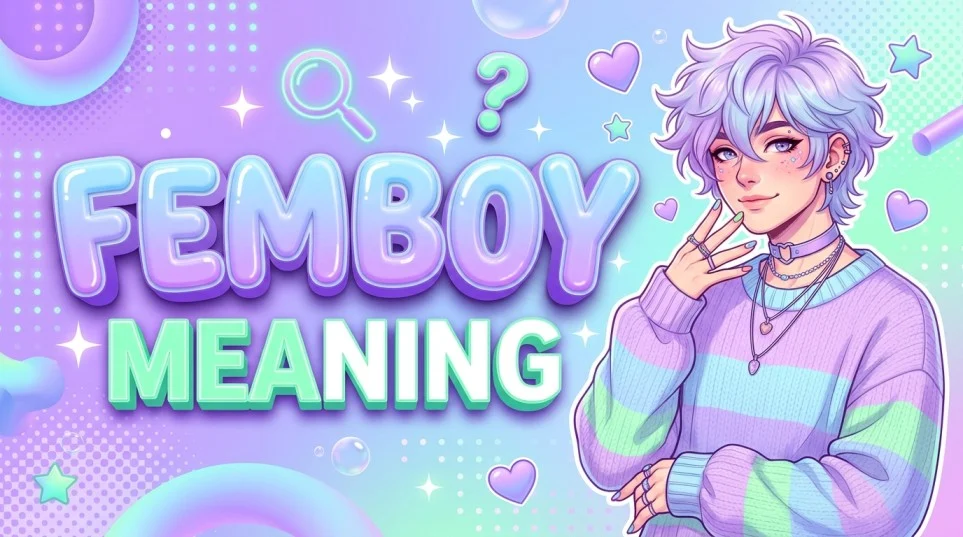
The word femboy can appear in a TikTok comment, an online conversation, a meme, or a discussion about fashion. If you have encountered it and wondered what it actually means, the answer is simpler than you might expect.
Femboy meaning: A femboy is typically a boy or man who expresses himself in ways traditionally associated with femininity. This may include clothing, makeup, hairstyles, accessories, mannerisms, or an overall feminine appearance. The term combines the words feminine and boy.
The word describes gender expression, not necessarily gender identity or sexual orientation. Some people proudly use femboy as a personal label, while others may not identify with it at all. Understanding this distinction makes it easier to interpret the term correctly, especially when it appears in online slang or social media discussions.
What Does Femboy Mean?
A femboy is generally a boy or man who embraces a feminine style or presentation while identifying with being a boy or man. The term is informal and is often used in internet culture, fashion discussions, and online communities.
For example, a man might wear a skirt, paint his nails, use eyeliner, or choose a soft, feminine fashion style. If he identifies with the term femboy, he may use it to describe his appearance or self-expression.
However, there is no single look that makes someone a femboy. One person might prefer oversized sweaters and pastel colors, while another might wear skirts, thigh-high socks, jewelry, or bold makeup. Someone else may express femininity through hairstyles and mannerisms alone.
The important point is that femboy describes a style of gender expression, not a fixed personality, body type, or set of interests.
What Does the Word Femboy Literally Mean?
The word femboy combines two elements:
- Fem: A shortened form associated with feminine or femininity.
- Boy: Refers to a boy or, in common usage, a man who identifies with the label.
Together, the word describes a feminine-presenting boy or man. It is a slang term rather than a formal medical or psychological diagnosis.
Femboy Meaning in Text and Social Media
In texting, the femboy meaning usually stays the same, but its tone depends on the conversation.
On platforms such as TikTok, Reddit, Discord, and Instagram, the word can appear in fashion posts, memes, profile descriptions, fan communities, or conversations about personal identity.
Here are a few realistic examples.
| Text or comment | What it means |
|---|---|
| “He has a femboy aesthetic.” | His style is traditionally feminine. |
| “I’m a femboy, and I love experimenting with fashion.” | The speaker uses the label for himself. |
| “That outfit gives femboy vibes.” | The outfit has a feminine style associated with the term. |
| “Is femboy the right word for this character?” | The person is asking about a label for a feminine-presenting character. |
| “This community is welcoming to femboys.” | The community welcomes people who identify with or relate to the label. |
Is Femboy a Compliment or an Insult?
It can be either, depending on context.
When someone uses the term to describe themselves, it may express confidence, identity, fashion preferences, or belonging to an online community. Among friends, it may also be used playfully.
However, calling someone a femboy to embarrass them, question their masculinity, or mock their appearance can be disrespectful.
A useful rule: Pay attention to how the person uses the word for themselves. A label that feels positive to one person may feel uncomfortable to another.
What Is the Femboy Aesthetic?
The femboy aesthetic refers to a style of clothing, grooming, and self-presentation associated with feminine-presenting boys and men. It has a visible presence in online fashion communities and internet culture.
There is no official dress code. The aesthetic varies according to personal taste, culture, budget, and comfort.
Common elements may include:
- Clothing: Skirts, oversized sweaters, fitted tops, shorts, crop tops, or layered outfits.
- Colors: Pastel pink, lavender, white, black, and other preferred shades.
- Accessories: Necklaces, rings, hair clips, chokers, or bracelets.
- Makeup: Eyeliner, lip gloss, blush, or a complete makeup look.
- Hairstyles: Long hair, layered cuts, soft fringes, or other preferred styles.
- Footwear: Sneakers, boots, platform shoes, or other fashion choices.
Not everyone who wears these items identifies as a femboy. Likewise, someone who identifies as a femboy does not need to wear feminine clothing every day.
Is the Femboy Aesthetic Only About Clothing?
No. Clothing is one part of the picture, but personal expression can also involve grooming, posture, accessories, or simply feeling comfortable with a feminine appearance.
For some people, it is a fashion interest. For others, it is a meaningful part of how they present themselves socially. The label does not tell you everything about a person’s identity or private life.
Is Femboy a Gender Identity or Sexual Orientation?
This is one of the most important distinctions to understand.
Femboy is primarily a term related to gender expression. It does not automatically identify someone’s gender identity or sexual orientation.
These concepts are related, but they mean different things.
| Concept | Meaning | How it relates to femboy |
|---|---|---|
| Gender expression | How someone presents themselves through appearance, clothing, behavior, or style | The main concept associated with the term |
| Gender identity | A person’s internal sense of their gender | Cannot be determined from appearance alone |
| Sexual orientation | The pattern of a person’s romantic or sexual attraction | Cannot be inferred from the label |
| Fashion preference | The clothing and aesthetic someone enjoys | May overlap with femboy expression |
| Personality | A person’s characteristic ways of thinking, feeling, and behaving | Not determined by the term |
A femboy may be straight, gay, bisexual, asexual, or have another sexual orientation. People who use the label may also have different gender identities and personal experiences.
It is best not to assume someone’s identity or attraction based on their clothes, makeup, voice, or appearance.
Femboy vs. Tomboy: What Is the Difference?
Femboy and tomboy are often compared because both terms describe a presentation that differs from traditional gender expectations.
The key difference is the direction of the expression and the people the terms traditionally describe.
| Feature | Femboy | Tomboy |
|---|---|---|
| Traditional usage | A boy or man with feminine expression | A girl or woman with masculine-associated expression |
| Common style | Feminine clothing, makeup, or accessories | Masculine-associated clothing, activities, or mannerisms |
| Example | A man who enjoys skirts and nail polish | A girl who prefers loose jeans and traditionally masculine styles |
| Main concept | Feminine expression in a boy or man | Masculine expression in a girl or woman |
Neither term determines sexual orientation. The terms also do not mean that every person who dresses this way uses the corresponding label.
Femboy vs. Transgender Woman
These terms should not be treated as interchangeable.
A femboy is typically a boy or man who expresses himself in traditionally feminine ways. A transgender woman is a woman whose gender identity differs from the sex she was assigned at birth.
For example, a man who enjoys makeup and dresses femininely may identify as a femboy. A transgender woman may also enjoy feminine fashion, but her identity is that of a woman.
Appearance alone cannot establish which label fits someone. Some transgender women may have feminine-presenting styles, and some femboys may have similar styles, but their identities are not necessarily the same.
The respectful approach is to use the words people choose for themselves rather than assigning labels based on appearance.
Femboy vs. Cross-Dresser
The terms can overlap, but they describe different things.
Femboy generally refers to a feminine-presenting boy or man and may be used as a broader personal or community label.
Cross-dresser generally refers to someone who wears clothing traditionally associated with a gender different from the one associated with their own. The term describes a clothing practice, not necessarily a gender identity or sexual orientation.
A person can be both a femboy and a cross-dresser, but not everyone who cross-dresses identifies as a femboy. Likewise, a femboy does not have to wear clothing traditionally associated with women.
Where Did the Word Femboy Come From?
Femboy developed as an informal term combining feminine and boy. Related expressions have appeared in English-language usage over time, while the word became particularly visible through internet culture and online communities.
Its modern use is often connected to discussions of gender expression, fashion, memes, gaming communities, and social media.
The meaning can shift slightly across different online spaces. In one community, it may be a straightforward self-description. In another, it may appear as a joke, a fashion label, or a term in fan culture.
Because slang evolves, it is useful to interpret the word according to its context rather than assuming that every online use carries the same meaning.
Femboy Examples in Everyday Sentences
These examples show how the term can be used naturally in different situations.
In a conversation about fashion
“He describes his style as femboy fashion because he enjoys mixing skirts with oversized sweaters.”
In a social media comment
“The pastel outfit fits the femboy aesthetic he was going for.”
In a personal introduction
“I’m a femboy, and experimenting with clothes helps me express myself.”
In an online community
“The group discusses fashion ideas and personal experiences among people who identify as femboys.”
In a question about terminology
“Does the term femboy describe someone’s clothing style or their gender identity?”
In a discussion about stereotypes
“Being a femboy does not mean someone has a particular personality or sexual orientation.”
These examples illustrate the word’s range without assuming that everyone who fits a particular style identifies with the label.
Common Misconceptions About Femboys
Online slang can become confusing when people repeat assumptions instead of checking what a word actually means. Several misconceptions are worth correcting.
All femboys are gay
Incorrect. The term does not specify sexual orientation. A femboy can have any sexual orientation.
Every feminine-presenting man is a femboy
Incorrect. Someone may enjoy feminine clothing without identifying with the label. Self-identification and context matter.
Femboys are transgender women
Incorrect. A femboy typically identifies as a boy or man, while a transgender woman identifies as a woman. Individual experiences can vary, so it is important not to assume.
Femboys must dress femininely all the time
Incorrect. People can change their appearance according to the occasion, their comfort, or their preferences. A label does not impose a uniform.
The word is always offensive
Incorrect. Some people use it positively as a self-description. It can still be insulting when used mockingly or against someone’s wishes.
Understanding these distinctions helps readers interpret the term accurately without relying on stereotypes.
How to Use the Word Femboy Respectfully
The word is informal, so context matters when using it in conversation, writing, or online comments.
- Use it when a person has chosen the label for themselves or when it is relevant to the discussion.
- Do not assume someone’s gender identity or sexual orientation from their appearance.
- Avoid using the term as an insult or a way to shame someone for being feminine.
- Recognize that people may prefer different labels or no label at all.
- When writing educational content, define the word clearly and distinguish expression from identity.
For example, “He identifies as a femboy and enjoys feminine fashion” is more precise than assuming that a person is a femboy simply because they wear makeup.
Respectful language does not require memorizing every internet term. It requires paying attention to how people describe themselves and avoiding assumptions.
Frequently Asked Questions
What does femboy mean in simple words?
A femboy is usually a boy or man who expresses himself in traditionally feminine ways, such as through clothing, makeup, hairstyles, or personal style.
What does femboy mean in text?
In texting, femboy generally means a feminine-presenting boy or man. Its tone may be positive, playful, neutral, or insulting depending on context.
Is femboy a slang word?
Yes. Femboy is an informal slang term commonly encountered in online conversations, fashion communities, and social media.
Is femboy a gender identity?
Not inherently. The word primarily describes gender expression, although some people use it as a personal label that forms part of how they describe themselves.
Can a straight man be a femboy?
Yes. Gender expression and sexual orientation are different concepts. A straight man can identify as a femboy.
What is the difference between a femboy and a tomboy?
A femboy traditionally describes a boy or man with feminine expression, while a tomboy traditionally describes a girl or woman with masculine-associated traits.
Is a femboy the same as a transgender woman?
No. A femboy typically identifies as a boy or man, while a transgender woman identifies as a woman. Appearance alone does not determine gender identity.
Is femboy an offensive word?
Not automatically. Some people use it as a positive self-description, but it can be offensive when used to mock someone or label them against their wishes.
What does femboy aesthetic mean?
It refers to a style associated with feminine-presenting boys and men, potentially including makeup, skirts, accessories, pastel colors, and other personal fashion choices.
Final Thoughts
The simplest way to understand the femboy meaning is to think of it as a term for a boy or man who embraces feminine expression. That expression can involve fashion, makeup, hairstyles, mannerisms, or other personal choices.
The word does not automatically reveal someone’s sexual orientation, gender identity, or personality. Its meaning can also depend on the social setting and the way the person uses it.
When you encounter femboy in a text, meme, or social media post, look at the surrounding context. This will usually tell you whether the word is being used as a personal label, a fashion description, or an informal slang term.
Understanding the distinction between appearance, identity, and attraction is the key to interpreting the word accurately and using it respectfully.
Discover More Post:
- 111 Meaning | Spiritual Significance, Symbolism, Love & the …
- Unhinged Meaning | Definition, Examples, Tone & Why It’s …
- FUPA Meaning in Text & Slang – SynonyMore.com
