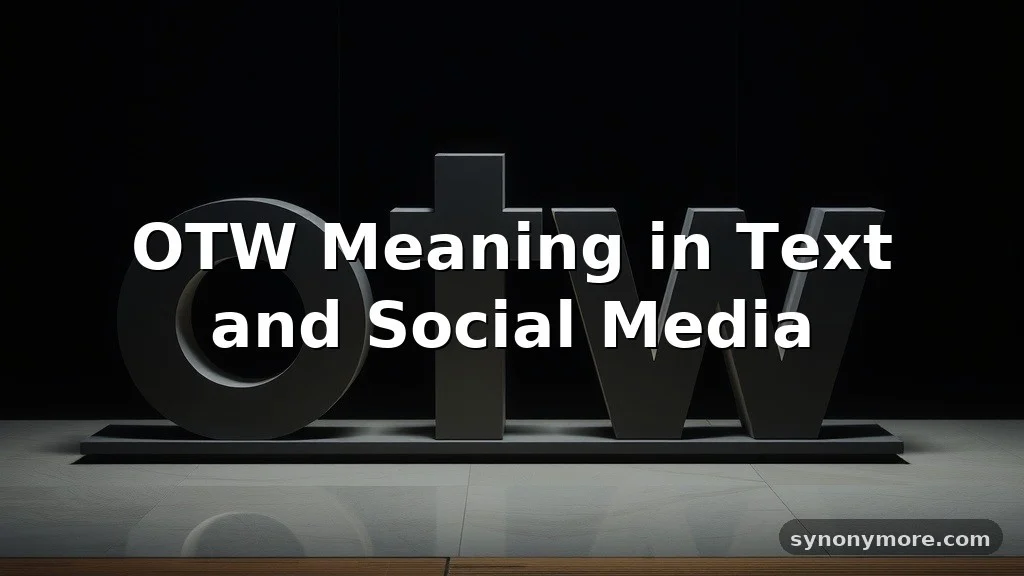
A short message can carry a very clear meaning when you know the abbreviation behind it. OTW Meaning in Text is commonly used in chats, texts, social media messages, and casual online conversations. It usually tells someone that a person is on the way, meaning they have started traveling toward a place or are currently heading there.
Understanding OTW is useful because text abbreviations often depend on context. A friend may send “OTW” to say they are coming to meet you. Someone in a group chat may use it to confirm that they are heading to an event. The abbreviation is informal and works best in relaxed conversations rather than formal emails, reports, or professional documents.
This guide explains the OTW Meaning in Text, its full form, definition, common uses, examples, tone, and modern texting context. You will also learn when OTW sounds natural and when writing the complete phrase “on the way” is a better choice.
Definition & Meaning
OTW means “On the Way.”
In text messages, it usually means that someone is traveling or heading toward a specific destination. It can also be used more casually to show that something is coming or currently in progress, depending on the context.
Example:
“Are you coming to the restaurant?”
“Yep, OTW!”
Full Form and Meaning
OTW = On the Way
- O = On
- T = The
- W = Way
Meaning: Someone is heading toward a place or destination.
Example:
“Leaving now. OTW.”
This means: “I’m leaving now and I’m on the way.”
Defining the Acronym and Its Purpose
At its core, the acronym OTW stands for “on the way.” It is a simple, efficient way to tell someone that you have departed from your current location and are currently in transit to your destination. In a world where we value speed and brevity, OTW serves as a functional tool to manage expectations.
Instead of writing out a full sentence like “I am currently driving to your house,” a user can simply type three letters. It saves time and energy while still conveying the necessary information.
The meaning of this term is usually quite literal. When someone sends this to you, they are indicating that their journey has begun. However, the exact timing can vary.
Some people use it the moment they step out the door, while others might use it when they are halfway there. This is why context is so important. If you are waiting for a friend to arrive at a restaurant, an OTW text gives you a sense of relief because you know they are officially en route.
Beyond its literal use, the term is also used to express progress or movement toward a goal. For example, if a project is nearing completion, a team member might say the final report is OTW. This shows that the work is in motion and will arrive shortly.
It bridges the gap between the start of a task and its final delivery. Because it is so versatile, it has become a staple of modern texting vocabulary. Understanding this acronym helps you participate in fast-paced conversations without feeling like you are lagging behind.
Background and Evolution of the Term
The origins of OTW are rooted in the early days of mobile messaging and SMS culture. As mobile phones became popular, character limits on text messages were a major concern. Service providers often charged per message, or simply capped the length of a single text at 160 characters.
Consequently, users had to find ways to shorten their thoughts. Abbreviations became a necessity rather than a stylistic choice. OTW fit perfectly into this landscape because it communicated a complete thought in minimal space.
Over the decades, as technology shifted from basic SMS to instant messaging platforms and social media, the term stuck around. It evolved from a necessity born of character limits into a standard piece of digital shorthand.
Today, even though we have unlimited texting and high-speed data, we continue to use these acronyms because they have become part of our shared cultural language. We use them for efficiency and to maintain a casual, conversational tone.
The evolution of OTW also reflects the broader trend of “text-speak.” Concepts like this are now deeply embedded in how we interact online. You can find more information about the history of linguistics and digital communication by visiting the Merriam-Webster dictionary to see how language changes over time.
The term has moved from being a niche shorthand for tech-savvy teenagers to a widely understood phrase used by people of all ages. It is a perfect example of how digital communication has permanently altered the way we express ourselves in both casual and semi-professional environments.
Usage Across Various Contexts
How you use OTW depends largely on your relationship with the person you are messaging. In casual texting, it is the go-to phrase for meeting up. Imagine you are meeting a friend for coffee.
You might text, “Hey, I am running a few minutes late, but I am OTW now.” This tells your friend that while you are behind schedule, you are actively moving toward them.
In social media comments or direct messages, the term often takes on a slightly more playful tone. On Instagram, you might see a photo of a package with a caption saying “New gear OTW.” Here, the user is building hype.
They are letting their followers know that something exciting is coming soon. In the gaming world, the term is vital for coordination. If you are playing a team-based game and a teammate needs help at a specific location on the map, you might type “OTW” to let them know you are coming to their aid.
Consider these dialogue examples:
Person A: “Are you still at home?”
Person B: “Nope, I just left. OTW!”
Person A: “Is the update ready for the website?”
Person B: “Almost done, it will be OTW to your inbox in ten minutes.”
Person A: “I am getting camped at the base!”
Person B: “Hold on, I am OTW to help you.”
These examples show that whether you
These examples show that whether you are talking about physical travel, digital files, or virtual gameplay, the meaning remains consistent: movement is happening.
Common Misconceptions and Clarifications
One common misconception is that OTW always means the person is just around the corner. This is rarely the case. Because the term is subjective, it can be frustrating if you are waiting for someone and they send “OTW” when they have not even left their house yet.
This is often referred to as “the OTW lie.” It is a lighthearted social friction where the sender wants to appear more prepared than they actually are.
Another point of confusion is how it compares to OMW, which stands for “on my way.” These terms are essentially interchangeable. Some users prefer one over the other based on habit or personal preference.
There is no strict rule governing which one you should use. However, some people feel that OMW sounds slightly more personal because it includes the word “my,” implying a direct focus on the speaker’s movement toward the recipient.
It is also important to note that the term is not inherently rude, but it can be perceived as dismissive if it is the only thing you send in response to a detailed question. If someone asks you for a status update on a project and you just reply with “OTW,” it might come across as curt.
In these situations, it is better to add a little more detail, such as “OTW, I will be there in about fifteen minutes.” This clarifies the timeline and makes your communication more effective and polite.
Similar Terms and Alternatives
There are many ways to express that you are moving or that something is in progress. Depending on the setting, you might choose an alternative that feels more natural or precise. Below is a breakdown of how these terms compare to one another.
| Term | Context | Tone |
|---|---|---|
| OTW | Casual/General | Neutral |
| OMW | Personal/Direct | Active |
| En route | Formal/Professional | Precise |
| Coming | Very casual | Simple |
| In transit | Logistics/Business | Technical |
As the table suggests, “en route” is a fantastic alternative when you are in a professional environment. If you are emailing a client, telling them you are “en route” sounds much more polished than using an acronym. On the other hand, if you are texting your best friend, “OTW” or “OMW” is perfectly acceptable.
Choosing the right term is all about matching the level of formality of your conversation. If you find yourself overusing the same acronym, mixing in these alternatives can make your communication feel more varied and thoughtful.
It shows that you are conscious of your audience and the context of the interaction. Always consider who is reading your message before deciding on the level of shorthand you want to employ.
How to Respond to the Term
Responding to an OTW message is usually straightforward, but your reaction should depend on your goals. If you are the one waiting for someone, you might want to acknowledge their update without pressuring them.
A simple “Sounds good, see you soon” works well. It confirms you received the message and keeps the tone friendly.
If you are feeling a bit impatient, you might ask for a more specific time frame. For example, “Got it, how much longer do you think you have?” This is a polite way to get more information without being accusatory.
In a professional setting, if a colleague tells you a file is OTW, you might respond with “Thanks for the update, I will look out for it.” This confirms receipt and closes the loop on that specific task.
For funny or lighthearted situations, especially if you know the person has a habit of being late, you could use humor. A response like “OTW or ‘OTW’ (in your dreams)?” can be a playful way to call out their tardiness without starting an argument. Just be sure that your relationship with the person is close enough that they will appreciate the joke rather than feel offended by it.
Regional and Cultural Variations
While English is the primary language for this acronym, the concept of a quick shorthand for “on the way” exists in many cultures. In many non-English speaking countries, users have adopted English acronyms into their daily digital vernacular.
In the Philippines, for example, OTW is widely used in chat and social media, often alongside local slang. The digital world is increasingly global, and these terms have become a universal language for mobile users.
Regional slang can sometimes influence how these terms are used. In some areas, people might add extra letters for emphasis, such as “OTWWWWW” to show they are really rushing.
While this is not standard, it shows how language adapts to express emotion. In regions where English is a second language, you might find that people use these acronyms more frequently because they are easier to type than long phrases in a language they are still mastering.
Cultural context is key. In some cultures, being precise about time is highly valued, so an OTW message might be expected to include a time estimate.
In other cultures where the perception of time is more fluid, an OTW message might simply mean “I am thinking about coming over.” Being aware of these subtle differences can help you navigate cross-cultural communication more effectively and avoid misunderstandings.
Online Communities and Dating Apps
On dating apps like Tinder or Bumble, OTW is a common part of the “getting to know you” phase. If you have made plans to meet a match for a date, receiving an OTW message is a standard confirmation that the date is actually happening. It signals reliability and excitement.
However, be cautious: in the world of online dating, some people use this term to keep a conversation going without actually intending to meet up. If someone says they are OTW but never arrives, it is a red flag.
In gaming communities, the term is essential for real-time strategy. Whether you are playing a first-person shooter or a massive multiplayer role-playing game, coordination is everything.
When a teammate says they are OTW to support you, you can plan your next move with confidence. It is a vital shorthand that keeps the team functioning smoothly.
On platforms like Twitter or X, you might see the term used in threads about shipping, where fans discuss the trajectory of a relationship between two characters. “Their marriage is OTW” might be a way of saying that the characters are clearly headed toward a romantic union. It shows how the term has transcended its original meaning of physical travel to include metaphorical journeys as well.
Hidden Meanings and Tone
While OTW is generally benign, tone is everything. As mentioned earlier, context changes the meaning. If you are in the middle of an argument and the other person sends “OTW,” it could be a sign of aggression or a way to shut down the conversation.
It might imply “I am coming over to finish this, so be ready.” In this context, the term shifts from a helpful status update to a warning.
Always look at the surrounding messages. Is the person usually friendly? Are they stressed?
If you are unsure about the tone, it is perfectly fine to ask for clarification. A simple “Are you on your way to meet up, or did you mean something else?” can prevent a major misunderstanding. Never assume the worst, but always be aware that digital words lack the nuance of tone of voice and body language.
If the term is used in a way that makes you feel uncomfortable or threatened, trust your instincts. Digital communication is a tool, and you have every right to set boundaries.
If someone is using the term to manipulate your time or your emotions, you do not have to engage with them. Keeping your digital interactions healthy is just as important as maintaining your real-world relationships.
Professional Communication Standards
Is it okay to use OTW in a professional setting? The answer depends on your workplace culture. If you work in a fast-paced environment like a tech startup or a creative agency, using acronyms is often the norm.
It keeps communication efficient and informal. However, if you are working in a more traditional environment like a law firm or a corporate office, it is generally better to avoid it.
In professional emails, it is almost always better to write out the full phrase. Writing “I am currently en route to the office” or “The report is on the way” conveys a level of professionalism and attention to detail that an acronym simply cannot match. It shows that you respect the formality of the business relationship.
If you are unsure, err on the side of caution. It is never a mistake to be slightly more formal than necessary. If you have a close relationship with a colleague, you can mirror their level of formality.
If they use acronyms with you, it is usually safe to use them back. But when in doubt, use full sentences. It keeps your communication clear, unambiguous, and appropriate for any level of seniority within your organization.
Frequently Asked Questions
1. Does OTW always mean the person is currently moving?
Usually, yes.
However, as discussed, some people use it to mean they are about to leave. If you need to know exactly where they are, it is best to ask for a specific ETA.
2. Can I use OTW in a formal email?
It is generally discouraged. Stick to “en route” or “on the way” to maintain a professional tone in formal correspondence.
3. Is OTW different from OMW?
They mean the same thing. OMW is slightly more personal because of the “my,” but they are interchangeable in almost all casual contexts.
4. Why do people lie about being OTW?
It is often a social defense mechanism. People want to avoid the guilt of being late, so they send the message to signal that they are at least thinking about their arrival.
5. Is OTW used in other languages?
While the acronym itself is English, the concept is global. In many non-English speaking countries, the English acronym is used alongside local slang because of the ubiquity of international social media.
6. What should I do if someone says they are OTW but they never show up?
If this becomes a pattern, it is a sign of unreliability. You might want to have a conversation about expectations or stop relying on them for time-sensitive plans.
7. Can OTW be offensive?
It is not inherently offensive, but it can be perceived as dismissive if used as a one-word reply to an important question or if used in an aggressive context during an argument.
Final Thoughts
Understanding the nuance behind common digital acronyms like OTW allows you to navigate the modern world with more confidence. Whether you are coordinating a meetup with friends, working on a collaborative project, or just chatting on social media, knowing how to interpret and use this term effectively will make your communication smoother. Remember that while these shortcuts are designed for efficiency, the human element of conversation context, tone, and clarity should never be ignored.
Use these tools to enhance your connections, not to replace the depth of your interactions. By staying mindful of how you communicate, you ensure that your messages are received exactly as you intended. Keep these tips in mind the next time you see that familiar three-letter notification, and you will always know exactly what is on the way.
Read More Related Articles:
- … meaning in text from a girl – SynonyMore.com
- Sn meaning in text – SynonyMore.com
- AFK Meaning in Text: From Gaming Slang to Everyday Chats …