
The word psyop often appears in political discussions, viral posts, memes, and debates about what people see online. Someone might call a celebrity controversy a psyop, describe a political message as a psyop, or joke that a popular internet trend is designed to manipulate everyone. But what does the word actually mean?
Psyop means psychological operation, a planned effort to influence people’s beliefs, emotions, decisions, or behavior through information and communication. The term originally belongs to military and strategic contexts. In modern internet slang, it is also used to suggest that an event, trend, or public message has been deliberately engineered to influence people.
The important distinction is that a psyop is a real type of influence activity, but an accusation that something is a psyop does not prove that it is one. Understanding the original definition, modern slang, and common examples makes the word much easier to interpret.
What Does Psyop Mean?
A psyop is short for psychological operation. It refers to a planned activity intended to influence how a target audience thinks, feels, understands a situation, or behaves.
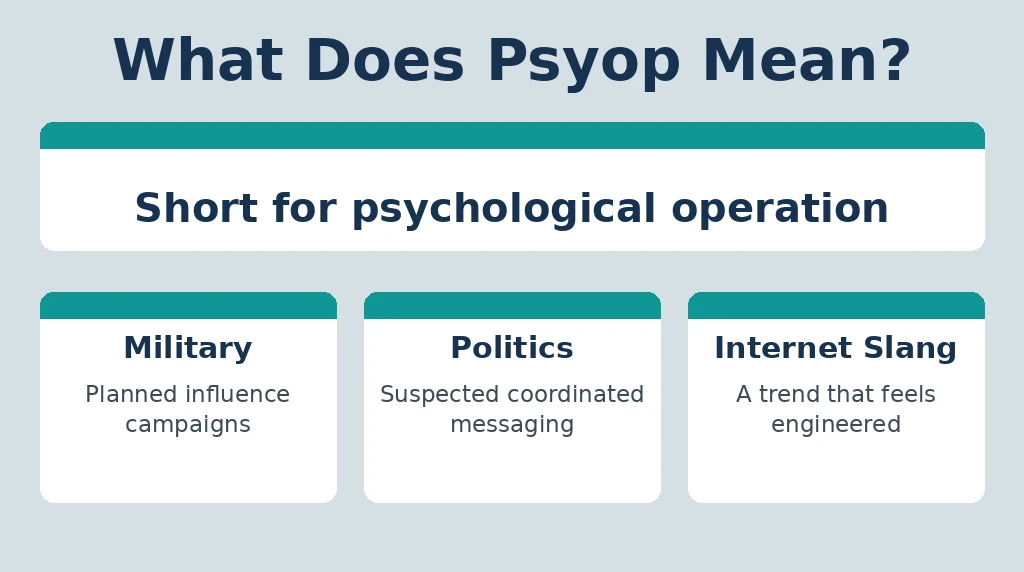
In military contexts, psychological operations are designed to support specific objectives by communicating selected information to particular audiences. The methods may include broadcasts, printed materials, digital messages, and other forms of communication. The US Army describes psychological operations as activities that use communication and cultural understanding to influence foreign audiences in support of military objectives. <a href=”https://www.goarmy.com/careers-and-jobs/specialty-careers/special-ops/psychological-operations“>US Army overview of psychological operations</a>.
In everyday online conversation, the word has a broader and often less precise meaning. People use psyop to suggest that a message, trend, controversy, or cultural phenomenon is not happening naturally but is being promoted to influence public opinion.
For example:
- Military context: A planned campaign communicates information intended to influence an opposing force’s decisions.
- Political context: A person suspects that a carefully coordinated messaging campaign is intended to shape public opinion.
- Internet slang: Someone calls an unexpectedly popular trend a psyop because they suspect it is manufactured.
- Humorous context: A person says a new food trend is a psyop because they cannot understand why everyone suddenly likes it.
The first example describes the formal concept. The other examples show how the term can be applied in modern discussion, sometimes seriously and sometimes as a joke.
Psyop Meaning in Simple Words
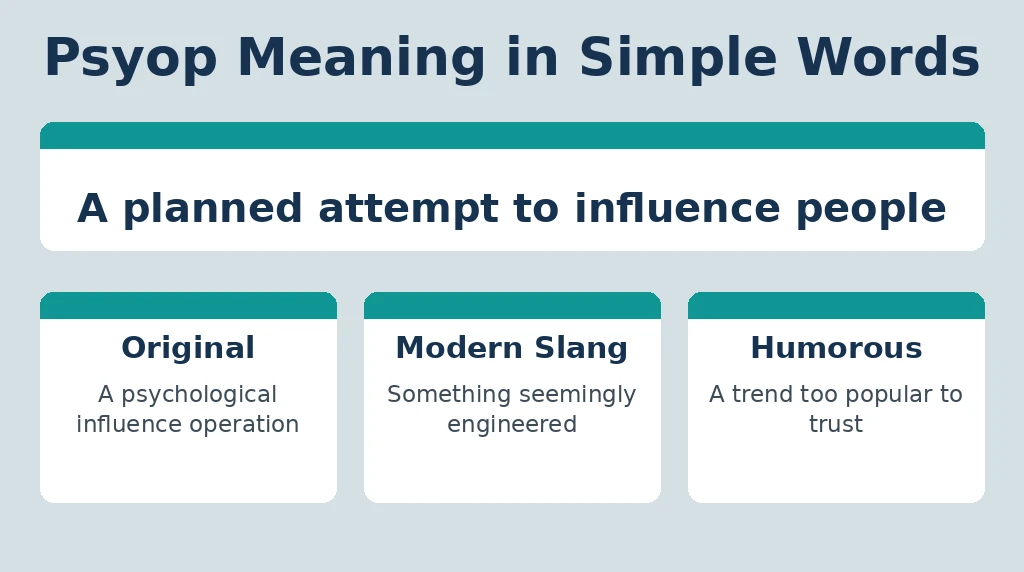
In simple English, psyop means a planned attempt to influence what people think or do by using information, messages, or other forms of communication.
Imagine a campaign that repeatedly shares messages encouraging people to support a particular decision. The campaign may select certain facts, emphasize particular emotions, and present information in a way designed to influence the audience.
If the activity is deliberately organized to achieve a defined influence objective, it may fit the general idea of a psychological operation, depending on the context and the formal definition being used.
Now imagine a person watching a viral video and commenting, “This is a psyop.”
That person is suggesting that the video may have been designed to influence viewers rather than becoming popular entirely on its own. However, the comment is only a claim. It does not establish who created the video, what their intentions were, or whether any coordinated operation exists.
This is the easiest way to remember the term:
- Original meaning: A planned psychological influence operation.
- Modern slang meaning: Something suspected of being deliberately engineered to manipulate public thinking.
- Humorous meaning: A trend that seems strangely popular, suspicious, or difficult to explain.
What Does PSYOP Stand For?
PSYOP stands for psychological operation. The plural form is commonly written as PSYOPs or psyops.
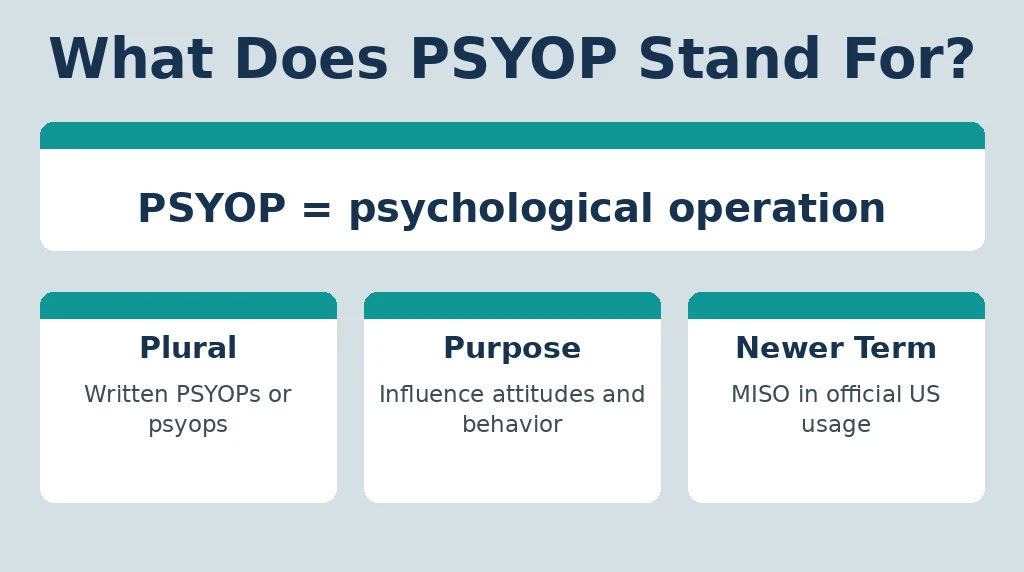
The term is associated with military activities that use communication to influence the attitudes, reasoning, emotions, or behavior of a target audience.
In official US military terminology, the wording has changed over time. The US Department of Defense used Military Information Support Operations, abbreviated MISO, in place of PSYOP for certain activities beginning in 2010. A December 2025 memorandum announced a return to the term Psychological Operations in Department of War usage, with implementation planned through fiscal year 2026. The formal terminology therefore depends on the institution, document, and date being discussed. <a href=”https://media.defense.gov/2025/Dec/08/2003839440/-1/-1/0/CHANGING-THE-TERM-MILITARY-INFORMATION-SUPPORT-OPERATIONS-BACK-TO-PSYCHOLOGICAL-OPERATIONS.PDF“>Official terminology memorandum</a>.
For everyday readers, the main point is straightforward: PSYOP is the established abbreviation for psychological operation, while psyop is the spelling commonly seen in informal writing and online conversations.
Psyop Pronunciation and Word Forms
The word psyop is commonly pronounced SY-op, with two syllables.
The pronunciation sounds like “sigh-op.”
Here are the common forms:
| Word Form | Meaning or Use |
|---|---|
| Psyop | A psychological operation; also used informally for a suspected influence campaign |
| PSYOP | An uppercase abbreviation often used in military contexts |
| Psyops | The plural form, referring to multiple operations or to the field generally |
| Psychological operation | The full formal term |
| Psyop-related | An informal compound adjective describing something associated with a suspected or actual psyop |
Example: “The analyst studied how the campaign’s messages influenced public opinion.”
In formal writing, use psychological operation when clarity matters. In a casual discussion, psyop is usually sufficient.
Psyop Meaning in Text and Slang
When someone searches for the psyop meaning in text, they are often trying to understand a message, comment, meme, or social media post rather than a military document.
In online slang, psyop commonly implies that something is being deliberately promoted, staged, or manipulated to shape how people think.
The slang is often skeptical. It suggests that the visible explanation for an event may not tell the whole story.
Consider these examples:
Example 1: A viral trend
“Everyone started wearing the same shoes overnight. This has to be a psyop.”
The speaker suspects that the trend was artificially promoted. The comment could be a joke or a serious allegation.
Example 2: A political message
“That advertisement feels like a psyop designed to make voters afraid.”
Here, the speaker believes the advertisement is using emotional messaging to influence voters.
Example 3: A celebrity controversy
“The timing of this celebrity drama is so strange. People are calling it a psyop.”
The sentence reports what people are saying. It does not establish that the controversy was manufactured.
Example 4: A humorous comment
“Who convinced everyone that this drink tastes good? What kind of psyop is this?”
The speaker is joking about a popular preference they do not understand.
The slang meaning is flexible, which explains its popularity online. However, it is also less precise than the formal military definition. In casual conversation, psyop can mean anything from genuine suspicion about coordinated influence to simple disbelief about a trend.
Psyop Meaning on Social Media
Social media has made psyop a familiar word in conversations about trends, politics, celebrity culture, advertising, and viral content.
A post may gain attention because thousands of users share it, an influencer promotes it, a news outlet covers it, or an algorithm recommends it to more people. When the sudden popularity seems suspicious, some users describe the trend as a psyop.
There are several common uses.
1. Calling a Trend a Psyop
A trend may seem to appear everywhere at once. Users might suspect that brands, influencers, or other interested parties are deliberately making it popular.
For instance, someone might write:
“Three influencers promoted the same product this morning. Is this a psyop?”
The observation raises a reasonable question about coordinated promotion, but the evidence does not automatically establish a psychological operation. The influencers might have a shared sponsor, participated in a marketing campaign, or simply followed the same trend.
2. Calling a Political Narrative a Psyop
Political conversations frequently involve claims that a message is intended to change how people view a candidate, policy, institution, or public event.
A user might say:
“This narrative is a psyop to distract everyone from the real issue.”
The speaker is alleging intentional manipulation. To evaluate the claim, readers need evidence about the message’s origin, distribution, coordination, and intended purpose.
3. Calling Celebrity News a Psyop
Celebrity news can generate intense discussion, especially when several stories appear close together.
A comment such as “This breakup announcement is a psyop” may imply that the news was released to influence public attention or distract people from another issue.
It may also be nothing more than a joke about suspicious timing. Timing alone cannot establish that an event was staged.
4. Using Psyop as a Meme
The word is often used for comedic exaggeration.
Someone who dislikes a popular song might say, “The music industry is running a psyop on us.”
The statement expresses disbelief about the song’s popularity. It should not automatically be interpreted as a serious claim about a coordinated campaign.
Psyop Meaning on TikTok and Reddit
On platforms such as TikTok and Reddit, the word appears in short videos, comment threads, memes, and discussions about culture or politics.
Its meaning depends heavily on the surrounding conversation.
On TikTok, a creator might call a viral product a psyop because they suspect that sponsored content has made it appear more desirable than it really is. Another creator might use the term sarcastically to criticize an unusual fashion trend.
On Reddit, a user might describe a political talking point as a psyop and invite others to discuss whether the messaging appears coordinated. In other discussions, the term is used humorously to describe an advertisement, song, food, or popular opinion.
A useful way to interpret these posts is to ask three questions:
- Is the person using the word as a joke?
- Are they making a specific claim about coordinated influence?
- Do they provide evidence, or are they expressing suspicion?
The distinction matters because the same word can communicate humor, criticism, or a serious allegation. A comment containing the word psyop is not proof of an actual operation.
Psyop Meaning in Politics
In politics, psyop is often used to describe an alleged attempt to influence public opinion through carefully designed messaging.
Political communication can involve emotional appeals, selective framing, repetition, targeted advertising, and coordinated distribution. These techniques can affect what people notice and how they interpret events.
However, not every political campaign is a psyop in the formal military sense. Political persuasion, ordinary campaign advertising, public relations, and psychological operations are related in the broad sense that they can influence people, but they are not identical activities.
Consider this hypothetical example:
A political organization repeatedly shares a message emphasizing the economic risks of a proposed policy. It distributes the message through advertisements, interviews, and social media posts.
The organization may be conducting a persuasive communications campaign. To describe it more specifically as a psychological operation, the context, actors, objectives, and nature of the activity would need to support that classification.
An online user may call the campaign a psyop because they believe its messaging is manipulative. That is an interpretation, not a verified description.
Why the Word Is Common in Political Arguments
The term can be appealing because it offers a short explanation for something that appears suspicious or unusually coordinated.
Instead of arguing that a campaign uses selective information, emotional framing, or misleading claims, a person may simply call it a psyop.
That shorthand can sometimes open a useful discussion about influence. It can also stop a discussion prematurely if the label replaces evidence.
A stronger analysis identifies the specific message, who distributed it, what can be verified, and what remains uncertain.
Psyop Meaning in the Military
In its formal military context, a psychological operation is a planned activity intended to influence a selected audience in support of an operational objective.
The target audience may include individuals, groups, or populations whose attitudes or actions are relevant to the operation. Activities can involve communicating selected information through media suited to the audience and the situation.
Examples of possible military influence activities include:
- Communicating instructions or information intended to encourage a particular response.
- Distributing messages designed to affect an opposing force’s willingness to continue a course of action.
- Providing information to a population during a military operation.
- Using audience research to determine which communication channels are likely to reach a target group.
These examples illustrate the general purpose of psychological operations. They do not imply that every military message is deceptive or that every influence campaign uses the same methods.
A further distinction is important: psychological operations and military deception are related concepts, but they are not interchangeable in every official framework. A message intended to influence an audience does not necessarily have to be false.
Psyop Examples in Everyday Life
The following examples illustrate how the word is used. The informal scenarios are hypothetical and should not be mistaken for evidence of actual psychological operations.
| Situation | Example Statement | What the Speaker Means |
|---|---|---|
| Viral product | “This product appeared everywhere overnight. Is it a psyop?” | The speaker suspects coordinated promotion |
| Politics | “That message feels like a psyop.” | The speaker suspects deliberate influence |
| Celebrity news | “The timing makes this look like a psyop.” | The speaker suspects a story was strategically released |
| Fashion | “This trend is a psyop because nobody liked it last month.” | The speaker jokes that the trend was artificially created |
| Advertising | “The campaign is a psyop to make people buy things they don’t need.” | The speaker criticizes the campaign as manipulative |
| Military history | “The operation used targeted messages to influence the opposing force.” | The statement describes a possible formal psychological operation |
A More Concrete Example
Imagine a company pays several influencers to promote the same product over a short period. Each influencer presents it as a must-have item, and the product quickly becomes popular.
A user comments, “This is a psyop.”
What can actually be established?
If sponsorship disclosures or reliable records confirm a coordinated advertising campaign, the coordinated promotion is supported by evidence. It may be persuasive marketing, but calling it a formal psychological operation would require additional context.
The example shows why identifying the underlying activity is more useful than relying on a dramatic label.
Psyop vs. Propaganda
Psyop and propaganda overlap, but they are not exact synonyms.
Propaganda generally refers to information or messaging designed to promote a particular viewpoint, cause, ideology, or political objective. It may use accurate information, selective presentation, misleading claims, or falsehoods.
A psyop is a planned influence operation with a defined objective and target audience, particularly in military usage. Its methods may include propaganda, but the terms describe different aspects of communication.
| Feature | Psyop | Propaganda |
|---|---|---|
| Main idea | A planned psychological influence operation | Messaging that promotes a viewpoint or cause |
| Scope | Often tied to an operational objective and target audience | Can range from individual messages to broad campaigns |
| Context | Especially associated with military and strategic settings | Politics, war, ideology, advertising, and public debate |
| Truthfulness | Depends on the specific activity and message | Can be truthful, selective, misleading, or false |
| Relationship | May use propaganda techniques | May be used within a psychological operation |
For example, a series of posters promoting a political ideology may be described as propaganda. If those posters form part of a planned military operation intended to influence a particular audience, they may also be one component of a psychological operation.
The context determines the most accurate term.
Psyop vs. Misinformation and Disinformation
These terms are often mixed together in online discussions, but they refer to different things.
Misinformation is false or inaccurate information shared regardless of whether the person sharing it intends to mislead.
Disinformation is false or misleading information deliberately created or spread to deceive.
Psyop refers to a planned influence operation. It is not simply another word for false information.
A psychological operation may use truthful information, selective framing, or other communication methods. Disinformation can also occur without being part of an organized operation.
| Term | Key Meaning | Example |
|---|---|---|
| Psyop | A planned effort to influence an audience | A coordinated campaign designed to change a target audience’s decisions |
| Misinformation | Inaccurate information shared without necessarily intending deception | A person shares an incorrect statistic believing it is true |
| Disinformation | False or misleading information deliberately spread | An account knowingly publishes a fabricated statistic to deceive readers |
| Propaganda | Messaging intended to promote a cause or viewpoint | A campaign repeatedly promotes a political ideology |
These categories can overlap, but one does not automatically prove another. A coordinated influence campaign may use disinformation, for example, but evidence of a false post alone does not establish the existence of a broader psyop.
Psyop vs. Conspiracy Theory
The word psyop is frequently used in conspiracy-oriented online discussions to suggest that a hidden group is secretly manipulating public events.
For example, someone might claim that a major cultural trend was manufactured to change public attitudes or that a news story was deliberately staged to distract the public.
Such claims may involve real questions about advertising, public relations, political messaging, or coordinated online activity. They may also involve unsupported assumptions about secret actors and hidden intentions.
This shift helps explain why the word is so common online. It can describe a documented influence activity, but it can also be used as a general explanation for events that people find suspicious.
How to Evaluate a Claim That Something Is a Psyop
Before accepting the claim, consider:
- What exactly is being alleged? Identify the event, message, campaign, or behavior in question.
- Who is supposedly behind it? Look for reliable evidence connecting the alleged actors to the activity.
- Is there evidence of coordination? Similar posts or simultaneous coverage can have several explanations.
- What was the intended objective? Distinguish a documented goal from a guess about hidden motives.
- Can independent sources confirm the claim? Look for verifiable records, credible reporting, or direct evidence.
- Are alternative explanations plausible? Advertising, shared incentives, ordinary popularity, and algorithmic recommendations may explain some trends.
These questions do not guarantee that a claim is true or false. They help separate what is known from what is merely suspected.
What Are Common Psyop Tactics?
Psychological influence activities can use different communication methods depending on the audience, objectives, and circumstances. The presence of one of these methods does not, by itself, prove that a psyop is taking place.
Emotional Framing
A message emphasizes feelings such as fear, hope, anger, pride, or belonging to encourage a particular response.
Emotional framing is common in ordinary communication, advertising, and politics. It becomes evidence of a particular operation only when the broader context supports that conclusion.
Repetition
A message appears repeatedly across different channels. Familiarity can affect how people perceive information, but repetition alone does not establish coordination or deception.
Selective Information
A message highlights certain facts while leaving out other relevant details. This can produce a one-sided impression even when the included facts are accurate.
Audience Targeting
Communication is adapted to the interests, language, concerns, or circumstances of a specific audience.
Audience targeting is used in marketing, public health, political communication, and other fields. Its purpose and context matter.
False or Misleading Claims
Some influence efforts use fabricated information or deceptive framing. When false information is deliberately spread to deceive, it can be described as disinformation.
Not every psyop involves disinformation, and not every instance of disinformation is part of a psyop.
The key lesson is to evaluate the message, evidence, and context rather than treating an individual communication technique as proof of a coordinated campaign.
Signs That an Online Claim Deserves Closer Examination
People often search for signs of a psyop because they want to understand whether a viral event or message is being deliberately manipulated.
There is no universal checklist that can prove a psyop from appearances alone. However, some observations may justify further investigation.
- Multiple accounts appear to publish identical or nearly identical messages.
- A campaign’s sponsorship or funding is unclear.
- A viral claim relies on fabricated evidence or repeatedly misrepresents verified facts.
- Reliable records indicate that seemingly independent accounts are coordinated.
- The stated purpose of a campaign conflicts with documented communications or actions.
- Independent reporting identifies a specific organization, network, or campaign responsible for the activity.
Each observation needs context. Identical messages can result from shared press releases, reposting, or common trends. Anonymous accounts are not automatically part of an operation, and suspicious timing does not establish hidden coordination.
Stronger conclusions require evidence connecting the behavior to specific actors and objectives.
Psyop Meaning in a Sentence
Here are examples showing the word in formal, conversational, and humorous contexts.
- The report examined how psychological operations can influence public attitudes during a conflict.
- Some users called the viral advertising campaign a psyop, although they provided no evidence of a coordinated operation.
- “This trend feels like a psyop” was the most common joke in the comment section.
- The researcher studied how misleading messages can affect people’s interpretation of political events.
- The military document described a planned psychological operation aimed at a specific audience.
- Calling every unpopular policy a psyop can prevent a serious discussion about the evidence.
- The influencer’s post was sponsored, but that fact alone did not establish a psychological operation.
- The online debate showed how the formal meaning of psyop differs from its modern slang use.
- The campaign’s organizers used targeted communication to encourage a particular response.
- “The internet is trying to convince me to buy another gadget. What is this, a psyop?” was meant as a joke.
These examples show that psyop can be used as a noun referring to an actual operation or informally as a label for something a speaker suspects is manipulative.
How to Use Psyop Correctly
Use the word according to the meaning you intend to communicate.
Use Psyop for a Planned Influence Operation
When discussing a documented military or strategic activity, explain the operation’s context and purpose.
Example: “The historical analysis examined the psychological operation and its intended audience.”
Use Psyop as Informal Slang
When reporting a person’s suspicion or making a joke, make that distinction clear.
Example: “People online called the sudden trend a psyop, but the claim remained unverified.”
Avoid Treating Suspicion as Fact
A sentence such as “The new advertisement is definitely a government psyop” makes a factual allegation. Unless reliable evidence supports it, a more accurate version would be:
“Some viewers suspect the advertisement is part of a coordinated influence campaign, but that claim has not been verified.”
This wording distinguishes an opinion from an established fact.
Avoid Using Psyop as a Synonym for Anything You Dislike
A bad advertisement, unpopular policy, strange song, or sudden fashion trend is not automatically a psychological operation.
The word is more useful when it describes a specific claim about planned influence, rather than serving as a general insult.
Is Psyop a Real Word?
Yes. Psyop is an established abbreviation for psychological operation, and dictionaries recognize its use as a noun. It is also widely used in informal English, especially in discussions of politics, military affairs, and online culture. <a href=”https://www.dictionary.com/browse/psyop“>Dictionary.com definition of psyop</a>.
The word has a formal meaning and a broader slang meaning. In formal settings, it usually refers to a planned psychological influence activity. In online conversations, it can refer to a suspected manipulation campaign or be used jokingly.
Its popularity as slang does not make the underlying concept fictional. However, using the word to describe a particular event does not prove that the event qualifies as a psychological operation.
Frequently Asked Questions
What does psyop mean in simple terms?
Psyop means psychological operation, a planned effort to influence how people think, feel, or behave. Online, it can also refer to something people suspect is deliberately engineered to manipulate public opinion.
What does psyop mean in text messages?
In text messages, psyop usually means that a person suspects something is designed to influence or manipulate people. It can be serious or humorous depending on the conversation.
What does psyop mean on social media?
On social media, the term often describes a suspected attempt to manipulate public opinion through viral trends, political messages, celebrity stories, or online campaigns. The label alone does not prove that manipulation occurred.
What does PSYOP stand for in the military?
PSYOP stands for psychological operation. It refers to planned activities that use communication and information to influence a selected audience in support of operational objectives.
Is psyop the same as propaganda?
No. Propaganda is messaging intended to promote a viewpoint or cause. A psyop is a planned influence operation that may use propaganda among other communication methods.
Is a psyop the same as disinformation?
No. Disinformation involves deliberately spreading false or misleading information to deceive. A psyop is a planned influence operation and does not necessarily involve false information.
What does it mean when someone calls something a psyop?
The person usually suspects that an event, trend, or message was deliberately created or promoted to influence people. The statement may be a joke, an opinion, or a serious allegation that needs evidence.
What is an example of a psyop?
A documented military campaign that uses targeted communication to influence an opposing audience can be an example of a psychological operation. An ordinary viral trend should not be classified as one without supporting evidence.
Is psyop a negative word?
Often, yes. In modern slang, the word usually implies suspicion, manipulation, or hidden intentions. In formal military usage, it is a technical term and does not automatically mean that the activity is deceptive.
Conclusion
The psyop meaning comes from the phrase psychological operation. In its formal sense, it describes a planned effort to influence an audience’s attitudes, emotions, decisions, or behavior through communication and information.
In modern slang, the word has expanded to cover suspected manipulation in politics, celebrity culture, advertising, viral trends, and online conversations. Sometimes it is used to raise a genuine question about coordinated influence. Other times, it is simply a joke or an unsupported accusation.
The most useful distinction is between a real influence operation and a claim that something is one. Understanding that difference makes it easier to interpret the word accurately, evaluate online information critically, and avoid confusing suspicion with evidence.
Discover More Post:
- 111 Meaning | Spiritual Significance, Symbolism, Love & the …
- Unhinged Meaning | Definition, Examples, Tone & Why It’s …
- FUPA Meaning in Text & Slang – SynonyMore.com

1 thought on “Psyop Meaning | The Hidden Psychology Behind Mind Games, Media & Mass Influence in 2026”