The right word can completely change the tone of a sentence. A simple expression of disapproval might sound too harsh, too formal, or not strong enough, which is why many writers search for better ways to say the same thing. Finding suitable synonyms for scold helps you communicate with greater accuracy and confidence.
you’re writing a story, preparing professional content, or expanding your everyday vocabulary, using different words keeps your writing fresh and engaging. The best alternative depends on the situation, the audience, and the emotion you want to express without sounding repetitive.
This collection of synonyms for scold explores words with different shades of meaning, along with clear explanations and practical examples. As you go through the list, you’ll discover expressions that fit casual conversations, formal writing, and everything in between.
Best Synonyms for Scold
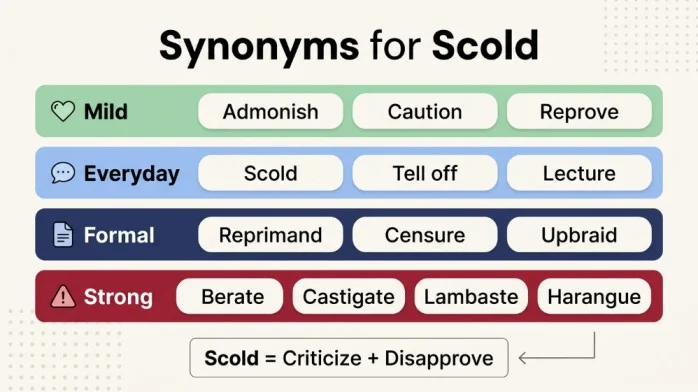
The best synonyms for scold are reprimand, admonish, rebuke, chastise, berate, lecture, and chide. For mild correction, use admonish or chide. formal criticism, use reprimand or rebuke. For harsh scolding, use berate or castigate. The right choice depends on tone, context, and how harsh the criticism needs to be.
What Does Scold Mean?
Scold means to criticize someone angrily or to tell someone off for doing something wrong. It involves expressing disapproval, often in a sharp or stern tone.
Part of speech: Verb
Simple definition: To speak angrily to someone because they have done something wrong.
Example sentences:
- His mother scolded him for coming home late.
- The teacher scolded the students for talking during class.
Core Meaning of Scold
The word “scold” comes from Old English and has always been about angry criticism. At its heart, scolding is a verbal response to bad behavior. It is a way of saying “you did wrong, and I am telling you about it.” But not all scolding is the same. A parent’s gentle scolding of a child is different from a boss’s harsh scolding of an employee. One is loving correction; the other is professional discipline. One is mild; the other is severe. The best synonym captures the specific intensity and tone of the scolding. Is it gentle? Then it is admonish or chide. Is it formal? Then it is reprimand or rebuke. Is it harsh? Then it is berate or castigate.
Grammar and Usage Notes
Scold is a transitive verb, meaning it needs an object. You scold someone. You can also scold someone for something.
Common sentence patterns:
- Scold + person: She scolded her son.
- Scold + person + for + noun/gerund: He scolded them for being late.
Common phrases:
- scold someone for
- get scolded
- scold sharply
- scold harshly
- scold gently
When scold sounds natural: Use it in everyday situations, family contexts, and when describing mild to moderate criticism. It fits in both casual and neutral writing.
When a synonym may work better: Use reprimand for formal or official criticism. Use berate for harsh, angry criticism. admonish for gentle, constructive correction. Use chide for mild, almost affectionate scolding.
Best Synonyms for Scold
| Synonym | Meaning | Tone | Best Use Case | Example Sentence |
|---|---|---|---|---|
| Reprimand | Formal or official criticism | Formal | Workplace, professional contexts | The manager reprimanded the employee for negligence. |
| Admonish | Gently warn or advise | Formal to neutral | Gentle correction, advice | She admonished him to be more careful in future. |
| Rebuke | Sharp, firm criticism | Formal to strong | Serious mistakes, discipline | The judge rebuked the lawyer for his behavior. |
| Chastise | Criticize severely | Strong to formal | Serious wrongdoing | The principal chastised the students for cheating. |
| Berate | Scold angrily and at length | Strong, harsh | Angry criticism, intense scolding | He berated his assistant for the costly error. |
| Chide | Mildly scold or criticize | Mild, gentle | Everyday, gentle correction | She chided him for forgetting their anniversary. |
| Lecture | Give a long, serious talk | Neutral to strong | Giving advice, moral lessons | His father lectured him about responsibility. |
| Upbraid | Criticize harshly and angrily | Strong, formal | Sharp criticism | The boss upbraided the team for their failure. |
| Censure | Formal and strong disapproval | Formal, strong | Official criticism, public condemnation | The committee censured the official for misconduct. |
| Reprove | Disapprove of or criticize | Formal, mild to moderate | Gentle to moderate criticism | The teacher reproved the student for not paying attention. |
Common Synonyms for Scold
These everyday words work in most situations. They are not too formal or too casual.
Tell off
- Meaning: Scold or reprimand someone.
- Best context: Everyday conversation, informal criticism.
- Example: His boss told him off for being late again.
Lecture
- Meaning: Give a long, serious talk to someone.
- Best context: Parents, teachers, giving advice.
- Example: My mother lectured me about staying out too late.
Criticize
- Meaning: Point out faults or mistakes.
- Best context: General use, feedback.
- Example: She criticized him for his carelessness.
Correct
- Meaning: Point out errors and suggest improvement.
- Best context: Teaching, coaching, parenting.
- Example: The coach corrected his technique gently.
Chew out
- Meaning: Scold someone angrily (informal).
- Best context: Casual, angry situations.
- Example: The sergeant chewed out the recruits.
Dress down
- Meaning: Scold or reprimand severely (informal).
- Best context: Casual, workplace, military.
- Example: The manager dressed him down for the mistake.
Formal Synonyms for Scold
Use these in academic papers, business reports, legal documents, and professional communication.
Reprimand
Means formal or official criticism. Often used in workplace or military contexts. The board reprimanded the executive for unethical conduct.
Rebuke
Means sharp, firm criticism. Formal and strong. The senator publicly rebuked his colleague for the offensive remarks.
Censure
Means formal and strong disapproval. Often used in politics or official bodies. The committee voted to censure the member for misconduct.
Admonish
Means gently warn or advise. Formal but not harsh. The judge admonished the defendant to follow the law.
Chastise
Means criticize severely. Formal and strong. The editorial chastised the government for its inaction.
Upbraid
Means criticize harshly and angrily. Formal and strong. The director upbraided the staff for their poor performance.
Reprove
Means disapprove of or criticize. Formal and moderate. The principal reproved the students for their disruptive behavior.
Castigate
Means criticize severely. Very formal and very strong. The article castigated the corporation for its environmental record.
Informal Synonyms for Scold
These work in conversation, social media, friendly writing, and personal messages.
Tell off
Very common and casual. She told him off for forgetting her birthday.
Chew out
Casual and vivid. Implies angry scolding. His mom chewed him out for breaking the vase.
Dress down
Casual and common. Means scold severely. The boss dressed him down in front of everyone.
Give someone a piece of one’s mind
A phrase, not a word, but very common. Means speak angrily to someone. I gave him a piece of my mind.
Lay into
Casual and strong. Means attack verbally. She really laid into him about his behavior.
Read the riot act
A phrase meaning give a strong warning or scolding. The teacher read the riot act to the noisy class.
Come down on
Casual. Means criticize or punish someone. The supervisor came down on him hard.
Strong Synonyms for Scold
These words carry more weight, intensity, or harshness. Use them when you want to emphasize severe criticism.
Berate
Strong and harsh. Means scold angrily and at length. He berated his employee for the costly mistake.
Castigate
Very strong and formal. Means criticize severely. The newspaper castigated the politician for corruption.
Upbraid
Strong and formal. Means criticize harshly and angrily. She upbraided him for his thoughtless remark.
Chastise
Strong and formal. Means criticize severely, often with punishment. The principal chastised the students for their dangerous prank.
Rebuke
Strong and formal. Means sharp, firm criticism. The manager rebuked the team for failing to meet targets.
Lambaste
Strong and vivid. Means criticize harshly. The critics lambasted the director’s latest film.
Censure
Strong and formal. Means official disapproval. The council censured the official for misconduct.
Excoriate
Very strong and literary. Means criticize harshly. The editorial excoriated the government’s handling of the crisis.
Mild Synonyms for Scold
These words soften the meaning. Use them when you want to be gentle, constructive, or less harsh.
Admonish
Mild to moderate. Means gently warn or advise. She admonished him to be more careful.
Chide
Mild and gentle. Means mildly scold. She chided him for not calling.
Reprove
Mild to moderate. Means express disapproval gently. The teacher reproved the student for daydreaming.
Correct
Mild. Means point out errors. He corrected her gently.
Advise
Mild. Means give guidance. I advised him to think before acting.
Remind
Very mild. Means gently point something out. She reminded him to do his homework.
Warn
Mild. Means alert someone to potential trouble. He warned them to be careful.
Suggest
Very mild. Means offer advice gently. She suggested he apologize.
Synonyms for Scold by Context
Everyday Conversation
Use tell off, lecture, criticize, or chide. My mom told me off for forgetting to call.
Professional Writing (Business)
Use reprimand, rebuke, censure, or admonish. The manager reprimanded the employee for the error.
Academic Writing
Use admonish, reprove, chastise, or censure. The professor admonished the student for academic dishonesty.
Parenting
Use correct, admonish, chide, or lecture. She gently chided her son for not cleaning his room.
Legal/Political
Use censure, rebuke, reprimand, or upbraid. The court censured the attorney for misconduct.
Journalism
Use criticize, condemn, lambaste, or castigate. The article lambasted the corporation’s policies.
Teaching
Use correct, reprove, admonish, or chide. The teacher reproved the student for not paying attention.
Personal Relationships
Use chide, admonish, lecture, or tell off. She chided him gently for leaving his shoes in the hall.
Another Word for Scold in a Sentence
Here are 15 natural example sentences using different synonyms for scold.
- The manager reprimanded the employee for missing the deadline.
- She admonished him to be more careful in future.
- The judge rebuked the lawyer for his disrespectful behavior.
- The principal chastised the students for their dangerous prank.
- He berated his assistant for the costly error.
- She chided him gently for forgetting their anniversary.
- His father lectured him about responsibility and hard work.
- The committee voted to censure the official for misconduct.
- The teacher reproved the student for not paying attention.
- The sergeant upbraided the recruits for their poor performance.
- The editorial castigated the government for inaction.
- His boss told him off for being late again.
- The coach corrected the player’s technique gently.
- She criticized him for his careless attitude.
- The critics lambasted the director’s latest movie.
Scold Synonyms Compared
Some synonyms for scold are very close but have small, important differences.
| Synonym | Primary Difference | When to Choose This |
|---|---|---|
| Scold vs. Reprimand | Reprimand is formal, often official. | Choose reprimand for workplace or official contexts. |
| Scold vs. Admonish | Admonish is gentle and advisory. | Choose admonish for gentle, constructive correction. |
| Scold vs. Berate | Berate is harsh and angry. | Choose berate for intense, angry criticism. |
| Scold vs. Chide | Chide is mild and almost affectionate. | Choose chide for gentle, playful criticism. |
| Scold vs. Rebuke | Rebuke is sharp and firm. | Choose rebuke for serious, formal criticism. |
| Scold vs. Castigate | Castigate is extremely harsh. | Choose castigate for severe, formal criticism. |
| Scold vs. Lecture | Lecture implies a long talk. | Choose lecture for giving advice or moral lessons. |
| Scold vs. Tell off | Tell off is informal and common. | Choose tell off for casual conversation. |
Words Similar to Scold
These words belong to the same semantic field but are not always exact synonyms. Use them carefully.
Discipline
Related because it involves correcting behavior. But discipline can mean punishment or training, not just verbal criticism. The parents discipline their children firmly.
Criticize
Related because it involves pointing out faults. But criticism can be constructive and not necessarily angry. She criticized his work but offered solutions.
Condemn
Related but much stronger. Means express strong disapproval, often publicly. The statement condemned the violent actions.
Correct
Related because it involves fixing errors. But correction is usually gentle and instructive. He corrected her pronunciation kindly.
Reprove
Related but formal. Means express disapproval gently. The teacher reproved the student for not paying attention.
Castigate
Related but much stronger. Means criticize harshly. The article castigated the company’s policies.
Blame
Related because it involves holding someone responsible. But blame is about responsibility, not necessarily verbal criticism. She blamed him for the failure.
Fault
Related because it involves pointing out errors. But fault is often used in the phrase “find fault with.” He always finds fault with my work.
Antonyms of Scold
| Antonym | Meaning | Example Sentence |
|---|---|---|
| Praise | Express approval or admiration | She praised him for his hard work. |
| Compliment | Say something nice about someone | He complimented her on her excellent presentation. |
| Commend | Formally praise someone | The manager commended the team for their success. |
| Applaud | Show approval or praise | Everyone applauded his courageous decision. |
| Encourage | Give support or confidence | She encouraged him to try again. |
| Flatter | Praise excessively | He flattered her with kind words. |
How to Choose the Right Synonym for Scold
Picking the best word is not hard if you ask yourself a few questions.
Match the intensity. Is it a gentle correction or a harsh verbal attack? This is the most important question.
Match the context. A workplace needs “reprimand.” A family situation needs “chide.” A formal report needs “censure.”
Match the tone. Do you want to sound formal, literary, casual, or neutral? Choose your word accordingly.
Think about the relationship. A parent scolding a child is different from a boss scolding an employee. Choose a word that fits the relationship.
Check whether the synonym is exact or only related. “Discipline” is related but not exact. Use it only when you mean training or punishment.
Keep the sentence natural. Read the sentence aloud. If the synonym sounds strange or forced, pick a different one.
When in doubt, use “scold.” It is clear, versatile, and understood everywhere. Only switch to a synonym when you need a specific tone, intensity, or meaning.
Common Mistakes When Using Synonyms for Scold
Using “berate” for mild scolding. Berate is harsh and angry. Do not use it for gentle correction.
Using “admonish” for harsh criticism. Admonish is gentle. Do not use it for severe scolding.
Using “censure” for personal situations. Censure is formal and official. Do not use it for family scolding.
Using “chide” for formal contexts. Chide is mild and almost affectionate. Do not use it in workplace reports.
Using a formal word in casual writing. “I was censured by my mom” sounds odd. Just say “scolded” or “told off.”
Using a casual word in formal writing. “He was chewed out by the board” is too informal. Use “reprimanded” or “censured.”
Replacing “scold” without checking meaning. “Discipline” is not the same as scolding. Use it only when punishment is involved.
Making the sentence sound unnatural. “He castigated me for forgetting my keys” is overkill. Save strong words for serious situations.
Using “criticize” when you mean angry scolding. Criticism can be constructive. Scolding is usually angry. Choose the right word.
Forgetting that “scold” can be mild or harsh. The word covers a range. Your synonym should match the specific intensity.
Quick Synonym List for Scold
Common synonyms
- tell off
- lecture
- criticize
- correct
- chide
Formal synonyms
- reprimand
- rebuke
- censure
- admonish
- reprove
Informal synonyms
- tell off
- chew out
- dress down
- lay into
- come down on
Strong synonyms
- berate
- castigate
- upbraid
- lambaste
- excoriate
Mild synonyms
- admonish
- chide
- reprove
- correct
- warn
Related words (not exact)
- discipline
- condemn
- blame
- fault
- correct
FAQs
What is another word for scold in a formal document?
Use reprimand, rebuke, censure, or admonish depending on the intensity. “Reprimand” is the most common formal alternative.
What is an informal synonym for scold?
Tell off, chew out, dress down, and lay into are all casual alternatives. “Tell off” is the most common.
What is a stronger word for scold?
Berate, castigate, upbraid, lambaste, and excoriate are stronger. Use them for harsh, angry, or severe criticism.
What is a milder word for scold?
Admonish, chide, reprove, and correct are milder. They suggest gentle, constructive criticism.
What words are similar to scold but not exact synonyms?
Discipline, condemn, blame, fault, and correct are related but not direct replacements.
What is the opposite of scold?
The most direct opposites are praise, compliment, commend, applaud, and encourage.
How do I choose the right synonym for scold?
First, decide how harsh the criticism needs to be. Then match the word to your context, tone, and audience. When unsure, use “scold” itself.
Is “admonish” the same as “scold”?
Mostly, but “admonish” is gentler. It implies warning or advising, not angry criticism.
Can “scold” be used in formal writing?
Yes, but “reprimand” or “rebuke” is more formal. “Scold” is neutral and fits many contexts.
Conclusion
There is no single perfect synonym for scold because the word covers a range of intensities. you mean gentle correction, use admonish or chide. When you mean formal criticism, use reprimand or rebuke. you mean harsh scolding, use berate or castigate. When you mean casual telling-off, use tell off or chew out. Keep your meaning clear, match your tone to your audience, and choose the word that fits the situation. When you do that, your writing will always strike the right tone.
Read More Related Articles:
Synonyms for Taught | Meaning, Examples, and Better Word …
Synonyms for Distinct | Meaning, Examples, and Better Word …