
Life does not always follow the plan we make. A sudden job loss, a family problem, a failed exam, or an unexpected financial burden can turn an ordinary week into a difficult one. These situations help explain the adversity meaning: the hardships, challenges, and unfavorable circumstances people face in life.
Adversity is more than a minor inconvenience. It often involves obstacles that require time, effort, patience, or support to manage. The word appears in everyday conversations, books, motivational writing, and discussions about personal growth. Understanding it helps you describe difficult experiences more accurately and explain how people respond to them. Although adversity can sometimes lead to valuable lessons, hardship is not automatically beneficial. Its impact depends on the circumstances, available resources, and support a person receives.
What Does Adversity Mean?
Adversity means a difficult or unfavorable situation that causes hardship, creates obstacles, or makes it harder to achieve something.
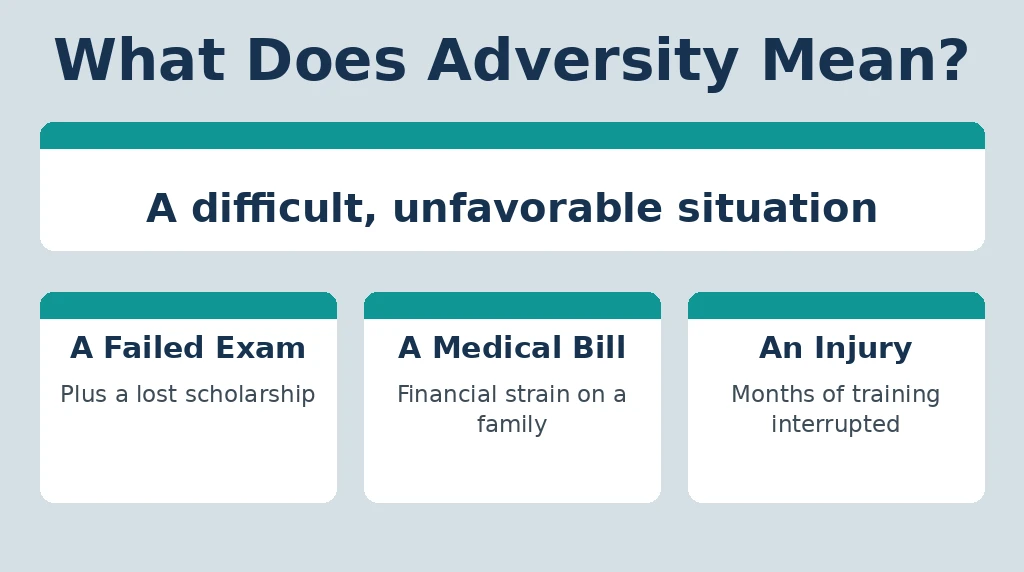
It is a noun used to describe challenging circumstances rather than one specific event.
For example:
- A student faces adversity after failing an important exam and losing a scholarship.
- A family experiences adversity when an unexpected medical bill creates financial pressure.
- A small business encounters adversity during a period of declining sales.
- An athlete deals with adversity after an injury interrupts months of training.
In each example, the person faces a situation that requires effort, adjustment, or support.
Adversity can be temporary, such as recovering from a disappointing result, or long-lasting, such as living through ongoing financial insecurity. The word does not tell us how serious a situation is on its own. The surrounding context explains the type and extent of the hardship.
Adversity Meaning in Simple English
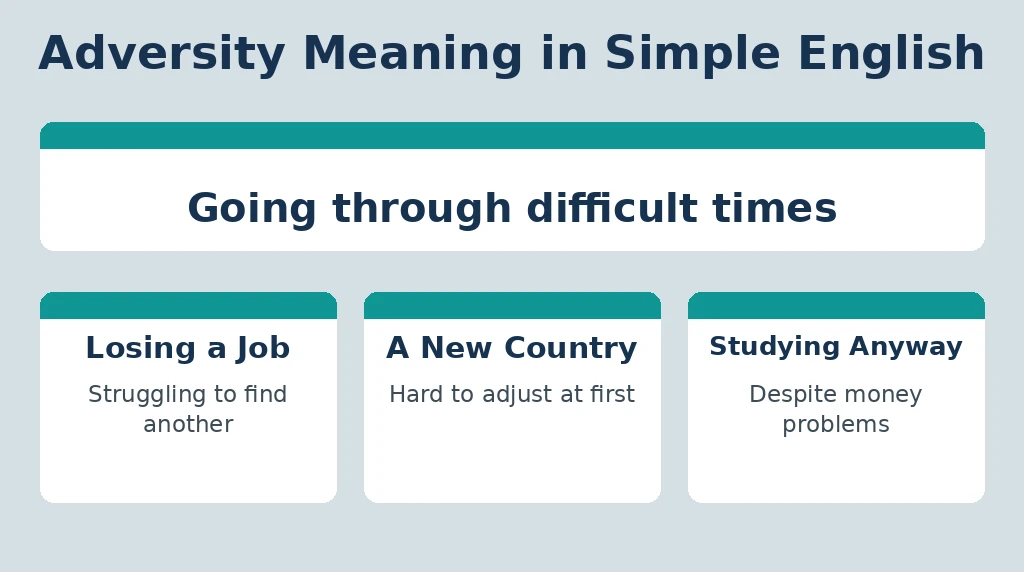
In simple English, adversity means going through difficult times or facing problems that make life harder.
Imagine preparing for a job interview for several weeks, only to learn that another candidate has been selected. That disappointment is a setback. If you then face repeated rejections while trying to find work, you may describe the wider experience as adversity.
Here are a few easy examples:
- Losing a job and struggling to find another one.
- Moving to a new country and having difficulty adjusting.
- Caring for a family member during a challenging period.
- Trying to continue studying while dealing with financial problems.
- Rebuilding a business after a major loss.
These situations are different, but they share a common feature: a person must deal with circumstances that make progress more difficult.
Adversity Definition, Pronunciation, and Word Type
The standard adversity definition is a state of hardship, difficulty, or unfavorable circumstances.

Pronunciation: ad-VUR-suh-tee
Part of speech: Noun
Related adjective: Adverse, meaning unfavorable or harmful.
Related expression: Adverse circumstances, meaning conditions that make a situation difficult.
The word has roots in Latin adversitas, associated with opposition or unfavorable circumstances. Its history reflects the idea of facing conditions that work against someone or something.
Examples:
- She showed courage in the face of adversity.
- The team continued working despite adversity.
- Adverse weather conditions delayed the journey.
Notice the grammatical difference: adversity is a noun, while adverse is an adjective.
Examples of Adversity in Everyday Life
Adversity can affect almost every part of life. The following examples show how the word applies to realistic situations.
| Situation | Example of Adversity | Possible Response |
|---|---|---|
| Education | A student fails an important examination | Review mistakes and seek academic support |
| Career | An employee loses a job unexpectedly | Update a resume and explore new opportunities |
| Finances | A family faces an unexpected expense | Review essential costs and seek appropriate assistance |
| Relationships | Two close friends experience a serious conflict | Communicate honestly and establish boundaries |
| Business | A company loses several major customers | Reassess its services and customer needs |
| Sports | An athlete suffers an injury | Follow appropriate treatment and recovery guidance |
| Relocation | Someone struggles to adjust to a new city | Build connections and learn local routines |
| Family life | A caregiver experiences ongoing pressure | Ask for help and arrange practical support |
These examples also show that dealing with adversity does not always mean solving everything alone. Sometimes the most effective response is to seek help, change expectations, or take one manageable step at a time.
Types of Adversity
Adversity can take several forms. Recognizing the type of difficulty can help people describe it clearly and identify suitable next steps.
1. Personal Adversity
Personal adversity involves challenges that affect an individual’s daily life, goals, or well-being.
Examples include losing confidence after repeated setbacks, adjusting to a major life change, or trying to rebuild a routine after a disappointment.
Example: She faced personal adversity while learning to live independently for the first time.
2. Financial Adversity
Financial adversity occurs when money-related difficulties limit a person’s choices or create stress.
Job loss, rising essential expenses, unexpected bills, and reduced income can all contribute to financial hardship.
Example: The family experienced financial adversity after the main earner lost a job.
3. Academic Adversity
Academic adversity refers to challenges related to education, learning, or school performance.
A difficult subject, repeated exam failures, limited study resources, or pressure to balance school and work may create academic hardship.
Example: He overcame academic adversity by changing his study routine and asking his teacher for guidance.
4. Professional Adversity
Professional adversity includes workplace problems, career setbacks, failed projects, and unexpected changes in employment.
Example: The manager faced professional adversity when the company canceled a major project.
Such difficulties may require new skills, a different strategy, or a reassessment of career goals.
5. Social and Relationship Adversity
Social adversity can involve isolation, discrimination, family conflict, rejection, or the loss of an important relationship.
Example: Moving to a new city brought social adversity because she had to build a support network from scratch.
These experiences can be especially difficult when a person lacks reliable emotional or practical support.
6. Community and Environmental Adversity
Communities may experience adversity through natural disasters, economic disruption, infrastructure problems, or other widespread challenges.
Example: The town faced adversity after severe flooding damaged homes and local businesses.
In such situations, recovery often depends on coordinated community action, public services, and available resources.
Adversity Synonyms and Antonyms
Choosing the right synonym helps you communicate the type of difficulty you mean. Some words describe a broad period of hardship, while others refer to a specific problem or unfortunate event.
Synonyms of Adversity
| Synonym | Meaning | Best Use |
|---|---|---|
| Hardship | A difficult condition that causes suffering or inconvenience | Financial or personal struggles |
| Difficulty | Something hard to manage or accomplish | General situations |
| Misfortune | An unfortunate event or circumstance | Unexpected losses or setbacks |
| Struggle | A difficult effort to manage a problem | Personal or professional challenges |
| Trouble | A problem or source of difficulty | Everyday conversation |
| Distress | Serious emotional or physical suffering | Difficult personal circumstances |
| Setback | An event that delays progress | Education, work, or projects |
| Obstacle | Something that blocks progress | Goals and plans |
| Tribulation | A period of severe trouble or suffering | Formal, literary, or religious writing |
| Ordeal | An extremely difficult or painful experience | Serious personal challenges |
These words are related but not identical. A setback may be one event within a longer period of adversity. An ordeal usually emphasizes an especially difficult experience, while hardship can describe the ongoing conditions a person lives under.
Antonyms of Adversity
Adversity has no single perfect opposite in every context. Depending on the sentence, useful contrasts include:
- Prosperity: A state of financial or general success.
- Good fortune: Favorable circumstances or luck.
- Ease: A condition with little difficulty.
- Comfort: A state of physical or emotional well-being.
- Advantage: A favorable position or benefit.
- Success: The achievement of a desired goal.
- Well-being: A state of health and general welfare.
- Favorable circumstances: Conditions that support progress.
For example, the company faced adversity during the recession contrasts with the company enjoyed prosperity during a period of growth.
Adversity vs. Hardship: What Is the Difference?
Adversity and hardship are close in meaning, but their emphasis can differ.
| Feature | Adversity | Hardship |
|---|---|---|
| Main meaning | Difficult or unfavorable circumstances | A difficult condition that causes suffering or inconvenience |
| Typical emphasis | Challenges that work against progress | The burden or difficulty of a situation |
| Common use | Personal growth, careers, life challenges | Financial struggles, living conditions, personal difficulties |
| Example | She learned to navigate adversity at work. | The family experienced financial hardship. |
In everyday English, the words often overlap. Adversity can sound slightly more formal or broad, while hardship often highlights the burden a person experiences.
For example, losing a job may create financial hardship. The wider period of unemployment, uncertainty, and difficulty finding new work may be described as adversity.
Neither word is automatically more serious than the other. The details determine the level of difficulty.
What Does Overcoming Adversity Mean?
Overcoming adversity means finding a way to manage, respond to, or move forward through difficult circumstances.
It does not always mean returning to the exact situation you had before. Sometimes it means adapting to a new reality, accepting help, protecting your well-being, or choosing a different goal.
Consider this example:
A student fails a required course and cannot graduate on the planned date. Instead of giving up, the student meets with an academic adviser, identifies the topics that caused problems, and creates a realistic study schedule. The student later completes the course.
The adversity was the academic setback and its consequences. The response involved support, planning, and consistent effort.
Practical Ways to Deal With Adversity
1. Identify the actual problem. Separate what has happened from what you fear might happen next. This can make a stressful situation easier to understand.
2. Focus on what you can influence. You may not control a job loss or another person’s decisions, but you may be able to control your next application, budget, or conversation.
3. Break the situation into smaller steps. A large problem often feels less overwhelming when you identify one practical action you can take today.
4. Seek appropriate support. Friends, family members, teachers, mentors, community organizations, or qualified professionals may offer useful help.
5. Adjust your plan when necessary. Persistence does not mean repeating an approach that is not working. Sometimes a different strategy is more effective.
6. Allow time for recovery. Difficult experiences can affect emotions, energy, and confidence. Rest and support may be necessary before you can make progress.
Not every challenge can be overcome quickly, and some hardships are outside an individual’s control. Asking for help or adapting to circumstances can be meaningful progress, even when the problem remains unresolved.
Adversity and Resilience: How Are They Connected?
Adversity refers to the difficult circumstances a person faces. Resilience refers to the ability to adapt, recover, or continue functioning during or after challenging experiences.
The two concepts are connected, but they are not the same.
For example, an employee may face adversity after losing a job. Resilience may appear in the way that employee adjusts to the change, seeks assistance, develops new skills, and gradually rebuilds a career.
Resilience does not mean never feeling sad, afraid, or overwhelmed. A person can experience strong emotions and still take useful steps toward recovery.
It is also important not to romanticize hardship. Difficult experiences can have lasting negative effects, and not everyone has equal access to money, health care, education, or social support. Personal effort matters, but circumstances matter too.
Adversity Meaning in the Bible
In biblical contexts, adversity generally refers to trials, suffering, opposition, persecution, or difficult circumstances that test a person’s faith.
The exact meaning depends on the passage and its wider message. Some biblical accounts describe individuals facing hardship while continuing to trust God. Other passages explore suffering, injustice, patience, and the search for hope.
For example, James 1:2-4 discusses facing trials and connects them with the development of perseverance. Interpretations vary across Christian traditions, and the passage should be read in its full context.
The broader lesson often drawn from these texts is that people may seek faith, wisdom, community, and endurance during difficult times. This does not mean that suffering is always deserved or that every hardship automatically produces a positive result.
Adversity Meaning in a Sentence
Here are additional examples showing how adversity is used naturally.
- She showed remarkable patience while dealing with adversity.
- The team continued its work despite financial adversity.
- His early career was marked by adversity and uncertainty.
- The community united to help families facing adversity after the storm.
- Academic adversity encouraged him to seek tutoring and improve his study habits.
- The business survived adversity by adapting to changing customer needs.
- Facing adversity can reveal which support systems are reliable.
- The athlete returned to training after a period of personal adversity.
- They remained hopeful during adversity, even when progress was slow.
- The novel explores how people respond to adversity and loss.
These sentences show common patterns, including face adversity, overcome adversity, deal with adversity, in the face of adversity, and despite adversity.
Common Mistakes When Using Adversity
Confusing Adversity With a Single Minor Problem
A small inconvenience can be difficult, but adversity often describes more substantial challenges or a broader set of unfavorable circumstances. Context still matters, so the word does not have a strict severity threshold.
Assuming Adversity Always Makes People Stronger
Some people gain useful skills or perspective from difficult experiences. Others may experience lasting stress or need significant support. Growth is possible, not guaranteed.
Using Adversity as an Adjective
Adversity is a noun. The adjective is adverse.
Correct: They faced adversity during the project.
Correct: They worked under adverse conditions.
Incorrect: They faced an adversity situation.
A natural alternative is a difficult situation or an adverse situation.
Treating Adversity and Resilience as Synonyms
Adversity is the challenge. Resilience is the ability to adapt or recover while facing it. The terms are related, but they describe different things.
Frequently Asked Questions
What does adversity mean in simple words?
Adversity means difficult circumstances or hardships that make life more challenging, such as financial problems, job loss, illness, or academic setbacks.
What is an example of adversity?
A student who struggles to pay school fees while preparing for important exams is facing adversity. The situation creates obstacles that require effort and support to manage.
What does adversity mean in life?
Adversity in life refers to the difficult experiences people encounter, including personal loss, financial pressure, relationship problems, health challenges, and unexpected changes.
What is another word for adversity?
Common synonyms include hardship, difficulty, struggle, misfortune, and tribulation. The best alternative depends on the situation being described.
What is the opposite of adversity?
Possible opposites include prosperity, good fortune, ease, comfort, and favorable circumstances. The most suitable term depends on the context.
What does overcoming adversity mean?
It means managing or moving forward through difficult circumstances. This may involve solving a problem, adapting to change, seeking support, or learning a new approach.
What is the difference between adversity and hardship?
Adversity often describes difficult or unfavorable circumstances broadly. Hardship usually emphasizes the burden or suffering those circumstances cause. The words frequently overlap.
How is adversity connected to resilience?
Adversity is the challenge a person faces, while resilience is the ability to adapt or recover during or after that challenge. Resilience can develop with time and support.
What does adversity mean in the Bible?
It generally refers to trials, suffering, opposition, or difficult circumstances. Its specific meaning depends on the biblical passage and its religious context.
Conclusion
The adversity meaning is simple: it refers to hardships, difficulties, and unfavorable circumstances that make life more challenging. Adversity can appear in education, work, relationships, finances, family life, and communities.
Learning this word also helps distinguish a challenge from the response to it. Adversity describes the difficulty, while resilience and perseverance describe ways people may respond. Difficult experiences do not always lead to growth, and seeking support is not a sign of weakness. A clear understanding of adversity makes it easier to describe real-life struggles accurately and discuss practical ways to move forward.
Read More Related Articles:
- Their Meaning | Definition, Grammar, Examples & How to Use …
- FUPA Meaning in Text & Slang – SynonyMore.com
- Martyr Meaning | Definition, History, Examples & the Deeper …
