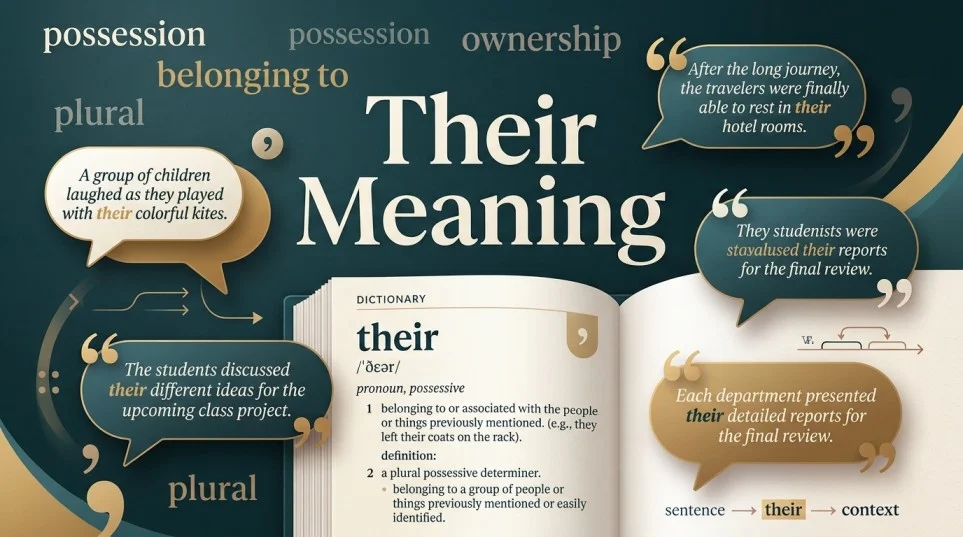
The word “their” shows that something belongs to, is connected with, or is associated with one or more people. It is a possessive determiner, so it normally comes before a noun: their house, their idea, their teacher, or their plans. It is related to they and them, but it does not work in exactly the same way as theirs.
A useful point is that their can refer to a group of people or to one person when the person’s gender is unknown, irrelevant, or the person uses they/them pronouns. For example, “Someone left their phone on the table” is standard modern English. Understanding this small word also helps prevent one of the most common writing mistakes: confusing their with there or they’re.
What Does “Their” Mean?
Their means belonging to them or associated with them.
It is used before a noun to indicate possession or connection.
| Example | Meaning |
|---|---|
| They parked their car. | The car belongs to them. |
| The students opened their books. | The books belong to the students. |
| Someone forgot their umbrella. | The umbrella belongs to that person. |
| The company changed its policy. | Here, its is used because the company is treated as a singular entity. |
The simplest pattern to remember is:
their + noun
Examples:
- their home
- their family
- their opinion
- their work
- their decision
- their children
- their responsibility
Their Definition in English
Their is a possessive determiner used before a noun. It tells the reader who something belongs to or who it is connected with.
For example:
The players celebrated their victory.
Here, their tells us that the victory belongs to or is associated with the players.
Another example:
I spoke with Sarah about their project.
In this sentence, their can refer to Sarah if Sarah uses they/them pronouns, or it can refer to another person or group depending on the context.
Traditional grammar resources often describe their as a possessive adjective. Modern grammar terminology generally calls it a possessive determiner because it determines the noun that follows it.
Is “Their” a Pronoun?
This is a common grammar question.
In modern English grammar, their is normally classified as a possessive determiner when it appears directly before a noun.
Correct:
They brought their bags.
Here, their modifies the noun bags.
By contrast, theirs is a possessive pronoun because it can stand on its own.
Compare:
This is their car.
This car is theirs.
The first sentence uses their before the noun car. The second uses theirs without a following noun.
Their vs. Theirs
| Word | Function | Example |
|---|---|---|
| their | Possessive determiner | That is their house. |
| theirs | Possessive pronoun | That house is theirs. |
A quick test is simple:
If a noun comes immediately after it, “their” is usually the correct form.
their book
their answer
their business
If the possessive expression stands alone:
The book is theirs.
The answer is theirs.
How to Use “Their” in a Sentence
The basic structure is:
Subject + verb + their + noun
Examples:
The children packed their bags.
The employees shared their ideas.
The couple sold their house.
The team changed their strategy.
My friends invited me to their party.
The noun following their can describe almost anything that belongs to, relates to, or is associated with the person or people being discussed.
Possession
They sold their apartment.
The apartment belongs to them.
Relationship
She introduced me to their manager.
The manager is associated with the person or group being discussed.
Responsibility
Each student must complete their assignment.
The assignment is associated with the individual student.
Opinion or idea
The researchers published their findings.
The findings are connected with the researchers.
This broader idea of association is important. “Their” does not always describe literal ownership.
“Their” Can Show More Than Ownership
Many learners initially connect their only with things people own. In real English, its meaning is wider.
Consider:
The company announced their new policy.
The policy is not something the employees physically own. Their indicates a relationship between the company and the policy.
Another example:
The athlete thanked their coach.
The coach does not belong to the athlete. The word shows a relationship or association.
So, a better way to understand their meaning is:
Their identifies something as belonging to, connected with, or associated with a person or people represented by “they.”
Their, There, and They’re: The Difference
These three words sound alike in many varieties of English, but their meanings and grammatical roles are completely different.
| Word | Meaning/Function | Example |
|---|---|---|
| their | Shows possession or association | They forgot their keys. |
| there | Refers to a place or introduces something | Put the keys over there. |
| they’re | Short form of they are | They’re waiting outside. |
Their
Use their before a noun to show possession or association.
The students finished their work.
There
Use there when referring to a location or in certain sentence structures.
Your shoes are over there.
They’re
They’re is a contraction of they are.
They’re ready.
You can test it by replacing they’re with they are:
They are ready. ✓
But:
They are car. ✗
That tells you the sentence needs their:
Their car is outside. ✓
Their vs. There vs. They’re: A Simple Memory Trick
Think of the words this way:
- their = belongs to them
- there = a place
- they’re = they are
Try this sentence:
They’re taking their bags over there.
Each word has a different job:
- They’re = they are
- their = the bags belong to them
- there = that place
This is one sentence worth remembering because it puts all three forms together naturally.
Is “Their” Singular or Plural?
Their can be used with both plural and singular antecedents.
Plural use
The boys finished their homework.
Here, their refers to several boys.
The teachers collected their papers.
Here, their refers to several teachers.
Singular use
Modern English also commonly uses their with a singular person.
Someone left their jacket here.
The antecedent someone is grammatically singular, but their is used naturally when the person’s gender is unknown or not relevant.
Another example:
If a customer has a question, they can contact their representative.
Here, their refers to an individual customer.
This usage is often called singular they.
Singular “They” and “Their”
Singular they has a long history in English and is now common in everyday speech and writing.
It can be used when:
- The person’s gender is unknown.
- The person’s gender is not relevant to the sentence.
- The person uses they/them pronouns.
For example:
Someone left their wallet.
The writer does not know who left the wallet.
Another example:
Every applicant should bring their identification.
The sentence refers to each applicant individually, while their provides a natural gender-neutral possessive form.
This makes English more flexible than the old assumption that their must always refer to several people.
Common Examples of “Their”
Here are examples from everyday contexts.
Everyday conversation
They brought their own food.
My neighbors painted their house.
The children are playing with their toys.
School and education
Students should check their answers.
Every learner develops their skills differently.
The teachers prepared their lessons.
Work and business
Employees should submit their reports by Friday.
The managers discussed their goals.
The company updated their website.
Writing and communication
Writers should choose their words carefully.
Authors often revise their drafts several times.
The editors shared their feedback.
Social situations
My friends invited me to their wedding.
The guests left their coats near the door.
Someone posted their photos online.
15 Realistic Sentences Using “Their”
- The students opened their books.
- My neighbors sold their house.
- The children cleaned their room.
- The employees submitted their reports.
- They changed their plans.
- The players celebrated their victory.
- Someone left their phone on the desk.
- Each guest received their ticket.
- The writers reviewed their drafts.
- The parents spoke with their children.
- The customers shared their feedback.
- The team announced their decision.
- The researchers published their findings.
- Every applicant should check their email.
- My friends brought their own food.
Notice that the noun after their changes, but the grammatical function stays consistent.
When to Use “Their”
Use their when you need to connect a noun with a person or people represented by they.
A useful checklist:
Use “their” when:
- You are showing possession.
- You are showing association.
- You are referring to several people.
- You are using singular they.
- You are referring to someone whose gender is unknown.
- You are referring to someone who uses they/them pronouns.
Examples:
The students finished their project.
Someone forgot their password.
Alex brought their laptop.
The key is not simply counting people. Look at the relationship between the noun and the person or people it refers to.
Common Mistakes With “Their”
Mistake 1: Using “there” for possession
Incorrect:
They forgot there keys.
Correct:
They forgot their keys.
Keys are associated with them, so their is required.
Mistake 2: Using “they’re” for possession
Incorrect:
They’re car is parked outside.
Correct:
Their car is parked outside.
Remember, they’re means they are.
They’re parked outside.
They are parked outside.
But:
Their car is outside.
Mistake 3: Using “their” by itself when “theirs” is needed
Incorrect:
That car is their.
Correct:
That car is theirs.
When the possessive form stands alone, use theirs.
Mistake 4: Assuming “their” must refer to several people
Incorrect assumption:
“Their” can only refer to a group.
Modern English allows singular their:
If someone calls, tell them I’ll return their call.
The antecedent someone is singular, but their is appropriate.
Their vs. Its
Another useful comparison is their vs. its.
Use their with a person or group represented by they:
The students submitted their work.
Use its for a singular nonhuman noun in contexts where it is the appropriate pronoun:
The company updated its policy.
The dog wagged its tail.
The choice depends on the antecedent and the pronoun system being used in the sentence.
Their vs. His or Her
Traditional English often used his or her when referring to one person whose gender was unknown.
For example:
Every student should bring his or her notebook.
Modern English frequently uses singular their instead:
Every student should bring their notebook.
The second version is shorter and gender-neutral.
For many contemporary contexts, singular their is a natural and widely accepted choice.
Their Meaning in Different Contexts
The exact interpretation of their comes from context.
Compare:
The students returned to their classroom.
- Here, their identifies the classroom associated with the students.
The company hired their first designer.
- Here, their identifies someone associated with the company.
Jamie forgot their keys.
- Here, their refers to Jamie, assuming Jamie uses they/them pronouns or the writer does not specify Jamie’s gender.
The word itself stays the same. The surrounding sentence tells you exactly who their refers to.
Their Meaning: A Useful Grammar Pattern
You can think of their as part of this family:
| Form | Function | Example |
|---|---|---|
| they | Subject pronoun | They arrived early. |
| them | Object pronoun | I called them. |
| their | Possessive determiner | Their car is new. |
| theirs | Possessive pronoun | The car is theirs. |
| themselves | Reflexive pronoun | They prepared themselves. |
Learning these forms together is often easier than memorizing their in isolation.
Words Related to “Their”
The closest grammatical terms and related forms include:
- they
- them
- theirs
- themselves
- possessive determiner
- possessive pronoun
- pronoun
- antecedent
- singular they
- plural pronoun
- possession
- association
- ownership
- noun
- English grammar
These terms help explain the broader grammatical system behind their.
Quick Comparison: Their, Theirs, There, and They’re
| Word | Main Role | Example |
|---|---|---|
| their | Possessive determiner | Their house is large. |
| theirs | Possessive pronoun | The house is theirs. |
| there | Place/reference word | The house is over there. |
| they’re | Contraction of they are | They’re at home. |
If you can identify the job each word performs, these spellings become much easier to distinguish.
How to Choose the Correct Word
When you are unsure, use these three checks.
Step 1: Does it show possession?
If yes, consider their or theirs.
Their dog is friendly.
Step 2: Is a noun immediately after it?
If yes, their is usually correct.
their dog
their opinion
their office
If there is no noun and the possessive expression stands alone, use theirs.
The dog is theirs.
Step 3: Does it mean “they are”?
If yes, use they’re.
They’re happy.
If it refers to a location, use there.
They are waiting there.
Frequently Asked Questions
What is the simple meaning of “their”?
Their means belonging to, connected with, or associated with them. It usually appears before a noun, as in their house, their opinion, or their plans.
Is “their” a possessive pronoun?
In modern grammatical terminology, their is generally a possessive determiner when it comes before a noun. Theirs is the possessive pronoun form.
Can “their” refer to one person?
Yes. Singular their is standard modern English usage. It can refer to one person when the person’s gender is unknown, irrelevant, or the person uses they/them pronouns.
What is the difference between “their” and “there”?
Their expresses possession or association, while there commonly refers to a place or introduces a sentence structure.
Their house is there.
The first word shows possession. The second refers to a location.
What is the difference between “their” and “they’re”?
Their shows possession:
Their car is new.
They’re means they are:
They’re driving home.
Can “their” be used with singular nouns?
Yes. The noun after their can be singular:
They brought their laptop.
It can also be plural:
They brought their laptops.
What is the difference between “their” and “theirs”?
Their comes before a noun:
This is their book.
Theirs can stand without the noun:
This book is theirs.
Is singular “their” grammatically correct?
Yes. Singular their is an established feature of contemporary English and is widely used when referring to an individual without specifying gender or to a person who uses they/them pronouns.
Final Takeaway
The easiest way to remember their meaning is to connect it with the idea of belonging or association. It normally comes before a noun: their car, their family, their idea, their responsibility.
Do not confuse it with there, which often refers to a place, or they’re, which means they are. Also remember that their is not limited to groups. Singular their is useful when referring naturally and accurately to one person.
Once you understand the relationship between they, them, their, theirs, and themselves, the word becomes much easier to use correctly in everyday English.
Read More Related Articles:
- Parasocial Meaning | Definition, Examples, Psychology & the …
- Helonium Meaning | Definition, Origin, Uses & the Story …
- Inshallah Meaning | Definition, Origin, Usage & the Deeper …