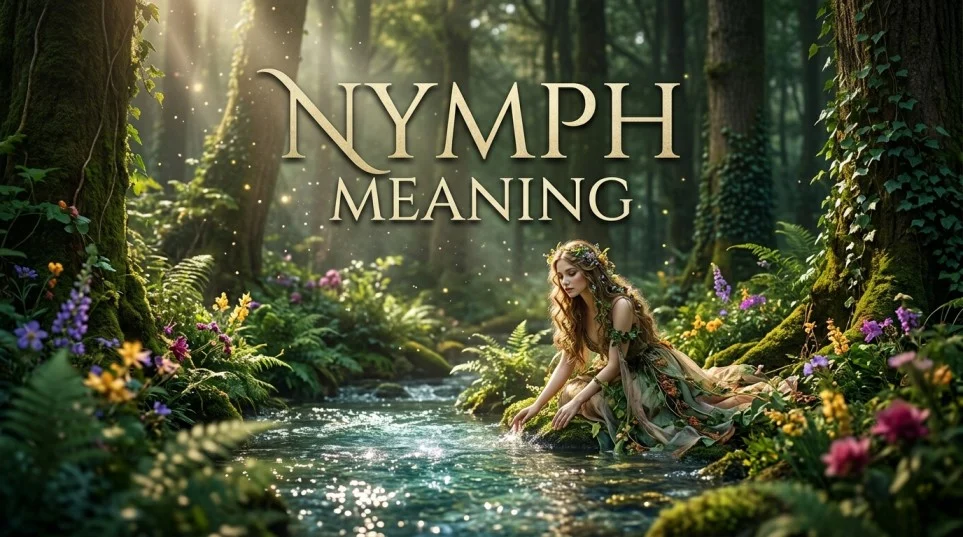
The word nymph has two important meanings. In Greek mythology, a nymph is a female nature spirit connected with places such as forests, mountains, rivers, springs, and meadows. In biology, a nymph is an immature insect that resembles the adult form but has not reached full maturity.
The mythological meaning is the one most people encounter in literature, fantasy, mythology, and poetry. The biological meaning appears in science, especially when discussing insects such as grasshoppers, cockroaches, and true bugs. Understanding the context makes the word much easier to interpret.
What Does Nymph Mean?
A nymph is traditionally a female nature spirit from Greek mythology, often portrayed as young, beautiful, and closely connected with the natural world. Different nymphs were associated with water, forests, mountains, and other natural environments.
In biology, nymph describes an immature insect stage. Unlike a larva, an insect nymph generally looks like a smaller, less-developed version of the adult.
Nymph Definition
The word nymph has a different definition depending on the subject.
| Context | Meaning |
|---|---|
| Greek mythology | A female nature spirit associated with a particular natural environment |
| Literature | A beautiful or youthful female nature spirit, often inspired by Greek mythology |
| Fantasy | A supernatural female being connected with nature |
| Biology | An immature insect that resembles the adult form |
| General usage | Usually refers to the mythological creature unless the context is scientific |
This distinction is important because the same word can describe something from ancient mythology or a stage in an insect’s development.
Nymph Meaning in Greek Mythology
In Greek mythology, nymphs were supernatural female spirits associated with nature. They were not usually considered major goddesses like Athena, Hera, or Aphrodite. Instead, they belonged to the natural world and were often connected to a particular location.
A nymph might be associated with:
- A spring
- A river
- A forest
- A mountain
- A meadow
- A grove
- The sea
Ancient stories often portray nymphs as beautiful, youthful, and lively figures. They can appear alongside gods, heroes, and other mythological beings.
Their importance comes partly from the way ancient Greek culture imagined nature. A river, tree, spring, or mountain was not simply scenery. Mythology could give such places a personality and a supernatural presence.
What Did Nymphs Represent?
Nymphs often represented the living character of nature.
A forest nymph was not simply a woman who happened to live in a forest. The mythology connected her identity with the forest itself. The same idea appears in stories about water nymphs and mountain nymphs.
This makes the concept of a nymph more specific than simply calling someone a “nature goddess.”
Types of Nymphs
Greek mythology includes several categories of nymphs. Their names often reveal the environment they were connected with.
| Type | Associated with | Simple explanation |
|---|---|---|
| Naiads | Fresh water | Springs, rivers, streams, and fountains |
| Dryads | Trees and forests | Tree spirits and woodland environments |
| Nereids | Sea | Marine nymphs associated with the sea |
| Oreads | Mountains | Mountain and rocky landscapes |
| Oceanids | Ocean waters | Daughters of Oceanus in Greek mythology |
These categories help explain why nymphs are strongly connected with nature.
Naiads
Naiads were freshwater nymphs. They were associated with sources of fresh water, including springs, rivers, and streams.
A story describing a supernatural woman living beside a spring may draw on the tradition of the Naiads.
Dryads
Dryads were tree or woodland nymphs. Their identity was closely tied to trees and forests.
In later literature and fantasy, Dryads became a particularly recognizable form of nature spirit.
Nereids
Nereids were sea nymphs and were traditionally associated with the Mediterranean Sea. They were described as daughters of the sea god Nereus.
They appear in several Greek myths, including stories involving heroes and sea journeys.
Oreads
Oreads were mountain nymphs. Their natural setting was rocky and mountainous terrain.
The term comes from the Greek tradition of associating different types of nymphs with different landscapes.
Nymph vs. Goddess
A nymph and a goddess are not the same thing.
A goddess is a divine female deity with a broader supernatural status. A nymph is generally a nature spirit tied to a specific aspect or location in the natural world.
For example, Aphrodite is a goddess associated with love and beauty. A Naiad is a freshwater nymph associated with a particular water source.
The distinction becomes useful when reading mythology because calling every female supernatural figure a goddess can erase important differences between mythological beings.
Nymph vs. Fairy
Modern fantasy sometimes makes nymphs and fairies look similar, but they come from different traditions.
A nymph comes primarily from ancient Greek mythology and is strongly associated with nature and specific environments.
A fairy belongs mainly to European folklore traditions, particularly those associated with Celtic and British folklore.
Modern fantasy can blend these traditions, so fictional characters may not follow the original distinctions.
Nymph Symbolism
The nymph has become a powerful literary symbol.
Common associations include:
- Nature
- Youth
- Beauty
- Freedom
- Transformation
- Fertility
- Mystery
- The relationship between humans and nature
Writers have often used nymph-like characters to make natural settings feel alive.
A forest can simply be described as dark and quiet. Introducing a woodland nymph changes the atmosphere. The forest becomes a place with personality, secrets, and supernatural presence.
That is one reason the idea of the nymph has survived long after ancient Greek religion ceased to be practiced in its original form.
Nymph Meaning in Biology
The scientific meaning is completely different.
In biology and entomology, a nymph is an immature stage of an insect that generally resembles the adult.
A young grasshopper, for example, can look like a small version of the adult grasshopper. It has not yet developed all adult features, especially fully developed wings and reproductive maturity.
This is different from insects that pass through a larval stage, such as butterflies.
Nymph vs. Larva
The distinction is useful:
| Nymph | Larva |
|---|---|
| Usually resembles the adult | Often looks very different from the adult |
| Common in incomplete metamorphosis | Common in complete metamorphosis |
| Gradually develops toward adulthood | Passes through larval and pupal stages in many insects |
| Common in grasshoppers and true bugs | Common in butterflies and moths |
A young grasshopper is called a nymph, not a larva.
A caterpillar is a larva, not a nymph.
Examples of Insect Nymphs
You may encounter the biological term in descriptions of:
- Grasshoppers
- Crickets
- Cockroaches
- Aphids
- Cicadas
- True bugs
- Praying mantises
The exact development pattern varies among insect groups, so the term is best understood as a developmental stage rather than a general word for every young insect.
Nymph Life Cycle
In insects with incomplete metamorphosis, development typically moves through stages such as:
Egg → Nymph → Adult
The young insect molts several times as it grows.
During these stages, the nymph gradually develops adult characteristics. In many species, wings become more developed with successive molts.
This differs from complete metamorphosis:
Egg → Larva → Pupa → Adult
Butterflies and moths are familiar examples of insects with this second type of development.
Nymph Meaning in a Sentence
Here are examples showing both major meanings:
- The poet described a beautiful nymph living beside the spring.
- The forest nymph appeared in the ancient tale.
- The hero encountered several nymphs near the river.
- The grasshopper nymph had not yet developed full wings.
- The scientist observed the insect nymph under a microscope.
- The fantasy novel features a woodland nymph who protects the forest.
- The young insect was identified as a nymph rather than a larva.
- The painting depicts a sea nymph surrounded by waves.
Notice how the surrounding words make the meaning clear.
Words such as forest, river, mythology, spirit, and goddess usually point toward the mythological meaning.
Words such as insect, wings, molting, development, and adult point toward the biological meaning.
Nymph Pronunciation
Nymph is pronounced:
/nɪmf/
It sounds roughly like “nimf.”
The word has one syllable.
Its plural form is nymphs, pronounced approximately “nimfs.”
Nymph Plural
The plural of nymph is nymphs.
- Singular: nymph
- Plural: nymphs
Example:
Ancient stories describe several nymphs living near the river.
The same plural form applies to the mythological and biological meanings.
Nymph Etymology
The English word nymph comes through Latin from the Greek nymphē, a word associated with a young woman or bride and later with female nature spirits.
This history helps explain why the word carries associations with youth and beauty in many literary contexts.
Its meaning developed over time, and English eventually adopted it as a term for the mythological nature spirits familiar from Greek mythology.
Nymph vs. Mermaid
These creatures are sometimes confused because both can appear in stories involving water.
A nymph is a broader mythological category. Some nymphs are associated with freshwater, forests, mountains, or the sea.
A mermaid is specifically a legendary human-like creature with a fish-like lower body.
So a sea nymph is not automatically a mermaid.
The two may appear together in modern fantasy, but traditional mythology treats them as distinct concepts.
Is a Nymph a Human?
In mythology, nymphs are often described with human-like female appearances, but they are supernatural beings, not ordinary human women.
They may interact with humans and gods in myths, but their connection to nature and supernatural qualities sets them apart from humans.
In biology, of course, an insect nymph is not human at all. It is simply an immature insect.
Common Mistakes About the Word Nymph
Mistake 1: Assuming every nymph is a water spirit
Not all nymphs are associated with water. Naiads are linked with freshwater, but Dryads belong to trees and forests, while Oreads are associated with mountains.
Mistake 2: Calling a nymph a goddess
A nymph is generally a nature spirit rather than a major goddess. The terms are not interchangeable.
Mistake 3: Calling every young insect a nymph
The biological term applies to particular insect development patterns. A butterfly’s caterpillar is a larva, not a nymph.
Mistake 4: Treating modern fantasy as ancient mythology
Modern books, games, and movies often reinvent mythological creatures. A fictional nymph may have abilities or characteristics that do not appear in ancient Greek sources.
How to Understand Nymph From Context
A simple context check can solve most confusion.
If you see words like:
Greek mythology, forest, spirit, Dryad, river, goddess, ancient, nature
the writer probably means a mythological nymph.
If you see words like:
insect, grasshopper, molt, wings, adult, development, biology
the writer probably means an insect nymph.
This is especially useful because dictionaries list both meanings, while real sentences usually provide enough context to identify the intended one.
Nymph Synonyms and Related Words
There is no perfect synonym for nymph, because the word refers to a specific concept.
Depending on context, related terms include:
- Nature spirit
- Nature being
- Female spirit
- Woodland spirit
- Water spirit
- Dryad
- Naiad
- Nereid
- Oread
- Mythological being
For the biological meaning, related terms include:
- Immature insect
- Juvenile insect
- Developing insect
These are descriptive alternatives rather than exact synonyms.
Frequently Asked Questions
What is the simplest meaning of nymph?
A nymph is traditionally a female nature spirit from Greek mythology. In biology, it is an immature insect that generally resembles the adult.
Is a nymph a fairy?
Not traditionally. Nymphs belong to Greek mythology, while fairies come mainly from European folklore traditions. Modern fantasy sometimes combines their characteristics.
Are nymphs gods?
Nymphs are generally considered nature spirits rather than major gods or goddesses. Their supernatural status is closely connected to specific parts of nature.
What are the main types of nymphs?
Common categories include Naiads, Dryads, Nereids, Oreads, and Oceanids. Each group has a particular relationship with nature or a specific environment.
What is a nymph in biology?
A biological nymph is an immature insect that generally resembles its adult form. It grows through successive molts before reaching adulthood.
Is a caterpillar a nymph?
No. A caterpillar is the larval stage of a butterfly or moth. It is not called a nymph.
What is the difference between a nymph and an adult insect?
A nymph is immature and has not reached the adult stage. It may lack fully developed wings and reproductive maturity. An adult has completed its development.
How do you pronounce nymph?
Nymph is pronounced /nɪmf/, roughly like “nimf.” It has one syllable.
What does nymph symbolize?
In literature and mythology, nymphs can symbolize nature, beauty, youth, freedom, mystery, fertility, and the living spirit of the natural world.
Final Takeaway
The nymph meaning depends on context, but the two major definitions are easy to separate. In Greek mythology, a nymph is a female nature spirit associated with places such as forests, springs, rivers, mountains, and the sea. In biology, a nymph is an immature insect that resembles its adult form.
The most useful distinction is simple: mythology connects nymphs with nature spirits, while biology uses nymph for a stage of insect development. Once you recognize the surrounding vocabulary, the intended meaning is usually clear.
Read More Related Articles:
- Hawk Tuah Meaning | Origin, Definition, Viral Slang & How It’s …
- Naive Meaning | Definition, Examples, Synonyms & How to …
- Diabolical Meaning | Definition, Examples, Tone & the Dark …