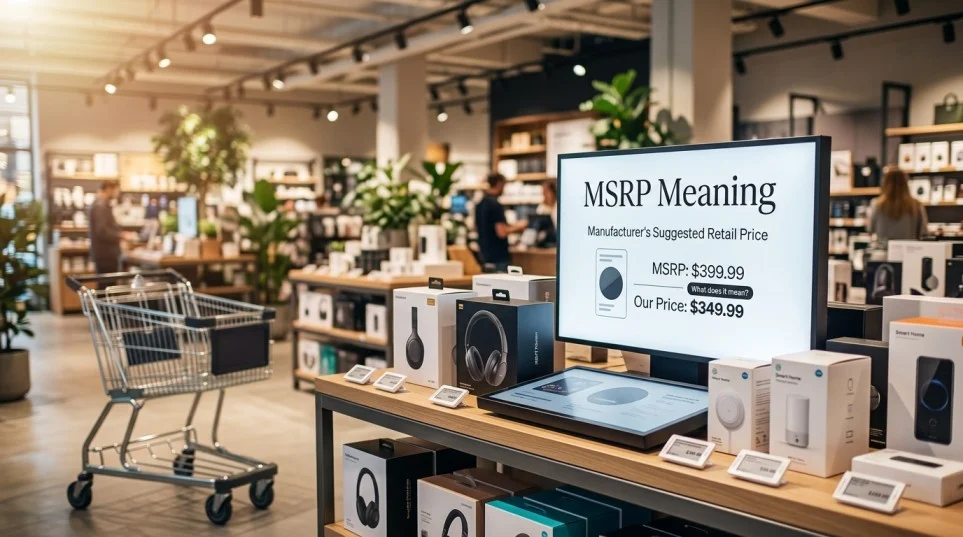
Seeing MSRP on a product page, car listing, or price tag can make the final cost seem more complicated than it needs to be. The basic MSRP meaning is simple: MSRP stands for Manufacturer’s Suggested Retail Price, the price a manufacturer recommends for selling a product to customers.
MSRP is a suggested benchmark, not a guaranteed selling price. A retailer can charge less through a discount, or a product can sell for more when demand is unusually high. For cars, MSRP can also appear alongside dealer fees, taxes, optional equipment, and other charges that affect the final amount.
Understanding MSRP helps you read price tags more intelligently. It lets you recognize a real discount, compare products fairly, and avoid assuming that the advertised MSRP is automatically the amount you will pay.
What Does MSRP Mean?
MSRP means Manufacturer’s Suggested Retail Price. It is the price a manufacturer recommends that a retailer use when selling a product.
The term is common in:
- Cars and trucks
- Electronics
- Appliances
- Furniture
- Clothing
- Sporting goods
- Toys
- Consumer products
- Online shopping
For example, imagine a laptop has an MSRP of $1,200. A retailer might sell it for $1,050 during a promotion. In that case, the MSRP gives you a reference point, while the retailer’s current selling price tells you what the store is actually asking.
The important word is “suggested.” MSRP does not automatically force every retailer to sell at that exact amount.
What Does MSRP Stand For?
MSRP stands for Manufacturer’s Suggested Retail Price.
Here is the breakdown:
| Letter | Word |
|---|---|
| M | Manufacturer’s |
| S | Suggested |
| R | Retail |
| P | Price |
You may also see the phrase written as manufacturer suggested retail price without the apostrophe.
The abbreviation is especially common in the United States and Canada, particularly in retail and automotive pricing.
How Does MSRP Work?
The process is easier to understand with a simple example.
Suppose a manufacturer produces a pair of headphones.
- The manufacturer determines a recommended retail price.
- The product is supplied to retailers.
- The retailer decides its actual selling price.
- Discounts, promotions, demand, and competition can change that price.
- The customer pays the final amount shown at checkout, plus applicable taxes or fees.
Imagine this pricing structure:
| Price | Amount |
|---|---|
| MSRP | $200 |
| Store discount | -$30 |
| Sale price | $170 |
| Sales tax | +$14 |
| Final checkout total | $184 |
Here, the MSRP is $200, but the customer pays $184 after the discount and tax.
This is why MSRP and final price should not be treated as the same thing.
Why Do Manufacturers Use MSRP?
MSRP gives manufacturers and retailers a common pricing reference.
It can help consumers compare products across different stores. It can also provide retailers with a suggested starting point for pricing.
For manufacturers, MSRP can reflect factors such as:
- Production costs
- Product features
- Brand positioning
- Distribution costs
- Competition
- Expected demand
- Product category
- Target market
MSRP can therefore tell you something about how a manufacturer positions a product, but it does not tell you the product’s actual market value in every situation.
MSRP vs. Retail Price
These terms are related, but they are not identical.
MSRP is the manufacturer’s suggested price. Retail price is the amount a particular retailer chooses to charge.
For example:
| Term | Example |
|---|---|
| MSRP | $500 |
| Retailer’s regular price | $480 |
| Promotional price | $425 |
| Customer’s final price before tax | $425 |
The retailer has chosen to sell below MSRP.
That does not mean the MSRP was the amount every retailer had to charge. It simply provides a recommended reference price.
MSRP vs. Sale Price
A sale price is a temporary or promotional price offered by a seller.
Suppose a television has:
- MSRP: $900
- Regular store price: $850
- Sale price: $699
The $699 figure is the price you can currently purchase it for, assuming there are no additional costs.
The difference between MSRP and sale price can make a promotion look attractive, but smart shoppers should also compare the product’s current prices at other retailers.
A large discount from MSRP does not automatically mean you are getting the best deal.
MSRP vs. Invoice Price
This distinction matters particularly when buying a vehicle.
MSRP is the manufacturer’s suggested retail price for the customer.
Invoice price generally refers to the amount a dealer is billed for a vehicle by the manufacturer, although the actual financial relationship can involve incentives, credits, holdbacks, and other arrangements.
A simplified example:
| Pricing term | Example |
|---|---|
| MSRP | $35,000 |
| Invoice price | $32,500 |
| Dealer selling price | $34,000 |
These numbers are illustrative, not a universal formula.
A common mistake is assuming that the invoice price automatically represents the dealer’s final cost. Real dealership economics can be more complicated.
MSRP vs. Market Price
Market price reflects what buyers are actually paying or what sellers are currently asking in a particular market.
This can differ substantially from MSRP.
Imagine a new gaming console has an MSRP of $500. If demand is weak, stores might sell it for $450. If supply is limited and demand is extremely strong, some sellers might ask $600 or more.
The MSRP remains the manufacturer’s suggested benchmark. The market price responds to real-world supply and demand.
This distinction is especially useful for:
- New cars
- Limited-edition products
- Popular electronics
- Collectibles
- High-demand releases
Is MSRP the Final Price?
No. MSRP is not necessarily the final price.
The amount you ultimately pay can depend on the product, retailer, location, taxes, shipping, dealer charges, optional features, discounts, and other costs.
For a standard retail product:
MSRP → retailer price → discount → tax/shipping → final cost
For a vehicle, the calculation can be more complicated:
Vehicle price + options + applicable fees + taxes – discounts/incentives = final amount
This is why comparing only MSRP figures can sometimes give an incomplete picture.
Does MSRP Include Tax?
Usually, MSRP does not represent the complete amount you will pay after sales tax.
For example:
- MSRP: $1,000
- Discounted price: $900
- Sales tax: $72
Your total would be $972 in this example.
The exact tax treatment depends on the product and location.
For vehicles, the final amount can include additional charges beyond the vehicle’s advertised price, so buyers should review the complete pricing breakdown rather than focusing on MSRP alone.
MSRP Meaning for Cars
The MSRP meaning for cars is particularly important because vehicle pricing can contain several layers.
A car’s advertised MSRP may include the base vehicle and certain standard equipment. Optional packages and features can raise the price.
For example:
| Vehicle pricing | Amount |
|---|---|
| Base MSRP | $30,000 |
| Optional package | $2,500 |
| Premium wheels | $1,200 |
| Destination charge | $1,100 |
| Advertised vehicle price | $34,800 |
This is only an example. Actual charges vary by manufacturer and vehicle.
When comparing cars, look beyond the headline MSRP. Check the exact trim, included equipment, options, destination charges, dealer charges, taxes, and available incentives.
What Is MSRP in Shopping?
In everyday shopping, MSRP functions as a reference price.
You might see:
MSRP: $150
Our price: $109
The retailer is telling you that the current price is below the manufacturer’s suggested price.
That can be useful, but it should not be the only number you consider.
A better shopping habit is to compare:
- MSRP
- Current selling price
- Prices at competing retailers
- Shipping costs
- Available coupons
- Warranty or included services
- Return policy
- Final checkout total
This gives you a much clearer picture of the actual deal.
How Is MSRP Determined?
There is no single universal formula for calculating MSRP.
Manufacturers can consider a range of business factors, including:
Production and distribution costs
Materials, manufacturing, transportation, storage, and distribution can influence pricing decisions.
Product features
A product with additional technology, materials, capacity, or functionality may receive a higher suggested retail price.
Brand positioning
Premium brands may position products at higher price points than competing products with similar basic functions.
Competition
Manufacturers often consider comparable products in the same category.
Customer demand
Expected demand can influence how a product is positioned in the market.
Business strategy
A manufacturer may use pricing to support a broader strategy involving product launches, market segments, or different versions of the same product.
MSRP is therefore better understood as a pricing benchmark than as a simple calculation based only on manufacturing cost.
Is MSRP the Same as List Price?
Not always.
The terms MSRP and list price can overlap in everyday shopping language, but they can have different meanings depending on the industry and seller.
MSRP specifically points to the manufacturer’s suggested retail price.
List price can refer more generally to a stated or published price.
For casual shopping, people sometimes use the terms interchangeably. In detailed pricing discussions, the distinction can matter.
Is MSRP the Same as Sticker Price?
Not necessarily, especially with cars.
A sticker price can refer to the price displayed on a vehicle’s window sticker. That sticker may contain the base MSRP, optional equipment, destination charges, and other information.
So, seeing a vehicle sticker does not always mean that every number printed there represents the base MSRP.
Always check the individual line items.
How to Use MSRP When Comparing Products
MSRP becomes most useful when you treat it as one piece of information rather than the entire pricing story.
Step 1: Find the MSRP
Identify the manufacturer’s suggested price for the exact model or version.
Step 2: Check the actual selling price
Look at what the retailer is currently charging.
Step 3: Compare other sellers
A product advertised at 20% below MSRP may still be available for less elsewhere.
Step 4: Check what is included
Two products can have similar prices but different features or accessories.
Step 5: Calculate the real cost
Include shipping, taxes, mandatory fees, and relevant extras.
This approach is much more useful than simply looking for the biggest percentage discount.
A Realistic MSRP Example
Imagine you want to buy a camera.
The manufacturer lists:
MSRP: $1,500
Three retailers offer different prices:
| Retailer | Selling Price | Difference from MSRP |
|---|---|---|
| Store A | $1,500 | $0 |
| Store B | $1,399 | $101 less |
| Store C | $1,249 | $251 less |
At first glance, Store C looks like the obvious winner.
But suppose Store C charges $80 for shipping while Store B offers free delivery and includes an extra battery worth $70.
Now the comparison changes.
This demonstrates an important point: MSRP can help establish a reference point, but the best deal depends on the complete offer.
Common Mistakes People Make With MSRP
Mistake 1: Assuming MSRP is mandatory
MSRP is a recommendation, not automatically a fixed retail price.
Mistake 2: Assuming a discount guarantees a bargain
A product can be advertised below MSRP and still cost more than the same product at another store.
Mistake 3: Ignoring the final checkout price
Taxes, shipping, and fees can change the amount you actually pay.
Mistake 4: Comparing different product versions
A $1,000 product may appear cheaper than a $1,200 model, but the more expensive version may include features that explain the difference.
Mistake 5: Treating MSRP as market value
MSRP is a manufacturer-recommended benchmark. Market value can move based on supply, demand, competition, and timing.
Quick Difference Between Common Pricing Terms
| Term | Basic meaning |
|---|---|
| MSRP | Manufacturer’s suggested retail price |
| Retail price | Price charged by a retailer |
| Sale price | Promotional or reduced selling price |
| Invoice price | Amount associated with a manufacturer’s invoice to a retailer or dealer |
| Market price | Price shaped by current market conditions |
| Wholesale price | Price generally used in business-to-business transactions |
| Sticker price | Displayed price, especially associated with vehicles |
| Final price | Amount ultimately paid after applicable additions and discounts |
The exact meaning and calculation of some pricing terms can vary by industry.
Quick Answer: MSRP Meaning
MSRP means Manufacturer’s Suggested Retail Price. It is the price a manufacturer recommends for a retailer to charge for a product. MSRP is a reference point, not necessarily the actual selling price. A retailer may sell below or above it, and taxes, shipping, fees, discounts, and optional features can affect the final amount.
Frequently Asked Questions
What does MSRP mean?
MSRP means Manufacturer’s Suggested Retail Price. It is the price a manufacturer recommends as the retail price for a product.
What does MSRP stand for?
MSRP stands for Manufacturer’s Suggested Retail Price.
Is MSRP the price I pay?
Not necessarily. The actual price can be lower or higher than MSRP. Discounts, market conditions, taxes, shipping, fees, and optional features can affect the final cost.
Is MSRP the same as retail price?
No. MSRP is the manufacturer’s suggested price, while retail price is what a particular retailer actually charges.
Is MSRP the same as sale price?
No. A sale price is a promotional selling price. It can be below MSRP, sometimes substantially.
What is MSRP on a car?
For a car, MSRP is the manufacturer’s suggested retail price for a particular vehicle configuration. Options and additional charges can increase the advertised or final amount.
Does MSRP include tax?
MSRP should not be assumed to include all taxes. The final tax treatment depends on the product and location.
Why is MSRP higher than the price in a store?
A retailer may offer a discount below MSRP because of promotions, competition, inventory levels, or other pricing strategies.
Can a retailer charge more than MSRP?
Yes, in many markets a retailer can choose its own selling price. Actual pricing can depend on competition, demand, supply, and applicable laws or industry rules.
Final Takeaway
The easiest way to remember the MSRP meaning is this: MSRP is the manufacturer’s suggested retail price, not a promise of what you will pay.
It gives shoppers a useful reference point, but the real value of a deal comes from the complete pricing picture. Compare the actual selling price, competing offers, included features, taxes, shipping, fees, and available discounts before deciding.
For cars and expensive purchases, this habit becomes even more important. A lower advertised price is not always the lower final cost, and a large discount from MSRP does not automatically make an offer exceptional.
Read More Related Articles:
- Fidelity Meaning | Definition, Examples, Context & The Deeper …
- Definition, Examples, Tone & the Art of Witty Humor in 2026