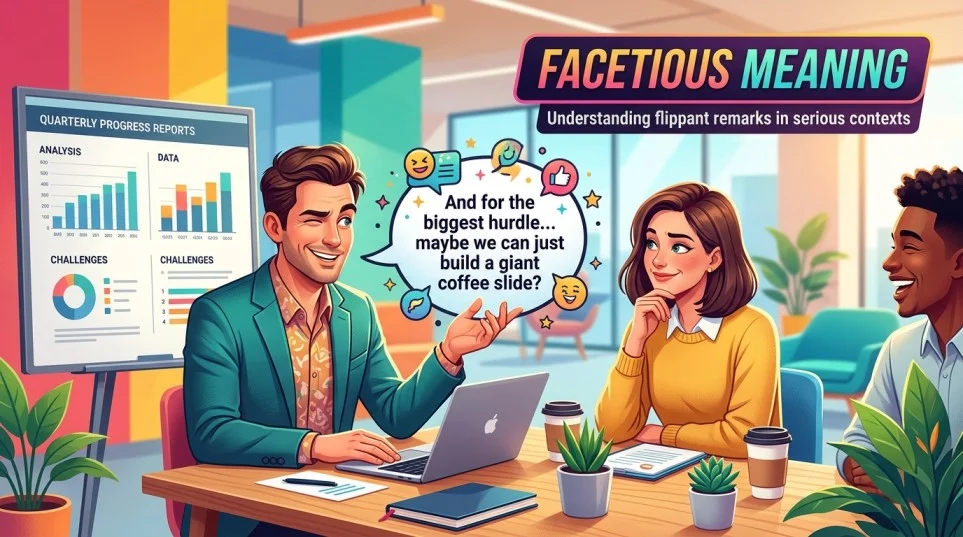
The word facetious meaning becomes clearer when you notice how a serious statement can suddenly turn playful, ironic, or deliberately humorous. In everyday English, facetious describes remarks that are not meant to be taken seriously, especially when someone jokes about a serious subject. The word can sound negative when humor feels inappropriate or forced, so understanding its tone matters. It commonly appears in conversations, writing, social media, and descriptions of someone’s personality or communication style.
Understanding facetious meaning also helps distinguish clever humor from sarcasm, irony, and simple joking. A facetious comment often has a light or witty surface, but its timing and context determine how it is received. Learning the word through realistic examples makes it easier to recognize when someone is being playful, deliberately unserious, or slightly inappropriate rather than genuinely serious.
What Does Facetious Mean?
Facetious means treating a serious subject in a joking, playful, or deliberately unserious way. It can describe a person, comment, remark, or tone.
For example:
“I guess we can solve the problem by asking the dog.”
If someone says this during a serious discussion, they may be making a facetious comment. They are not seriously suggesting that the dog can solve the problem. The humor comes from intentionally giving an unserious answer to a serious situation.
The word can sound playful, witty, sarcastic, or inappropriate depending on the context. That is why understanding the speaker’s tone and intention matters.
Facetious Definition and Meaning
The adjective facetious describes language or behavior that is intended to be funny or playful, often at a moment when a serious response would be more appropriate.
In simple English:
Facetious = joking about something serious instead of treating it seriously.
A facetious person may make a deliberately silly statement because they want to create humor, lighten the mood, tease someone, or avoid giving a serious response.
Simple Definition
Facetious: joking or humorous in a way that may seem inappropriate because the situation calls for seriousness.
Example
“Sure, I’ll just finish this 500-page report during my lunch break.”
The speaker probably knows the task cannot realistically be finished during lunch. The exaggerated statement is facetious.
What Is the Difference Between Funny and Facetious?
These words are related, but they are not interchangeable.
Funny is a broad word. It can describe anything that makes people laugh.
Facetious is more specific. It usually describes a deliberately playful or unserious response, often connected to a serious situation.
Compare these examples:
| Expression | What it means |
|---|---|
| “That movie was funny.” | The movie made people laugh. |
| “He made a facetious comment about the meeting.” | He made a deliberately unserious comment about the meeting. |
| “She has a funny story.” | Her story is amusing. |
| “His facetious answer avoided the serious issue.” | His answer was intentionally unserious. |
So, something can be funny without being facetious.
How to Understand Facetious in Simple Terms
A useful way to remember the word is:
Serious situation + deliberately unserious response = facetious
Imagine your friend says:
“I have three exams tomorrow, and I haven’t studied anything.”
You reply:
“Don’t worry. Just become a professor overnight.”
That response is facetious because you are joking instead of giving literal advice.
The statement is not meant to be taken seriously.
Facetious Examples in Everyday Conversation
Facetious remarks are common in casual conversations, online discussions, workplaces, and friendly banter.
Here are some realistic examples.
1. About Being Late
“You’re only two hours late. Early by your standards.”
This is facetious because the speaker is joking about someone’s lateness.
2. About the Weather
“I love this rain. Nothing makes a picnic better than a thunderstorm.”
The speaker probably does not genuinely believe a thunderstorm improves a picnic.
3. About Money
“I’m trying to save money, so I bought three expensive coffees.”
The contradiction creates the humor.
4. About Homework
“I finished my homework. I only need to start it first.”
The speaker is joking about not having completed the work.
5. About Technology
“My laptop froze again. Clearly, it just needed a vacation.”
The laptop does not literally need a vacation. The statement gives a human quality to the device for comic effect.
6. About Work
“Another meeting? Perfect. I was worried we might finish our work today.”
The speaker is making a playful complaint about having too many meetings.
7. About Cooking
“I burned the toast, so I think I’m ready to open a restaurant.”
The exaggeration makes the statement facetious.
Facetious Meaning in a Sentence
Here are several natural examples showing how facetious works grammatically:
- He gave a facetious answer when his manager asked about the delay.
- Her facetious comment made everyone laugh.
- I was being facetious; I didn’t actually expect you to call the president.
- His tone sounded facetious during the serious discussion.
- She made a facetious remark about needing a vacation after one busy day.
- The writer uses facetious humor to criticize modern workplace culture.
- Don’t take his comment literally. He was being facetious.
- The student gave a facetious response instead of answering the question seriously.
Notice that facetious often appears alongside words such as comment, remark, answer, response, tone, and humor.
What Does It Mean When Someone Is Being Facetious?
When someone says “I was being facetious,” they usually mean:
“I was joking. I didn’t mean that statement literally or seriously.”
For example:
Person A: “Did you really buy a new car just because you didn’t like the cup holders?”
Person B: “No, I was being facetious.”
Person B is explaining that the earlier statement was a joke rather than a factual explanation.
This phrase is especially useful when humor could be misunderstood.
Is Facetious Positive or Negative?
Facetious is not automatically positive or negative. Context determines how it sounds.
A facetious comment can be:
- funny
- playful
- clever
- teasing
- lighthearted
- inappropriate
- dismissive
- annoying
For example, joking with a close friend can sound playful:
“Nice of you to finally join us.”
The same style of comment during a serious business meeting could seem disrespectful.
This is an important part of the word’s meaning. Facetious describes the style and intention of the statement, not simply its quality.
Facetious vs. Sarcastic
Facetious and sarcastic overlap, but they are not the same.
Facetious
A facetious statement is generally made in a joking or deliberately unserious way.
“Sure, I’ll write the entire report in five minutes.”
The speaker is joking about an unrealistic task.
Sarcastic
A sarcastic statement often says something that appears positive or literal but actually communicates criticism, mockery, or the opposite meaning.
“Great job!”
said after someone makes an obvious mistake.
The speaker probably does not mean “great job” sincerely.
Quick Comparison
| Word | Main idea | Typical purpose |
|---|---|---|
| Facetious | Deliberately unserious or joking | Humor or lightness |
| Sarcastic | Mocking or saying the opposite of what is meant | Criticism, humor, or ridicule |
| Funny | Amusing | Entertainment |
| Flippant | Treating something serious too casually | Dismissiveness or lack of seriousness |
| Witty | Clever and amusing | Intelligent or clever humor |
A statement can be both facetious and sarcastic, but the two words emphasize different aspects of the speaker’s communication.
Facetious vs. Flippant
These words are particularly easy to confuse.
Facetious focuses on joking or deliberately unserious language.
Flippant focuses more strongly on a lack of appropriate seriousness, especially when discussing something important.
For example:
“I’ll defeat my entire workload with the power of positive thinking.”
This may be facetious because it is clearly a joke.
But:
“People lost their homes? They should just buy new ones.”
This could be described as flippant because the response treats a serious issue with an inappropriate lack of concern.
The key distinction
Facetious = jokingly unserious.
Flippant = casually dismissive about something that deserves seriousness.
Facetious vs. Ironic
Irony involves a contrast between what is expected, what is said, or what actually happens.
Facetiousness involves deliberately joking or being unserious.
They can overlap, but they describe different ideas.
For example:
“Wonderful weather for a beach trip,” someone says during a severe storm.
This could be ironic because the actual weather is the opposite of what would normally be expected.
If the person deliberately says it as a joke, it could also be facetious.
Facetious Synonyms
The best synonym depends on the context.
| Synonym | Meaning | Best Use |
|---|---|---|
| joking | Not meant seriously | Everyday conversation |
| playful | Light and fun | Friendly interactions |
| humorous | Intended to create amusement | General writing |
| witty | Clever and amusing | Intelligent humor |
| flippant | Too casual about something serious | Negative contexts |
| sarcastic | Mocking or ironic | Critical humor |
| irreverent | Showing little respect for serious subjects | Humor involving authority or tradition |
| lighthearted | Cheerful and not serious | Positive contexts |
| teasing | Playfully making fun of someone | Friends and casual conversation |
| sardonic | Grim, cynical, or mocking humor | More negative or cynical contexts |
Not every synonym has exactly the same meaning. Joking is usually broader and more neutral, while flippant can carry a stronger negative judgment.
Facetious Antonyms
Common words with meanings opposite or close to opposite include:
- serious
- sincere
- earnest
- solemn
- respectful
- straightforward
- genuine
- thoughtful
- earnest-minded
- grave
For example:
Facetious: “I’ll solve this problem with magic.”
Serious: “Let’s examine the problem and find a practical solution.”
What Is a Facetious Comment?
A facetious comment is a remark that is intentionally humorous or unserious, often in response to something that normally calls for a serious answer.
Example:
“How are we going to finish this project by Friday?”
“We’ll simply stop sleeping.”
The second statement is a facetious comment. The speaker does not seriously recommend eliminating sleep. The exaggeration creates the joke.
Facetious comments often rely on:
- exaggeration
- absurdity
- playful contradiction
- unexpected answers
- dry humor
- deliberate understatement
What Is a Facetious Tone?
A facetious tone makes a statement sound playful, joking, or deliberately unserious.
Tone is important because the exact same words can have different meanings depending on delivery.
Consider:
“Excellent. Another problem.”
If someone says this with genuine enthusiasm, it could be sincere.
If they say it after receiving another difficult task, the tone may be facetious or sarcastic.
In writing, tone can be harder to identify because readers cannot hear the speaker’s voice. Writers often use context to make the intended humor clearer.
How to Use Facetious Correctly
Facetious is an adjective.
You can use it before a noun:
a facetious comment
a facetious response
a facetious remark
a facetious answer
You can also use it after a linking verb:
His response was facetious.
Her comment sounded facetious.
Another common structure is:
He was being facetious.
Related forms
Facetiously is the adverb.
“He facetiously suggested that we cancel the entire project.”
Facetiousness is the noun.
“Her facetiousness made the serious discussion difficult.”
Common Mistakes With Facetious
Mistake 1: Using facetious as a synonym for funny
Not every funny thing is facetious.
A comedy movie can be funny without being facetious.
Mistake 2: Assuming facetious always means sarcastic
Sarcasm often involves mockery or an opposite meaning. Facetiousness is broader and centers on deliberate unseriousness.
Mistake 3: Thinking facetious always means rude
A facetious remark can be friendly and harmless.
“Sure, I’ll climb Mount Everest after breakfast.”
This is playful rather than necessarily rude.
Mistake 4: Using it for someone who simply made a mistake
If someone gives an incorrect answer because they genuinely misunderstood the question, that is not necessarily facetious.
The speaker generally needs to have some intention of joking or being deliberately unserious.
Mistake 5: Ignoring context
A facetious remark in a conversation among close friends may be perfectly acceptable. The same remark during a sensitive discussion may appear disrespectful.
When Should You Avoid a Facetious Comment?
Facetious humor can work well in relaxed situations, but it can create problems when people expect clarity or empathy.
Use extra caution during:
- serious workplace discussions
- medical conversations
- emergencies
- sensitive personal conversations
- formal interviews
- academic explanations
- legal discussions
- conversations about grief or loss
The problem is not humor itself. The issue is mismatched tone.
A joke can be clever and still be the wrong choice for the moment.
Facetious Meaning in Professional Communication
In professional writing, calling something facetious can be useful when you need to describe someone’s tone.
For example:
“The response appeared facetious rather than constructive.”
This communicates that the response was not intended as a serious contribution.
However, directly using facetious humor in professional communication requires judgment. A playful comment can build rapport among colleagues, but it can also make a writer appear dismissive if the subject is important.
For formal emails, reports, applications, and business documents, clear language is usually safer than humor that could be misunderstood.
Facetious Meaning in Text Messages and Social Media
Online communication makes tone especially difficult to read.
A text such as:
“Perfect, exactly what I needed today.”
could be sincere or facetious.
Without facial expressions, voice, or surrounding context, readers have fewer clues.
People may use phrases such as:
- “I’m kidding.”
- “Just joking.”
- “I was being facetious.”
- “Not serious.”
- “I’m being sarcastic.”
These expressions help clarify the intended tone.
Why Do People Use Facetious Language?
People use facetious language for several reasons.
To Make Someone Laugh
A deliberately silly answer can make an ordinary conversation more entertaining.
To Reduce Tension
Light humor can sometimes make an uncomfortable situation feel easier.
To Tease a Friend
Friends often use facetious comments as playful banter.
To Avoid a Serious Answer
Sometimes a person uses humor because they do not want to respond directly.
To Criticize Indirectly
A facetious statement can sometimes contain criticism beneath the humor.
This last use is important. Humor does not always mean harmlessness. The listener has to consider the speaker’s relationship, context, and intention.
A Fast Way to Identify a Facetious Statement
When you encounter an unfamiliar sentence, look for three clues:
1. Is the situation serious?
If the topic normally requires a serious answer, an obviously silly response may be facetious.
2. Is the statement intentionally unrealistic?
Exaggeration and absurd suggestions are common signals.
3. Is the speaker actually joking?
Context matters. A statement should not be labeled facetious simply because it sounds strange.
For example:
“I’ll finish 200 pages before dinner.”
If the speaker has only 20 minutes and clearly knows this is unrealistic, the statement is probably facetious.
Quick Comparison: Facetious, Sarcastic, Flippant, and Witty
| Word | Core Meaning | Tone |
|---|---|---|
| Facetious | Deliberately joking or unserious | Playful or inappropriate |
| Sarcastic | Mocking or expressing meaning indirectly | Often sharp |
| Flippant | Treating serious matters too casually | Often dismissive |
| Witty | Clever and amusing | Usually positive |
| Sincere | Genuine and serious | Earnest |
| Humorous | Amusing or funny | Broad and flexible |
This distinction is useful because replacing one word with another can subtly change the meaning of a sentence.
Frequently Asked Questions
What is the simple meaning of facetious?
Facetious means joking or being deliberately unserious, especially when discussing something that normally deserves a serious response.
Is facetious the same as sarcastic?
No. The meanings overlap, but they are different. Facetious usually emphasizes deliberate joking or unseriousness, while sarcastic often involves mockery or saying something that contrasts with the speaker’s actual meaning.
Is facetious a negative word?
Not always. It can describe harmless, playful humor, but it can sound negative when someone uses jokes in a serious or sensitive situation.
What is an example of a facetious comment?
If someone asks how you will finish a huge project in one hour and you reply, “I’ll just clone myself,” that is a facetious comment because you are giving an intentionally unrealistic answer.
What does “I was being facetious” mean?
It means “I was joking and did not intend my statement to be taken literally or seriously.”
What is the difference between facetious and flippant?
Facetious means deliberately humorous or unserious. Flippant suggests treating a serious matter too casually, often with a stronger sense of disrespect or dismissiveness.
Can facetious be used in formal writing?
Yes. The word itself is perfectly suitable for formal writing when you need to describe a joking or deliberately unserious tone. Using facetious humor in a formal document is a separate question and depends on the situation.
What is the noun form of facetious?
The noun is facetiousness, meaning the quality or behavior of being facetious. The adverb form is facetiously.
Final Takeaway
The facetious meaning is easier to understand when you focus on intent and context. A facetious person is not simply being funny. They are usually making a deliberately joking or unserious statement, often in response to something that could be treated seriously.
The word can describe a playful comment between friends, an exaggerated response in conversation, or a remark that feels inappropriate in a serious setting. It sits close to words such as sarcastic, witty, humorous, flippant, playful, and ironic, but each carries its own shade of meaning.
Read More Related Articles:
- Fidelity Meaning | Definition, Examples, Context & The Deeper …
- Inshallah Meaning | Definition, Origin, Usage & the Deeper …
- ENO Meaning in Text | Definition, Uses, Context & What It …










2 thoughts on “Facetious Meaning | Definition, Examples, Tone & the Art of Witty Humor in 2026”