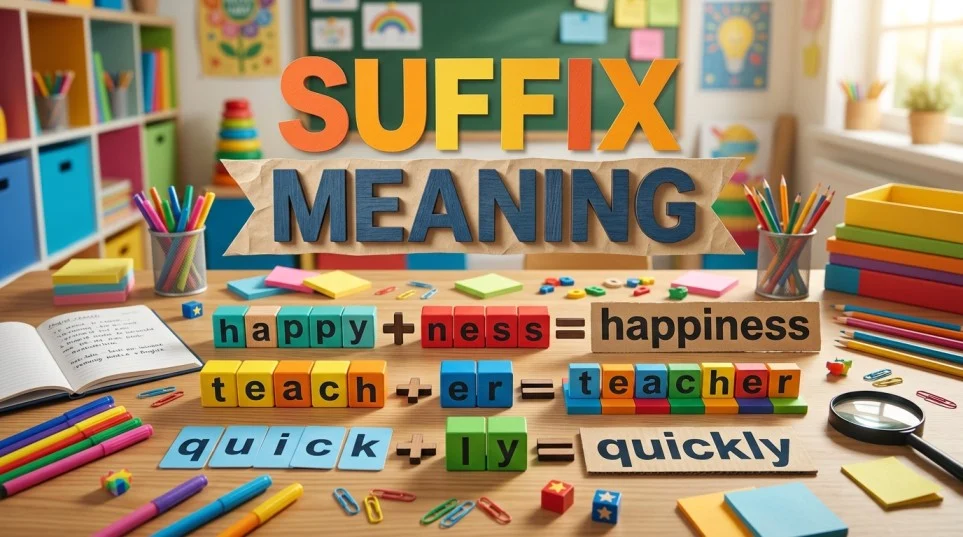
A suffix is a letter or group of letters added to the end of a word to change its meaning, grammatical form, or word class. For example, adding -ness to kind creates kindness, and adding -er to teach creates teacher. In English, suffixes help form new words and show grammatical information such as tense, number, or comparison.
The easiest way to understand a suffix is to look at where it appears. A prefix comes before a word or root, while a suffix comes after it. Some suffixes create completely new words, while others simply change how a word functions in a sentence. Understanding this difference makes unfamiliar words much easier to analyze.
What Does Suffix Mean?
The suffix meaning is a letter or group of letters placed at the end of a word to create a new word or show grammatical information.
Examples include:
- help + ful = helpful
- kind + ness = kindness
- teach + er = teacher
- walk + ed = walked
- quick + ly = quickly
A suffix can change a word’s meaning, grammatical role, tense, number, or degree.
What Is a Suffix?
A suffix is an affix attached to the end of a word, stem, or root. It is one of the main building blocks used in English word formation.
Consider the word hopeful:
hope + ful = hopeful
The base word is hope, and -ful is the suffix. The suffix changes the word into an adjective meaning “full of hope.”
Now consider:
hope + less = hopeless
Here, -less changes the meaning in the opposite direction. Hope refers to a feeling or expectation, while hopeless describes something lacking hope.
This shows an important point: suffixes do not all perform the same job. Their effect depends on the particular suffix and the word it attaches to.
Suffix Meaning in Grammar
Suffixes can perform several different functions in English grammar.
Some create a new word from an existing word. Others provide grammatical information without creating a completely different dictionary word.
For example:
happy → happiness
The suffix -ness changes an adjective into a noun.
But:
walk → walked
The suffix -ed tells us that the action happened in the past. It does not create an unrelated vocabulary item.
This distinction leads to two major categories: derivational suffixes and inflectional suffixes.
Derivational Suffixes
A derivational suffix usually helps create a new word or changes the grammatical category of a word.
Examples:
| Base Word | Suffix | New Word | Change |
|---|---|---|---|
| happy | -ness | happiness | adjective → noun |
| teach | -er | teacher | verb → noun |
| care | -ful | careful | noun → adjective |
| danger | -ous | dangerous | noun → adjective |
| quick | -ly | quickly | adjective → adverb |
| modern | -ize | modernize | adjective → verb |
Derivational suffixes can also change meaning without changing the word class.
For example:
friend → friendship
Both words are nouns, but friendship refers to the relationship or bond between friends.
Another example is:
child → childish
The suffix -ish creates an adjective and adds a particular meaning to the original word.
Inflectional Suffixes
Inflectional suffixes provide grammatical information such as tense, number, possession, or comparison.
English has a small set of commonly recognized inflectional endings.
| Suffix | Function | Example |
|---|---|---|
| -s | plural | books |
| -‘s | possession | John’s |
| -s | third-person singular | runs |
| -ed | past tense | played |
| -ing | present participle | running |
| -en / -ed | past participle | eaten, walked |
| -er | comparative | faster |
| -est | superlative | fastest |
The key difference is that inflection generally changes the grammatical form of a word rather than creating a separate lexical item.
For example:
walk → walked
Walked is still a form of walk.
By contrast:
teach → teacher
Teacher is a different word with its own meaning.
Common Suffixes and Their Meanings
Learning common suffixes can help you understand unfamiliar vocabulary.
| Suffix | Common Meaning or Function | Example |
|---|---|---|
| -able | capable of being | washable |
| -al | related to | personal |
| -er | person or thing that performs an action | runner |
| -ful | full of | useful |
| -less | without | careless |
| -ness | state or quality | darkness |
| -ment | result or process | development |
| -tion | action or process | education |
| -ity | state or quality | ability |
| -ous | characterized by | famous |
| -ly | in a particular manner | slowly |
| -ish | somewhat or relating to | childish |
| -ize | make or become | organize |
| -en | make or become | strengthen |
These meanings are useful clues, but they are not rigid formulas. English has many exceptions, and the same ending can have different functions in different words.
Suffix Examples in Everyday English
You already use suffixes constantly, even if you do not consciously notice them.
1. -ness
The suffix -ness often turns an adjective into a noun describing a state or quality.
- kind → kindness
- dark → darkness
- happy → happiness
- weak → weakness
- polite → politeness
Example:
Her kindness made the new student feel welcome.
2. -ful
The suffix -ful often means “full of” or “having.”
- hope → hopeful
- care → careful
- beauty → beautiful
- use → useful
- power → powerful
Example:
The instructions were useful and easy to follow.
3. -less
The suffix -less commonly means “without.”
- hope → hopeless
- care → careless
- fear → fearless
- home → homeless
- meaning → meaningless
Example:
His explanation made the confusing topic seem less complicated.
4. -er
The suffix -er can identify a person or thing that performs an action.
- teach → teacher
- run → runner
- drive → driver
- paint → painter
- work → worker
Example:
The driver stopped to check the map.
The same spelling can also have a different grammatical function:
- tall → taller
- fast → faster
- small → smaller
Here, -er forms the comparative degree rather than naming a person.
5. -ly
The suffix -ly frequently forms adverbs from adjectives.
- quick → quickly
- careful → carefully
- quiet → quietly
- honest → honestly
- sudden → suddenly
Example:
She answered the question carefully.
There are exceptions, so not every word ending in -ly is an adverb. Friendly, for example, is an adjective.
How Suffixes Change Word Classes
One of the most useful things about suffixes is their ability to change the grammatical category of a word.
| Original | New Word | Word-Class Change |
|---|---|---|
| happy | happiness | adjective → noun |
| govern | government | verb → noun |
| beauty | beautiful | noun → adjective |
| quick | quickly | adjective → adverb |
| modern | modernize | adjective → verb |
| employ | employee | verb → noun |
This can help you choose the right form of a word when writing.
For example:
The company wants to modernize its website.
Here, modernize is a verb.
The company introduced a modernization project.
Here, modernization is a noun.
The root idea remains connected, but the suffix changes how the word works in the sentence.
Suffixes Can Change Meaning Without Creating a New Topic
A suffix can add a specific idea to a base word.
Compare:
- care → careful
- care → careless
- child → childish
- child → childhood
- hope → hopeful
- hope → hopeless
The base gives you the central concept. The suffix adds information to it.
This is one reason suffix knowledge is valuable for students and English learners. You do not always need to memorize every word separately. Recognizing familiar word parts can give you a useful clue about a word’s meaning.
Still, context matters. A suffix gives you a clue, not a guaranteed dictionary definition.
Prefix vs. Suffix
A prefix appears at the beginning of a word. A suffix appears at the end.
| Feature | Prefix | Suffix |
|---|---|---|
| Position | Beginning | End |
| Example | unhappy | happiness |
| Example breakdown | un + happy | happy + ness |
| Common role | Often changes meaning | Can change meaning or grammar |
| Example | rewrite | writer |
For example:
un + happy = unhappy
The prefix un- changes the meaning of happy.
happy + ness = happiness
The suffix -ness changes the adjective happy into the noun happiness.
Both prefixes and suffixes are types of affixes.
What Is an Affix?
An affix is a linguistic element attached to a word or root to modify its meaning or grammatical function.
In English, the two most familiar types are:
- Prefix: added before the base
- Suffix: added after the base
For example:
un + helpful + ness
In unhelpfulness, the word contains both a prefix and suffix:
- un- = not
- help = base
- -ful = full of
- -ness = state or quality
Breaking a complex word into parts can reveal how its meaning developed.
What Is a Root Word?
A root is the central part of a word that carries its core meaning. A base can receive prefixes or suffixes to form related words.
For example:
act → action → active → actively
These words share the idea of act, but their forms and meanings differ.
Another useful word family is:
help → helpful → helpless → helplessness
Recognizing word families can make vocabulary learning more efficient because one familiar base can connect several related words.
How to Identify a Suffix
You can use a simple process when analyzing an unfamiliar word.
Step 1: Look at the End
Check the final letters of the word.
For example:
carelessness
The ending -ness is a familiar suffix.
Step 2: Remove the Suspected Suffix
Try removing it:
carelessness → careless
The remaining word is meaningful.
Step 3: Check the Meaning
Carelessness describes a lack of care or attention.
The suffix -ness helps turn the adjective careless into a noun describing a state or quality.
Step 4: Check the Sentence
Context confirms how the word is being used.
His carelessness caused the mistake.
Here, carelessness functions as a noun.
This method is helpful, but spelling alone is not enough. Some word endings look like suffixes even when they are not functioning as suffixes in the modern word.
Why Suffixes Matter When Learning English
Suffixes are more than grammar labels. They can make vocabulary easier to understand.
Suppose you know:
use + ful = useful
Later, you encounter:
powerful
You may recognize -ful and understand that the word describes something characterized by power.
The same strategy works with many word families:
- educate → education → educational
- create → creation → creative
- depend → dependent → dependence
- comfort → comfortable → comfortably
This approach does not replace learning vocabulary through context. It gives you another tool for interpreting unfamiliar words.
Common Mistakes With Suffixes
Mistake 1: Assuming Every Ending Is a Suffix
A word ending in -ly is not automatically an adverb.
Friendly is an adjective.
She spoke friendly. is generally not standard English.
A better sentence is:
She spoke in a friendly way.
Mistake 2: Treating Every Suffix as Having One Fixed Meaning
The ending -er can indicate a person who performs an action:
teach → teacher
It can also form a comparative:
fast → faster
The surrounding word and sentence determine the function.
Mistake 3: Confusing Spelling With Word Structure
Not every sequence of letters at the end of a word is a productive suffix.
For example, the -ly in family does not work like the -ly in quickly.
This is why linguistic analysis looks at meaning, grammar, and word history rather than spelling alone.
Mistake 4: Changing a Word Without Checking Its Grammar
Adding a suffix can change the role of a word.
For example:
accurate is an adjective.
accuracy is a noun.
You cannot simply use them interchangeably.
The report is accurate.
The accuracy of the report is important.
Knowing the suffix helps you recognize why the sentence structure changes.
A Practical Word-Building Exercise
Try building new words from these bases.
| Base Word | Add Suffix | Result |
|---|---|---|
| kind | -ness | kindness |
| hope | -ful | hopeful |
| fear | -less | fearless |
| teach | -er | teacher |
| quick | -ly | quickly |
| develop | -ment | development |
| educate | -ion | education |
| danger | -ous | dangerous |
Now use the resulting words in sentences.
Kindness can describe a quality.
Hopeful can describe a person or situation.
Teacher can identify a person.
Quickly can describe how an action happens.
This kind of practice helps connect word formation with real language use.
Frequently Asked Questions
What is the simple meaning of suffix?
A suffix is a letter or group of letters added to the end of a word. It can create a new word, change the word’s grammatical category, or show grammatical information.
What is an example of a suffix?
In kindness, -ness is the suffix. In teacher, -er is the suffix. In walked, -ed shows past tense.
What is the difference between a prefix and a suffix?
A prefix comes before a base or root, while a suffix comes after it. For example, un- is a prefix in unhappy, while -ness is a suffix in happiness.
What are the most common English suffixes?
Common suffixes include -ness, -ful, -less, -ly, -er, -ment, -tion, -ity, -able, -ous, -al, -ish, and -ize. Their functions vary by word.
Can a suffix change a word’s meaning?
Yes. A suffix can add meaning or create a related word. For example, hope becomes hopeless when -less is added, giving the idea of lacking hope.
Can a suffix change a noun into an adjective?
Yes. Several suffixes can do this. For example, danger + ous = dangerous, and care + ful = careful.
Are suffixes only used in English?
No. Many languages use suffixes as part of their word formation or grammar systems. The exact functions and patterns differ from language to language.
Why should English learners study suffixes?
Suffixes can help learners recognize word families, understand unfamiliar vocabulary, identify word classes, and choose the correct form of a word in a sentence.
Final Takeaway
The suffix meaning is simple: a suffix is a letter or group of letters added to the end of a word to change its meaning, form, or grammatical function.
Some suffixes create new vocabulary, such as -ness in kindness and -er in teacher. Others show grammar, such as -ed in walked and -s in books.
The most useful way to learn suffixes is to study them in real words and sentences. Pay attention to the base word, the ending, the resulting meaning, and the word’s role in the sentence. Once these patterns become familiar, unfamiliar English words often become easier to understand.
Read More Related Articles:
- Hawk Tuah Meaning | Origin, Definition, Viral Slang & How It’s …
- Naive Meaning | Definition, Examples, Synonyms & How to …
- Diabolical Meaning | Definition, Examples, Tone & the Dark …