Few cultural celebrations carry as much history, symbolism, and modern energy as Cinco de Mayo. The phrase literally means “Fifth of May,” but its significance goes far beyond a date on the calendar. It commemorates the Mexican victory over French forces at the Battle of Puebla in 1862, an event that became an important symbol of resistance and national pride. Understanding the Cinco de Mayo meaning helps separate its historical roots from the food, music, parades, and festivities commonly associated with the celebration today.
Over time, Cinco de Mayo has developed a distinct cultural identity, especially in the United States, where communities celebrate Mexican heritage through public events, traditional foods, music, and educational programs. Looking at its history and modern traditions provides a clearer picture of what this day represents and why its meaning continues to evolve.
What Does Cinco de Mayo Mean?
Cinco de Mayo means “Fifth of May” in Spanish. It is a Mexican observance held every year on May 5 to commemorate Mexico’s victory over the French army at the Battle of Puebla on May 5, 1862.
The victory was important because Mexican forces, despite being heavily outnumbered, defeated French troops near Puebla during the French intervention in Mexico. The event became a symbol of Mexican resistance and national pride.
Today, Cinco de Mayo has a different cultural presence in Mexico and the United States. In Puebla, it remains closely connected to the historical battle. Across parts of the United States, May 5 has also become a major celebration of Mexican culture, food, music, dance, and heritage.
What Is Cinco de Mayo?
Cinco de Mayo literally translates from Spanish as “Fifth of May.”
The name is simple, but its historical meaning goes much deeper. Cinco de Mayo commemorates the Mexican victory at the Battle of Puebla, a battle fought during France’s attempt to establish greater control over Mexico.
The battle took place on May 5, 1862, near the city of Puebla. Mexican troops led by General Ignacio Zaragoza defeated the invading French forces.
That victory did not end the conflict. France eventually occupied Mexico and installed Emperor Maximilian I as ruler. Still, the Battle of Puebla became an important moment in Mexican history because it showed that the Mexican army could successfully resist one of the world’s strongest military powers.
That distinction matters when explaining the Cinco de Mayo meaning. It celebrates a specific military victory, not Mexico’s independence.
Cinco de Mayo Meaning in English
The direct English translation is:
Cinco de Mayo = Fifth of May
The phrase itself refers to the date, while the holiday’s historical significance comes from what happened on that date in 1862.
| Spanish Term | English Meaning |
|---|---|
| Cinco | Five |
| de | of |
| Mayo | May |
| Cinco de Mayo | Fifth of May |
A common mistake is to assume that Cinco de Mayo means Mexican Independence Day. It does not.
Mexico’s Independence Day is celebrated on September 16 and commemorates the beginning of Mexico’s struggle for independence from Spanish rule in 1810.
The History Behind Cinco de Mayo
To understand the Cinco de Mayo meaning, it helps to understand the political situation in Mexico during the 19th century.
After years of conflict, Mexico faced serious financial problems. In 1861, Mexican President Benito Juárez suspended payments on some foreign debts. France, Britain, and Spain responded by sending forces to Mexico.
Britain and Spain eventually withdrew after reaching agreements with the Mexican government. France, under Emperor Napoleon III, continued its intervention.
French forces moved toward Mexico City. On the way, they encountered Mexican troops near Puebla.
The French army had a reputation for military strength, and the Mexican defenders faced difficult odds. Yet on May 5, 1862, Mexican forces under General Ignacio Zaragoza defeated the French at Puebla.
The victory was celebrated as a major achievement.
Why Was the Battle of Puebla Important?
The Battle of Puebla was important for several reasons:
- It demonstrated strong Mexican resistance.
- It boosted Mexican morale.
- It became a symbol of national unity and courage.
- It delayed the French advance toward Mexico City.
- It gained lasting importance in Mexican historical memory.
The French later returned with a larger force and eventually captured Mexico City. So the Battle of Puebla was not the end of the French intervention.
This is one of the most important facts to understand when discussing the holiday.
The Battle of Puebla on May 5, 1862
The Battle of Puebla is at the center of the holiday’s historical meaning.
Mexican forces were commanded by General Ignacio Zaragoza, while the French army was led by Charles de Lorencez.
The fighting took place around the fortified hills of Puebla, including Loreto and Guadalupe.
The Mexican victory surprised many observers because France possessed a powerful and experienced military force.
The result gave Mexico a symbolic victory at a difficult moment in its history.
What Happened After the Battle?
The victory did not permanently stop France.
France sent additional troops to Mexico the following year. French forces eventually captured Mexico City, and Napoleon III supported the establishment of the Second Mexican Empire under Maximilian I.
Mexico continued fighting against the French-backed government.
Eventually, French forces withdrew from Mexico, and Maximilian was captured and executed in 1867.
The Battle of Puebla therefore represents one important victory within a much larger conflict, rather than the complete defeat of France.
Why Is Cinco de Mayo Celebrated?
Cinco de Mayo is celebrated because the Battle of Puebla represented an important moment of Mexican resistance.
Its meaning can be understood through three major ideas:
1. Resistance
Mexico’s victory showed that a smaller Mexican force could defeat a powerful foreign army.
2. National Pride
The battle became associated with courage, determination, and Mexican national identity.
3. Cultural Heritage
Over time, especially in the United States, Cinco de Mayo developed into a broader celebration of Mexican culture and heritage.
The modern celebration can include music, food, dancing, parades, festivals, and educational events.
Cinco de Mayo in Mexico vs. the United States
One of the most interesting parts of Cinco de Mayo is how the observance developed differently in Mexico and the United States.
| Mexico | United States |
|---|---|
| Strong historical connection to the Battle of Puebla | Often celebrated as a broader expression of Mexican culture |
| Particularly significant in Puebla | Celebrations occur in many cities |
| Military reenactments and civic events may take place | Festivals, food events, music, dance, and cultural programs are common |
| May 5 is not Mexico’s main national holiday | The date has become highly visible commercially and culturally |
| Historical education is an important part of the observance | Mexican-American heritage is often highlighted |
In Mexico, Cinco de Mayo is particularly associated with Puebla. It is not generally considered the country’s biggest national holiday.
In the United States, the celebration became increasingly prominent during the 20th century and developed into a major occasion for recognizing Mexican heritage and culture.
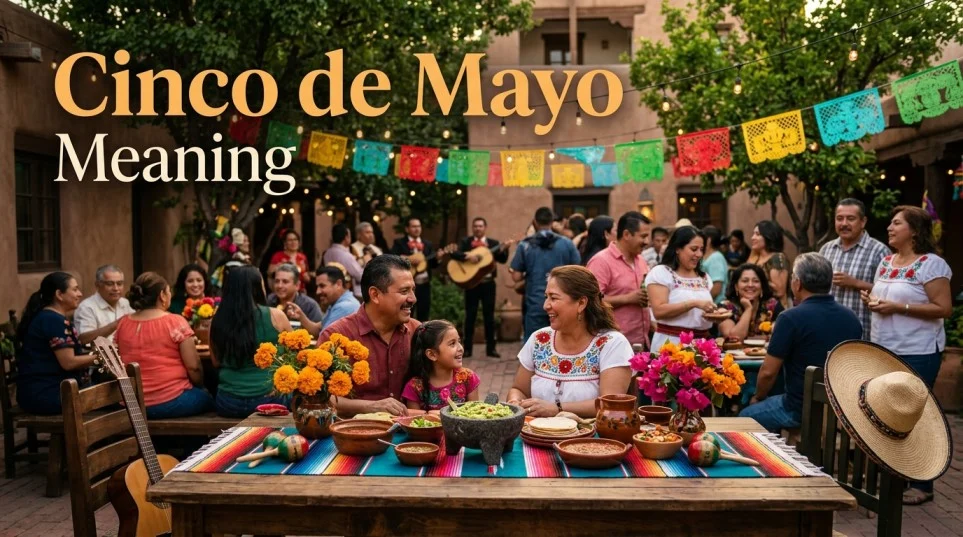
Cinco de Mayo Traditions and Celebrations
Modern Cinco de Mayo celebrations can look very different depending on location.
Common activities include:
- Mexican music performances
- Traditional dancing
- Parades
- Community festivals
- Mexican food
- Cultural exhibitions
- Historical reenactments
- School activities
- Art displays
- Educational programs
- Family gatherings
In Puebla, historical ceremonies and reenactments can connect the celebration directly to the Battle of Puebla.
In American communities, celebrations often focus more broadly on Mexican-American culture.
The strongest celebrations do more than use Mexican food or decorations. They also give people a chance to learn about Mexican history, heritage, art, music, and community traditions.
What Foods Are Associated With Cinco de Mayo?
Food has become a major part of Cinco de Mayo celebrations, particularly in the United States.
Popular dishes may include:
- Tacos
- Enchiladas
- Tamales
- Mole
- Chiles rellenos
- Guacamole
- Salsa
- Quesadillas
- Elote
- Mexican-style desserts
Food traditions vary widely across Mexico because Mexican cuisine is extremely regional.
For example, food associated with Puebla has its own historical and culinary identity. Mole poblano is especially associated with Puebla and is often mentioned in discussions of the region’s food culture.
This makes Cinco de Mayo a useful opportunity to explore Mexican cuisine beyond the familiar dishes commonly served at American celebrations.
Cinco de Mayo Is Not Mexican Independence Day
This is probably the most common misunderstanding about the holiday.
Cinco de Mayo celebrates the Battle of Puebla. Mexican Independence Day is September 16.
Here is the difference:
| Holiday | Date | What It Commemorates |
|---|---|---|
| Cinco de Mayo | May 5 | Mexican victory over French forces at Puebla in 1862 |
| Mexican Independence Day | September 16 | Beginning of Mexico’s independence movement against Spain in 1810 |
Mexico’s independence movement began decades before the Battle of Puebla.
So saying that Cinco de Mayo celebrates Mexican independence gives the wrong historical meaning.
Cinco de Mayo and Mexican-American Culture
Cinco de Mayo has particular significance in many Mexican-American communities.
The holiday became an opportunity to celebrate Mexican heritage and cultural identity, especially in parts of the United States with large Mexican-American populations.
Over time, community organizations, schools, businesses, and local governments began hosting public events around May 5.
The result is a holiday that can carry several layers of meaning:
- Historical remembrance
- Mexican pride
- Cultural heritage
- Community identity
- Education
- Music and artistic expression
- Family and community gathering
For many people, the day is less about the historical battle alone and more about recognizing the cultural influence and heritage of Mexican communities.
Common Misconceptions About Cinco de Mayo
Misconception 1: Cinco de Mayo Is Mexico’s Independence Day
Incorrect. Mexico’s Independence Day is September 16.
Misconception 2: Mexico Defeated France and Ended the War on May 5
Incorrect. The Battle of Puebla was a significant Mexican victory, but France continued its intervention.
Misconception 3: Everyone in Mexico Celebrates Cinco de Mayo in the Same Way
Incorrect. The holiday has particular historical importance in Puebla, while its level of visibility varies across Mexico.
Misconception 4: Cinco de Mayo Is Only About Food and Parties
Food and festivals are part of modern celebrations, but the historical foundation is the Battle of Puebla and Mexican resistance to French intervention.
Cinco de Mayo Facts at a Glance
Here are the essential facts in a quick format:
- Meaning: Fifth of May
- Date: May 5
- Key event: Battle of Puebla
- Year: 1862
- Location: Puebla, Mexico
- Mexican commander: General Ignacio Zaragoza
- French commander: Charles de Lorencez
- Mexican president: Benito Juárez
- Historical context: French intervention in Mexico
- Main historical significance: Mexican victory over French forces
- Mexico’s Independence Day: September 16
- Modern U.S. context: Mexican culture and heritage celebrations
What Does Cinco de Mayo Represent Today?
The modern meaning of Cinco de Mayo goes beyond a single battle.
At its historical core, it represents resistance, courage, and Mexican national pride.
In modern cultural settings, it can also represent an opportunity to recognize Mexican heritage and the contributions of Mexican and Mexican-American communities.
That broader meaning explains why May 5 can look different in Puebla, Mexico City, Los Angeles, Chicago, Houston, or another community.
The historical event remains the foundation, but culture gives the observance its modern character.
How to Explain Cinco de Mayo to a Child
A simple explanation can make the history easier to understand:
Cinco de Mayo is a day that remembers an important Mexican victory against the French army in 1862. Mexican soldiers won the Battle of Puebla even though they faced a powerful opponent. Today, people also use the day to celebrate Mexican culture and heritage.
This explanation keeps the important historical fact without suggesting that the battle ended the entire conflict.
Example Sentences With “Cinco de Mayo”
Here are natural examples using the phrase:
- Cinco de Mayo is celebrated on May 5 each year.
- Our school held a cultural event for Cinco de Mayo.
- The history of Cinco de Mayo is connected to the Battle of Puebla.
- Many communities celebrate Cinco de Mayo with music and traditional food.
- Cinco de Mayo is not the same as Mexican Independence Day.
- Puebla has a special historical connection to Cinco de Mayo.
- The Cinco de Mayo celebration included traditional Mexican dancing.
Related Words and Phrases
If you’re researching the meaning of Cinco de Mayo, these related terms can help you understand the topic more fully:
- Battle of Puebla
- Mexican history
- Mexican culture
- Mexican heritage
- Mexican Independence Day
- Puebla
- Benito Juárez
- Ignacio Zaragoza
- French intervention in Mexico
- Mexican-American culture
- May 5
- Mexican traditions
- cultural celebration
- national pride
Frequently Asked Questions
What does Cinco de Mayo mean?
Cinco de Mayo means “Fifth of May” in Spanish. It commemorates Mexico’s victory over French forces at the Battle of Puebla on May 5, 1862.
Why is Cinco de Mayo celebrated?
It is celebrated to remember the Mexican victory at the Battle of Puebla and the resistance shown against French forces during the French intervention in Mexico.
Is Cinco de Mayo Mexican Independence Day?
No. Cinco de Mayo commemorates the Battle of Puebla. Mexican Independence Day is celebrated on September 16 and marks the beginning of Mexico’s independence movement against Spain.
What happened on Cinco de Mayo in 1862?
On May 5, 1862, Mexican forces defeated a French army near Puebla. The victory became an important symbol of Mexican resistance and national pride.
Who won the Battle of Puebla?
Mexico won the Battle of Puebla. Mexican forces under General Ignacio Zaragoza defeated French troops commanded by Charles de Lorencez.
Is Cinco de Mayo a big holiday in Mexico?
It is especially significant in Puebla, where the battle took place. Its importance and style of celebration vary across Mexico. It is not the same as Mexico’s major Independence Day celebration.
How is Cinco de Mayo celebrated?
Celebrations can include parades, music, traditional dancing, cultural programs, historical reenactments, food, and community events. Activities vary by location.
Why is Cinco de Mayo popular in the United States?
In the United States, Cinco de Mayo developed into a major cultural celebration connected with Mexican heritage, food, music, art, and Mexican-American community identity.
Final Takeaway
The simplest Cinco de Mayo meaning is “Fifth of May,” but the date carries a much richer historical story.
On May 5, 1862, Mexican forces defeated the French at the Battle of Puebla. The victory did not end France’s intervention in Mexico, yet it became a lasting symbol of resistance and national pride.
Today, Cinco de Mayo has both historical and cultural significance. In Puebla, its connection to the battle remains central. In the United States, the day is also widely associated with Mexican heritage and cultural celebrations.
Understanding that difference makes the holiday easier to appreciate. It is not Mexico’s Independence Day, and it is not simply a day for food and festivals. At its heart, Cinco de Mayo remembers a remarkable Mexican victory and the spirit of resistance behind it.
Read More Related Articles:
- Fidelity Meaning | Definition, Examples, Context & The Deeper …
- Definition, Examples, Tone & the Art of Witty Humor in 2026