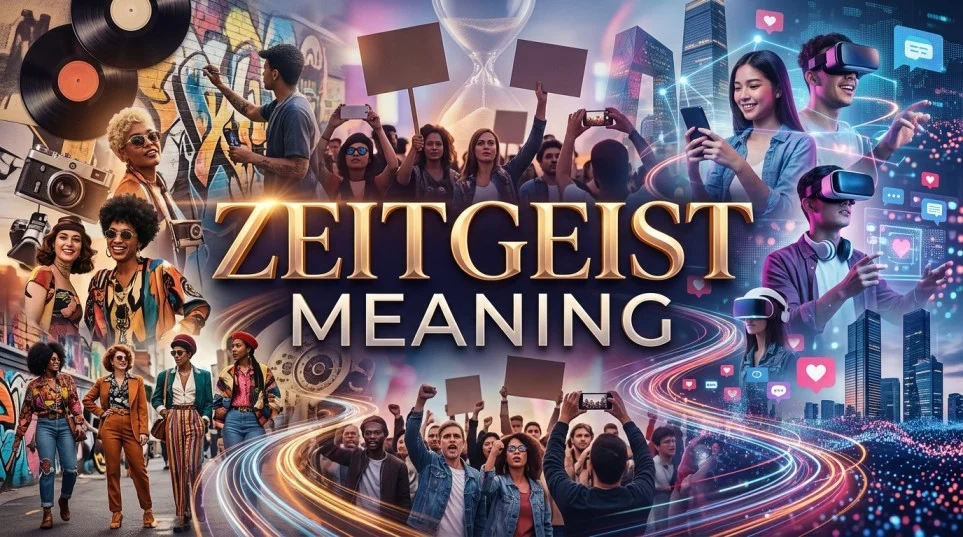
Zeitgeist meaning refers to the defining spirit, mood, ideas, attitudes, and cultural atmosphere of a particular period. In simple terms, it describes what a certain time in history feels like and what ideas or values seem to shape that time.
For example, the rise of smartphones, social media, streaming platforms, and online communities has influenced the cultural atmosphere of the 21st century. These developments can be viewed as part of the modern zeitgeist.
The word comes from German: Zeit means “time” or “age,” while Geist means “spirit.” So, zeitgeist literally translates as “spirit of the age” or “spirit of the times.”
What Does Zeitgeist Mean?
Zeitgeist is the general cultural, intellectual, and social climate of a particular era. It can include the beliefs, trends, concerns, values, artistic styles, technologies, and attitudes that become strongly associated with a period.
Think of it as the invisible character of an era.
A historical date tells you when something happened. The zeitgeist helps explain what the period felt like.
For instance, the 1960s in the United States became associated with major social movements, changing attitudes toward authority, youth culture, new forms of music, and political activism. Those combined characteristics help describe part of the era’s zeitgeist.
The term does not mean that every person in a society thought or behaved in the same way. It describes broader patterns that become noticeable across a culture or period.
Zeitgeist in Simple Terms
If you need a quick definition:
Zeitgeist means the dominant ideas, attitudes, trends, and cultural mood that characterize a particular time period.
Imagine visiting a city at different points in history.
The buildings may change. The clothes may change. Music, technology, political concerns, slang, entertainment, and social expectations may change too.
The overall combination creates a distinctive atmosphere. That is the basic idea behind zeitgeist.
Where Does the Word Zeitgeist Come From?
Zeitgeist is a German word made from two parts:
| German word | Meaning |
|---|---|
| Zeit | Time or age |
| Geist | Spirit or mind |
| Zeitgeist | Spirit of the age |
The English language adopted the term because it expresses an idea that can be difficult to capture with one ordinary English word.
The concept became especially important in German intellectual history during the late 18th and early 19th centuries. Philosophers and writers used ideas about the “spirit” of an age to discuss the characteristics and intellectual forces shaping particular historical periods.
Today, zeitgeist is used much more broadly. You may encounter it in discussions about technology, entertainment, fashion, politics, advertising, literature, business, and popular culture.
How Do You Pronounce Zeitgeist?
Zeitgeist is commonly pronounced:
ZYTE-guyst
A simple pronunciation guide is:
/ˈtsaɪtɡaɪst/
The first part sounds similar to “site,” followed by a sound close to “guyst.”
The pronunciation may initially look intimidating because the spelling is German, but it becomes easy after hearing it a few times.
Zeitgeist Examples
A good way to understand the word is to look at real cultural examples.
1. The 1960s
The 1960s are often associated with social activism, civil rights movements, youth culture, changing social norms, experimental art, and major musical developments.
These forces contributed to the zeitgeist of the 1960s.
2. The Early Internet Era
The late 1990s and early 2000s had a growing fascination with personal computers, websites, email, online chat, and the possibilities of the internet.
The excitement surrounding a rapidly expanding digital world became part of that period’s cultural atmosphere.
3. The Smartphone Era
Smartphones changed communication, photography, entertainment, navigation, shopping, and social interaction.
The expectation of being constantly connected is one feature of the modern technological zeitgeist.
4. Remote and Hybrid Work
The rapid expansion of remote work changed conversations about offices, productivity, flexibility, commuting, and work-life boundaries.
That shift became an important part of the workplace culture of the 2020s.
5. Streaming Culture
Traditional television schedules once controlled much of the entertainment experience. Streaming services changed how people discover, watch, discuss, and recommend shows and movies.
The shift toward on-demand entertainment reflects part of the contemporary cultural zeitgeist.
Zeitgeist Examples in Sentences
Here are natural ways to use the word:
- The film perfectly captured the zeitgeist of the 1990s.
- Social media has become a major part of the modern cultural zeitgeist.
- Her music reflects the anxieties and optimism of today’s zeitgeist.
- The novel captured the political zeitgeist of its generation.
- The fashion trend quickly became part of the youth zeitgeist.
- The campaign succeeded because it understood the zeitgeist of its audience.
- Artificial intelligence is becoming an important feature of the technological zeitgeist.
- The exhibition explores the artistic zeitgeist of postwar Europe.
Notice that the word usually connects a specific period with its broader cultural characteristics.
What Is the Cultural Zeitgeist?
The cultural zeitgeist is the collection of ideas, behaviors, values, interests, and creative expressions that strongly characterize a society or period.
It can appear in many forms:
- Music
- Movies and television
- Fashion
- Literature
- Art
- Advertising
- Technology
- Social media
- Political discussions
- Popular slang
- Consumer habits
- Workplace culture
- Public attitudes
For example, a generation’s heavy use of social platforms can influence language, humor, marketing, relationships, and entertainment. Those connected changes can contribute to its cultural atmosphere.
The zeitgeist is therefore bigger than a single trend.
A trend might become popular for six months. A zeitgeist describes a broader pattern that helps characterize a period.
Zeitgeist vs. Trend: What Is the Difference?
These words are related, but they are not interchangeable.
| Term | Meaning | Example |
|---|---|---|
| Zeitgeist | Broader spirit and cultural climate of an era | Growing fascination with digital life |
| Trend | A noticeable direction or popular development | A specific social media format becoming popular |
| Culture | Shared practices, values, beliefs, and expressions of a group | A society’s traditions and social habits |
| Mood | A general emotional state | Public optimism after a major event |
| Movement | Organized effort toward a particular goal | A social or artistic movement |
A trend can become part of the zeitgeist, but the two ideas are not the same.
Zeitgeist vs. Culture
Culture is broader than zeitgeist.
Culture can include traditions, language, religion, customs, art, food, values, social practices, and institutions that develop across generations.
Zeitgeist focuses more strongly on the distinctive character of a particular time.
For example, American culture has developed over centuries. The cultural zeitgeist of a particular decade is narrower. It highlights what makes that period distinctive.
A useful shortcut is:
Culture = the larger system.
Zeitgeist = the defining character of a particular period within that system.
Is Zeitgeist Positive or Negative?
The word itself is neutral.
A zeitgeist can contain positive, negative, or mixed characteristics.
For example, an era may have a zeitgeist shaped by:
- Optimism about new technology
- Fear of economic instability
- Excitement about social change
- Concern about climate issues
- Nostalgia for the past
- Political division
- Creativity and experimentation
So calling something part of the zeitgeist does not automatically mean it is good or bad.
The surrounding sentence provides the judgment.
Common Synonyms for Zeitgeist
There is no perfect one-word synonym in every context, but several expressions can communicate a similar idea.
| Related expression | Best use |
|---|---|
| Spirit of the age | Closest direct equivalent |
| Spirit of the times | Natural explanation of the concept |
| Cultural climate | Social and cultural discussions |
| Cultural atmosphere | General character of a period |
| Prevailing mood | Emotional or social tone |
| Intellectual climate | Ideas, philosophy, and scholarship |
| Social climate | Public attitudes and social conditions |
| Dominant culture | Widely influential cultural patterns |
| Collective mindset | Shared ways of thinking |
| Character of an era | Clear, accessible alternative |
Be careful with “trend” as a substitute. A trend is usually narrower than a zeitgeist.
How to Use Zeitgeist Naturally
Zeitgeist works best when you are discussing a recognizable period and its broader characteristics.
A natural structure is:
the zeitgeist of + period
Examples:
- the zeitgeist of the 1980s
- the zeitgeist of modern society
- the zeitgeist of a generation
- the zeitgeist of the digital age
- the political zeitgeist
- the cultural zeitgeist
You can also place the word after a possessive phrase:
The novel reflects the zeitgeist of its era.
This construction is especially common in writing about history, literature, art, media, and social change.
Common Mistakes When Using Zeitgeist
Using It for One Small Event
A single event is not normally a zeitgeist.
A major event may influence the zeitgeist, but the word refers to a broader cultural atmosphere.
Treating Zeitgeist as a Synonym for Trend
A viral trend can be part of an era’s zeitgeist, but a trend alone does not necessarily represent the spirit of an age.
Assuming Everyone Shares the Same View
A zeitgeist describes broad cultural patterns. It does not mean every individual agrees with them.
Different communities can experience the same historical period very differently.
Using It Without a Clear Time Context
The word becomes more meaningful when the relevant period is identifiable.
Compare:
Weak:
“The advertisement reflects the zeitgeist.”
Clearer:
“The advertisement reflects the consumer zeitgeist of the early digital era.”
The second sentence gives the reader a stronger frame of reference.
Why Zeitgeist Matters in Literature, Art, and Media
Writers and artists often capture more than the story or image directly in front of them.
A novel can reveal the fears of its period. A film can expose changing social values. A song can express the frustrations or hopes of a generation. Advertising can reveal what consumers were expected to desire.
This is why critics often discuss the zeitgeist of a particular era when analyzing creative work.
A work of art can become valuable as a historical record because it preserves attitudes and concerns that may otherwise be difficult to describe.
The Modern Zeitgeist
Today’s zeitgeist is not controlled by one single idea.
Modern life is shaped by several forces at once. Digital communication, artificial intelligence, economic uncertainty, changing workplace expectations, online communities, climate concerns, rapid cultural exchange, and personalized media all influence how people experience the present.
That makes the current zeitgeist more fragmented than the traditional image of one shared cultural mood.
People can live in the same year while experiencing very different cultural worlds.
A teenager who spends most of the day on social platforms may experience the present differently from someone who rarely uses digital technology. Both are part of the same historical period, but their cultural environments can differ substantially.
That distinction makes the concept especially useful today.
How to Identify the Zeitgeist of an Era
You can study an era by looking beyond its major historical events.
Consider these questions:
- What were people excited about?
- What were people afraid of?
- Which technologies were changing daily life?
- What social values were gaining influence?
- What topics dominated public conversations?
- What music, films, books, or art became influential?
- How did people communicate?
- What did advertising encourage people to want?
- What language or slang became popular?
- What assumptions about everyday life were changing?
Looking at these areas together gives a much richer picture of an era than studying a single event.
Frequently Asked Questions
What does zeitgeist mean in simple terms?
Zeitgeist means the spirit or defining cultural mood of a particular time. It includes the ideas, attitudes, values, trends, concerns, and behaviors that help characterize an era.
What is the literal meaning of zeitgeist?
Zeitgeist is German. Zeit means “time” or “age,” and Geist means “spirit.” The literal idea is therefore “spirit of the age” or “spirit of the times.”
Is zeitgeist an English word?
Zeitgeist originated in German, but it is widely used in English. English speakers commonly use it when discussing culture, history, art, literature, media, and social change.
What is an example of zeitgeist?
The growing influence of smartphones, social media, digital entertainment, and constant online communication can be viewed as features of the contemporary technological and cultural zeitgeist.
What is another word for zeitgeist?
The closest common expression is “spirit of the age.” Depending on the context, cultural climate, cultural atmosphere, prevailing mood, or intellectual climate may also work.
Is zeitgeist positive or negative?
Neither. Zeitgeist is a neutral term. It can describe positive developments, negative conditions, or a mixture of both.
How do you use zeitgeist in a sentence?
A natural example is: “The movie captured the zeitgeist of its generation.” This means the movie reflected the ideas, concerns, attitudes, or cultural atmosphere associated with that period.
What is the difference between zeitgeist and culture?
Culture refers to the broader shared practices, beliefs, values, language, and traditions of a group. Zeitgeist focuses on the distinctive character or prevailing atmosphere of a particular period.
Quick Takeaway
Zeitgeist means the “spirit of the age,” or the collection of ideas, attitudes, values, trends, and cultural influences that characterize a particular period.
It is useful when a simple word like trend or mood feels too narrow. A trend can describe one popular development. A mood can describe an emotional state. Zeitgeist brings together the larger character of a time.
From literature and music to technology and social change, the concept helps explain why different eras feel different. It also reminds us that history is not only a list of dates and events. Every period has its own atmosphere, assumptions, hopes, fears, and ways of seeing the world.
Read More Related Articles:
- Hawk Tuah Meaning | Origin, Definition, Viral Slang & How It’s …
- Naive Meaning | Definition, Examples, Synonyms & How to …
- Diabolical Meaning | Definition, Examples, Tone & the Dark …