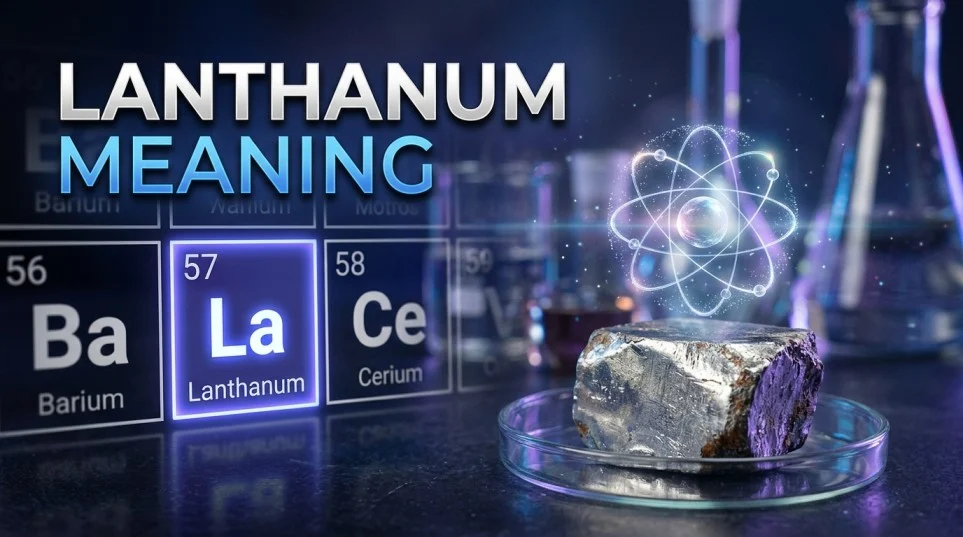
Lanthanum meaning refers to a chemical element with the symbol La and atomic number 57. It is a soft, silvery-white metal that belongs to the lanthanide series and is commonly grouped with the rare-earth elements.
You may encounter lanthanum in discussions about chemistry, the periodic table, batteries, optical glass, catalysts, and advanced materials. Although the name sounds highly technical, its basic idea is simple: lanthanum is a metallic chemical element with useful optical, chemical, and material properties.
Its position at the beginning of the lanthanide series also makes it important for understanding how the rare-earth elements are organized and how their properties change across the periodic table.
What Is Lanthanum?
Lanthanum is a naturally occurring chemical element. Its chemical symbol is La, and its atomic number is 57, meaning each neutral lanthanum atom contains 57 protons.
It is classified as a lanthanide, a group of elements located in the f-block of the periodic table. Lanthanum is also commonly described as a rare-earth element.
In its pure form, lanthanum is a relatively soft, malleable, silvery-white metal. It is chemically reactive compared with many familiar metals and can react with oxygen and other substances.
Lanthanum at a Glance
| Property | Information |
|---|---|
| Element | Lanthanum |
| Symbol | La |
| Atomic number | 57 |
| Atomic mass | About 138.91 u |
| Category | Lanthanide / rare-earth element |
| Appearance | Silvery-white metal |
| State at room temperature | Solid |
| Block | f-block |
| Period | 6 |
| Group | Often associated with Group 3 |
| Name origin | From Greek lanthanein, meaning “to lie hidden” |
The name itself has an interesting history. Lanthanum comes from the Greek word lanthanein, associated with something hidden or escaping notice. The name reflects the element’s discovery in material that had previously been confused with another rare-earth substance.
Lanthanum Meaning in Simple English
In simple English, lanthanum means a specific type of metallic chemical element found in the rare-earth family.
Think of the periodic table as a large organized map of elements. Lanthanum has its own location, symbol, atomic number, and characteristic properties.
For example:
- La is the symbol for lanthanum.
- 57 is its atomic number.
- It is a metal.
- It is associated with the lanthanide series.
- It is classified among the rare-earth elements.
- It can form compounds with oxygen and other elements.
- Its properties make it useful in specialized industrial applications.
So, when someone searches for what is lanthanum, they are generally asking for the identity, classification, properties, and uses of this chemical element.
Lanthanum on the Periodic Table
Lanthanum is found in period 6 of the periodic table. It appears at the beginning of the series commonly shown separately beneath the main body of the periodic table.
Its position is useful because lanthanum sits at the starting point of the group commonly called the lanthanides.
The lanthanide series is known for elements that have related chemical characteristics. Many are silvery metals and tend to form compounds in the +3 oxidation state.
Is Lanthanum a Lanthanide?
Yes. Lanthanum is traditionally included with the lanthanide series, although its exact electronic classification can lead to some discussion in advanced chemistry.
This distinction matters because different periodic-table conventions place lanthanum and lutetium differently when defining the boundaries of the f-block.
For everyday chemistry and general science writing, calling lanthanum a lanthanide and rare-earth element is accurate and useful.
Is Lanthanum a Rare-Earth Element?
Yes. Lanthanum is considered a rare-earth element.
The term “rare earth” can be misleading. These elements are not necessarily extremely rare in Earth’s crust. The challenge often involves finding them in concentrated deposits and separating chemically similar elements from one another.
Lanthanum occurs naturally in minerals that also contain other rare-earth elements, especially cerium.
This is one reason lanthanum is important in rare-earth chemistry. It is not usually encountered as a large piece of pure metal in everyday life. Instead, it is obtained through processing and separation of mineral sources.
Lanthanum Symbol and Atomic Number
The chemical symbol for lanthanum is La.
Its atomic number is 57.
The atomic number is especially important because it identifies the element. Every neutral lanthanum atom has 57 protons in its nucleus.
Its standard atomic weight is approximately 138.90547, commonly rounded to 138.91 in general educational material.
Why Does Lanthanum Have the Symbol La?
The symbol La comes from the element’s name, lanthanum.
Chemical symbols normally use one or two letters. The first letter is capitalized, while a second letter, if present, is lowercase.
Examples include:
- La = lanthanum
- Ce = cerium
- Nd = neodymium
- Pr = praseodymium
These short symbols make it easier to represent elements in chemical formulas and equations.
Physical Properties of Lanthanum
Lanthanum is a soft, silvery-white metal with a relatively high melting point.
Some useful physical facts include:
| Property | Approximate value |
|---|---|
| Atomic number | 57 |
| Atomic weight | 138.91 |
| Melting point | 920°C |
| Boiling point | 3,464°C |
| Density | About 6.15 g/cm³ |
| State at room temperature | Solid |
Lanthanum is malleable, meaning it can be shaped without easily breaking. Like other reactive metals, its surface can change when exposed to air.
The metal also has interesting optical and electronic characteristics, which help explain several of its specialized applications.
Chemical Properties of Lanthanum
Lanthanum is chemically reactive and commonly occurs in the +3 oxidation state.
It reacts with oxygen to form lanthanum oxide and can react with water under appropriate conditions. It also reacts with acids.
One important compound is lanthanum oxide, written as La₂O₃.
Lanthanum can also form compounds with elements such as:
- Oxygen
- Fluorine
- Chlorine
- Carbon
- Sulfur
- Hydrogen
Its chemistry becomes especially useful when lanthanum compounds are incorporated into ceramics, catalysts, optical materials, and other specialized products.
Lanthanum Electron Configuration
The electron configuration of lanthanum is commonly written as:
[Xe] 5d¹ 6s²
The configuration is notable because lanthanum sits at the beginning of the lanthanide sequence and has a somewhat unusual relationship with the filling of the 4f orbitals.
This is one reason university-level chemistry discussions can treat the exact boundaries of the lanthanide and f-block categories differently.
For a basic understanding, the key point is that lanthanum is element 57 and belongs to the family of elements associated with the lanthanide series.
Where Is Lanthanum Found?
Lanthanum is found naturally in minerals containing rare-earth elements.
It is particularly associated with minerals such as monazite and bastnäsite, which can contain several rare-earth elements together.
This makes extraction more complicated than simply mining a deposit containing isolated lanthanum.
The elements often have very similar chemical properties, so industrial processing uses methods designed to separate them efficiently.
Why Is Separation Difficult?
Lanthanum and neighboring rare-earth elements can behave similarly in chemical reactions.
That similarity is useful scientifically, but it creates a practical challenge.
A mineral may contain lanthanum alongside cerium, neodymium, praseodymium, and other rare-earth elements. Producing purified lanthanum therefore requires separation processes that exploit small differences in chemical behavior.
What Is Lanthanum Used For?
Lanthanum has several specialized applications. Its compounds and alloys can be more useful than the pure metal itself.
1. Optical Glass
Lanthanum compounds are used in certain types of optical glass.
Adding lanthanum can improve optical characteristics, helping manufacturers produce specialized lenses and glass used in cameras, scientific instruments, and other optical systems.
This is one of the more important practical connections between lanthanum chemistry and everyday technology.
2. Catalysts
Lanthanum compounds can be used as catalysts or catalyst components.
Catalysts help chemical reactions happen more efficiently without being consumed in the same way as ordinary reactants.
Lanthanum-containing materials have applications in petroleum refining and other chemical processes.
3. Nickel-Metal Hydride Batteries
Lanthanum-containing alloys have historically played an important role in nickel-metal hydride batteries.
These batteries have been used in various rechargeable devices and were especially important in some early hybrid-electric vehicle systems.
The lanthanum-containing alloy can help store hydrogen within the battery’s electrode material.
4. Specialized Ceramics
Lanthanum compounds are also used in certain advanced ceramic materials.
Their chemical and physical characteristics can modify the behavior of ceramic products, making them useful in specialized technical applications.
5. Hydrogen Storage Research
Lanthanum-containing alloys have attracted interest because some can absorb and release hydrogen.
This makes lanthanum relevant to research and technology involving hydrogen storage materials.
The practical value depends heavily on the specific alloy rather than on pure lanthanum alone.
Lanthanum vs. Other Rare-Earth Elements
Lanthanum is often discussed alongside elements such as cerium, neodymium, and praseodymium.
| Element | Symbol | Atomic Number | Common Association |
|---|---|---|---|
| Lanthanum | La | 57 | Optical materials, catalysts, batteries |
| Cerium | Ce | 58 | Catalysts, glass polishing, automotive applications |
| Praseodymium | Pr | 59 | Magnets, specialized glass, alloys |
| Neodymium | Nd | 60 | Powerful permanent magnets |
| Samarium | Sm | 62 | Magnets and specialized applications |
These elements share many chemical characteristics, but their individual properties make them useful for different purposes.
For example, neodymium is strongly associated with high-performance permanent magnets, while lanthanum has important applications in optical glass, catalysts, and hydrogen-storage alloys.
Lanthanum vs. Cerium
- Lanthanum and cerium are neighboring elements in the periodic table.
- Lanthanum has atomic number 57, while cerium has atomic number 58.
Both belong to the rare-earth family and can occur together in natural minerals. Their chemical similarity is one reason separating rare-earth elements can be technically demanding.
The distinction is important in scientific writing because “rare earth” describes a broader family, not one single substance.
Is Lanthanum Dangerous?
Pure lanthanum and its compounds should be handled with appropriate laboratory or industrial safety controls.
The risk depends on the specific form, concentration, route of exposure, and working environment. A piece of lanthanum metal and a fine powder of a lanthanum compound do not present exactly the same practical hazards.
For laboratory work, the correct safety data sheet and institutional handling procedures should guide storage, protective equipment, exposure control, and disposal.
For general readers, there is no need to treat lanthanum as an everyday household substance. Its main relevance is scientific, industrial, and technological.
Common Mistakes About Lanthanum
A few misunderstandings can make explanations of this element confusing.
Mistake 1: Thinking “rare earth” means extremely rare
The term does not simply mean an element is scarce. Rare-earth elements can occur in significant amounts in Earth’s crust, but economically useful concentrations and efficient separation can be challenging.
Mistake 2: Treating all rare-earth elements as interchangeable
Lanthanum, cerium, neodymium, and other rare-earth elements have similarities, but their properties and applications differ.
Mistake 3: Assuming pure lanthanum is the main form used everywhere
Many practical applications involve lanthanum compounds or alloys, not pure elemental lanthanum.
Mistake 4: Confusing atomic number with atomic mass
Lanthanum’s atomic number is 57. Its atomic mass is approximately 138.91 u. These numbers describe different characteristics.
A Quick Memory Trick for Lanthanum
If you need to remember the basic facts quickly, use this simple chain:
Lanthanum → La → 57 → Lanthanide → Rare Earth → Silvery Metal
That sequence connects the name to its most important identifying information.
For students, remembering La = 57 is a useful starting point. From there, connect it to the lanthanide series and its practical uses in optical materials, catalysts, and battery-related alloys.
Related Words and Concepts
If you are researching lanthanum, these terms are closely connected:
- Lanthanide: A family of elements associated with lanthanum and the f-block.
- Rare-earth element: A broader category that includes the lanthanides.
- La: Chemical symbol for lanthanum.
- Atomic number: The number of protons in an atom’s nucleus.
- Lanthanum oxide: A compound with the formula La₂O₃.
- Cerium: Element 58, located immediately after lanthanum.
- Monazite: A mineral that can contain lanthanum and other rare-earth elements.
- Bastnäsite: Another important source of rare-earth elements.
- Rare-earth metal: A metallic element belonging to the rare-earth group.
Common Questions
What does lanthanum mean?
Lanthanum is the name of a chemical element with the symbol La and atomic number 57. It is a soft, silvery-white metal classified among the lanthanides and rare-earth elements.
What is lanthanum used for?
Lanthanum is used in specialized optical glass, catalysts, rechargeable battery materials, advanced ceramics, and some hydrogen-storage alloys. Its compounds also have applications in technical materials.
Is lanthanum a metal?
Yes. Lanthanum is a metal. It is a soft, silvery-white, relatively reactive metal associated with the rare-earth elements.
Is lanthanum a rare earth?
Yes. Lanthanum is classified as a rare-earth element and is traditionally included in the lanthanide series.
What is the symbol for lanthanum?
The chemical symbol for lanthanum is La. The first letter is capitalized and the second is lowercase.
What is the atomic number of lanthanum?
Lanthanum has an atomic number of 57. This means a neutral lanthanum atom contains 57 protons.
Where is lanthanum found?
Lanthanum occurs naturally in rare-earth minerals, including monazite and bastnäsite. It is commonly found alongside other rare-earth elements rather than as an isolated mineral.
Why is lanthanum important?
Lanthanum is important because its chemical and physical properties make it useful in optical materials, catalysts, battery alloys, ceramics, and other specialized technologies.
Final Takeaway
The simplest lanthanum meaning is this: lanthanum is a soft, silvery-white chemical element with the symbol La and atomic number 57. It belongs to the lanthanide series and is classified as a rare-earth element.
Its importance goes beyond its place on the periodic table. Lanthanum and its compounds are useful in optical glass, catalysts, battery materials, ceramics, and specialized hydrogen-storage alloys. Its close chemical relationship with neighboring rare-earth elements also makes it a useful example of why separating and processing these elements can be challenging.
Read More Related Articles:
- What This Viral Slang Really Means in Texts, TikTok & Online …
- SMH Meaning in Text | Decode the Tone, Emotion, and Real …