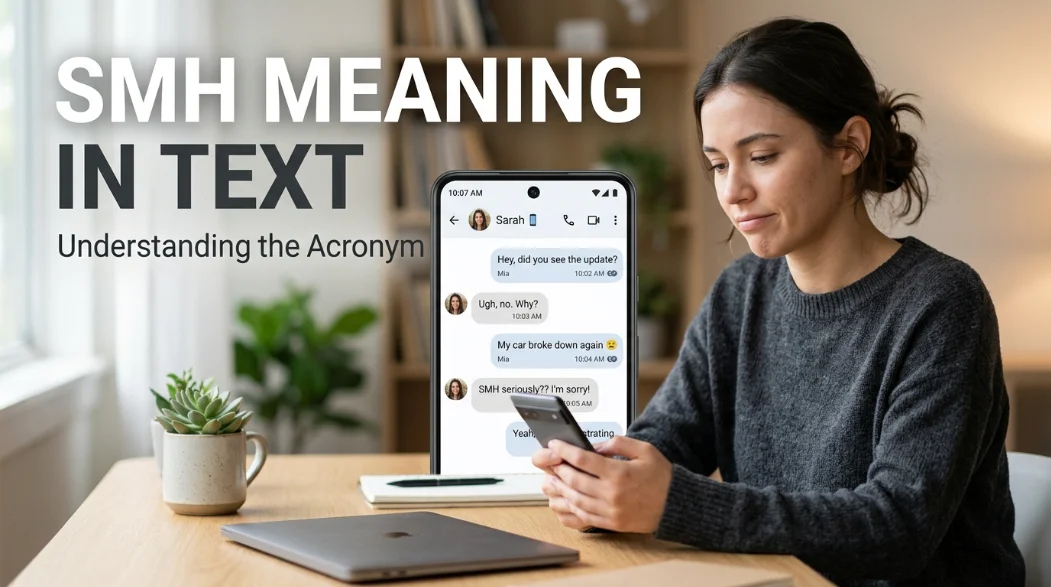
SMH meaning is “Shaking My Head.” It is a common texting abbreviation used to show disappointment, disbelief, frustration, annoyance, or mild disapproval. You may see SMH in text messages, social media comments, group chats, memes, and casual online conversations.
For example, if someone forgets their keys for the third time, a friend might text, “SMH, you did it again.” The abbreviation does not literally mean that the person is physically shaking their head. It represents the reaction someone might naturally have in that situation.
Understanding the context is important because SMH can sound playful between friends but slightly critical in another conversation. Its meaning usually depends on what happened, who is using it, and the tone of the surrounding message.
What Does SMH Mean?
SMH stands for “Shaking My Head.”
It is an informal internet and texting expression. People use it when something seems foolish, frustrating, disappointing, surprising, or difficult to believe.
Simple definition
SMH = Shaking My Head
The expression communicates a reaction rather than a specific action. It is similar to saying:
- “I can’t believe this.”
- “That was disappointing.”
- “Seriously?”
- “I’m frustrated.”
- “That was a bad decision.”
- “I have no words.”
The exact feeling changes with context.
SMH Full Form and Meaning
| Term | Meaning |
|---|---|
| SMH | Shaking My Head |
| Type | Texting abbreviation |
| Language style | Informal |
| Common setting | Texts, chats, social media |
| Main purpose | Expressing a reaction |
| Common emotions | Disbelief, frustration, disappointment, annoyance |
SMH is generally associated with casual digital communication. It is not normally suitable for formal business emails, academic assignments, official documents, or professional reports.
How Is SMH Used in Texting?
SMH is usually placed at the beginning or end of a sentence, although people can use it on its own.
At the beginning
“SMH, you forgot your wallet again.”
Here, SMH expresses frustration or disbelief.
At the end
“You really sent that message to the wrong person, SMH.”
The abbreviation emphasizes the speaker’s reaction.
As a standalone response
“SMH.”
This short response can communicate disappointment, disbelief, or annoyance without explaining the feeling directly.
With lowercase letters
“smh, that’s wild.”
Lowercase SMH is common in casual texting. Capitalized SMH is equally understandable.
SMH Meaning in Different Contexts
The same abbreviation can communicate different emotions depending on the situation.
| Context | Possible meaning | Example |
|---|---|---|
| Mistake | Disbelief or frustration | “SMH, you missed the deadline.” |
| Bad decision | Disapproval | “SMH, why would you do that?” |
| Funny situation | Playful disbelief | “You ate the whole pizza? SMH.” |
| Disappointing news | Disappointment | “SMH, they canceled the event.” |
| Argument | Annoyance | “SMH, we’re still arguing about this.” |
| Unexpected behavior | Surprise | “SMH, I didn’t expect that from him.” |
| Social media | Reaction to a post | “SMH at these comments.” |
The context determines the emotional strength.
SMH Tone: Is It Rude?
SMH is not automatically rude. It can be lighthearted, playful, disappointed, annoyed, or critical.
Among close friends, it may be harmless teasing:
“You wore two different shoes today. SMH 😂”
In another situation, it could sound judgmental:
“SMH, you should know better.”
That difference matters. The words around SMH, the relationship between the speakers, and even emojis can change how the message feels.
If you are speaking to someone you do not know well, a clearer phrase may be safer than using SMH.
SMH Examples in Text Messages
Here are realistic examples showing how people use the abbreviation.
1. Forgetting something
“SMH, I left my phone at home again.”
The speaker is frustrated with their own mistake.
2. Reacting to a friend’s mistake
“You forgot her birthday? SMH.”
This expresses mild disappointment or disbelief.
3. Reacting to surprising behavior
“SMH, he actually walked out of the meeting.”
The speaker is surprised or disapproving.
4. Playful teasing
“You finished the snacks without me. SMH 😂”
Here, the tone is playful rather than genuinely angry.
5. Social media reaction
“SMH at some of these comments.”
The writer is expressing disbelief, disappointment, or annoyance about comments they have seen.
6. Personal frustration
“SMH, I studied the wrong chapter.”
The speaker is frustrated with their own mistake.
7. A short reaction
“SMH. What were you thinking?”
The abbreviation reinforces the speaker’s disapproval.
What Does SMH Mean on Social Media?
On social media, SMH works as a quick reaction to something frustrating, confusing, disappointing, or ridiculous.
You may see it in:
- Instagram comments
- TikTok comments
- Facebook posts
- X posts
- Snapchat messages
- Reddit discussions
- YouTube comments
- Group chats
For example:
“SMH at this entire situation.”
The writer does not necessarily mean literal head shaking. They are expressing a strong reaction to what they have seen.
SMH Meaning on Snapchat, Instagram, and TikTok
The basic meaning of SMH remains “Shaking My Head” across major social platforms.
Its emotional meaning can change based on the post or conversation.
- On TikTok, it may appear as a reaction to a funny or unbelievable video.
- On Instagram, someone might use it in a comment about an unexpected post.
- On Snapchat, friends may use it casually in direct messages.
The platform does not give SMH a completely different definition. Context remains the key.
SMH vs Similar Texting Expressions
SMH is sometimes confused with other internet abbreviations. They can overlap, but they are not interchangeable in every situation.
| Expression | Meaning | Typical feeling |
|---|---|---|
| SMH | Shaking My Head | Disbelief, frustration, disappointment |
| OMG | Oh My God | Surprise or excitement |
| WTF | What the F*** | Strong surprise, confusion, anger |
| LOL | Laughing Out Loud | Amusement |
| IDK | I Don’t Know | Uncertainty |
| TBH | To Be Honest | Directness or honesty |
| IDC | I Don’t Care | Indifference |
| NGL | Not Gonna Lie | Informal honesty |
| SMDH | Shaking My Damn Head | Stronger frustration |
SMH vs SMDH
SMDH means “Shaking My Damn Head.”
It generally carries a stronger or more frustrated tone than SMH because of the added intensifier.
Example:
“SMH, he forgot again.”
This can sound mildly frustrated.
“SMDH, he forgot for the fifth time.”
This sounds more strongly annoyed.
When Should You Use SMH?
SMH works best in casual communication with people who understand internet slang.
Good situations include:
- Texting friends
- Group chats
- Casual social media comments
- Informal online conversations
- Memes and humorous posts
- Casual personal messages
The abbreviation can make a message shorter and more expressive.
Instead of writing:
“I am disappointed that you forgot to bring the tickets again.”
A friend might simply write:
“SMH, you forgot the tickets again.”
The second version feels much more conversational.
When Should You Avoid SMH?
Avoid SMH when clarity and professionalism are more important than casual expression.
For example, it would usually be inappropriate in:
- Job applications
- Resumes
- Academic essays
- Formal reports
- Official letters
- Professional proposals
- Customer service communication
- Formal business emails
Instead of writing:
“SMH, this caused another delay.”
A professional alternative could be:
“Unfortunately, this caused another delay.”
The second sentence communicates the issue clearly without relying on internet slang.
Is SMH an Insult?
Not necessarily.
SMH expresses a reaction, but the reaction can range from playful teasing to genuine disapproval.
Compare these examples:
“SMH 😂 You really forgot your own birthday?”
This is likely playful.
“SMH. You should have known this was unacceptable.”
This sounds much more critical.
So, calling SMH an insult in every situation would be inaccurate. The surrounding language and context matter.
How to Respond to SMH
Your response depends on what the sender means.
If they are joking
“😂 I know, I know.”
If they are disappointed
“Yeah, that was my mistake.”
If you disagree
“I see it differently.”
If you want clarification
“What do you mean?”
If you want to keep things casual
“Haha, fair enough.”
You do not always need to respond to SMH directly. Sometimes it simply works as a reaction within an ongoing conversation.
Common Mistakes With SMH
1. Thinking SMH means something completely different
The standard meaning in texting is “Shaking My Head.”
2. Using it in formal writing
SMH is informal internet slang. Professional and academic writing usually requires clearer language.
3. Assuming it always means anger
SMH can express mild disappointment, humor, surprise, disbelief, or annoyance.
4. Treating it as a literal action
Most people use SMH figuratively. They are communicating a reaction rather than describing actual physical movement.
5. Using it with everyone
Not every reader knows texting abbreviations. With unfamiliar audiences, spelling out your meaning may be clearer.
SMH in a Sentence
Here are additional examples for learning natural usage:
- “SMH, I can’t believe I made that mistake.”
- “You forgot your password again? SMH.”
- “SMH at how quickly that meeting went off track.”
- “He showed up two hours late, SMH.”
- “SMH, we just talked about this yesterday.”
- “You really bought another pair? SMH 😂”
- “SMH, some people never learn.”
These examples show why context matters. The same abbreviation can sound humorous, annoyed, disappointed, or critical.
SMH in Professional Communication
Using SMH at work depends heavily on the relationship and communication channel.
A casual message between coworkers who regularly use texting slang may include it. However, a formal email to a manager, client, customer, or business partner should normally use direct language instead.
For example:
Casual chat:
“SMH, the meeting link isn’t working again.”
Professional message:
“The meeting link is not working again. Could you please send an updated link?”
The professional version removes ambiguity and keeps the communication appropriate.
What Are the Best Alternatives to SMH?
If your audience may not understand internet slang, use a phrase that directly communicates the intended reaction.
Depending on context, alternatives include:
- “I can’t believe it.”
- “That’s disappointing.”
- “Seriously?”
- “That’s frustrating.”
- “I don’t understand why.”
- “I can’t believe you did that.”
- “That’s hard to believe.”
- “What were you thinking?”
- “That’s unfortunate.”
- “I am surprised.”
There is no single perfect replacement because SMH can express several related emotions.
SMH and Digital Communication
Texting abbreviations developed partly because digital conversations favor speed and compact expressions. Three letters can communicate an entire emotional reaction when both people understand the convention.
SMH also shows an important feature of online communication: tone is often compressed into a few characters. Since text does not include facial expressions or voice, abbreviations, punctuation, emojis, and surrounding words often help communicate the intended feeling.
That is why “SMH 😂” and “SMH.” can feel very different even though the abbreviation is identical.
Frequently Asked Questions
What does SMH mean in text?
SMH means “Shaking My Head.” It is an informal texting abbreviation used to express disbelief, frustration, disappointment, annoyance, or playful disapproval.
What does SMH stand for?
SMH stands for “Shaking My Head.” It is commonly used in texts, chats, comments, and social media conversations.
Is SMH rude?
SMH is not automatically rude. It can be playful among friends, but it may sound critical or judgmental in a serious conversation.
What does SMH mean on social media?
On social media, SMH usually means “Shaking My Head.” People use it to react to something surprising, frustrating, disappointing, or difficult to believe.
Can I use SMH in a professional email?
It is generally better to avoid SMH in formal professional emails. Use clear language such as “That is disappointing,” “I am surprised,” or “Unfortunately, this caused a delay.”
What is the difference between SMH and SMDH?
SMH means “Shaking My Head,” while SMDH means “Shaking My Damn Head.” SMDH generally communicates stronger frustration or disbelief.
Can SMH be used jokingly?
Yes. Friends often use SMH as playful teasing. Emojis and surrounding words can make the humorous intention clearer.
Is SMH still used in texting?
Yes. SMH remains recognizable as informal internet and texting slang. Its exact emotional tone depends on the conversation and context.
Final Takeaway
SMH means “Shaking My Head.” It is a short, informal way to communicate disbelief, frustration, disappointment, annoyance, or playful disapproval.
The abbreviation is most natural in texts, chats, comments, and other casual digital conversations. Its tone is flexible, so the surrounding words and context matter. For formal or professional writing, a direct phrase is usually clearer.
Read More Related Articles:
- JW Meaning in Text | The Hidden Meaning Behind This Short …
- LWK Meaning in Text | What It Really Means, How to Use It …
- HM Meaning in Text | What It Really Means in Modern Chats …