You tell your friends the wildest news of the week. Front row concert tickets, twenty dollars, total luck. The reply comes back in five capital letters: “IKYFL.” No explanation, no question, just those letters and a crying emoji. Are they calling you a liar, or are they just shocked?
Here is the short answer first. IKYFL means “I know you f***ing lying”. People type it as a dramatic reaction of shock or disbelief, like saying “no way, that cannot be true”. Most of the time it is playful, not a real accusation, though the swear word inside it means it can sting when the moment is tense. This guide covers the ikyfl meaning in text, both senses, and the best replies.
What Does IKYFL Mean in Text?
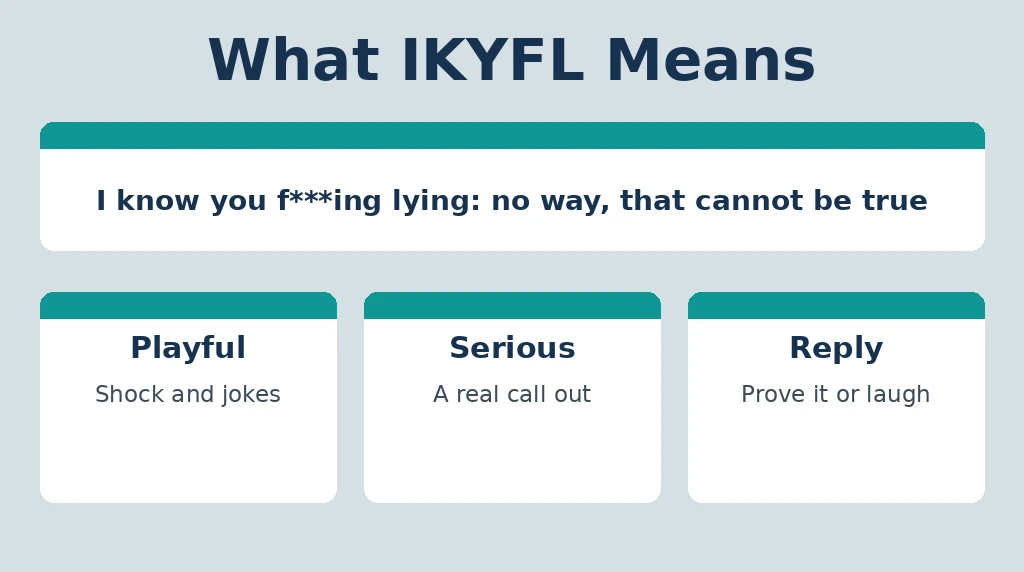
IKYFL is short for “I know you f***ing lying”, with some people writing it as “I know you are f***ing lying”. Someone sends it when a story sounds too wild, too lucky or too funny to be true. “You got front row tickets for twenty dollars? IKYFL.” The sender is not running a lie detector test. They are saying “I cannot believe that”, with extra drama.
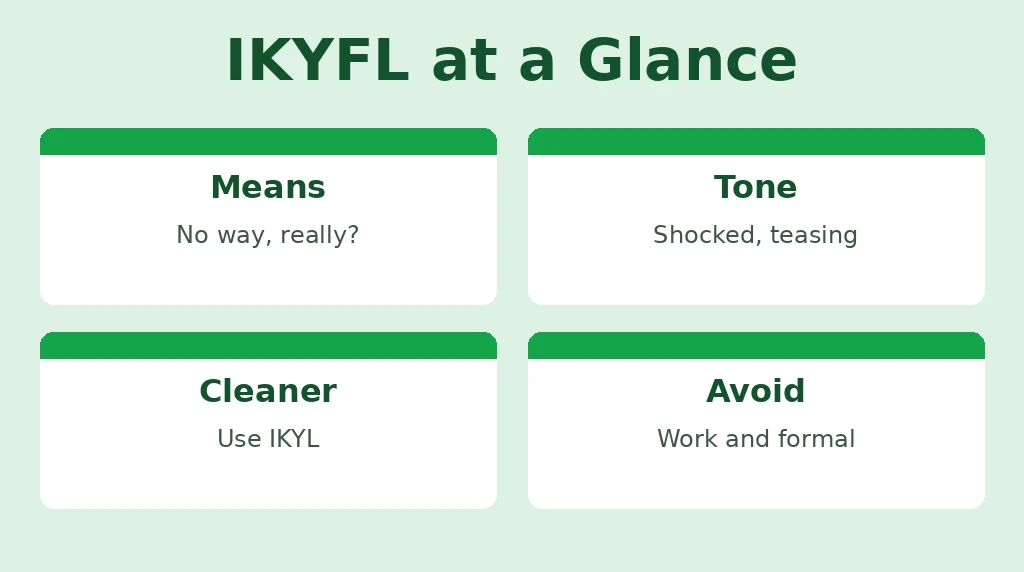
The tone decides everything, and emoji usually sets it. “IKYFL” with a laughing face is a joke between friends. “IKYFL” with a skull emoji is comedic shock. “IKYFL” with an angry face in the middle of an argument is a real accusation, and it can hurt or escalate fast. Lowercase “ikyfl” reads softer than capital “IKYFL”, which can look louder.
So the letters never tell the whole story. Read the message above them, the relationship behind them, and the emoji beside them. A friend who adds “ikyfl, pick it up right now” after you found money on the street is hyping you up, not calling you a liar. Context is the real dictionary here.
Full Form of IKYFL
The full form is as direct as the abbreviation, with one word or phrase behind each letter:
- I: I
- K: know
- Y: you
- F: f***ing
- L: lying
Put together, you get “I know you f***ing lying”, sometimes written with “you are” in the middle. Say it out loud and people pronounce each letter on its own: eye-kay-why-eff-ell. Most people simply say the full phrase instead, since the letters are a mouthful. The F in the middle is a swear word, which is why the whole abbreviation carries a harder edge than most texting slang.
IKYFL vs IK vs IKR: What Is the Difference?
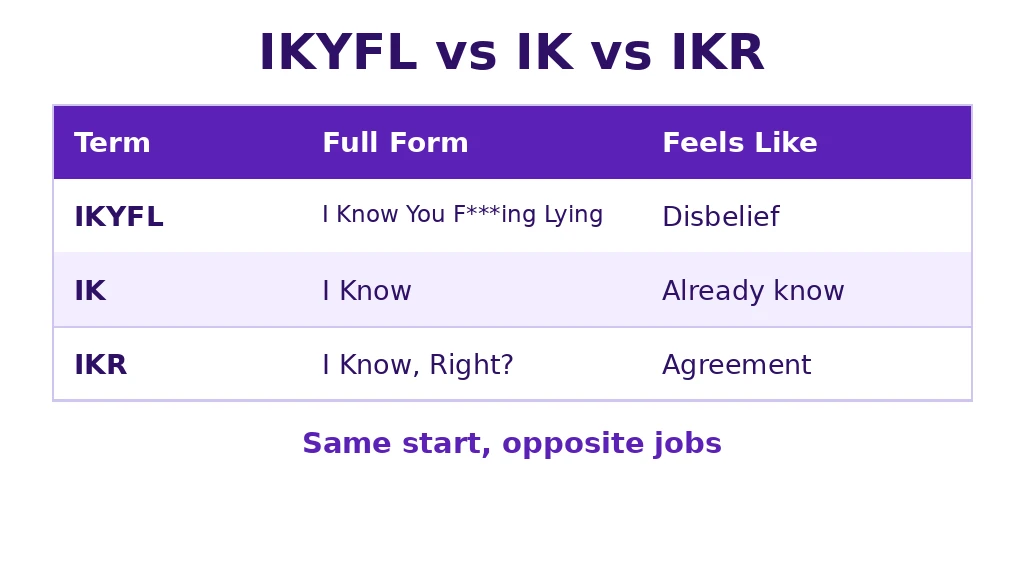
IKYFL, IK and IKR all start with “I know”, but they do very different jobs in a chat. Here they are side by side.
| Abbreviation | Full Form | What It Really Says | Tone |
|---|---|---|---|
| IKYFL | I know you f***ing lying | That cannot be true | Shocked, teasing |
| IK | I know | I already know that | Neutral, plain |
| IKR | I know, right? | I agree with you | Warm, agreeing |
The classic mix up is IKYFL versus IKR, because both start with “I know” and both react to something someone said. They point in opposite directions, though. IKR agrees with a point, as in “that movie was too long, I know, right?” IKYFL doubts a claim, as in “you met a celebrity at the grocery store? IKYFL.” One backs the other person up, the other playfully calls them out.
IK is the plainest of the three. It simply says “I already know that”, with no agreement and no disbelief attached. A cousin worth knowing is IYKYK, short for “if you know, you know”, which marks an inside joke that only some people will understand. It winks at insiders without explaining anything, while IKYFL shouts its reaction for everyone to hear.
Where IKYFL Is Commonly Used
Texting and WhatsApp
One to one chats and group chats are the natural home of ikyfl. It reacts to wild stories, lucky breaks and unbelievable claims between close friends. A typical line looks like this: “Dude, I just found a hundred dollar bill on the street” “IKYFL, pick it up right now”. Short, dramatic, and the chat keeps moving.
Instagram and Snapchat
On Instagram and Snapchat, ikyfl shows up in DMs, story replies and comments. People use it to react to a friend’s surprising post or a celebrity gossip screenshot, often with laughing or skull emojis beside it. A story about a surprise engagement or a last minute holiday gets an “ikyfl” because the news is almost too good to believe.
TikTok Comments
Scroll a busy TikTok comment section and ikyfl is everywhere. Viewers use it under viral videos, reaction clips and celebrity drama threads to say “no way” in five letters. Comments like “IKYFL” under a shocking storytime video have become a format of their own.
Group Chats
Group chats run on stories that get bigger every time they are told, so ikyfl is the word that calls them out. One person tells an escalating holiday story, the rest reply “ikyfl”, and everyone laughs. It also works as a quick vote on a rumour: “ikyfl” means the group does not buy it, and the storyteller knows it instantly.
Gaming Chats
In game chat there is no time for full sentences, so ikyfl does quick work between rounds. Players type it after an unbelievable clutch play or a suspiciously lucky shot, half joking and half accusing. Everyone understands it instantly, and nobody stops playing to decode it.
Discord and Forums
Discord servers and forums use ikyfl the same way, just in longer threads. Someone shares a wild claim about a game or a celebrity, and “ikyfl” replies stack up underneath it. It signals “I do not believe that” without starting a full argument, and in a busy server that is often all anyone needs.
Origin and History of IKYFL
IKYFL grows out of the phrase “I know you lying”, which comes from African American Vernacular English. The phrase travelled through Black social media and messaging apps, where it picked up the extra word in the middle and got compressed into five letters. No single inventor is known, and no exact first use date is verified, which is normal for slang that spreads person to person.
The abbreviation started appearing online in the late 2010s, and TikTok pushed it into mainstream Gen Z slang in the early 2020s, where reaction videos and storytime clips gave it a perfect home. Some sources date its wider traction later, around 2023 and 2024, so the timeline is not fully settled. What is clear is the path: a spoken phrase from Black English became a texting abbreviation, then a comment section staple.
Other Meanings and Variations of IKYFL
In casual texting, IKYFL almost always means “I know you f***ing lying”, but the same letters carry a second reading, and a few close cousins shift the force.
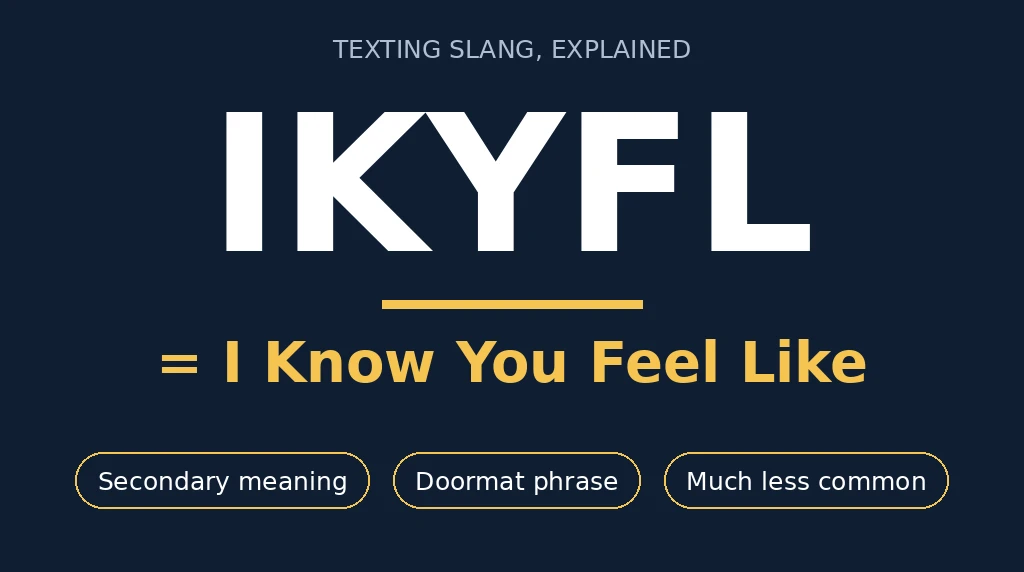
- I know you feel like: a much less common second reading of the same letters. Its only concrete, well known context is the viral doormat phrase “IKYFL Poppin Up Here”, meaning “I know you feel like popping up here”, as in coming inside. It is a home decor joke, not a normal chat reply, so do not use this reading in a conversation and expect people to understand it.
- IKYL: “I know you are lying”, or “I know you lyin”. The cleaner version, with no swear word and the same meaning.
- Lowercase ikyfl: the same letters in lowercase, which read softer and more playful than capital IKYFL. The case is the tone control.
- Game show sense: IKYFL is also the name of a game show built around calling out bluffs, where a player hits a buzzer and says “I know you f***ing lying” when they think someone is bluffing. That is a separate, minor sense, not the texting one.
- idgaf as a cousin: a different kind of shutdown. Where ikyfl doubts a claim, idgaf refuses to care about it at all. Both are hard edged, but they do opposite jobs in a chat.
On social media, ikyfl also works as a caption and a tag. A video captioned with #ikyfl or tagged #ikyfl is usually a shocking or funny clip, and the tag tells viewers to expect disbelief. Read that use as a reaction label, not as an answer to a question.
How to Use IKYFL Correctly
- Keep it between close friends. IKYFL belongs in friendly, informal chats where everyone knows you are joking. If the conversation would not welcome a swear word, it will not welcome an IKYFL either.
- Mean it as playful disbelief, not a real accusation. Use it when a story sounds wild and you are reacting with shock. People can tell a joking ikyfl from a genuine call out, and the genuine one lands very differently.
- Add emoji to set the tone. A laughing face or a skull emoji tells the other person you are joking. Without emoji, the same five letters can read as an attack.
- Watch the moment. If a friend is upset, telling a serious story, or talking about honesty and trust, an ikyfl can land badly. Slow down and write a real sentence instead.
- Use IKYL when you want it cleaner. The version without the swear word says the same thing and works in more places. When the chat is mixed company, IKYL is the better default.
Example Conversations Using IKYFL
A lucky break
Person A: “Dude, I just found a hundred dollar bill on the street”
Person B: “IKYFL, pick it up right now”
Concert tickets
Person A: “You got front row tickets for twenty dollars? IKYFL”
Person B: “I swear, look at the screenshot”
An escalating story
Person A: “So then I met the whole band backstage, and they invited me on tour”
Person B: “Okay… IKYFL.”
A group chat rumour
Person A: “Did you hear, Sara is moving to Paris next month?”
Person B: “ikyfl, she literally just signed a lease here”
A gaming clutch
Person A: “I won that round with one health left”
Person B: “ikyfl, that was pure luck”
A TikTok comment
Person A: “He really said that on live TV, I cannot believe it”
Person B: “IKYFL, frl, no way that happened”
The surprise birthday
Person A: “Surprise! We got you front row seats for your birthday”
Person B: “OMG! IKYFL! You did not!”
The genuine call out
Person A: “I was on time, the bus was just late again”
Person B: “IKYFL. You said the same thing last week”
That last one is not a joke. Same letters, very different message.
When Not to Use IKYFL
- Work email: write “really? That is surprising” instead. A swear word looks careless on the record.
- Workplace chat: even in a casual team channel, ikyfl can read as an accusation against a colleague.
- Teachers and bosses: anyone grading or managing you deserves a full, polite sentence.
- Parents and family chats: the profanity makes it a poor choice for family groups, especially with older relatives.
- Strangers and new contacts: someone who does not know your humour will read ikyfl as a real accusation.
- Serious conversations about trust: when honesty is genuinely on the table, a slang call out makes things worse. Talk directly instead.
How to Respond When Someone Sends You IKYFL
An ikyfl lands in your chat and you have to decide fast: were they joking, or did they just call you a liar? Check the emoji and the friendship, then pick the lane that matches the moment.
Double down replies work when your story is true:
- “I swear it is true, look at the screenshot.”
- “No lie, I was shook too.”
- “Dead serious, it really happened.”
Laugh it off replies suit a joke or an exaggeration:
- “Okay, maybe I exaggerated a tiny bit.”
- “LMAO, you caught me.”
- “You got me, it was not quite that wild.”
Agree it is wild replies fit good news that sounds unbelievable:
- “I know right, still cannot believe it myself.”
- “Tell me about it, I would not believe me either.”
Calm replies help when the ikyfl felt tense:
- “I get why it sounds wild, but it really happened.”
- “idc, believe what you want, I know what happened.”
One thing to avoid: do not fire back with more slang when the ikyfl was a genuine accusation. If someone really thinks you lied, a calm, clear answer fixes things faster than a joke will.
Common Mistakes People Make With IKYFL
- Using it as an agreement term. IKYFL doubts a claim, it never agrees with one. If you want to agree, use IKR instead.
- Treating the feel like sense as equal. “I know you feel like” is a rare second reading tied to a doormat phrase, not a normal chat meaning. Lead with the lying sense.
- Sending it without emoji to a stranger. Friends read the joke, strangers read an accusation. Without emoji or history, the letters alone sound harsh.
- Using it in a serious trust conversation. When honesty genuinely matters, a slang call out escalates the argument. Talk directly instead.
- Using it at work. A colleague who gets “ikyfl” hears “you are lying to me”. Spell out your surprise and ask for the details instead.
Frequently Asked Questions
What does IKYFL mean in text?
IKYFL means “I know you f***ing lying”. People type it as a dramatic reaction of shock or disbelief, like saying “no way, that cannot be true”. Most of the time it is playful, not a real accusation.
Is IKYFL rude?
It can be. Between close friends it is usually a joke, but the phrase contains a swear word, so it can sound confrontational, especially from a stranger or in a serious conversation about honesty.
What does IKYFL mean as I know you feel like?
“I know you feel like” is a much less common second reading of IKYFL. Its only concrete, well known context is the viral doormat phrase “IKYFL Poppin Up Here”, meaning “I know you feel like popping up here”. It is not a normal chat reply.
What is the difference between IKYFL and IKR?
IKYFL reacts with disbelief, as in “that cannot be true”. IKR means “I know, right?” and agrees with someone else’s point. One doubts a claim, the other backs it up, so they do opposite jobs.
Can I use IKYFL in a work message?
No. IKYFL contains profanity and reads as an accusation, so it has no place in work email, workplace chat, messages to teachers, or any formal setting. In a work chat, write “Really? That is surprising” instead.
How do I reply when someone sends me IKYFL?
If your story is true, double down with proof, such as “I swear it is true, look at the screenshot”. If you were joking, laugh it off with “okay, you caught me”. If it felt tense, stay calm and clarify instead of arguing back.
Final Thoughts
Five letters, one dramatic job with a surprising amount of range packed inside. IKYFL is the quickest way to say “no way, that cannot be true” in texting, and it has earned its place in everyday chats because everyone hears a story that sounds too wild to believe. Used playfully, between close friends, with the right emoji, it never really causes trouble.
If you want the official stamp, Dictionary.com lists ikyfl with exactly this meaning, which shows how far a slang abbreviation can travel from a spoken phrase to a dictionary entry. Either way, you now have the ikyfl meaning in text down, plus a decent reply ready for the next time it shows up in your messages.
