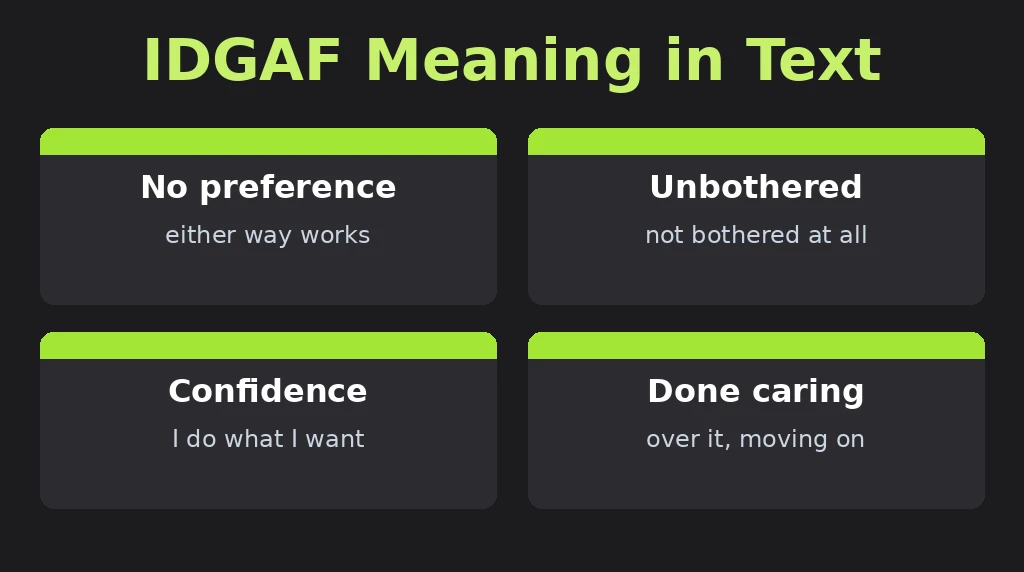
You open a chat and there it is, five letters sitting alone on the screen. “IDGAF.” No emoji, no follow up, just a flat statement that the person on the other end does not care. It can read as confidence, as a joke, or as a door slamming shut, and telling those apart is the whole trick.
Here is the quick answer. IDGAF means “I don’t give a f***”, a blunt way of saying someone does not care about something at all. The last word is a swear word, which is why the whole thing hits harder than a plain “I don’t care”. This guide covers the idgaf meaning in text, when it sounds confident and when it sounds rude, where it shows up, and what to send back when it lands in your messages.
What Does IDGAF Mean in Text?
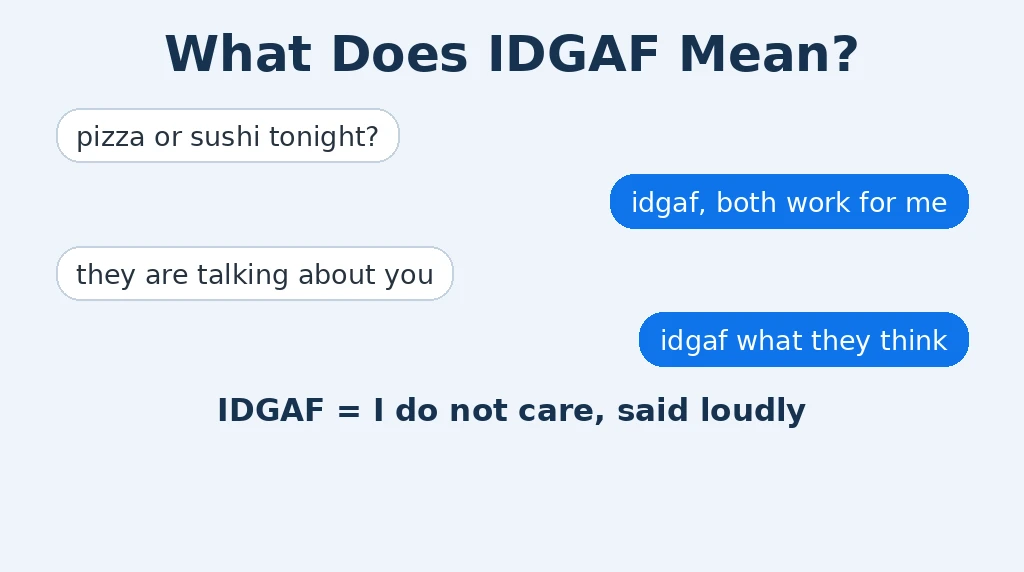
IDGAF is short for “I don’t give a f***”. Someone types it when they want to say, loudly and without apology, that something does not matter to them. It is not a soft “eh, whatever”. It is a firm “I truly could not care less, and I want you to know it”. The swear word inside it is doing real work: it turns mild indifference into a statement with attitude.
The tone shifts with the situation, and that is where most people get tripped up. Between close friends, “idgaf, both work for me” is relaxed and easy, just a quick way to settle a low stakes choice like pizza or sushi. Aimed at criticism, “idgaf what they think” is a shield, a way of saying other people’s opinions do not get a vote. Used in a fight, the same five letters can sound cold and dismissive, like the person has stopped listening entirely.
Capitalization barely changes it. Lowercase “idgaf” is the everyday form in chats and comments, quick and casual. All caps “IDGAF” reads a touch louder, like the person is planting their feet. If you hear someone say it out loud, they usually sound the letters out as “eye-dee-gaff”, though most people just say the full phrase instead.
Full Form of IDGAF
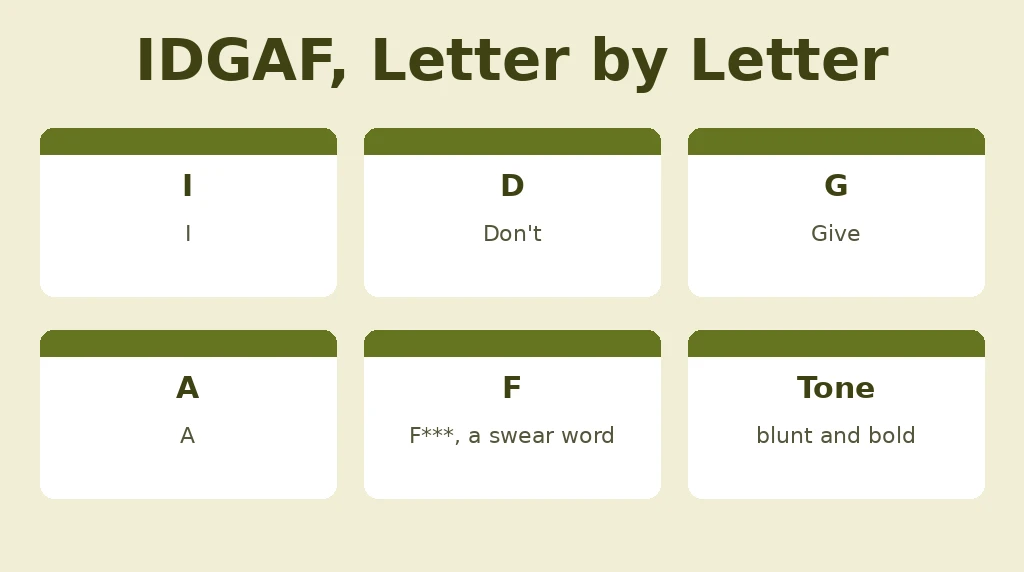
The full form is blunt, because each letter stands for one word of a very direct sentence:
- I: I
- D: don’t
- G: give
- A: a
- F: f*** (a swear word)
Put together, you get “I don’t give a f***”. The abbreviation makes the phrase faster to type and a little less in your face on screen, but it does not make it more polite. The feeling behind the letters is exactly the same as the full sentence, which is why it lands so hard in a chat. A few softer cousins exist, like IDGAC, “I don’t give a care”, for people who want the same shrug without the swear word.
IDGAF vs IDC vs IDK: What Is the Difference?
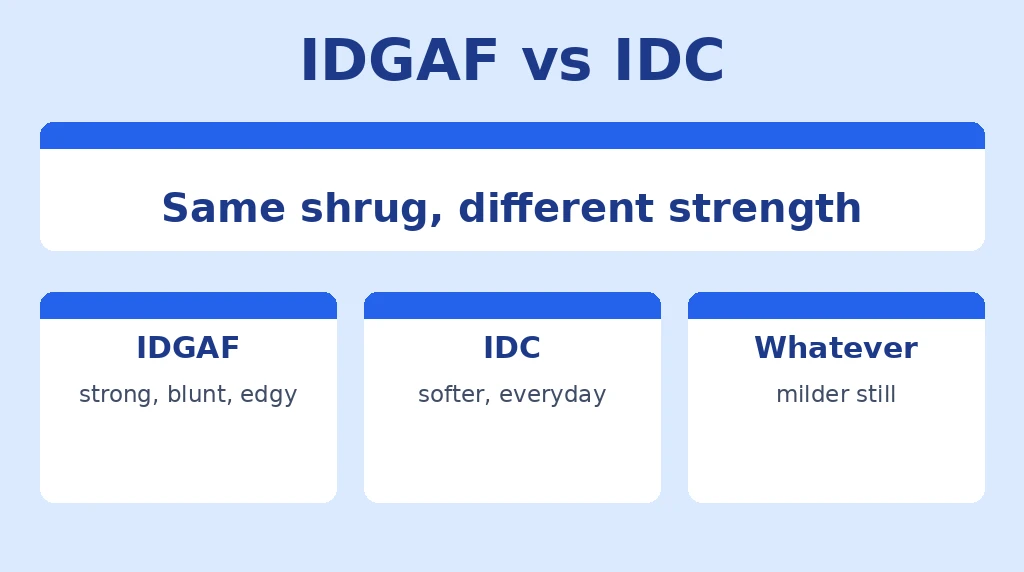
IDGAF shares its corner of texting with a few close cousins, but they are not the same word. Here they are side by side.
| Abbreviation | Full Form | What It Really Says | Tone |
|---|---|---|---|
| IDGAF | I don’t give a f*** | I do not care, and I mean it | Strong, blunt |
| IDC | I don’t care | It does not matter to me | Neutral, everyday |
| IDK | I don’t know | I do not have the answer | Neutral, honest |
| Whatever | Whatever | Do what you want | Dismissive, mild |
The classic mix up is IDGAF versus IDC, because both talk about not caring. IDC is the softer, everyday version. It works in almost any casual setting without sounding harsh. IDGAF is the same idea with the volume turned all the way up, thanks to the swear word inside it. “Idc where we eat” is flexible. “Idgaf where we eat” is flexible with attitude, and it can sound like the person is annoyed, not just easygoing.
IDK is a different word entirely, even though it looks like part of the same family. IDK means “I don’t know”, so it talks about missing information. IDGAF talks about missing interest. Reply “idk” to “where should we eat?” and you are undecided. Reply “idgaf” and you are saying the choice does not matter to you at all. Swap them and the whole mood of the reply flips.
Where IDGAF Is Commonly Used
Texting and WhatsApp
In one to one chats, idgaf settles small choices and brushes off gossip between friends. A typical exchange looks like this: “pizza or sushi tonight?” “idgaf, both work for me lol”. It is the kind of word that fits a close chat, where both people already know the tone is light.
Instagram and Snapchat
On Instagram and Snapchat, idgaf thrives in captions and bios as a confidence statement. People post a photo with “idgaf” underneath it to say they like the picture and do not care who judges it. You will also see it in DMs and in replies to stories, usually when someone reacts to drama or an opinion they do not respect.
TikTok Comments
TikTok turned idgaf into a whole attitude. Creators use it in captions to signal unbothered, main character energy, and viewers drop it in comments to defend a creator or to dismiss a hater. Comments like “idgaf, I am still doing it lol” under a video about an overdone trend are everywhere.
Group Chats
Group chats are where idgaf gets used most casually, often about small, low stakes stuff like what restaurant to pick or who is driving. It is less dramatic here and more just shorthand for “I have no preference” or “do whatever, I am not bothered”. The group usually just moves on and makes the call.
Gaming Chats
In game chat, idgaf is a quick way to say “your opinion does not affect me” mid match without breaking focus. Players type things like “idgaf man, next round we win” after losing a round, or after getting trash talked by the other team. It keeps the mood light while shutting the argument down.
Discord and Forums
Discord servers and forums use idgaf the same way, just in longer threads. Someone dismisses criticism of their opinion, or ends an argument with a conversational mic drop: “idgaf, moving on”. It signals the topic is closed, at least for that person.
Origin and History of IDGAF
IDGAF starts with a phrase that is far older than texting. “I don’t give a f***” has roots in 20th century American vernacular, showing up in music, film and everyday speech as a marker of someone who has stopped playing by other people’s rules. The sentiment was already a cultural staple long before anyone shortened it.
The written initialism has an early trail too. Its earliest citation traces to a hip-hop demo tape from 1993, and Urban Dictionary got its first definition for the term in April 2003, describing it as something people said when they could not be bothered to type the full phrase. It followed the same pattern as other phrases getting shortened for speed, like IDC and IDK.
The abbreviation really picked up steam in the 2010s, when Twitter and Tumblr turned the “I don’t care” attitude into almost a cultural moment. Songs, hashtags and even merchandise leaned into the IDGAF attitude as a badge of confidence rather than just rudeness. By the time TikTok and Instagram became dominant, IDGAF had fully cemented itself as shorthand for an entire mood, the confident, unbothered energy a lot of online culture celebrates. Merriam-Webster now lists it as a real entry.
Other Meanings and Variations of IDGAF
IDGAF has one main meaning, but it wears several moods depending on the chat. Knowing the moods keeps you from misreading it.
- Genuine indifference: someone truly does not care about the topic, like “idgaf what we eat tonight”.
- Defensive dismissal: used to shut down criticism or judgment, like “people talk about me? IDGAF”.
- Confidence and branding: used as an identity statement, especially in bios or captions, implying someone lives life unapologetically.
- Sarcastic or joking tone: sometimes used humorously among friends, not meant seriously at all, almost like an inside joke about not caring.
- Frustration or venting: used when someone is fed up and wants to say “I am done caring about this situation”.
- IDGAFWYT: “I don’t give a f*** what you think”, the directed version, aimed at someone specific.
- IDGAC: “I don’t give a care”, the toned down, cleaner version for people who want the same shrug without the swear word.
On social media, idgaf also works as a tag and a caption style. People add it to posts to signal the “unbothered” mood, and friends use it to describe someone who stays calm under pressure, as in “he is winning the IDGAF war”. The meaning stays the same. Only the stage changes.
How to Use IDGAF Correctly
- Know your audience. It is casual and can come across as harsh, so make sure you are texting someone who will not be offended by the implied swear word.
- Match the energy of the conversation. If it is a lighthearted chat, idgaf works as a fun way to say “no preference”. If it is a serious conversation, it might come across as dismissive or cold.
- Pair it with context. Adding a little explanation after idgaf keeps it from sounding overly blunt. “Idgaf what we eat, you pick” reads far friendlier than a bare “idgaf”.
- Soften it with friends. A “lol”, “tbh” or “haha” next to it signals the playful version, not the angry one. Text hides tone, so give the reader a clue.
- Do not overuse it. Like any slang, it loses impact if you use it in every other sentence. Save it for moments when the shrug actually means something.
Example Conversations Using IDGAF
Deciding plans in a group chat
Person A: “Pizza or sushi tonight?”
Person B: “idgaf, both work for me lol.”
An Instagram comment
Person A: “People are saying your new haircut is weird.”
Person B: “idgaf, I love it.”
Venting to a friend
Person A: “He said you copied his idea.”
Person B: “gmfu, idgaf what he thinks tbh, I know the truth.”
Gaming with a teammate
Person A: “Bro, why did you go that route? We lost because of you.”
Person B: “idgaf man, next round we win.”
A TikTok comment
Person A: “This trend is so overdone.”
Person B: “idgaf, I am still doing it lol.”
Text between friends
Person A: “Everyone is talking about your outfit today.”
Person B: “idgaf, I felt cute so that is all that matters.”
A confident reply
Person A: “You really posted that opinion publicly?”
Person B: “Yep, idgaf.”
Done with the drama
Person A: “Did you hear what she said about you?”
Person B: “Honestly idgaf anymore, I am over the drama.”
When Not to Use IDGAF
- Work email or workplace messages: it reads as unprofessional and can come across as disrespectful, even among friendly coworkers.
- Formal conversations with teachers or authority figures: even in texting form, it is too casual and too blunt for these settings.
- Serious or sensitive conversations: if someone is sharing something emotional or important, responding with idgaf, even jokingly, can feel like you are dismissing their feelings.
- First-time conversations or new acquaintances: until you know someone’s sense of humor and comfort level, idgaf might come across the wrong way.
- Customer service or official communication: if you would not casually curse in front of someone, you probably should not use idgaf with them either.
How to Respond When Someone Sends You IDGAF
An idgaf lands differently depending on the mood behind it, so read the chat before you reply. Pick the lane that fits the moment.
Lighthearted replies work when it is casual:
- “Same tbh, fair enough lol.”
- “Haha, okay, I will decide then.”
- “Love that energy.”
Checking-in replies fit when it sounds defensive or frustrated:
- “You good? Wanna talk about it?”
- “Hey, no stress. We can sort it out.”
Decision replies fit when it is about plans:
- “Cool, I will pick and let you know.”
- “Alright, pizza it is then.”
Playful replies suit close friends and light topics:
- “smh, okay, unbothered queen”
- “idgaf either, we are a great team”
One thing to avoid: if the idgaf feels dismissive toward you specifically, do not fire back with attitude. Ask one calm question, like “wait, are you upset?” Text hides tone, and a quick check beats a pointless argument.
Common Mistakes People Make With IDGAF
- Assuming it is always aggressive. A lot of the time it is just casual and not meant to offend. Read the chat around it before deciding the person is angry.
- Confusing it with IDC. They are similar but not identical. IDGAF is stronger and more emotionally charged, because of the implied swear word. IDC fits far more settings.
- Using it in professional settings by accident. Autocorrect and muscle memory can betray you, so always double check before hitting send in serious chats.
- Misreading tone. Since it is text based, idgaf can come across harsher than intended. Adding an emoji or a casual filler word like “lol” or “tbh” can soften it.
- Overusing it until it loses meaning. If every response is idgaf, it stops feeling like a genuine statement and starts feeling like a filler word. Save it for when you actually mean it.
Frequently Asked Questions
What does IDGAF mean in text?
IDGAF means “I don’t give a f***”. People type it in chats and comments to say, bluntly, that they do not care about something.
Is IDGAF rude?
It can come across as blunt or harsh depending on context, because the full phrase contains a swear word. Among friends in casual conversation it is often not meant to be offensive, just a strong way of saying “I do not care”.
What is the difference between IDGAF and IDC?
IDC means “I don’t care” and is the softer, more neutral version. IDGAF carries stronger emotional weight because of the implied swear word, so it sounds bolder and more defiant.
Can I use IDGAF in a work email?
No. IDGAF is casual slang with an implied swear word, and it looks unprofessional in work writing. In a work email, write the full sentence, such as “I have no strong preference on this.”
What does IDGAF mean on Instagram?
On Instagram it usually works as a confidence statement. People put it in captions and bios to say they like what they posted and do not care who judges it, or they use it in comments to brush off hate.
How do I reply when someone sends me IDGAF?
Match the mood. If it is lighthearted, reply casually with “same tbh” or “fair enough”. If it sounds frustrated, check in gently with “you good?” If it is about plans, just make the decision yourself.
Final Thoughts
Five letters, one loud shrug. IDGAF is the bluntest way to say “I do not care” in texting, and it has earned its place in everyday chats because sometimes a soft “whatever” just does not cut it. Used with friends, in the right chats, it reads as confidence. Used carelessly, it reads as a door closing. The difference is almost always the audience and the moment.
If you want the dictionary view, Dictionary.com lists idgaf with exactly this meaning, which shows how far a blunt piece of internet slang has travelled into everyday language. Either way, you now have the idgaf meaning in text down, plus a decent reply ready for the next time it shows up in your messages.

2 thoughts on “IDGAF Meaning in Text: What It Means, How to Use It and How to Reply”