
You are sorting out Saturday plans in the group chat when a reply lands: “WBT”. No emoji, no follow up, no hint about what comes next. Is your friend confirming they are coming, asking about your plans, or reminiscing about the old days?
Here is the short answer first. WBT most often means “Will Be There” when someone confirms plans, and it means “What About You?” when it bounces a question back, as in “I am going, WBT you?” The chat around it decides which one fits, and a quick context test in this guide will show you how to tell them apart in seconds. This guide covers the wbt meaning in text, the tone traps, WBT vs WBU and OTW, where you will see it, and the best replies for every version of it.
What Does WBT Mean in Text?
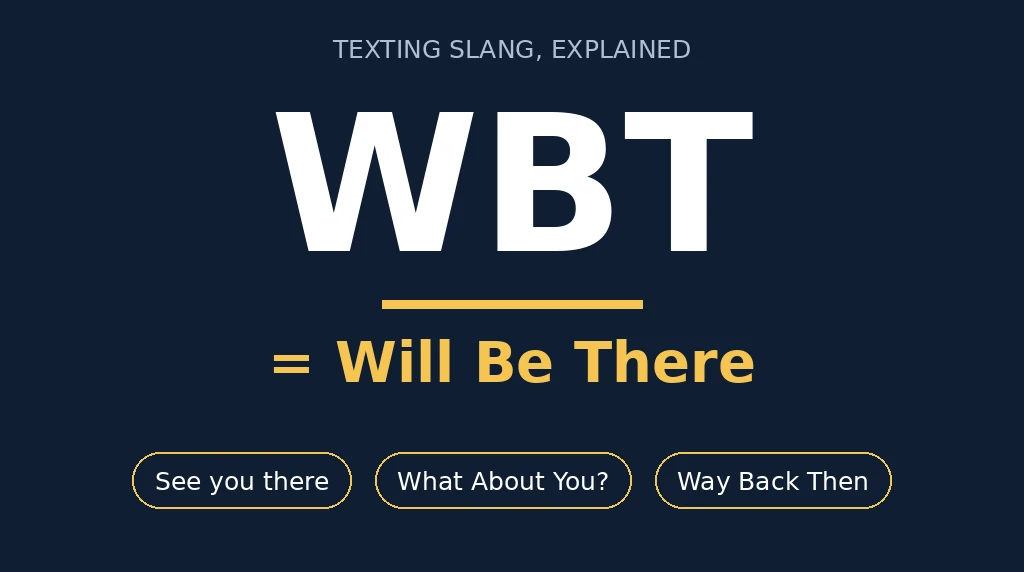
WBT is a flexible abbreviation with two main texting jobs. The first is confirming attendance: “Movie night at my place, 7 PM Friday” gets a “WBT” back, and everyone knows that person is coming. The second is returning a question: “I am going to the party, WBT you?” means “what about you, are you coming too?” Same three letters, two different moves, and the sentence around them tells you which one is happening.
The honest truth is that no single meaning owns WBT. Even the guides that rank for this term disagree with each other: some lead with “Will Be There”, some lead with “What About You?”, and some lead with “Want to Be There”, the wishful version for when someone wants to join in. That disagreement tells you WBT is a context abbreviation, and guessing from the letters alone is the one thing you should never do.
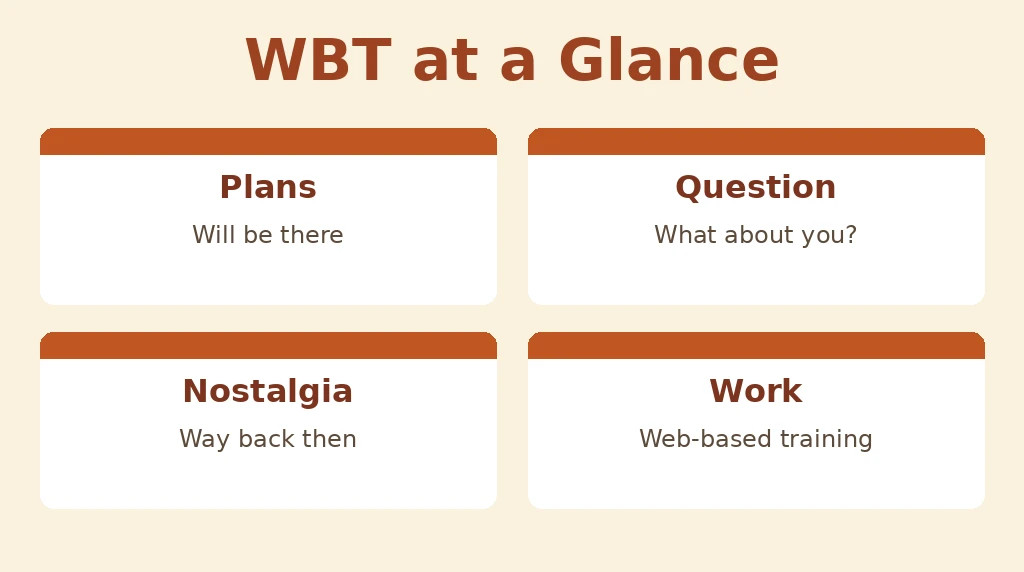
So here is the context test. If WBT answers a plan, an invitation or a time, it means “Will Be There”. If WBT follows someone sharing their own answer and ends with a question mark, it means “What About You?” If it sits under an old photo or a throwback post, it probably means “Way Back Then”. And if it shows up in a work email about a course, it means “Web-Based Training”. Four contexts, four readings, and the message around the letters picks the right one every time.
Full Form of WBT
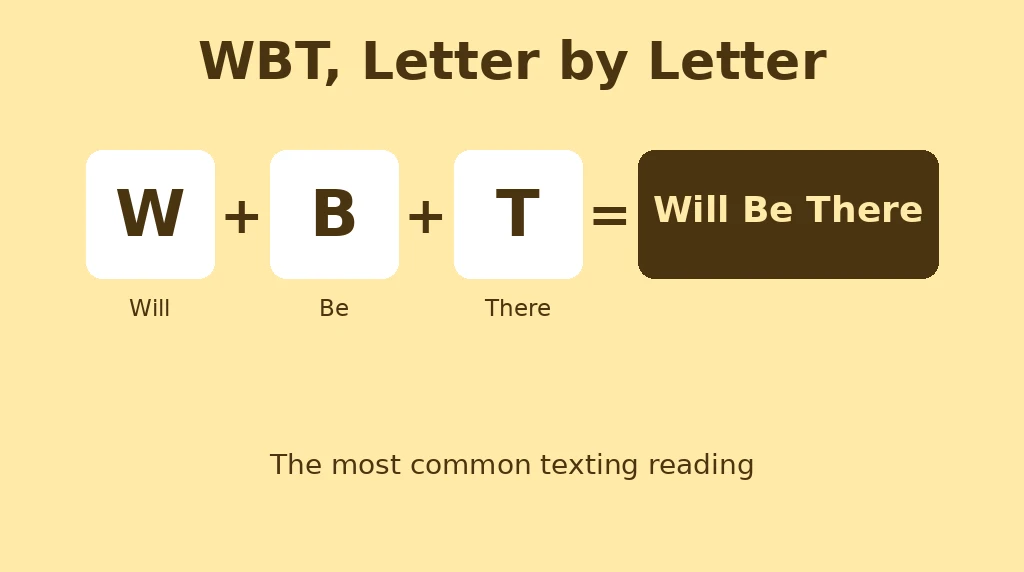
The most common full form in texting is “Will Be There”, with one word behind each letter:
- W: Will
- B: Be
- T: There
Put together, you get “Will Be There”. Say it out loud and people pronounce each letter on its own: double-you-bee-tee. You will hear that spoken version in planning chats and in jokes between friends who text all day.
But “Will Be There” is only the lead reading, not the only one. The same letters expand to “What About You?” when the message is a question, “Want to Be There” when someone wishes they could join, “Way Back Then” when the topic is the past, and “Web-Based Training” in professional settings.
WBT vs WBU vs OTW: What Is the Difference?
Three short abbreviations cause most of the mix ups in this corner of texting, so here they are side by side.
| Abbreviation | Full Form | What It Really Says | Tone |
|---|---|---|---|
| WBT | Will Be There | Yes, I am coming | Warm, casual |
| WBU | What About You? | Same question back to you | Friendly, curious |
| OTW | On the Way | I have already left | Quick, practical |
The classic mix up is WBT versus WBU, because the two look similar and both can carry a question. They do different jobs, though. WBU always means “What About You?” and nothing else, so it is the safe pick when you want to bounce a question back. WBT only means that when it is used as a question, and most of the time it means “Will Be There” instead. If you want to ask about someone, type WBU. If you want to confirm you are coming, type WBT.
OTW is the useful comparison for the timing side of WBT. OTW means the person has already left and is on the road, while WBT means they will show up later, with no promise about when they leave. Reply “otw” to a party invite and your friends expect you in minutes. Reply “wbt” and they expect you at the time you agreed. And WBT is nothing like idgaf, which is a hard dismissal, not a confirmation at all. A softer cousin worth knowing is “RSVP”, the formal version of the same confirmation, used on real invitations where WBT would look too casual.
Where WBT Is Commonly Used
Texting and WhatsApp
One to one chats about plans are the natural home of wbt. It confirms attendance, answers a question about the evening, or bounces a question back without slowing anything down. A typical line looks like this: “Dinner is at 6, do not be late” “WBT, just finishing up work”. Short, warm, and the plan keeps moving.
Instagram and Snapchat
On Instagram and Snapchat, wbt shows up in DMs and in comments, often with a nostalgic lean. Under a throwback photo or an old song, “WBT, those were good days” means “way back then”, not “will be there”. You will also see it in story replies, where “WBT?” asks about tonight’s plans, or a quick “WBT, wish I was there” under a holiday photo.
TikTok Comments
Scroll a busy TikTok comment section and wbt is everywhere. Viewers use it under nostalgic videos to mean “way back then”, as in “WBT when this song was on repeat every summer”. Under event announcements it flips back to “will be there”, with comments like “WBT, cannot wait”. The video above the comment decides which reading fits.
Group Chats
Group chats run on half finished plans, so wbt is the glue holding the RSVPs together. One person posts the plan, three people reply wbt, and the headcount is done in seconds.
Gaming Chats
In game chat there is no time for full sentences, so wbt does quick work between rounds. Players type things like “Raid starts at 9, WBT?” or “WBT, loading up now” while the match is still moving. Everyone understands it instantly, and nobody stops playing to decode it.
Discord and Forums
Discord servers and forums use wbt the same way, just in longer threads. Someone announces a stream or a community event, and “WBT, cannot wait” is a normal, accepted reply. On nostalgia threads it leans the other way, toward memories of old internet days.
Origin and History of WBT
WBT has a mixed origin, which explains why it carries so many meanings. Its earliest documented use was not casual at all: “Web-Based Training” became a common phrase in the early 2000s as companies moved employee training online, and back then WBT had nothing to do with texting. It was strictly a workplace term for learning delivered through the web.
As SMS texting and instant messaging exploded through the 2000s and early 2010s, people started shortening every common phrase to save time and fit character limits. “Will Be There” was a natural candidate, since confirming plans is one of the most typed sentences in daily life. Over time it settled into casual texting as a quick RSVP shorthand, and later, as nostalgia culture grew on social media, “Way Back Then” attached itself to the same three letters.
So the WBT you meet today is really two worlds colliding: one professional, one casual. The context picks the meaning, and it always has.
Other Meanings and Variations of WBT
In casual texting, WBT usually means “Will Be There” or “What About You?”, but the same letters carry other meanings in other rooms, and a few close cousins shift the tone.
- Want to Be There: the wishful version. “WBT, that beach looks amazing” means “I wish I was there”, not “I am coming”. It shows up under photos and travel posts.
- Way Back Then: the nostalgic version. “WBT we used to skip class together” looks back at the past, and it needs a memory nearby to make sense.
- What About Tonight: a question version for evening plans. “WBT?” on its own in the afternoon usually asks about tonight.
- Web-Based Training: the professional version, used in HR emails and e-learning platforms for online courses and modules.
- Wet Bulb Temperature: the scientific version, used in meteorology and aviation to measure how humidity affects temperature.
On social media, wbt also works as a caption and a tag. A photo captioned “wbt” or tagged #wbt is usually nostalgic, a small public look back at an old memory. Read that use as “way back then”, not as a plan confirmation, unless the post is about an upcoming event.
How to Use WBT Correctly
- Match the meaning to the moment. Use WBT for confirming plans, asking “what about you?” or looking back at a memory. Pick the reading your chat already points to.
- Add a little context when it matters. “WBT, see you at 7” can only mean one thing. A bare “WBT” on its own can mean three, so the extra words are worth it.
- Keep it casual. WBT belongs in friendly, informal chats. If the conversation would not welcome a “lol”, it will not welcome a “wbt” either.
- Watch the question mark. “WBT” states a plan. “WBT?” asks a question. That one mark changes the whole meaning, so type it when you mean it.
- Do not use the work meaning in a chat. “Web-Based Training” belongs in emails about courses. Using it in a group chat about a party will confuse everyone.
Example Conversations Using WBT
Planning an event
Person A: “Movie night at my place, 7 PM Friday!”
Person B: “WBT, perfect, see you then”
A family chat
Person A: “Dinner is at 6, do not be late”
Person B: “WBT, just finishing up work”
Bouncing a question back
Person A: “I am going to the party, WBT you?”
Person B: “Yeah, I will be there too”
Gaming with teammates
Person A: “Raid starts in 20 minutes, everyone ready?”
Person B: “WBT, loading up now”
Nostalgia on Instagram
Person A: “Found this old photo from high school”
Person B: “WBT we thought we were so cool lmfao“
A TikTok comment
Person A: “This song takes me back to summer”
Person B: “WBT when this was on repeat every day”
Asking about tonight
Person A: “WBT? Are we still on for tonight?”
Person B: “Yes, I will be there at 8”
The wishful one
Person A: “Beach day tomorrow, you in?”
Person B: “WBT, been wanting to go for weeks”
When Not to Use WBT
- Work email: write “Yes, I will be there” instead. Three letters look careless on the record, and your boss may read the training meaning.
- Job interviews and applications: even over chat, recruiters read wbt as unprepared or uninterested.
- Formal invitations: an RSVP deserves the full answer. “Will be there, thank you” beats a bare WBT every time.
- Customer service chats: on either side of the counter, wbt sounds vague when clarity matters more than speed.
- When the meaning is unclear: if your chat could read WBT two ways, spell it out. A confused reply costs more time than the shortcut saves.
- With people who do not know texting slang: a grandparent or a new coworker might genuinely have no idea what you mean.
How to Respond When Someone Sends You WBT
A wbt lands in your chat and the ball is suddenly in your court. What you send next depends on which meaning fits, so check the context first and then pick the lane below.
Confirmation replies work when someone confirmed plans:
- “Awesome, see you then!”
- “Great, cannot wait!”
- “Perfect, I will save you a seat.”
Question replies suit a “WBT you?” bounce back:
- “I am in too, see you there.”
- “frl, I was just about to ask you the same thing.”
Nostalgia replies fit a throwback “way back then”:
- “Haha yes, those were the days.”
- “I miss that so much.”
Clarifying replies help when you genuinely cannot tell:
- “Wait, do you mean you are coming, or are you talking about back then?”
- “Do you mean tonight, or the old days?”
One thing to avoid: do not answer a plan confirmation as if it were nostalgia, or a nostalgia post as if it were a plan. A quick glance at the message above the WBT saves you from both mistakes, and asking takes two seconds when you are still unsure.
Common Mistakes People Make With WBT
- Assuming WBT always means “Will Be There”. The question and nostalgia readings are just as real. Read the message around it before you reply.
- Confusing WBT with WBU. WBU always means “What About You?” WBT only means that when it is a question. Mix them up and your reply will answer the wrong thing.
- Using a bare WBT in an unclear chat. Three letters with three meanings need a little help. Add a word or two so the reader cannot misread you.
- Using it in professional settings. A manager who gets “WBT” about a meeting may read it as “Web-Based Training”. Spell it out and add when you will be there.
- Reading nostalgia as a plan. Replying “see you then!” to a “way back then” post is a classic mix up, and it is easy to avoid by reading the post first.
Frequently Asked Questions
What does WBT mean in text?
WBT most often means “Will Be There” when someone confirms plans, or “What About You?” when someone bounces a question back. The message around it decides which one fits.
Is WBT the same as WBU?
Not quite. WBU always means “What About You?” WBT only means that when it is used as a question. Most of the time WBT means “Will Be There” instead.
What does WBT mean on Instagram?
On Instagram it leans nostalgic. Under an old photo or a throwback post, WBT often means “Way Back Then”, as in “WBT, those were good days”.
Can WBT mean something in work emails?
Yes. In professional and training contexts WBT means “Web-Based Training”, online learning delivered through the internet. That meaning belongs at work, not in casual chats.
Is WBT rude?
No. WBT is friendly and harmless in every texting sense. The only risk is confusion, since the letters carry more than one meaning, so add a little context when it matters.
How do I reply when someone sends me WBT?
Match the meaning. If they confirmed plans, say “great, see you then”. If they asked “WBT you?”, answer with your own plans. If you are unsure, ask which one they meant.
Final Thoughts
Three letters, four or five meanings, and one rule that sorts them all out: read the message around it. WBT is the quickest way to confirm plans in texting, the friendliest way to bounce a question back, and a warm little nod to the past under old photos, and it does all three jobs well precisely because the context always points to the right one.
If you want the dictionary side of the story, Dictionary.com lists wbt with these meanings, which shows how far a humble texting shortcut has come. Either way, you now have the wbt meaning in text down, plus a decent reply ready for the next time it shows up in your messages. And if you are ever unsure, just ask: “do you mean you are coming?” clears up any confusion without making things awkward.
