You are scrolling through your group chat when a message stops you cold. Someone just wrote “FRL?” under a story that sounds too wild to be true. Three letters, one question mark, and suddenly the whole chat is waiting to find out if the story is real or just a joke.
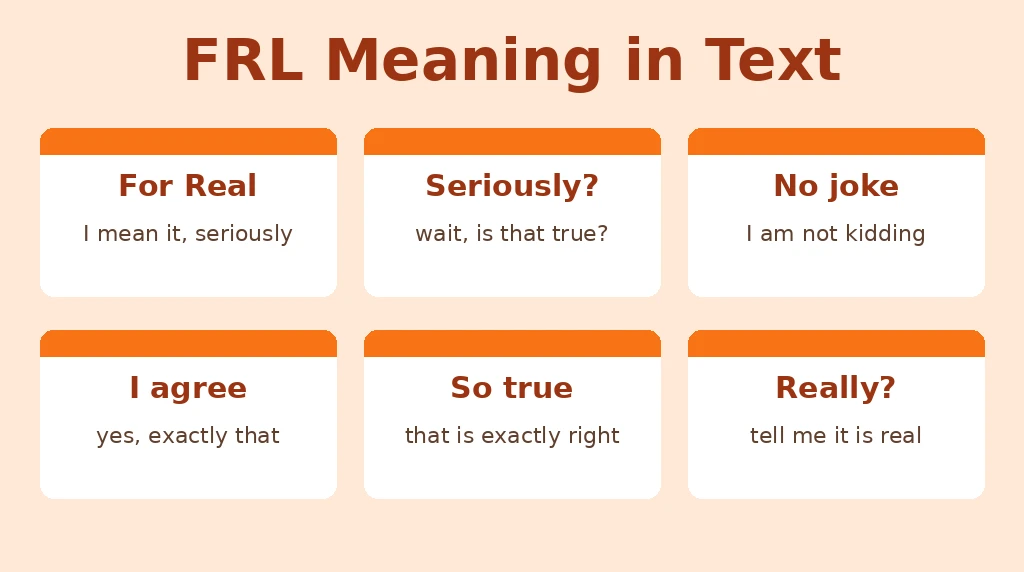
Here is the quick answer. FRL means “For Real”, and people use it to say they are being serious, to agree strongly, or to ask if someone else is telling the truth. It is the texting version of “seriously?” and “I mean it” rolled into one short word. This guide covers the frl meaning in text, how it sounds as a statement and as a question, where it came from, and what to send back when it lands in your messages.
What Does FRL Mean in Text?
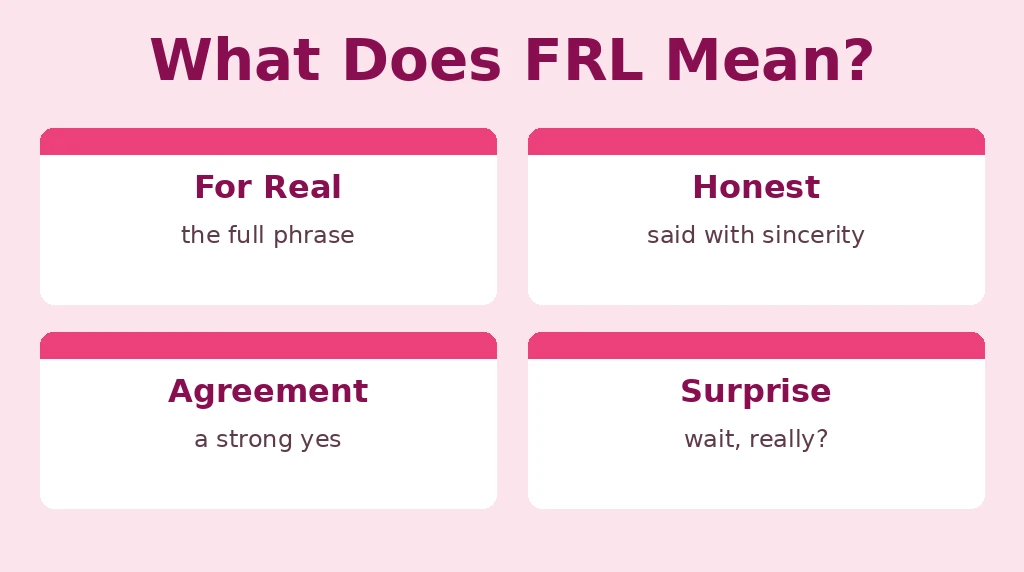
FRL is short for “For Real”. Someone types it to stress that they mean what they just said, to agree hard with something, or to check whether a claim is actually true. The meaning bends with the punctuation. “That was amazing frl” is a statement: I really mean it. “FRL? That actually happened?” is a question: wait, is that true?
Think of it as a stamp of authenticity at the end of a sentence. It tells the reader that the words before it are genuine, not a joke and not an exaggeration. “I studied for six hours straight frl” is not just a fact. It is a fact the sender wants you to believe, because it sounds a little unbelievable on its own.
Capitalization barely changes it. Lowercase “frl” is the everyday form in chats and comments, quick and relaxed. All caps “FRL” reads a touch louder, like the person is leaning forward in their chair. Either way the core idea stays the same: this is real, I mean it, and I am not kidding around.
Full Form of FRL
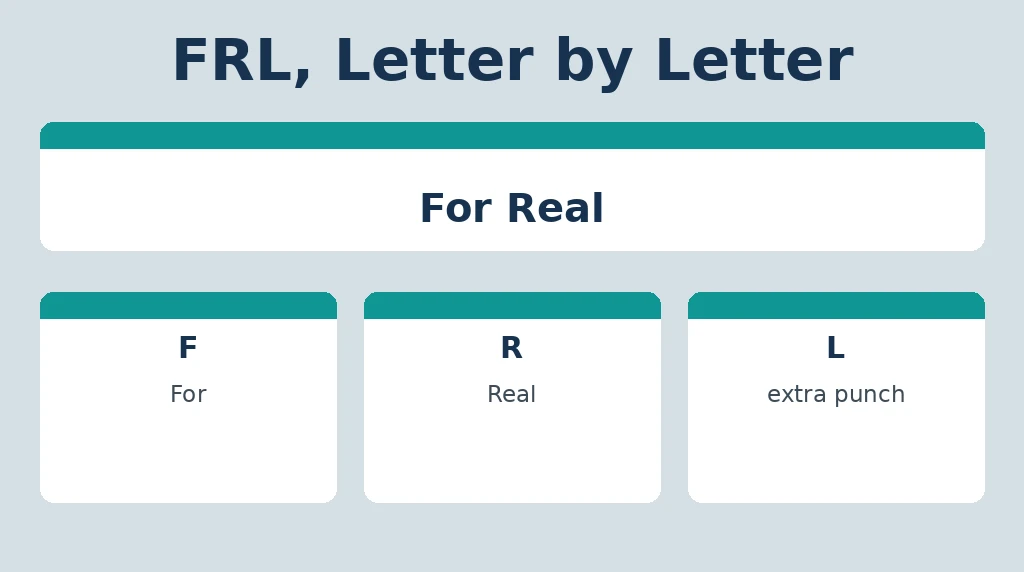
The full form is simple, because the three letters come from a phrase people have said out loud for decades:
- F: For
- R: Real
- L: the extra letter that gives the short form its own shape and punch
Put together, you get “For Real”. The extra L is what sets FRL apart from the shorter form “FR”, which means the same thing in fewer letters. Some people say the letters out loud one by one, “eff-ar-ell”, but most people just say the full phrase, “for real”, when they speak. The abbreviation lives mostly on screens.
FRL vs FR vs No Cap: What Is the Difference?

FRL shares its corner of texting with a few close cousins. Here they are side by side.
| Abbreviation | Full Form | What It Really Says | Tone |
|---|---|---|---|
| FRL | For Real | I mean it, is that true? | Sincere, reactive |
| FR | For Real | Same idea, even shorter | Relaxed, quick |
| No cap | No lie | I am not exaggerating | Confident, casual |
| Ong | On God | I swear this is true | Strong, sincere |
FRL and FR are the closest pair on the list, and most people use them interchangeably. Both mean “for real”, and the only real difference is length. FR is a touch faster to type, while FRL feels a little more deliberate, as if the person chose the longer form to add a bit more weight. Nobody will misunderstand you either way.
No cap and ong play nearby roles but with different flavours. No cap denies a lie: “I am not exaggerating”. Ong swears a truth: “I promise this is true”. FRL sits between them, doing both jobs at once. It confirms honesty like no cap and adds emphasis like ong, which is why it works as both a statement and a question.
Where FRL Is Commonly Used
Texting and WhatsApp
In one to one chats, frl confirms stories and reacts to news between friends. A typical exchange looks like this: “I got the job!” “FRL?? Congrats, that is amazing”. It is the kind of word that fits a close chat, where excitement needs a quick outlet.
Instagram and Snapchat
On Instagram and Snapchat, frl lives in comments and DMs, usually as a fast reaction to a photo, a story or a transformation. You will see lines like “this glow up is unreal frl” or a quick “frl I cannot believe you finished the whole show in one night” under a story.
TikTok Comments
TikTok comments are full of frl reactions. Viewers use it to agree with a take, to swear a story is real, or to question a plot twist in a video. Comments like “the way she flipped that pancake perfectly frl, I am impressed” pile up under clips that look too good to be true.
Group Chats
Group chats are probably where frl thrives the most. They move at lightning speed, and frl is the perfect tool to hype something up or question if someone is being honest. One person shares big news, three people reply “frl?”, and the chat keeps rolling. Plans still stay tbd until someone decides, but the excitement is already real.
Gaming Chats
In game chat there is no time for long sentences, so frl does quick work between rounds. Players type things like “that clutch was amazing frl” or “frl, did that really just happen?” while the match is still moving. Everyone reads the emphasis instantly.
Discord and Forums
Discord servers and forums use frl the same way, just in longer threads. Someone shares a surprising personal story, and “wow, that is such a wild story frl” is a normal reply. It signals belief and solidarity without needing a paragraph to back it up.
Origin and History of FRL
FRL starts with the phrase “for real”, which has been part of casual spoken English for decades. It grew out of African American Vernacular English, where “for real” was long used to confirm sincerity or push back on doubt, and it spread into wider speech through music, film and everyday conversation.
When texting took over in the 2000s, people naturally started shortening the phrases they typed most often. “For real” compressed first into “FR”, and then into “FRL”, a slightly longer form that some people felt carried more punch. The abbreviation picked up speed in the early 2010s, appearing alongside similar shortcuts like TBH and IKR, and social media did the rest.
TikTok played the biggest role in pushing FRL into mainstream texting. Short captions and fast comment sections reward words that are quick to type and easy to read, and FRL fits both. By the mid 2020s it was a standard part of Gen Z texting, used across every major platform by people who may never have thought twice about where it came from.
Other Meanings and Variations of FRL
In casual texting, FRL almost always means “For Real”. A few other uses exist, and knowing them keeps you from getting confused.
- FR: the shorter version of the same phrase. Same meaning, fewer letters, and the form most people type first.
- Fr fr: “for real, for real”, the doubled version. It adds extra emphasis, like saying something twice to prove you mean it.
- For Real Life: a playful, slightly dramatic expansion some people use in younger online spaces. Same idea, more theatre.
- Friend Request Later: in some gaming or social contexts, FRL has been used informally to mean someone will send a friend request later. This is rare, and the chat around it will make it clear.
- Free and Reduced-Price Lunch: outside slang entirely, FRL is the official shorthand in American schools for the federal meal program. If you see it in a school document, it has nothing to do with texting.
If you see frl in a chat, a comment or a caption, read it as “for real” first. The other meanings only show up in very specific settings, and the context around it will tell you which one applies.
How to Use FRL Correctly
- Use it to confirm honesty. FRL works best when you want the reader to believe you: “I studied for six hours straight frl”. Save it for claims that deserve the extra weight.
- Use it to question something. A lone “frl?” after surprising news asks “is that really true?” without sounding rude. It is one of the friendliest ways to double check a story.
- Place it at the end or the start. It lands naturally after the statement it supports, or at the very start of a reaction: “frl that is amazing”. Both spots work.
- Keep it casual. FRL belongs in friendly, informal chats. If the conversation would not welcome a “lol”, it will not welcome an “frl” either.
- Do not overuse it. If every sentence ends with frl, it stops carrying weight and just becomes filler. Save it for moments that actually deserve emphasis.
Example Conversations Using FRL
Big news on WhatsApp
Person A: “I got the job!!”
Person B: “FRL?? Congrats, that is huge.”
An Instagram comment
Person A: “This transformation is unreal frl, glow up of the century.”
Group chat plans
Person A: “Coach said we do not have practice tomorrow.”
Person B: “FRL? Finally some rest.”
A TikTok comment
Person A: “The way she flipped that pancake perfectly frl, I am impressed.”
Texting a friend
Person A: “I saw your ex at the mall today.”
Person B: “FRL where?? idk if I believe you yet.”
Gaming with a teammate
Person A: “That clutch was amazing frl.”
Person B: “gg, did not think we would win that round.”
A surprised reaction
Person A: “I finished the whole show in one night.”
Person B: “FRL? No sleep at all?”
A soft, honest answer
Person A: “This song has been on repeat all week frl, cannot stop listening.”
Person B: “Same, it is stuck in my head too.”
When Not to Use FRL
- Work email: write “I can confirm this is accurate” instead. Three letters look careless on the record.
- Job interviews and applications: even over chat, recruiters read frl as far too casual for the setting.
- Formal documents or reports: academic papers, cover letters and official documents should avoid texting slang entirely.
- Customer service chats: if you are messaging a support team, stick to clear, standard English so nothing gets lost.
- Conversations with older relatives unfamiliar with slang: unless you know they follow texting lingo, frl might just confuse them.
How to Respond When Someone Sends You FRL
An frl usually means the person is being sincere or asking if you are serious, so your reply just needs to match that energy. Pick the lane that fits the moment.
Confirming replies work when they asked if you are serious:
- “Yes frl, I promise.”
- “100%, no cap.”
- “Deadass, it really happened.”
Acknowledging replies fit when they reacted to something you said:
- “I know, I could not believe it either.”
- “Right? Wild moment.”
- “Yup, still processing it myself.”
Playful replies suit close friends and light topics:
- “smh, frl? You always say that”
- “frl back at you, that was unreal”
- “lol, told you so”
One thing to avoid: do not answer a questioning “frl?” with another question. If someone is checking whether your story is true, give them a straight confirmation and one extra detail. That settles it in one message.
Common Mistakes People Make With FRL
- Confusing it with “friend request later”. That alternate meaning exists but is rare, so most people read “for real” automatically. In gaming chats, a quick check of context avoids the mix up.
- Overusing it until it loses meaning. If every sentence ends with frl, it stops carrying weight and just becomes filler, the same way saying “like” too much weakens a story.
- Using it in professional settings by accident. Because it feels so natural in casual texting, it can slip into a work message where it looks very out of place.
- Assuming everyone knows what it means. Older generations or people unfamiliar with texting slang might not recognize frl at all, which leads to confused replies.
- Using it as a question when you mean a statement. “Frl?” asks if something is true, while “frl” at the end of a sentence swears it is. The question mark changes the job completely, so place it with care.
Frequently Asked Questions
What does FRL mean in text?
FRL means “For Real”. People type it in chats and comments to show they are being honest, to agree strongly, or to ask if something is actually true.
Is FRL the same as FR?
Yes, they are essentially interchangeable. Both mean “for real”, with FRL being a slightly longer version that some people feel carries a little more weight.
What does FRL mean in education?
In American schools, FRL stands for Free and Reduced-Price Lunch, a federal meal program for students from lower income households. That meaning has nothing to do with texting slang.
Is FRL rude?
No. FRL is a neutral, casual word, not a rude one. It borrows its tone from the situation, so it can sound excited, surprised or serious, but it is not offensive by itself.
Can I use FRL in a work email?
No. FRL is casual texting slang, and it looks unprofessional in work writing. In a work email, write the full sentence, such as “I can confirm this is correct.”
How do I reply when someone sends me FRL?
If it is a question, confirm sincerely, like “yes frl, I promise”. If it is a reaction, acknowledge it casually, like “I know, right?” Match their energy and the chat keeps moving.
Final Thoughts
Three letters, two jobs. FRL is the quickest way to swear something is true or to ask if it is, and it has earned its place in everyday chats because everyone needs a fast way to say “seriously” without typing a whole sentence. Used casually, in the right chats, it keeps conversations honest and moving.
If you want the dictionary view, Dictionary.com lists “for real” with exactly this sense of genuine and sincere, which shows how far a spoken phrase has travelled into everyday typing. Either way, you now have the frl meaning in text down, plus a decent reply ready for the next time it shows up in your messages.

1 thought on “FRL Meaning in Text: What It Means, How to Use It and How to Reply”