You check an event invitation and see the date listed as “TBD.” You open a work schedule, and the meeting location is marked the same way. What does it mean, and should you expect more information later?
TBD stands for “To Be Determined.” It means a detail has not been decided or finalized yet. People commonly use it for dates, times, locations, project decisions, and other details that still need to be worked out. In some contexts, TBD also stands for “To Be Decided.”
The TBD meaning stays largely the same across texting, workplace communication, event planning, and project management: something remains unresolved. However, understanding the difference between TBD, TBA, and TBC helps you interpret schedules and messages correctly. These abbreviations look similar, but they communicate different stages of planning.
What Does TBD Mean?
TBD most commonly means To Be Determined. It is an abbreviation formed from the initial letters of the three words.

When someone writes TBD, they are indicating that a particular detail is not yet settled.
For example:
- Meeting time: TBD
- Concert location: TBD
- Project launch date: TBD
- Final price: TBD
Each example identifies information that has not been finalized.
Imagine your manager shares a project schedule for next month. The tasks and deadlines are listed, but the launch date says TBD. This means the launch date has not yet been determined. It does not automatically mean the project is delayed or canceled.
The abbreviation is useful because it keeps plans readable while decisions are still pending.
TBD Meaning in Simple English
In simple English, TBD means “not decided yet.”
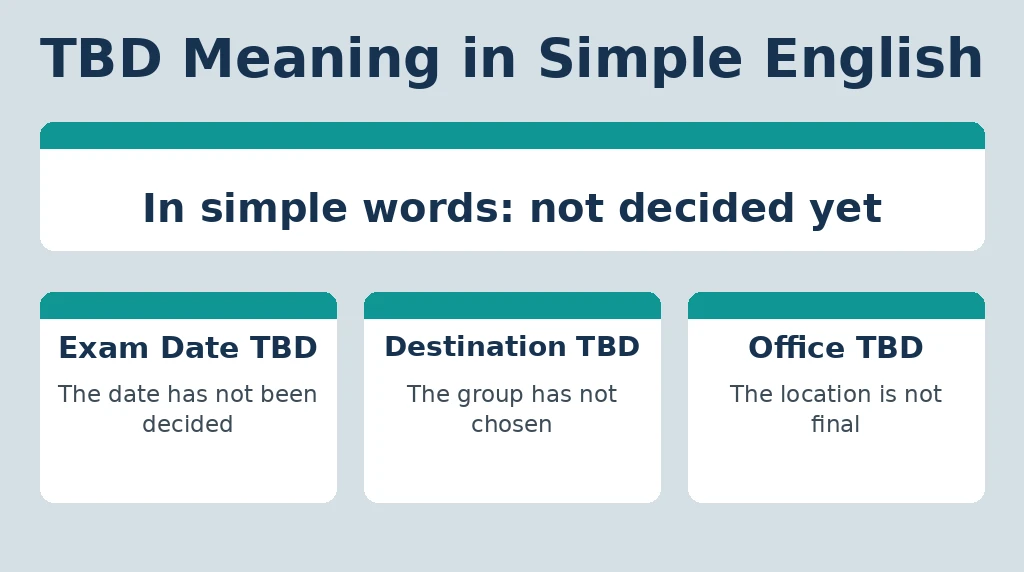
It tells the reader that information is missing because a decision still needs to be made.
Consider these examples:
- “The exam date is TBD.” The date has not been decided.
- “Our vacation destination is TBD.” The group has not chosen where to go.
- “The new office location is TBD.” The location has not been finalized.
TBD is not necessarily a sign of a problem. Sometimes a decision depends on budget approval, availability, feedback, or other factors.
For example, an event organizer might know the event will happen in December but still be comparing venues. The venue can reasonably be marked TBD until the organizer makes a final choice.
What Does TBD Mean in Text and Chat?
In texting and online chats, TBD usually means that a plan or detail is still undecided.
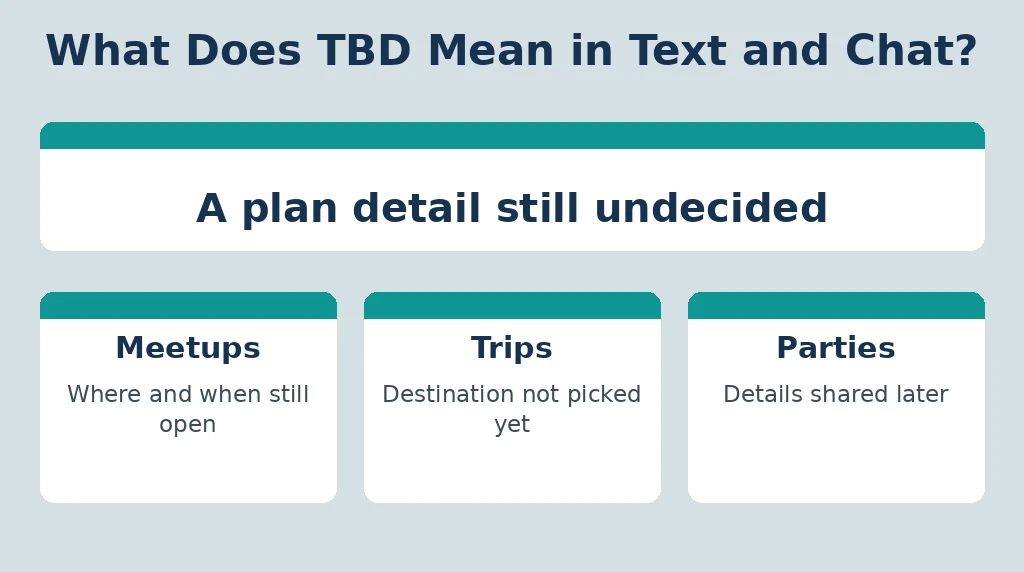
People use it when discussing meetups, trips, appointments, parties, or shared activities. It is a quick way to communicate uncertainty without writing a long explanation.
Here are some realistic examples.
Example 1: Making weekend plans
Alex: “Where are we meeting on Saturday?”
Jamie: “TBD. I’ll check which place has space.”
Meaning: Jamie has not chosen the meeting place yet.
Example 2: Planning a trip
Friend 1: “Do we know the departure time?”
Friend 2: “Not yet, it’s TBD.”
Meaning: The departure time has not been finalized.
Example 3: Organizing a birthday party
Friend 1: “Who’s bringing the cake?”
Friend 2: “TBD, we’re still sorting everything out.”
Meaning: Nobody has made or confirmed that decision yet.
Does TBD Mean Someone Is Ignoring You?
No. TBD does not normally mean that someone is ignoring you, avoiding your question, or refusing to make plans.
It simply communicates that the answer is not settled. The surrounding conversation can provide additional clues, but the abbreviation itself does not reveal someone’s intentions.
If you need a firm answer, you can ask, “When do you think you’ll know?” This keeps the conversation clear without assuming anything negative.
TBD Meaning at Work and in Business
In professional communication, TBD helps teams identify information that remains unresolved. It appears in project documents, meeting agendas, planning spreadsheets, reports, and business emails.
For example, a project tracker might look like this:
| Project Detail | Status |
|---|---|
| Project owner | Confirmed |
| Initial budget | Approved |
| Launch date | TBD |
| Marketing channels | Selected |
| Final campaign copy | In progress |
This table shows why TBD is useful. It separates a pending decision from work that is already complete.
TBD Meaning in Email
In an email, TBD can appear in a sentence, a subject-related detail, or a list of meeting information.
Example:
“Hi team,
The planning session is scheduled for next week. The exact time is TBD while we confirm everyone’s availability. I’ll share the final details once they are decided.”
Here, TBD communicates that the time is not settled. The rest of the message explains what needs to happen next.
In formal emails to clients or external partners, consider adding a short explanation or expected update date if the missing information affects their plans.
TBD Meaning in Meetings
When a meeting agenda lists a topic, presenter, room, or time as TBD, that detail has not been finalized.
For example:
| Meeting Item | Details |
|---|---|
| Date | November 12 |
| Time | 10:00 a.m. |
| Conference room | TBD |
| Guest speaker | TBD |
The meeting date and time are known, but the room and speaker remain undecided.
If a meeting requires people to travel or arrange their schedules, it is helpful to replace TBD with confirmed details as soon as possible.
TBD Meaning in Project Management
Project teams often use TBD to mark decisions that still need input or approval.
Common examples include:
- Product release dates
- Assigned team members
- Feature requirements
- Project budgets
- Delivery schedules
- Client approval dates
However, TBD should not become a permanent substitute for planning. If a project depends on an undecided item, the team should identify who will make the decision and when it is needed.
A useful project entry might read:
“Release date: TBD. Project manager to confirm after testing is complete.”
This is more actionable than simply writing “Release date: TBD” because it explains what the decision depends on.
TBD Meaning in Dates, Schedules, and Event Planning
TBD appears frequently in calendars, event listings, travel plans, school schedules, and public announcements.
Its meaning depends on the specific detail being discussed.
| Example | What TBD Means |
|---|---|
| Event date: TBD | The date has not been determined |
| Meeting time: TBD | The time has not been decided |
| Venue: TBD | The location has not been selected |
| Ticket price: TBD | The price has not been finalized |
| Speaker: TBD | The speaker has not been selected or confirmed |
| Travel itinerary: TBD | Some travel details remain undecided |
One important point: TBD does not guarantee that the information will be announced soon. It only tells you that the detail has not been determined at the time the information was written.
If you need to make arrangements, look for an update deadline or contact the organizer for clarification.
TBD vs. TBA vs. TBC: What’s the Difference?
TBD, TBA, and TBC are closely related abbreviations, but they do not mean exactly the same thing.
- TBD: To Be Determined
- TBA: To Be Announced
- TBC: To Be Confirmed
The easiest way to remember the difference is to think about the stage of the information.
| Abbreviation | Full Form | Meaning | Example |
|---|---|---|---|
| TBD | To Be Determined | A decision has not been made | The venue is TBD. |
| TBA | To Be Announced | Information will be announced later | The guest performer is TBA. |
| TBC | To Be Confirmed | A detail is awaiting confirmation | The meeting room is TBC. |
When Should You Use TBD?
Use TBD when a decision still needs to be made.
Example: “The workshop date is TBD because the organizers are comparing available dates.”
When Should You Use TBA?
Use TBA when information is expected to be announced later, often after arrangements have been made.
Example: “The lineup includes three performers, with one additional guest TBA.”
The performer might already be selected, but their identity has not yet been announced.
When Should You Use TBC?
Use TBC when a detail is awaiting confirmation. The information may be tentatively arranged but is not yet confirmed.
Example: “The interview is scheduled for Thursday, TBC.”
This suggests that Thursday is the proposed date, but it still needs confirmation.
Practical tip: These abbreviations are sometimes used loosely, and their exact meaning can vary by organization. If a distinction matters, explain the status in plain English instead of relying on the abbreviation alone.
How to Use TBD in a Sentence
TBD can appear in a sentence, a table, a calendar entry, or a short message. It is usually written in uppercase letters.
Here are eight examples:
- The exact date of the conference is TBD.
- Our weekend plans are still TBD.
- The company will share the launch date once it is determined.
- The meeting location is TBD until the office renovation is complete.
- The final project budget remains TBD.
- The school will announce the examination schedule after the dates are finalized.
- The speaker for the closing session is TBD.
- We have selected the destination, but the departure time is still TBD.
The first, second, fifth, and seventh examples use the abbreviation directly. The others show how to express the same idea in full sentences.
Is TBD Formal or Informal?
TBD works in both professional and casual settings.
It is common in work schedules, internal emails, project plans, event calendars, and informal messages. In a formal document, it may be appropriate in a table or status field.
For important client-facing communication, contracts, or official notices, a complete explanation is often clearer. For example, “The delivery date has not yet been finalized” tells the reader more than TBD alone.
If a document creates legal or financial obligations, do not assume that writing TBD automatically resolves the issue. The wording should accurately reflect the agreement and any applicable requirements.
What Are Alternatives to TBD?
If you want to avoid abbreviations or explain the status more clearly, several alternatives are available.
| Alternative | Best Use |
|---|---|
| Not yet decided | A decision has not been made |
| Not yet determined | A detail remains unresolved |
| Pending approval | Someone must approve the decision |
| To be finalized | The details are still being completed |
| Awaiting confirmation | A tentative detail needs verification |
| Undecided | No final choice has been made |
| Details forthcoming | More information is expected later |
These phrases are related but not interchangeable.
For instance, “pending approval” is more specific than TBD because it identifies an approval as the outstanding step. “Details forthcoming” suggests that more information is expected, but it does not necessarily explain whether the decision has already been made.
Choose the phrase that accurately describes the situation rather than using TBD for every kind of uncertainty.
Common Mistakes When Using TBD
Assuming TBD Means Canceled
A date or activity marked TBD is not automatically canceled. It means the relevant detail has not been determined.
Confusing TBD With TBA
TBD focuses on making a decision. TBA focuses on announcing information. They can overlap in some situations, but their usual meanings differ.
Leaving TBD Without a Follow-Up Plan
In a work setting, an unresolved detail can delay other tasks. When possible, add an owner, a decision deadline, or a condition that must be met.
For example, “Budget: TBD, pending finance approval by Friday” gives the team a clearer next step.
Using TBD When the Information Is Already Known
If a date has been selected but still needs verification, TBC may be more accurate. If a date is known but has not been shared publicly, TBA might fit better, depending on the context.
Frequently Asked Questions
What does TBD stand for?
TBD most commonly stands for “To Be Determined.” It indicates that a detail, date, decision, or plan has not yet been finalized.
What does TBD mean in text?
In text messages, TBD means that something has not been decided yet. For example, “Dinner plans are TBD” means the details of the dinner are still undecided.
What is the full form of TBD in English?
The most common full form is “To Be Determined.” In some contexts, people also use TBD to mean “To Be Decided.”
What does TBD mean at work?
At work, TBD marks an unresolved item, such as a meeting location, project deadline, budget, or task assignment. Teams can use it to track decisions that remain pending.
What does TBD mean on a schedule?
It means a scheduling detail has not been determined. This might be a date, time, location, or activity.
What is the difference between TBD and TBA?
TBD means a decision still needs to be made. TBA means information is to be announced later. The distinction depends on whether the issue is an undecided detail or a pending announcement.
What is the difference between TBD and TBC?
TBD means “To Be Determined,” while TBC means “To Be Confirmed.” TBD usually indicates that a decision is outstanding, while TBC suggests that a detail needs confirmation.
Is TBD professional to use in an email?
Yes. TBD is common in professional emails, project trackers, and meeting schedules. For important external communication, explain what remains undecided and when the recipient can expect an update.
Does TBD mean the date is not available?
Not necessarily. It means the date has not been determined or finalized. The date might depend on availability, approval, planning, or another decision.
Conclusion
The TBD meaning is simple: “To Be Determined.” It tells you that a detail has not yet been decided, making the abbreviation useful in text messages, emails, business documents, schedules, and project plans.
Remember the distinction between TBD, TBA, and TBC. Use TBD for an undecided detail, TBA for information to be announced, and TBC for something awaiting confirmation. When a decision affects other people, adding a clear next step or expected update makes communication more useful than leaving TBD unexplained.
Read More Related Articles:
- Their Meaning | Definition, Grammar, Examples & How to Use …
- FUPA Meaning in Text & Slang – SynonyMore.com
- Martyr Meaning | Definition, History, Examples & the Deeper …

10 thoughts on “TBD Meaning | Decode the Acronym, Uncover Its Hidden Context & Master Modern Communication in 2026”