Your phone lights up and the whole message is one word: “sup”. No name, no question mark, no clue about what comes next. It could be a close friend, a classmate, or someone you met last weekend, and now the ball is in your court.
Here is the quick answer. SUP means “What’s up?” and it works as a casual greeting, much like “hey” or “hi”. People send it to open a chat, check in on a friend, or find out if you are free to talk, and most of the time it does not call for a long reply. This guide covers the sup meaning in text, the tone it can carry, how it differs from greetings like “hey” and “yo”, and the best ways to answer it without overthinking.
What Does SUP Mean in Text?
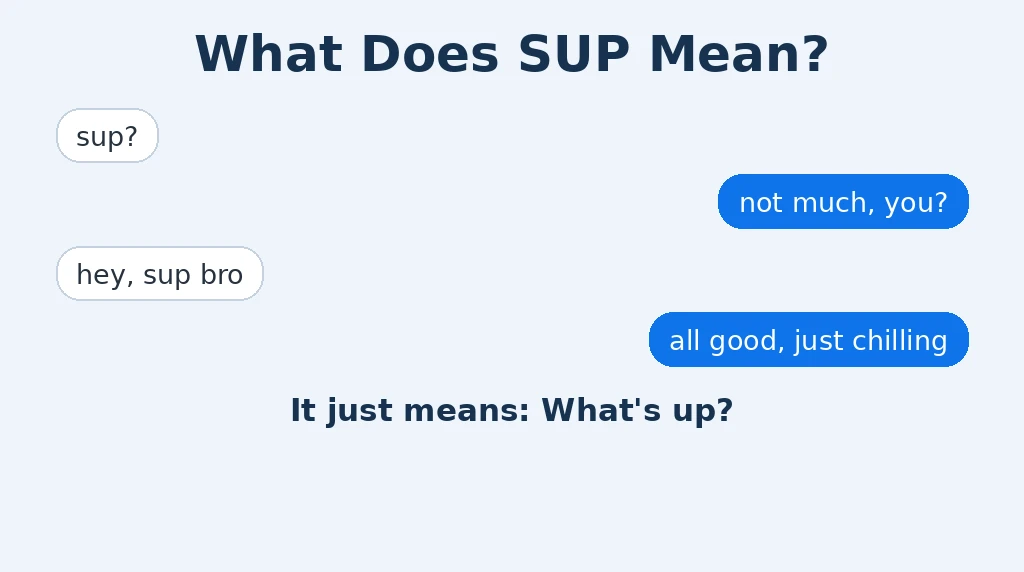
SUP is the shortened form of “What’s up?” When someone texts it, they are saying hello and asking what is going on with you, all in a single syllable. It is a greeting first and a question second, which is why a short answer like “not much, you?” fits it so well.
Most of the time, sup does not ask for a real update. It works like a knock on the door: a way to open the conversation and see if you are around. If the sender wanted details, they would usually ask a fuller question, so a one line reply is completely normal.
Capital letters change the energy a little. Lowercase “sup” is the everyday form, relaxed and easy. Uppercase “SUP” can look louder or more excited, a bit like someone calling across a room. The meaning stays the same either way, so read the person and the chat, not just the letters.
Tone also depends on who sends it. From a friend, sup is a plain check in. In a DM from someone you barely know, it can carry a flirty edge, a low pressure way of testing whether you want to talk. Add a friendly emoji and the meaning usually turns warm; send it bare at 2 a.m. and it can read as “are you awake?” instead.
Full Form of SUP
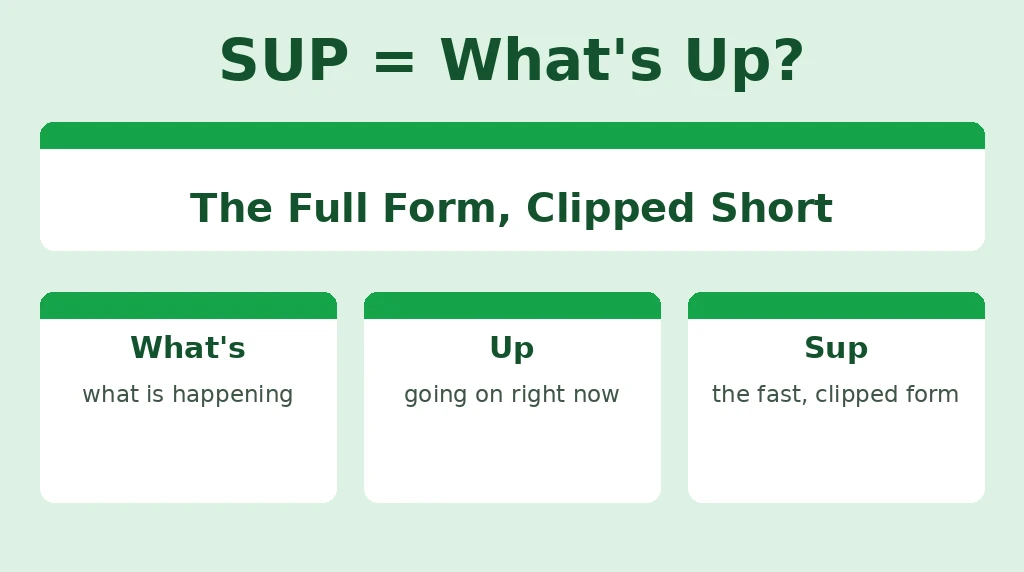
The full form of SUP is “What’s up?” It is not an acronym like IDK, where each letter stands for a word. It is a clipped word, made by trimming the front off a phrase people already said every day.
Say “what’s up” fast a few times and you can hear how it happens. The phrase melts into “wassup”, then the first part falls away and only “sup” is left. You will also see it written as “‘sup” with an apostrophe, which shows the missing letters, and as “wassup” or “whassup” when someone wants the longer, drawled out version.
It is pronounced “sup”, rhyming with “up”, and dictionaries write it as /sʌp/. You say it as one quick syllable, never letter by letter, which is another clue that it is a clipped word rather than a set of initials.
SUP vs Similar Terms: What Is the Difference?
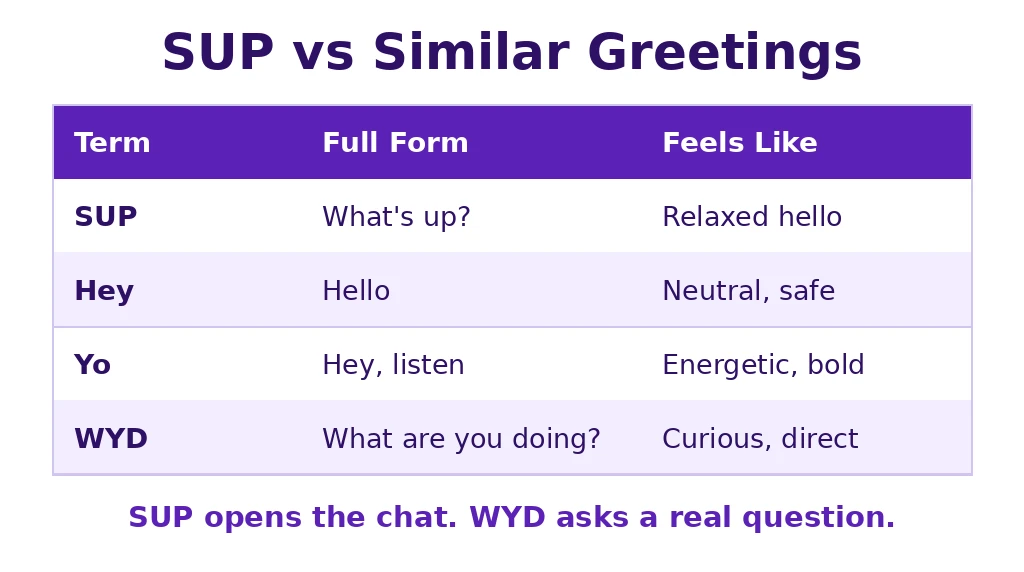
Sup shares its job with a few other short greetings, but each one lands a little differently. The table below puts them side by side so you can pick the right one for the moment.
| Term | Full Form | What It Really Says | Tone |
|---|---|---|---|
| SUP | What’s up? | Hello, what is going on? | Relaxed, friendly |
| Hey | Hello | Just saying hi | Neutral, safe |
| Yo | Hey, listen | I want your attention | Energetic, bold |
| WYD | What are you doing? | What are you up to right now? | Curious, direct |
Hey is the safe choice. It works with almost anyone, in almost any chat, and it never risks sounding too familiar. Sup is warmer and more casual, which makes it great for friends and weak for strangers or formal chats.
Yo grabs attention, so it can sound loud or pushy if the chat is calm. WYD is different again, because it asks a real question about what you are doing right now, while sup mostly just opens the door. If you want an actual answer about someone’s plans, ask WYD; if you just want to say hello, send sup.
Where SUP Is Commonly Used
Sup turns up anywhere people keep things casual, but the vibe shifts a little from place to place.
Texting and WhatsApp
This is sup’s natural home. It opens one to one chats and restarts threads that went quiet, often with nothing more than “sup?” on its own. A typical opener looks like “sup, you free after class?” and the short form keeps the whole exchange moving fast.
Instagram and Snapchat
On Instagram and Snapchat, sup is a classic DM opener, and it often follows a story reply or a photo like. It can be friendly, flirty, or just curious, and the profile it lands on usually decides which one it is. You will also see it as a quick comment under a post, a public hello rather than a real question.
TikTok Comments
TikTok comments and live chats run on short bursts, so sup fits right in. Viewers drop it when they join a live stream, creators get it as a greeting under videos, and whole comment threads can start with one bare “sup” from a stranger who just wants to say hi.
Group Chats
In a group chat, sup works as a roll call. Someone drops “sup everyone” and waits to see who is around, and the plans stay tbd until someone finally picks a day. It is low pressure, which is exactly why group chats love it.
Gaming Chats
Gaming lobbies move fast, so sup is the standard hello when players join a match or a voice channel. Lines like “sup, you ready to queue up?” take one second to type and nobody has to stop playing to read them.
Discord and Forums
Discord servers and forums use sup the same way, as a casual greeting in a channel or a thread. New members often open with it, and regulars answer it without a second thought, because everyone in the room already knows what it means.
Origin and History of SUP
“What’s up?” has been an American greeting for a long time. Cartoon fans will know it from Bugs Bunny’s “What’s up, Doc?”, which helped spread the phrase from the 1940s onward, and by the late 20th century it was part of everyday speech across the United States.
The clipped form came next. In fast, casual speech, “what’s up” slid into “wassup” and then into “sup”, a change that picked up speed in 1990s pop culture and hip hop. The Budweiser “Whassup?” adverts in the late 1990s turned the longer form into a catchphrase, and the shorter sup rode along with it into texting and instant messaging.
Dictionary.com dates the slang form of sup to 1985 to 1990, noting it was formed by shortening. Once phones and chat apps took over, sup became a standard opener, because it says hello in three letters and asks for nothing more than a nod back.
Social media sense: beyond private chats, sup also works as a public greeting. It shows up in Instagram DMs, TikTok comments and live chats, where it says hello to a whole room instead of asking one person a real question.
Other Meanings and Variations of SUP
In texting, sup almost always means “What’s up?” Still, a few close cousins and one or two completely different meanings are worth knowing, so the word never catches you out.
- Wassup / Whassup: the longer, drawled out spellings. Same meaning, more playful energy, often used as a joke or a call back to the old adverts.
- WSP: an even shorter texting form of “what’s up”, popular in fast chats where every letter counts.
- ‘Sup: the same word with an apostrophe, which marks the missing “what” at the front.
- Sup with you?: a fuller version that asks what is happening with you in particular, as in “hey, sup with you?” It can also ask why someone is acting differently, so the tone depends on the chat.
- SUP in watersports: outside texting, SUP is short for stand up paddleboarding, the sport where you stand on a board and paddle. Context makes this one obvious, since it shows up in beach and travel posts, not in your DMs.
- Sup as an old verb: the word sup also has a much older meaning, to sip or eat a meal slowly, which dictionaries still list. You will almost never see it used that way in a chat.
- Sup in gaming: in some game chats, players shorten “support” to sup when they call for backup, as in “need sup here”. It is rare, and the match usually makes the meaning clear.
If the message comes from a friend in a normal chat, read sup as a greeting. The other meanings live in very different places, so confusion is rare once you know they exist.
How to Use SUP Correctly
- Keep it casual. Sup belongs in friendly chats with people you know. If the conversation would not welcome a “lol”, it will not welcome a sup either.
- Use it to open, not to interrogate. Sup works best as the first message, a way to start talking. If you need a real answer, follow it with a proper question.
- Match the other person’s energy. If they reply with a full sentence, answer in kind. If they keep it to three letters, a short reply back is fine.
- Add a little context when it matters. “Sup, did you finish the assignment?” tells your friend why you are writing, while a bare sup leaves them guessing.
- Skip it with strangers in formal settings. A teacher, a boss, or a customer service chat deserves a proper hello, not a clipped greeting.
Example Conversations Using SUP
Checking in with a friend
Person A: “sup?”
Person B: “not much, just got home. you?”
A DM opener
Person A: “sup, loved your story today”
Person B: “haha thanks! what is good with you?”
Planning in a group chat
Person A: “sup everyone, anyone free Saturday?”
Person B: “yeah I am in, what is the plan?”
Gaming lobby
Person A: “sup, ready to queue up?”
Person B: “yep, loading in now”
A flirty DM
Person A: “sup 😏”
Person B: “hey! not much, what about you?”
Late night text
Person A: “sup, you still awake?”
Person B: “barely lol, what is going on”
Catching up after a while
Person A: “sup, long time no talk”
Person B: “I know, been busy. How have you been?”
A short, honest reply
Person A: “sup?”
Person B: “idk, not much, just scrolling. you?”
When Not to Use SUP
- Work email and Slack: write a proper greeting instead. Sup looks careless on the record.
- Job interviews and applications: even over chat, recruiters read sup as unprepared.
- Teachers and bosses: anyone grading or managing you deserves the full sentence.
- Customer service chats: on either side of the counter, sup sounds like nobody is taking the problem seriously.
- Serious conversations: if someone is upset or sharing bad news, opening with sup can feel dismissive.
- First messages to older or formal contacts: with people you do not know well, sup can read as too familiar.
How to Respond When Someone Sends You SUP
A sup lands in your chat and the conversation is yours to steer. Pick the lane that matches the moment.
Casual replies keep things light and easy:
- “Not much, you?”
- “Just chilling, wbu?”
- “nm, what is up with you?”
Friendly replies open the door a little wider:
- “Hey! I am good, what about you?”
- “All good here, what is new with you?”
- “Not much, just finished work. How is your day going?”
Playful replies suit close friends and light topics:
- “smh, you only ever send one word”
- “sup yourself, stranger”
- “oh look, he lives!”
Flirty replies work when the spark is mutual:
- “Hey you 😊”
- “Hey, I was just about to text you”
- “not much, you made my day a bit better”
One thing to avoid: do not answer a friendly sup with a cold one word reply if you actually want to talk. Sup is an open door, so walk through it with at least a sentence of your own.
Common Mistakes People Make With SUP
- Treating it as a deep question. Sup rarely wants a life update. Answering with a long paragraph can stall a chat that only needed a hello.
- Using it at work. A manager who gets “sup” about a deadline hears “I have not looked into this”. Spell it out instead.
- Reading flirt into every sup. Most sup messages are just friendly. The sender’s history with you matters far more than the word itself.
- Sending it bare to someone you barely know. A lone sup from a stranger can feel odd, so add your name or a reason for writing.
- Assuming tone from text alone. The same three letters can be warm, bored, or flirty. If the tone matters, ask one follow up question instead of guessing.
Frequently Asked Questions
What does SUP mean in text?
SUP means “What’s up?” It is a casual greeting people use in texts and chats to say hello or ask what someone is doing.
Is SUP rude?
Not usually. Sup is friendly and relaxed, though a bare sup in a serious chat or from a stranger can feel blunt, so a few extra words soften it.
What is the difference between SUP and WYD?
SUP is a general greeting that means “What’s up?” while WYD means “What are you doing?” and asks about your current activity. Sup opens a chat, WYD asks a real question.
What does “sup with you” mean?
“Sup with you?” means “What is up with you?” It asks how you are doing or what you are up to, and it can also ask why you are acting differently, depending on the tone.
Can I use SUP in a work email?
No. SUP is casual texting slang, and it looks careless in professional writing. In a work email, write the full greeting, such as “Hi, I hope you are doing well.”
How do I reply when someone sends me SUP?
Keep it easy. A short reply like “Not much, you?” works in most cases, or add a detail about your day if you want the chat to keep going.
Final Thoughts
Three letters, one simple job. SUP is the quickest friendly hello in texting, and it has lasted because everyone needs a low effort way to open a chat. Used with friends, with a little context when the moment calls for it, it never really causes trouble.
If you want the dictionary view, Dictionary.com lists sup as a casual form first noted in the late 1980s, which shows how far a clipped greeting can travel. Either way, you now have the sup meaning in text down, plus a reply ready for the next time it shows up in your messages.

3 thoughts on “SUP Meaning in Text: What It Means, How to Use It and How to Reply”