Your phone buzzes. You open the chat and there it is, one tiny word sitting on its own: “huh?” No emoji, no follow up, no clue what the other person is thinking. Are they confused, surprised, annoyed, or did they just miss what you said?
Here is the short answer first. In text, huh means “I do not understand”, “I am surprised”, or “Can you repeat that?” It is a spoken sound people started typing, a quick reaction when something does not make sense or catches you off guard. The exact feeling comes from the punctuation and the chat around it, and this guide covers the huh meaning in text, the tone traps, huh versus what and uh-huh, where it shows up, and the best ways to reply.
What Does HUH Mean in Text?
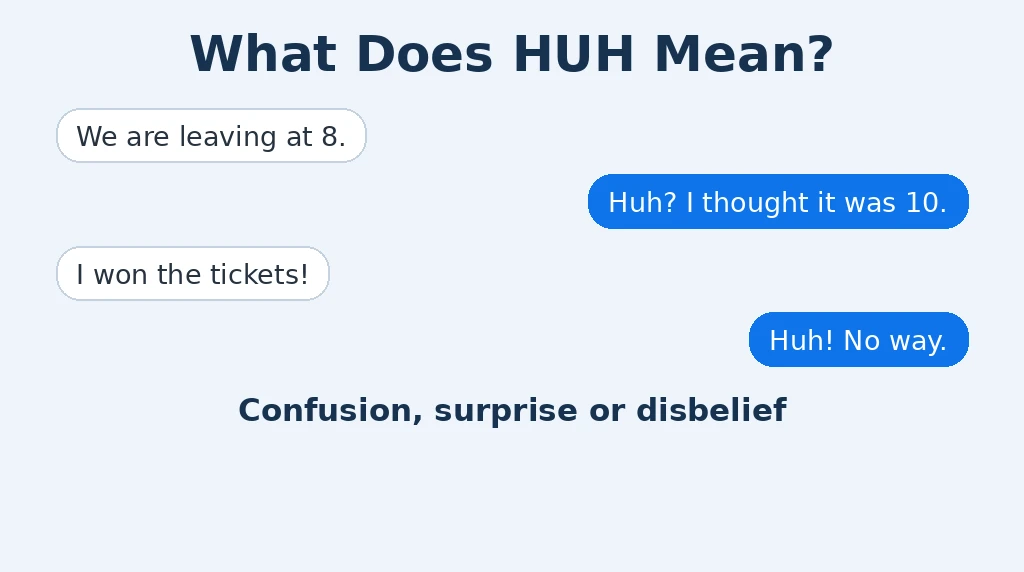
Huh is an interjection, a short sound people make to show a reaction. In a text it usually means the sender did not understand what you said, something surprised them, something sounds hard to believe, or they want you to say it again. It is not an abbreviation. It is simply the sound of a confused brain, typed out.
Punctuation does most of the talking. A plain “huh?” is the everyday version, a polite flag that says “I missed that, help me out.” Add an exclamation mark and it turns into surprise: “Huh! I had no idea.” Stretch it with dots and it slows into thinking: “Huh… maybe you are right.” Shout it in capitals, “HUH?!”, and you get shock or disbelief. Same three letters, very different messages.
Huh also works as a tag question at the end of a sentence, the way some people use “eh” or “right?”. “Pretty wild, huh?” is not asking for an explanation. It is inviting you to agree. On social media, huh shows up in comments and captions as a one word reaction to a confusing video or a strange post, and everyone reading knows what it means: that made no sense to me either.
The tone question matters more than the dictionary meaning. A friendly “huh?” between close friends is harmless. The same word sent cold, after a long serious message, can feel dismissive. If you are the one sending it, add a few words when the chat is serious. “Huh? What do you mean by that part?” sounds curious, while a bare “huh?” can sound like a door slamming shut.
Full Form of HUH
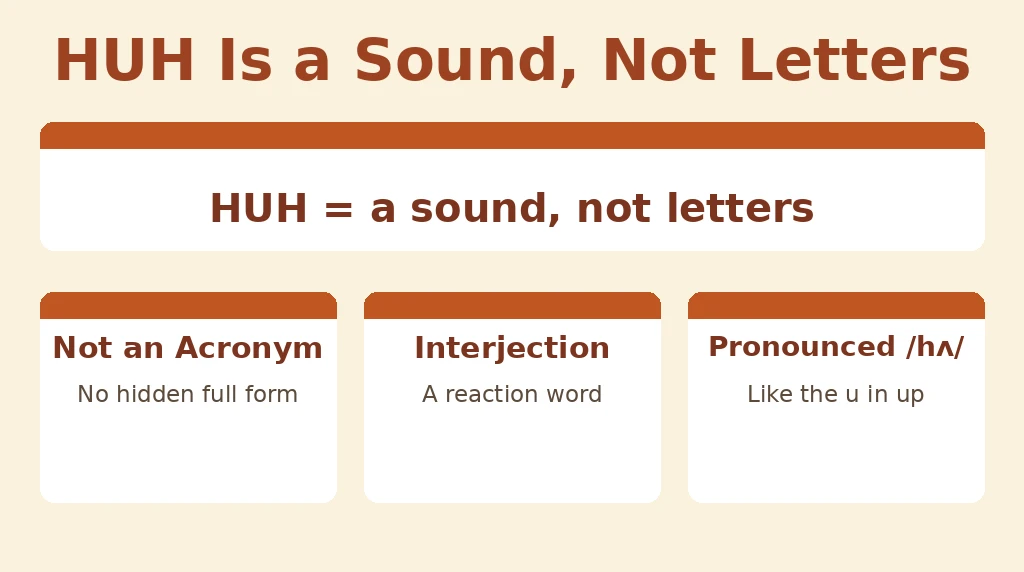
Huh has no full form, because it was never an acronym. The letters H, U and H do not stand for three words the way IDK stands for “I don’t know”. Huh is a sound first and a word second, a grunt of confusion people have made out loud for centuries and only later started typing.
That said, people do assume a closest meaning when they see it, and it usually boils down to one of these:
- “What did you say?” when the sender missed your message.
- “I did not understand that.” when the words were clear but the sense was not.
- “Can you repeat that?” when they need the same thing said a second time.
- “Really? I was not expecting that.” when the news itself is the shock.
Those are interpretations, not official expansions, so treat them as translations of a feeling rather than a definition. The honest answer to “what does HUH stand for?” is simply: nothing. It stands on its own.
Pronunciation is easy, because you say it the way it looks. Huh sounds like “huh”, with the vowel from the word “up”. Say it with a rising voice and it becomes a question. Say it flat and low and it becomes a shrug. In text, the question mark does the job of the rising voice for you.
HUH vs Similar Terms: What Is the Difference?
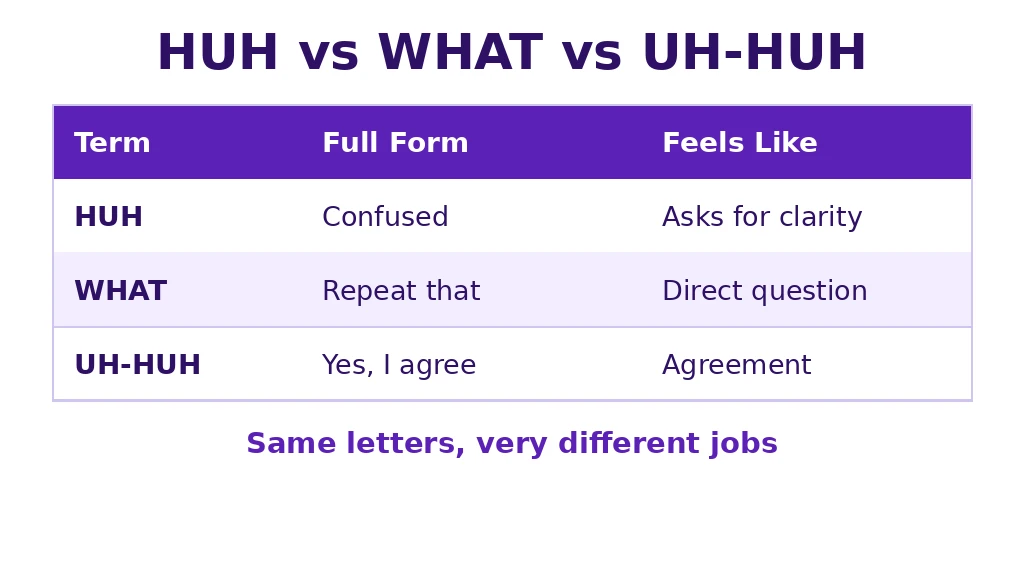
Huh shares a neighbourhood with a few other short reactions, and mixing them up changes what you are saying. Here they are side by side.
| Term | What It Really Says | Tone | Best Moment |
|---|---|---|---|
| HUH | I am confused or surprised | Casual, puzzled | Something does not add up |
| WHAT | Repeat that, please | Direct, blunt | You missed the message |
| UH-HUH | Yes, I agree | Warm, confirming | You are nodding along |
| HMM | Let me think about that | Slow, thoughtful | You need a second to decide |
The classic mix up is huh versus what. Both can ask for a repeat, but “what?” is more direct and can sound sharper, almost like a demand. “Huh?” is softer and more puzzled, closer to “wait, that does not fit what I expected.” If a friend tells you surprising news, “huh?” says you are processing it, while “what?!” says you can barely believe it.
The trickier pair is huh versus uh-huh, because they look like cousins and mean opposite things. Uh-huh means yes. It is a nod in word form, the sound of someone agreeing or listening along. Huh means hold on, I am lost. Send “uh-huh” when you understand and agree, and “huh?” when you do not understand at all. Swap them in a chat and the other person will think you agreed to something you never even followed.
Where HUH Is Commonly Used
Texting and WhatsApp
Day to day chats are the natural home of huh. It answers unclear messages in a single tap. A typical exchange: “Bring the blue one, not the red one.” “Huh? Which blue one?”
Instagram and Snapchat
On Instagram and Snapchat, huh shows up in DMs and in replies to stories, usually when someone reacts to a post they have not thought through. You will see “huh? since when do you like hiking” under a story, or a quick “huh lol” in a DM.
TikTok Comments
Scroll any busy TikTok comment section and huh is everywhere. Viewers use it to react to plot twists, strange life hacks and videos that end without an explanation.
Group Chats
Group chats run on half finished plans and inside jokes. One person references something from last week, three people reply “huh?”, and the plan stays tbd until someone finally explains. It keeps the thread alive without forcing anyone to pretend they followed a conversation they clearly missed.
Gaming Chats
In game chat there is no time for full sentences, so huh does quick work between rounds. Players type things like “huh? where is the last guy hiding” while the match is still moving. Everyone understands it instantly.
Discord and Forums
Discord servers and forums use huh the same way, just in longer threads. Someone asks about a patch note, and “huh, worked fine for me yesterday” is a normal reply.
Origin and History of HUH
Huh was not invented by smartphones, social media or modern texting culture. It is a much older sound, one people have made out loud for centuries whenever something did not register or did not make sense. Merriam-Webster records its first known use in English in 1608, and describes it as imitative of a grunt, which is a polite way of saying it began as a noise the human throat makes naturally.
That age is what makes huh different from most texting slang. Abbreviations like LOL and BRB were built to save typing time. Huh was already a complete reaction long before anyone typed it, and texting simply gave it a written form.
It never really went out of fashion, because the need behind it never changed. People still misunderstand each other every single day, and they still want to say so quickly. Its staying power is now official too, since major dictionaries list huh as a real entry.
Other Meanings and Variations of HUH
Huh is a small word with a busy family, and the punctuation next to it shifts the meaning a little. Here are the forms you will actually meet.
- Huh? the standard version: confusion, or a request to repeat something.
- Huh! surprise or sudden realization, sometimes with a hint of disbelief.
- Huh… thinking, hesitation, or a slow “maybe you have a point”.
- HUH?! strong shock or disbelief, the capitals and double mark doing the shouting.
- Huh lol casual confusion softened by humour, very common in friendly chats.
- Uh-huh the opposite cousin: it means yes, I agree, or I am listening, not confusion at all.
- Huh as a tag question at the end of a sentence, like “pretty good, huh?”
On social media there is one more sense worth knowing. In captions and hashtags, creators sometimes use “huh” as a label for confusing or absurd content, a short way of saying “this makes no sense and that is the joke”. That caption use is separate from the chat use, but the feeling behind it is the same.
Outside everyday chat, huh has a couple of rare meanings. CyberDefinitions notes that in 2020 some political commentators used HUH as a nickname, “Heels Up Harris”, for Kamala Harris, and the site also lists “Do you understand?” as a tag question sense. Those are niche uses, not the texting meaning.
How to Use HUH Correctly
- Match the mark to the mood. A question mark asks for help, an exclamation mark shows surprise, and dots show thinking. Pick the punctuation that matches what you actually feel, because the reader has nothing else to go on.
- Add one small detail. “Huh? What do you mean by Friday?” takes two extra seconds and sounds far more helpful than a bare “huh?” on its own.
- Keep it casual. Huh belongs in friendly, informal chats. If the conversation would not welcome a “lol”, it will not welcome a “huh” either.
- Watch the moment. If a friend is upset or sharing serious news, a flat “huh?” can land badly. Write a real sentence instead, like “Sorry, I did not quite follow that.”
- Use it as a reaction, not an answer. Huh is a great opener when you are confused, but it is not a full reply. Follow it with a question so the conversation has somewhere to go.
Example Conversations Using HUH
A plan that changed without warning
Person A: “We are meeting at eight, not ten.”
Person B: “Huh? I thought it was ten all week.”
Surprising news from a friend
Person A: “I got the job! I start Monday.”
Person B: “Huh! That is amazing, congratulations!”
A confusing TikTok reply
Person A: “Wait, why did the video end like that?”
Person B: “Huh? I watched it twice and it still makes no sense.”
Group chat confusion
Person A: “Bring the thing from the old place.”
Person B: “Huh? Which thing, and which old place?”
Gaming with a teammate
Person A: “Rotate to the other side now.”
Person B: “Huh? We are already there.”
A joke that needs a second look
Person A: “My boss just gave me Friday off for no reason.”
Person B: “Huh lol, what did you do?”
A slow, thoughtful reply
Person A: “Maybe you should try a different approach.”
Person B: “Huh… that might actually work.”
Talking about a show ending
Person A: “They killed off the main character in episode two.”
Person B: “idk, the ending made no sense. Huh?”
When Not to Use HUH
- Work email: write “Sorry, could you clarify that point?” instead.
- Job interviews and applications: even over chat, recruiters read “huh?” as unprepared or uninterested.
- Teachers and bosses: anyone grading or managing you deserves the full sentence.
- Customer service chats: on either side of the counter, “huh?” sounds like nobody is taking the problem seriously.
- Serious conversations: when someone is upset or asking for real support, a bare “huh?” can feel like a door closing.
- With strangers or new contacts: without a friendly history behind it, “huh?” can read as rude or dismissive.
How to Respond When Someone Sends You HUH
A “huh?” lands in your chat and the conversation stalls. What you send next decides whether it picks up again.
Patient replies work when the person is genuinely lost:
- “No worries, let me say it again in a simpler way.”
- “All good, I probably explained it badly.”
- “Sure, here is the short version.”
Helpful replies clear up the confusion without any fuss:
- “I meant Friday at eight, not Saturday.”
- “Long story short, the plan changed this morning.”
- “Here, I will send you the link so you can see it.”
Playful replies suit close friends and light topics:
- “lol, yeah, I was confused too when I first heard it”
- “smh, okay, I will explain it slowly this time”
- “huh right back at you, we are both lost”
One thing to avoid: do not fire back a sarcastic reply when the “huh?” was honest. Most of the time the person is not being rude. They really did not follow you, and a calm repeat keeps the chat friendly.
Common Mistakes People Make With HUH
- Reading every huh as rude. Most “huh?” replies are honest and quick, not dismissive. Tone in text is easy to misjudge, so give the sender the benefit of the doubt first.
- Sending a bare “huh?” in a serious chat. When someone pours out a long message, a one word reply can feel cold.
- Confusing huh with uh-huh. One means “I am lost” and the other means “yes, I agree”. They sit at opposite ends of the conversation, so do not swap them.
- Using it at work. A manager who gets “huh?” about a deadline hears “I was not listening”. Spell it out and ask for the detail you need.
- Assuming the tone from text alone. The same three letters can be a shrug, a joke or a sarcastic jab. If the tone matters, ask one follow up question instead of guessing.
Frequently Asked Questions
What does huh mean in text?
Huh means “I do not understand”, “I am surprised”, or “Can you repeat that?” People type it when something confuses them, catches them off guard, or needs explaining again.
Is huh rude?
Not by itself. In casual chats it is a normal, honest reaction, though a bare “huh?” in a serious conversation can sound dismissive, so adding a few extra words softens it.
What is the full form of huh?
Huh has no full form. It is an interjection, a spoken sound people have used for centuries, not an acronym built from other words.
What is the difference between huh and what?
Both can ask for a repeat, but “what?” is more direct and can sound sharper, while “huh?” is softer and more puzzled.
Can I use huh in a work email?
No. Huh is casual spoken slang, and it looks careless in professional writing. In a work email, write the full sentence, such as “Sorry, could you clarify that point for me?”
How do I reply when someone sends me huh?
Keep it easy. Repeat your point in simpler words, or add the detail they missed. A patient reply like “no worries, let me say it again” works in most cases.
Final Thoughts
Three letters, one very old job. Huh is the quickest honest reaction in texting, and it has earned its place in everyday chats because everyone gets confused far more often than they like to admit. Used casually, with a little context when the moment is serious, it never really causes trouble.
If you want the official stamp, Dictionary.com lists huh as an informal interjection used to show that you have not heard or understood something, which is exactly the meaning you will meet in your chats.

1 thought on “HUH Meaning in Text: What It Means, How to Use It and How to Reply”