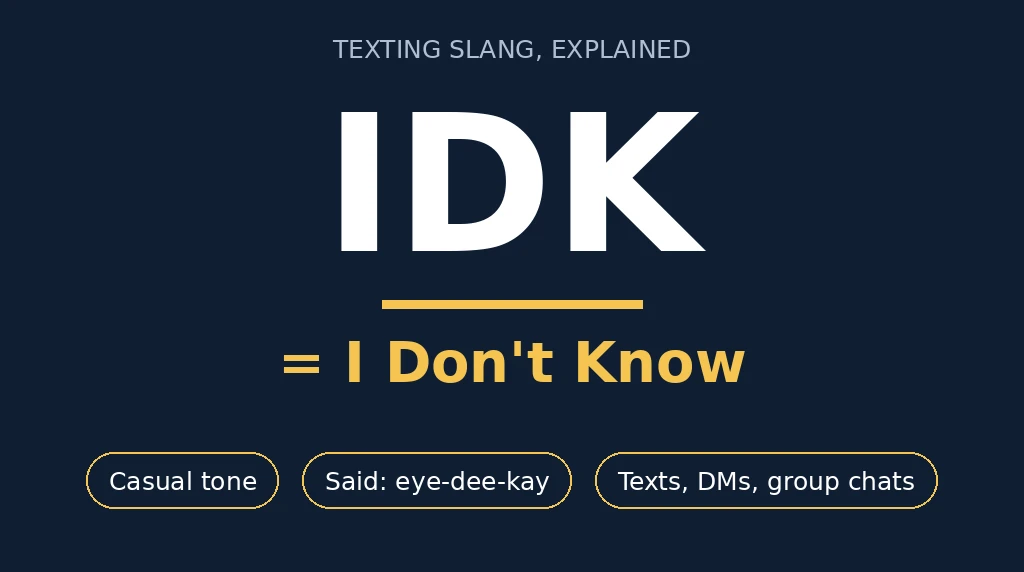
You ask a simple question in the chat. “What time are we leaving?” Three dots appear, then one short reply lands: “idk”. That is it. No explanation, no follow up, just three little letters.
Here is the short answer first. IDK means “I don’t know”, and people type it when they genuinely have no answer, have not decided yet, or cannot be bothered to type the full sentence out. Still, those three letters can sound honest, lazy, funny or a bit cold depending on the chat, and that tone is where most of the confusion starts. This guide walks through the idk meaning in text, how it differs from IDC and IDEK, where you will see it, and what to reply when it lands in your inbox.
What Does IDK Mean in Text?

IDK is short for “I don’t know”. Someone sends it when a question catches them without an answer, when plans are still up in the air, or when they have not made up their mind yet. It is not a brush off by itself. Most of the time it is simply the fastest honest answer a person can give with their thumbs.
Capitalization changes the feel more than the meaning. Typed in all caps, IDK can look a little louder, almost like the person is shrugging with extra energy. Lowercase idk is the everyday version. It reads softer, more relaxed, and it is the form you will see in ninety percent of chats. A plain “idk” from a friend usually just means the answer is not there yet, nothing deeper.
Context does the rest of the work. “idk, ask Sara, she booked it” is helpful. A lone “idk” after you poured out a long message can feel flat. Same letters, different weight. Read the words around them and you have the real idk meaning in text every time.
Full Form of IDK
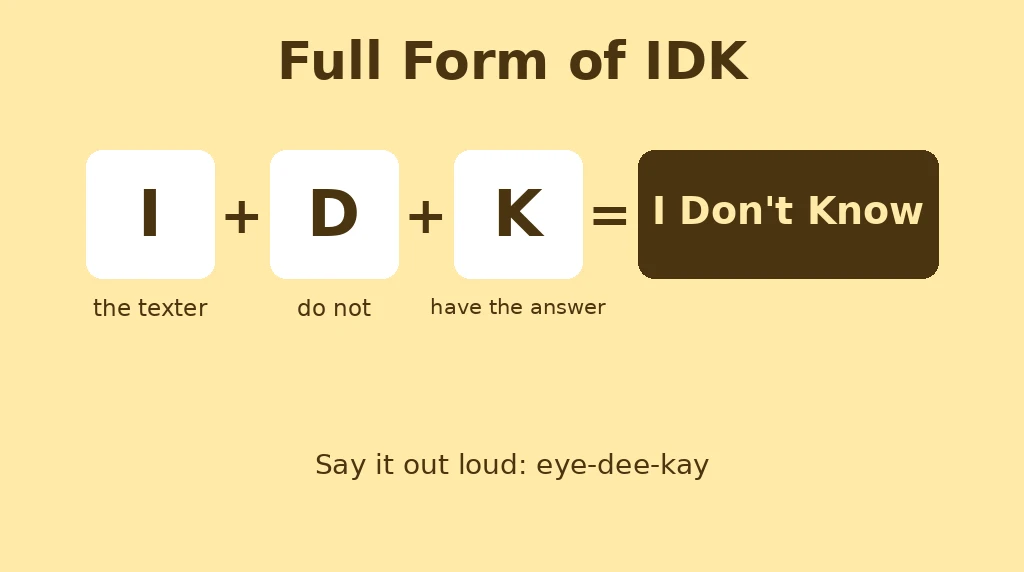
The full form could not be simpler, because each letter stands for one word of the phrase:
- I: I
- D: don’t
- K: know
Put together, you get “I don’t know”. There is no hidden second layer and no trick spelling behind it, which is exactly why it spread so fast. If you ever hear someone say it out loud instead of typing it, they pronounce each letter on its own: eye-dee-kay. That spoken version pops up in voice chats and in real life jokes between friends who text a lot.
IDK vs IDC vs IDEK: What Is the Difference?

Three little abbreviations cause most of the mix ups in this corner of texting, so here they are side by side.
| Abbreviation | Full Form | What It Really Says | Tone |
|---|---|---|---|
| IDK | I don’t know | The answer is missing | Neutral, honest |
| IDC | I don’t care | The answer does not matter to me | Cool, sometimes blunt |
| IDEK | I don’t even know | I am lost, shocked or overwhelmed | Strong, emotional |
The classic mix up is IDK versus IDC, because the two look almost identical at a glance. They say opposite things, though. IDK talks about knowledge: the person is missing information. IDC talks about interest: the person has the information, or could get it, and simply does not mind either way. Reply “idk” to “where should we eat?” and you are undecided. Reply “idc” and you are happy with anything. Swap them and the whole mood of the reply flips.
IDEK sits in a different lane again. The word “even” adds weight, so IDEK usually shows up when someone is stunned, exasperated or laughing at a situation that makes no sense. “idek what he was thinking” is not about a missing fact. It is a reaction.
Where IDK Is Commonly Used
Texting and WhatsApp
Day to day chats are the natural home of idk. It answers quick questions about times, places and plans without slowing the conversation down. A typical exchange looks like this: “train or bus tomorrow?” “idk yet, checking prices tonight”. Short, honest, and the chat keeps moving.
Instagram and Snapchat
On Instagram and Snapchat, idk shows up in DMs and in replies to stories, usually when someone reacts to a photo or a plan they have not thought through. You will see lines like “idk why this filter makes me look famous” or a quick “idk, maybe Saturday?” under a story about a meetup.
TikTok Comments
Scroll any busy TikTok comment section and idk is everywhere. Viewers use it to guess at song names, argue about video endings and admit they are just as confused as everyone else. Comments like “idk who needs to hear this but the sequel was better” have basically become a format of their own.
Group Chats
Group chats run on half finished plans, so idk is the glue holding them together. One person asks who is bringing snacks, three people reply idk, and the plan stays tbd until someone finally decides. It keeps the thread alive without forcing a fake answer out of anyone.
Gaming Chats
In game chat there is no time for full sentences, so idk does quick work between rounds. Players type things like “idk where the last guy is hiding” or “idk, push or hold?” while the match is still moving. Everyone understands it instantly, and nobody stops playing to decode it.
Discord and Forums
Discord servers and forums use idk the same way, just in longer threads. Someone asks about a patch note or a build, and “idk, worked for me yesterday” is a normal, accepted reply. It signals “this is my limit” without pretending to be an expert answer.
Origin and History of IDK
IDK belongs to the first big wave of texting shortcuts. Back in the early 2000s, phones had tight character limits, slow number pad keyboards and messages that cost money to send. Shortening the phrases you typed most often was not laziness, it was common sense, and “I don’t know” is one of the most typed sentences on earth.
The abbreviation has been in use since roughly 2002, first in SMS and chat rooms, then in instant messenger windows, and later in every social app that followed. It never really went out of fashion because the need behind it never changed. People still do not know things, every single day, and they still want to say so quickly. Its staying power is now official, too: major dictionaries such as Merriam-Webster list IDK as a real entry, which is more than most slang ever manages.
Other Meanings and Variations of IDK
IDK has a small family of close relatives, and each one shifts the meaning a little.
- IDEK: “I don’t even know”. The stronger version, used when confusion comes with disbelief, frustration or laughter.
- IDRK: “I don’t really know”. A softer hedge, handy when you have a rough idea but do not want to commit to it.
- Dunno: the spoken style alternative. People type it when they want the reply to sound like actual speech, shrug included.
- ion: a slang spelling that comes from “I don’t”, as in “ion know”. It belongs to casual social media talk, and ion has its own set of uses beyond this one phrase.
Outside slang, IDK very occasionally shows up as someone’s initials or as part of a username in a game or on a forum. That is rare enough that you can safely read it as “I don’t know” unless the context clearly points at a name.
How to Use IDK Correctly
- Keep it casual. IDK belongs in friendly, informal chats. If the conversation would not welcome a “lol”, it will not welcome an “idk” either.
- Mean it. Use it when you truly do not know or have not decided. People can smell a lazy idk, and it reads very differently from an honest one.
- Add one small detail. “idk yet, still checking” takes two extra seconds and sounds ten times more helpful than a bare idk on its own.
- Watch the moment. If a friend is upset or asking something serious, a flat idk can land badly. Slow down and write a real sentence instead.
- Pair it with a next step. “idk, let me ask and get back to you” closes the loop. The other person knows the question is not just floating in the air.
Example Conversations Using IDK
Planning with a friend
Person A: “Movie on Friday or Saturday?”
Person B: “idk yet, my shift ends late both days. Saturday is safer.”
Asking about homework
Person A: “Did he say which chapter the quiz covers?”
Person B: “idk, he rushed out before anyone could ask.”
Weekend plans in a group chat
Person A: “Beach or mountains this weekend?”
Person B: “idk lol, both sound good. You pick, I will bring the food.”
A confused TikTok reply
Person A: “Wait, why did the video end like that?”
Person B: “idk, watched it twice and the ending still makes no sense.”
Gaming with a teammate
Person A: “Do we rush the site or play slow?”
Person B: “idk, their sniper has not missed all game. Slow sounds smart.”
Talking about food
Person A: “What do you want for dinner?”
Person B: “idk, anything except pasta again.”
A soft, honest answer
Person A: “Are you mad at me?”
Person B: “idk. A little hurt, maybe. Can we talk tonight?”
At the last minute
Person A: “Are you still coming to the game?”
Person B: “idk yet, waiting on my brother. Will confirm by six.”
When Not to Use IDK
- Work email: write “I am not sure yet, I will confirm by noon” instead. Three letters look careless on the record.
- Job interviews and applications: even over chat, recruiters read idk as unprepared.
- Teachers and bosses: anyone grading or managing you deserves the full sentence.
- Customer service chats: on either side of the counter, idk sounds like nobody is taking the problem seriously.
- Serious conversations: when someone is upset or asking for real support, a bare idk can feel like a door closing.
How to Respond When Someone Sends You IDK
An idk lands in your chat and the conversation stalls. What you send next decides whether it picks up again. Pick the lane that matches the moment.
Patient replies work when the person is genuinely stuck:
- “No worries, take your time.”
- “All good, tell me when you know.”
- “No rush at all.”
Helpful replies move things forward without pressure:
- “Want me to check and send you the options?”
- “We can decide together, here is what I found.”
Playful replies suit close friends and light topics:
- “lol you say idk to everything”
- “smh, okay, I will decide then”
- “idk either, we are a great team”
One thing to avoid: do not fire back a sarcastic reply when the idk was honest. Most of the time the person is not dodging you. They really do not know, and a calm response keeps the chat friendly.
Common Mistakes People Make With IDK
- Confusing IDK with IDC. One letter changes “I do not know the answer” into “I do not care about the answer”. In a sensitive chat, that swap can start an argument out of nothing.
- Reading every idk as rude. Most idk replies are honest and quick, not dismissive. Tone in text is easy to misjudge, so give the sender the benefit of the doubt first.
- Using it to dodge decisions. An idk here and there is normal. An idk for every plan, every day, quietly trains your friends to stop asking you.
- Using it at work. A manager who gets “idk” about a deadline hears “I have not looked into this”. Spell it out and add when you will know.
- Assuming tone from text alone. The same three letters can be a shrug, a joke or a cry for help. If the tone matters, ask one follow up question instead of guessing.
Frequently Asked Questions
What does IDK mean in text?
IDK means “I don’t know”. People type it in chats and messages when they do not have an answer, or when they have not decided something yet.
Is IDK rude?
Not by itself. In casual chats it is a normal, honest reply, though a bare idk in a serious conversation can sound dismissive, so adding a few extra words softens it.
What is the difference between IDK and IDC?
IDK means “I don’t know”, so it is about missing information. IDC means “I don’t care”, so it is about not minding either way. The two are easy to mix up because they look almost the same.
What does IDEK mean?
IDEK means “I don’t even know”. It is the stronger version of IDK, used when someone is not just unsure but stunned, frustrated or laughing at something that makes no sense.
Can I use IDK in a work email?
No. IDK is casual texting shorthand, and it looks careless in professional writing. In a work email, write the full sentence, such as “I am not sure yet, but I will confirm by tomorrow.”
How do I reply when someone sends me IDK?
Keep it easy. A patient reply like “no worries, take your time” works in most cases, or offer help if a decision is waiting. Save the teasing replies for close friends.
Final Thoughts
Three letters, one simple job. IDK is the quickest honest answer in texting, and it has earned its place in everyday chats because everyone needs to say “I don’t know” far more often than they need to say almost anything else. Used casually, with a little context when the moment is serious, it never really causes trouble.
If you want the official stamp, Merriam-Webster lists idk with exactly this meaning, which shows how far a humble texting shortcut has come. Either way, you now have the idk meaning in text down, plus a decent reply ready for the next time it shows up in your messages.

5 thoughts on “IDK Meaning in Text: What It Means, How to Use It and How to Reply”