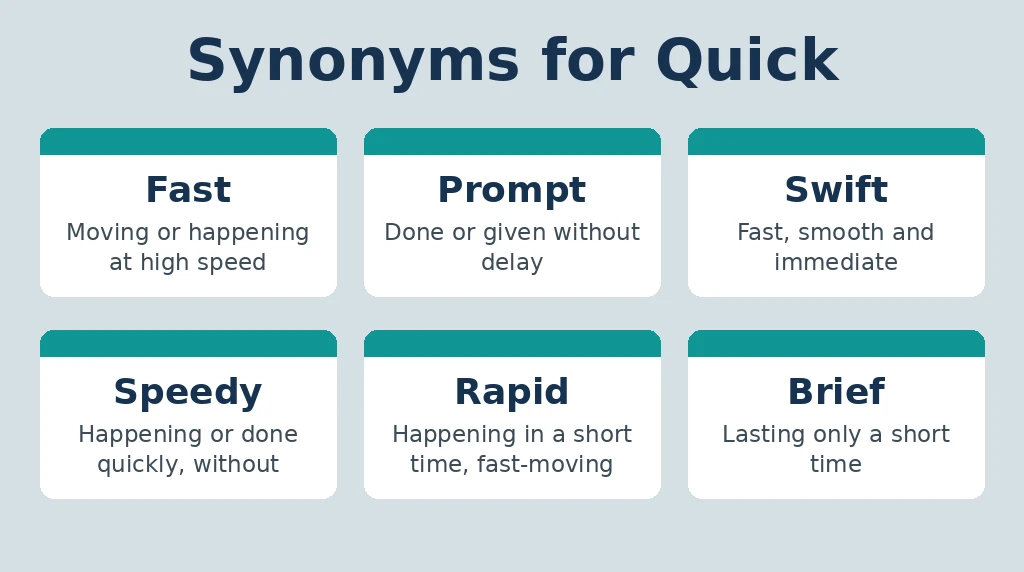
A goalkeeper reads the penalty before the boot has finished swinging. A nurse catches the falling chart. A friend answers the joke half a beat before the punchline lands. None of them is merely fast; all of them are quick, and the difference is the subject of this guide. The closest synonyms for quick are fast for raw speed, prompt for response without delay, brief for things that take almost no time, and sharp for the mind that arrives before everyone else.
This guide collects the synonyms of quick and sorts them by the kind of quickness on offer: moving fast, answering at once, thinking on your feet, lasting only a moment, and the hasty quickness that cuts corners and pays for them. Every word was checked against real thesaurus entries, and each one comes with a plain meaning and a short example, because quick is a compliment with several compartments, and they aren’t interchangeable in careful writing or careful speech.
Top Synonyms for Quick: Quick Reference
Start here for the working shortlist. The table gathers the quick synonyms that cover most situations, and the sections after it sort the full list into its separate families.
| Word | Meaning in one line | Best for |
|---|---|---|
| Fast | Moving or happening at high speed | Cars, runners, change |
| Prompt | Done or given without delay | Replies, service, action |
| Swift | Fast, smooth and immediate | Responses, justice, movement |
| Speedy | Happening or done quickly, without wasting time | Resolutions, recoveries, trials |
| Rapid | Happening in a short time, fast-moving | Growth, progress, heartbeats |
| Brief | Lasting only a short time | Visits, chats, replies |
| Instant | Happening immediately, with no pause | Results, coffee, decisions |
| Immediate | Happening at once, without delay | Effect, response, danger |
| Brisk | Quick and energetic | Walks, business, trade |
| Sharp | Quick and keen in mind | Wits, answers, eyes |
| Hasty | Done too quickly, with too little care | Decisions, exits, words |
| Short | Lasting a small amount of time | Breaks, sentences, lives |
| Apt | Quick to learn or respond, formal | Pupils, replies, quotations |
| Ready | Quick and fluent in response, in ready wit | Wits, answers, assistants |
| Lightning | Extremely fast, in phrases like lightning speed | Visits, reactions, campaigns |
| Momentary | Lasting for a moment only | Lapses, pauses, fears |
| Fleeting | Passing quickly, lasting a very short time | Glimpses, visits, fame |
| Alert | Quick to notice and respond | Guards, minds, services |
| Snappy | Quick and lively, informal, in make it snappy | Orders, comebacks, tunes |
| Cursory | Quick and not thorough | Glances, inspections, readings |
| Express | Fast and direct, of transport and delivery | Trains, deliveries, lanes |
| Breakneck | Dangerously fast | Speeds, progress, schedules |
| Expeditious | Fast and efficient, formal | Handling, replies, justice |
| High-speed | Moving or working very fast | Chases, trains, internet |
| Fleet | Fast and light in movement, literary | Runners, horses, messengers |
| Pronto | Immediately, informal, from Spanish | Requests, repairs, replies |
| Keen | Sharp and quick in sense or mind | Eyes, hearing, instincts |
| Hurried | Done quickly, feeling rushed | Breakfasts, goodbyes, meetings |

What Does Quick Mean?
Quick describes anything that happens in a short time, moves at speed, or responds without a pause, and it has carried those three jobs since Old English, when its ancestor meant something even more surprising: alive. The living sense survives fossilised in a few phrases this article visits in its Mistakes section, but the modern word is all about time, and about how little of it a thing uses.
Merriam-Webster’s chooser draws the map neatly. Quick and its close cousins apt, prompt and ready all mean able to respond without delay or hesitation, but quick stresses the instant quality of the response itself, as if the speed were built into the person or thing rather than trained into them: quick reflexes, a keen, quick mind. Fast, the obvious neighbour, leans the other way, toward movement through space, which is why a car is fast but a visit, which may involve sitting perfectly still, can only be quick.
That split, speed versus brevity, runs through the whole article and is worth keeping hold of. Half of quick’s family measures how fast something goes; the other half measures how soon it’s over. A quick runner and a quick meeting share almost nothing except a stopwatch, and the synonyms sort themselves accordingly, which is why this guide keeps the two families in separate rooms, with a third room between them for the minds that make quickness look easy.
One grammatical note before the lists. Quick is an adjective that longs to be an adverb, and in speech it often is: come quick, get here quick. Careful writing still prefers quickly for the adverb’s job and keeps quick for the adjective’s, a distinction the Mistakes section will defend. The word also has a temper: a quick temper ignites fast, a reminder that speed of response isn’t always a compliment, however useful it is in goalkeepers.
It helps to hear the word against its cousins one last time before the lists begin. Fast looks at the road, quick looks at the clock, and rapid looks at the graph paper, which is why a heart can be all three in a single hospital sentence and mean something slightly different each time. Writers who keep the three gazes separate rarely misuse any of them, and the families below are arranged to make the separation feel natural rather than memorised.
Quick as Speed: Fast, Rapid and Breakneck
The first family measures motion: things that cover ground, water or air at a rate. It’s the family shared most fully with fast, and the words differ mainly in texture: some make speed sound smooth, some make it sound busy, and some make it sound like a warning. If your subject has wheels, wings, legs or a current, this is your shelf.
Grade the danger before you choose. Swift and fleet praise the motion, rapid and high-speed measure it like instruments, and breakneck and meteoric enjoy it a little too much, promising thrills at the price of control. News writing lives in the measuring group, poetry in the praising group, and insurance documents in neither, for reasons that will become obvious.
- Fast: moving or happening at high speed. A fast bowler troubled the batsmen
- Rapid: happening quickly, of movement or change. Rapid growth strained the roads
- Swift: fast and smooth, without delay. A swift response saved the talks
- Speedy: done or happening without wasting time. Everyone wished her a speedy recovery
- Brisk: quick and energetic in movement or activity. A brisk walk before breakfast
- High-speed: designed for or moving at very high speed. A high-speed chase through the suburbs
- Lightning: extremely fast, in compounds and phrases. Lightning reactions at the crease
- Meteoric: extremely fast, like a meteor, usually of rises. A meteoric rise through the company
- Breakneck: dangerously or recklessly fast. The talks proceeded at breakneck speed
- Headlong: fast and headfirst, without control. A headlong rush to publish
- Express: fast, direct and stopping rarely, of transport and post. The express train reached the coast by noon
- Fleet: fast and light on the feet, literary. Fleet messengers crossed the hills
- Whirlwind: fast and full of activity, of tours and romances. A whirlwind tour of nine cities
- Supersonic: faster than the speed of sound, technical. Supersonic flight shrank the ocean
Two of these words measure more than they move. Rapid has become the house adjective of reports, attached to growth, decline, change and response, and its coolness is its value: nothing in it cheers. Speedy, by contrast, is almost always good news, since what people want speedy is recoveries, resolutions and refunds, a distribution no marketing department arranged and every reader feels.
Sport keeps this family in daily training, because sport is measured speed with witnesses. Commentators reach past fast within minutes, to swift for the winger, lightning for the counterattack and breakneck for the final lap that frightens the pit wall. The vocabulary survives there because the differences are visible to a whole stadium at once, and any writer describing motion can borrow the commentator’s habit of asking what the speed looked like, not merely how much of it there was.

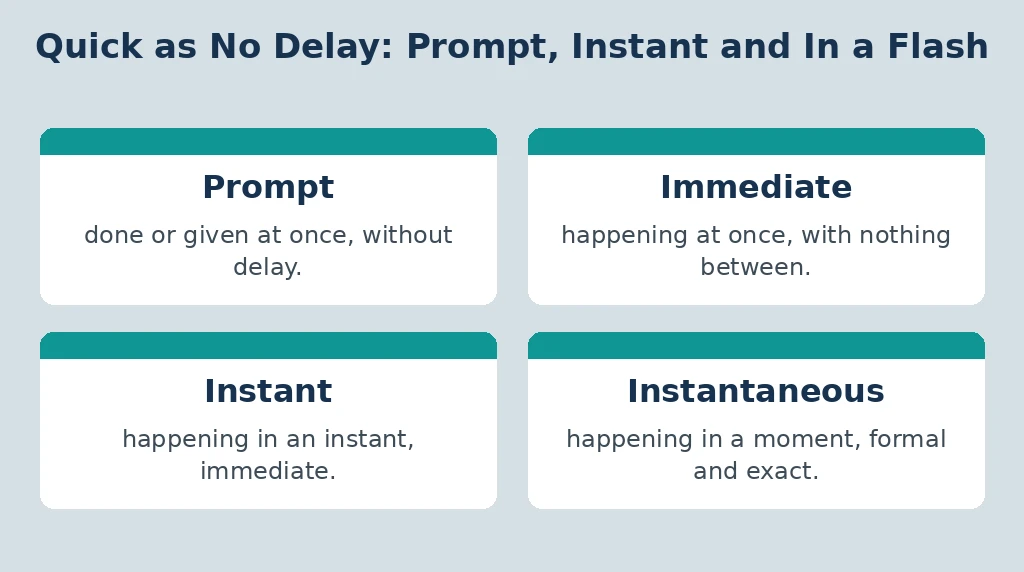
Quick as No Delay: Prompt, Instant and In a Flash
The second family is about the gap, or rather the absence of one, between the call and the answer. These words praise timing rather than motion: the reply that arrives before the question has cooled, the service that starts before the form is signed. Cambridge gives prompt pride of place here, and formal English keeps expeditious for the same compliment in a suit.
- Prompt: done or given at once, without delay. A prompt reply would be appreciated
- Immediate: happening at once, with nothing between. The medicine had an immediate effect
- Instant: happening in an instant, immediate. The song was an instant success
- Instantaneous: happening in a moment, formal and exact. The reaction was almost instantaneous
- Straightaway: immediately, without waiting, British. We left straightaway after lunch
- At once: immediately, in a phrase that doubles as an order. Come here at once
- In a flash: very quickly, in a vivid phrase. The answer came to her in a flash
- Double-quick: very fast, British, often in double-quick time. The forms were processed in double-quick time
- Pronto: immediately, informal, borrowed from Spanish. We need those figures, pronto
- Snappy: quick and lively, informal, in make it snappy. Make it snappy, the taxi driver said
The register ladder in this family is steep. Pronto and snappy belong to kitchens, barracks and film sets, where the order itself is a performance. Prompt belongs to the letter of thanks. Instantaneous belongs to the laboratory, where it makes a measurable claim. Choosing the wrong rung doesn’t confuse the reader, but it does costume your sentence, and costumes get noticed.
Business has standardised the polite end of this family so thoroughly that the phrases run on rails: a prompt payment, an immediate start, a decision instant on approval. The rail is comfortable but visible, and the writer who steps off it deliberately, promising a reply in a flash in a formal letter, had better be sure the flash is coming. Certainty about timing is a promise, and this family is where English keeps its promissory notes.
Quick Minds: Sharp, Apt and Quick on the Uptake
Between motion and brevity stands the family Merriam-Webster cares about most: quickness of mind. A sharp wit, an apt pupil and a smart answer are all quick in the sense that no time is wasted between the question and the light going on. Teachers, interviewers and improvisers live on this shelf, and its words grade the mind from watchful to brilliant.
The distinctions here are about where the speed comes from. Apt, in Merriam-Webster’s telling, stresses the qualities that make response possible, the talent underneath. Ready stresses fluency, the answer kept polished by the door. Alert stresses watchfulness, the sentry’s quickness rather than the scholar’s. All three can describe the same person on the same morning, and the choice tells the reader which part of her you noticed first.
- Apt: quick to learn or to respond fittingly, formal. An apt pupil who needed telling once
- Ready: quick and fluent in response, in ready wit. A ready answer for every objection
- Alert: quick to notice and react. Alert guards spotted the movement
- Sharp: quick and keen in mind or sense. A sharp ear for accents
- Keen: sharp and eager in sense or intellect. Keen eyes missed nothing
- Quick-witted: able to think and answer quickly. A quick-witted host saved the interview
- Smart: clever and quick in understanding. A smart reply that ended the argument
- Bright: intelligent and quick to learn. The brightest cadet in the intake
- Nimble: quick and light in mind or movement. A nimble mind for figures
- Agile: able to think and move quickly and easily. An agile negotiator switched ground
- Quick on the uptake: quick to understand, in an everyday phrase. Slow on paper, quick on the uptake
Classrooms run on this family, and so does comedy. The quick-witted character is a stock figure from Shakespeare’s fools to the modern panel show, and the word always promises the audience the same pleasure: watching thought happen at a speed slightly beyond their own. Writers describing intelligence of any kind should notice how much warmer these words are than intelligent itself, which certifies the engine, while the quick family applauds the acceleration.
Examiners and interviewers test this family without naming it. The follow-up question asked a half-second early, the objection raised before the slide has finished, are performances of apt and alert rather than of knowledge, and panels reward them accordingly. It’s worth telling students so. The student who believes quickness of mind is a gift will envy it; the one who sees it as a trainable family of habits (watchfulness, fluency, nerve) can set about acquiring it.
Quick and Brief: Moments, Glances and Flying Visits
Now for the second great sense: quick not as speed through space but as shortness in time. Cambridge gathers this family under the sign of continuing for less time than usual, and it’s the family of the quick phone call, the quick look and the quick word in your ear, none of which involves anything moving fast at all.
The family grades by what the brevity costs. A brief meeting loses nothing. A cursory inspection loses thoroughness. A fleeting glimpse loses almost everything except the memory of having seen. Choosing among these words is often the whole criticism, which is why reviewers keep fleeting and managers fear cursory in their own reports.
- Brief: lasting only a short time. A brief chat in the corridor
- Short: lasting a small amount of time, the plain word. A short break between sessions
- Momentary: lasting for a moment only. A momentary lapse of concentration
- Fleeting: passing very quickly, barely caught. A fleeting glimpse of the comet
- Short-lived: lasting a very short time, of things that end early. A short-lived celebrity marriage
- Transient: lasting only a short time, formal. The transient population of the port
- Transitory: not lasting, formal and philosophical. The transitory nature of fame
- Ephemeral: lasting a very short time, literary and formal. Ephemeral glory on the leaderboard
- Passing: brief and not lasting, in a passing glance or remark. A passing interest in heraldry
- Cursory: quick and not thorough. A cursory glance at the figures
- Summary: done quickly and without ceremony, of justice and dismissal. Summary dismissal for theft
- Flying: very brief, in phrases like a flying visit. A flying visit to the in-laws
Notice the two registers living side by side. Short and brief do the office work, neutral as paper. Transient, transitory and ephemeral belong to essays and sermons, where brevity becomes a meditation on life itself. The same sunset can be a fleeting glimpse for the tourist and an ephemeral glory for the poet, and the difference isn’t the sun but the sentence it has to carry.
Weather owns a private corner of this family. A passing shower, a fleeting glimpse of sun, a brief window between fronts: forecasters grade brevity for a living, and their vocabulary is correspondingly exact. So is the vocabulary of medicine, where a momentary lapse and a transient symptom are different entries in the notes, one a stumble and the other a visitor who may return. In both trades the brief family isn’t decoration but diagnosis.
One member of the family moonlights in the speed sections and should be greeted carefully: a lightning visit is brief rather than fast, named for how soon it’s over, and a flying visit works the same trick. Readers forgive the double duty because the metaphor is doing honest work in both rooms, but writers choosing synonyms should file each use under the family it’s actually serving in that sentence.
Too Quick: Hasty, Rushed and Slapdash
Every family in this article has praised speed so far, in motion, response, mind or brevity. This one files the complaints. Quickness that skips the checking stage has a vocabulary of its own, and it’s older than most of the praise: the words for haste were needed the first time a fast decision met a slow consequence.
- Hasty: done too quickly, with too little thought. A hasty decision they regretted
- Hurried: done quickly under pressure, feeling rushed. A hurried breakfast standing up
- Rushed: done in a rush, pressed for time. A rushed job on the wiring
- Precipitate: acting too quickly without care, formal. A precipitate withdrawal from the talks
- Overhasty: too hasty, formal and rare. An overhasty judgement of the newcomer
- Snap: done suddenly and without reflection, in a snap decision. A snap decision to sell
- Slapdash: quick and careless in execution. Slapdash paintwork over the damp
The family divides by sympathy. Hurried and rushed blame the clock and forgive the person. Hasty blames the person’s judgement. Slapdash blames the workmanship and leaves fingerprints. Editors reach for these words constantly, because most published errors aren’t failures of knowledge but failures of pause, and a vocabulary that can say exactly that is worth its small shelf.
Proverbs police this family from the folk side: hasty climbers who have sudden falls, marriages made in haste and repented at leisure, the brief family conscripted into a warning. The persistence of the proverbs tells you the fault is permanent. Every generation invents a faster tool and then a fresher word for the errors the tool makes possible, and the shelf above, from hasty to slapdash, is simply the current edition of a very old complaint.
How to Choose the Right Synonym for Quick
Ask what the stopwatch is measuring. If it measures movement, stay in the speed family, and let rapid do the reporting while swift does the praising. If it measures the gap before a response, you want the prompt family. If it measures how long something lasted, you’re in the brief family even if nothing moved, and if it measures a mind, grade the kind of cleverness before choosing between apt, sharp and quick-witted.
Then ask whether the quickness helped or harmed. English is unusually honest here: the same speed that earns prompt in the morning earns hasty by the afternoon, and the difference is usually the outcome. Writers reviewing decisions, their own included, should let the result pick the word, and readers should notice when a writer hasn’t, because praising a disaster as swift is one of the oldest tricks in public relations.
Two rehearsals fix the system. The ambulance that arrives in four minutes was prompt if the caller was waiting, fast if the traffic was watching, and its crew, if they sized up the scene before the doors had shut, were quick in the mind sense and probably apt in their training. The report of the same incident, read once and forgotten, had a fleeting life, unless an inquiry found the response cursory, in which case it lived much longer than anyone wished.
Finally, keep the register ladder in view. Pronto, snappy and double-quick dress a sentence in overalls. Expeditious, instantaneous and transitory dress it in a suit. Prompt, brief and rapid wear the smart casual of everyday prose. Most writing should live on the middle rungs, climbing only when the occasion (a cockpit, a courtroom, a christening) genuinely asks for costume.
Quick Synonyms for Writing and Dialogue
In professional writing, quick words are where tone is won and lost in miniature. The email that promises a prompt reply sounds courteous; the one that promises an instant reply sounds automated. The report that calls growth rapid sounds measured, while the release that calls it meteoric sounds like it’s selling shares. Customer service has quietly standardised on speedy for its warm neutrality, and technical writing on instantaneous where the timing can actually be proved.
In fiction, the brief family is a pacing tool disguised as vocabulary. A scene full of fleeting glances and passing remarks feels restless before anything has happened, while one cursory glance from a detective tells the reader the room is innocent and the plot is elsewhere. Dialogue takes the no-delay family for character: the officer says at once, the fixer says pronto, the head waiter says nothing at all and simply moves, which novelists render, cheating honourably, as prompt.
Students and ESL writers should memorise three partnerships above all: a quick look, a quick bite, a quick word, the social trio in which the word means brief rather than fast. With those in the ear, the commonest learner error, using quick where the language wants fast for vehicles and races, becomes easy to hear and easier to fix, and the distinction this whole article is built on starts to feel like instinct rather than rule.
One last professional habit is worth stealing: when you revise, search your draft for the word quick and interrogate each appearance. About half will be doing honest work. The rest will be hiding a more exact claim about speed, timing, cleverness or brevity, and swapping in the precise cousin (prompt for the reply, fleeting for the glimpse, sharp for the mind) tightens the sentence at no cost. Few single-word edits in the language pay for themselves so reliably.
Antonyms for Quick
The opposites of quick gather at both ends of the stopwatch: things that move slowly, and things that last and last.
- Slow: moving at low speed, taking a long time. A slow train through the hills
- Gradual: happening slowly over a long period. A gradual change in the weather
- Unhurried: done without rushing, at ease. An unhurried lunch in the garden
- Leisurely: done in a relaxed, unhurried way. A leisurely stroll by the river
- Lengthy: lasting a long time, often too long. A lengthy inquiry into the accounts
- Long: lasting a great amount of time, the plain opposite. A long wait at the border
- Delayed: made late, happening after the expected time. A delayed flight home
- Sluggish: slow to respond or move. A sluggish start to the economy
- Lingering: lasting a long time, slow to leave. A lingering smell of paint
- Drawn-out: extended over too long a time. A drawn-out negotiation
- Tardy: late in responding or arriving, formal. A tardy reply to the invitation
Notice how kindly half of this list sounds. Leisurely and unhurried are compliments wearing antonym clothing, and much of the modern argument about speed (slow food, slow travel, slow mornings) is really an argument about moving words from one side of this page to the other. The language took no side. It simply kept both vocabularies in good repair.
There’s a small lesson in that kindness. Quickness is the only virtue in this series of guides whose opposite is also, half the time, a virtue, and a writer who can hold both, praising the prompt rescue and the unhurried breakfast in the same paragraph without confusion, has understood something about English as well as about time. The language doesn’t want you fast or slow. It wants you accurate about which, and when, and why.
Common Mistakes: Words That Are Not True Synonyms for Quick
The quick, as a noun, is the great trap, and this guide keeps its promise to visit it. Under your fingernail lies the quick, the soft living flesh beneath the nail, and to be cut to the quick is to be hurt at the most tender point, which is why the phrase came to mean wounded feelings. The same old sense, alive, survives in the quick and the dead. None of this has anything to do with speed, and the reader who meets quick in these phrases and reaches for a stopwatch has been ambushed by history.
Quicken looks like the family verb and sometimes behaves: hearts quicken, steps quicken, and plots, in every writing manual, must quicken. But it’s a verb of becoming, not a synonym for the adjective, and its older obstetric sense, the moment a mother first feels the child move, still haunts older novels. Use it for pace that rises, never as a fancy replacement for the plain adjective in a list of qualities.
Quick-tempered borrows the word for a job it does badly in synonym lists. The compound doesn’t mean fast in any useful sense; it names a person whose anger ignites quickly, and the quickness belongs to the temper, not the person’s wit or feet. A quick-tempered goalkeeper may also be quick, but the two judgements are separate, and an article about synonyms should keep them so.
Quickly is a grammar trap rather than a vocabulary one. Careful English keeps quick for the adjective and quickly for the adverb: the reply was quick, she replied quickly. Speech breaks the rule cheerfully (come quick), and fiction may quote the breakage, but in essays and reports the flat adverb marks the writer as careless in exactly the place where the subject is care itself.
Quick as a noun for a group deserves a final fence. Readers of older books meet the quick meaning the living, as a body of people, and sports pages occasionally borrow quicks for natural speed, mostly in American writing. Both are survivals and special effects, not working vocabulary. The modern writer who needs a noun for speed has speed, pace and rapidity ready to hand, and should leave the antique in its glass case with the nail and the childbed.
Frequently Asked Questions
What is the best synonym for quick?
Fast is the closest everyday synonym for movement, while prompt is the best choice for replies and action without delay. Brief wins when the point is short duration rather than speed, and expeditious is the formal option. Pick by asking what the stopwatch in your sentence is actually measuring.
What is the difference between quick and fast?
Fast mainly describes speed of movement through space, while quick mainly describes shortness of time or speed of response. A fast car travels at high speed; a quick visit may involve sitting still but is soon over. In speech the two often swap, but careful writers keep the distinction.
What is a formal word for quick?
Expeditious is the most formal synonym for actions, suggesting speed with efficiency, and instantaneous is the formal choice for things that happen in a moment. For brief duration, transient and transitory serve formal writing, and precipitate is the formal word for acting too quickly.
Does quick mean brief as well as fast?
Yes. A quick look, a quick chat and a quick word all mean brief rather than fast, and dictionaries list this as a separate sense with its own family: short, brief, momentary, fleeting and short-lived. The speed sense and the brevity sense share a stopwatch but nothing else.
What does cut to the quick mean?
It has nothing to do with speed. The quick is the soft living flesh under a fingernail, from the old meaning of quick, alive, so to be cut to the quick is to be hurt in the most sensitive place, physically in the old phrase and emotionally in modern use.
Final Thoughts
Quick is the stopwatch word with a poet hiding inside it: the swift runner and the fleeting glance, the prompt reply and the apt pupil, the lightning visit and the long, kind opposite it implies, the leisurely afternoon. Sorting its families by what is actually being measured (motion, gap, mind or duration) turns a word everyone uses into an instrument anyone can aim, and the aiming, as with the goalkeeper at the start of this article, is most of the skill.
A word, finally, about the company quick keeps in the wild. It partners with nouns the way a spark partners with tinder: a quick succession of kings in the history books, a quick fire of questions in the interview room, a quick study in the American phrase for the actor who learns lines overnight. Each partnership leans on a different family from this article, and hearing which one is active (speed, gap, mind or moment) becomes easier every time you practise. That practice, repeated over a writing life, is the real syllabus hidden inside a one-syllable word.
For the complete reference, with every related word, phrase and example gathered in one place, the Merriam-Webster Thesaurus entry for quick is well worth your time. Keep this guide open beside it, and the next time a sentence needs to move, pause or think at speed, you’ll have the exact quick word it was waiting for.

2 thoughts on “Synonyms for Quick | 55+ Words for Speed, Short Moments and Thinking on Your Feet”