Some words describe a mood, while others make the reader feel it. Synonyms for Gloomy give you more precise ways to express darkness, sadness, dullness, or a lack of brightness without repeating the same word. Depending on the context, alternatives such as somber, dreary, bleak, melancholy, and overcast can create very different meanings and tones. A gloomy morning, a gloomy mood, and a gloomy outlook may all need different word choices.
Understanding these distinctions matters in essays, stories, professional writing, conversations, and everyday descriptions. Synonyms for Gloomy are not always interchangeable because each alternative carries its own shade of meaning. This guide focuses on natural usage, tone, context, and clear examples to help you choose a word that fits your sentence accurately. You will also discover formal, descriptive, mild, and stronger alternatives that make your writing more expressive without sounding forced.
Best Synonyms for Gloomy
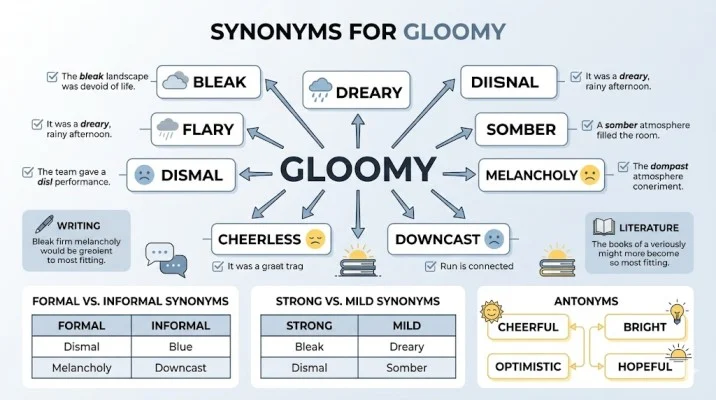
The best synonyms for gloomy are bleak, dreary, dismal, and somber. The right choice depends on tone, context, and intensity.
- Bleak hopeless or lacking encouragement.
- Dreary dull, depressing, and lifeless.
- Dismal very depressing or disappointing.
- Somber serious, dark, or quietly sad.
These words often replace gloomy, but each has its own shade of meaning.
What Does Gloomy Mean?
Gloomy is an adjective that describes something dark, depressing, sad, or lacking hope or brightness.
It can describe:
- A person’s emotional state
- Weather
- A room or place
- An atmosphere
- A prediction or outlook
Part of Speech
Adjective
Simple Definition
Gloomy means filled with sadness, darkness, or a feeling that things are unlikely to improve.
Example Sentences
- The sky looked gloomy before the storm arrived.
- She felt gloomy after hearing the disappointing news.
In everyday English, gloomy can describe both physical darkness and emotional sadness.
Core Meaning of Gloomy
At its heart, gloomy expresses a lack of light, hope, or cheerfulness.
Sometimes it refers to actual darkness:
The old castle looked gloomy on the cloudy afternoon.
Other times it describes emotions:
He remained gloomy despite everyone’s encouragement.
It can also describe situations:
Economists offered a gloomy forecast for the coming year.
The common idea behind every use is that something feels heavy, dull, or discouraging.
Grammar and Usage Notes
Since gloomy is an adjective, it describes nouns.
Common Sentence Patterns
- gloomy weather
- gloomy mood
- gloomy expression
- gloomy room
- gloomy forecast
- gloomy outlook
- gloomy atmosphere
- gloomy prediction
Common Collocations
You’ll frequently see gloomy paired with words such as:
- day
- evening
- sky
- future
- news
- thoughts
- feeling
- face
- mood
- office
When Gloomy Sounds Natural
Use gloomy when you want to suggest sadness mixed with darkness, dullness, or pessimism.
Examples:
- The forest became gloomy as the sun disappeared.
- The meeting ended on a gloomy note.
When Another Synonym Works Better
Sometimes another word communicates your meaning more precisely.
- Use melancholy for quiet, reflective sadness.
- Use bleak for hopeless situations.
- Use dreary for boring or lifeless places.
- Use somber for serious or respectful situations.
- Use dismal for extremely disappointing conditions.
Choosing the most accurate synonym improves clarity and tone.
Best Synonyms for Gloomy
| Synonym | Meaning | Tone | Best Use Case | Example Sentence |
|---|---|---|---|---|
| Bleak | Without hope or encouragement | Strong | Forecasts, situations | The report painted a bleak future. |
| Dreary | Dull and depressing | Neutral | Weather, rooms, daily life | It was a dreary afternoon. |
| Dismal | Extremely depressing | Strong | Results, conditions | Sales showed dismal growth. |
| Somber | Serious and quietly sad | Formal | Ceremonies, writing | The audience remained somber throughout the speech. |
| Melancholy | Deep, thoughtful sadness | Literary | Literature, emotions | A melancholy song played softly. |
| Depressing | Causing sadness | Common | News, experiences | The documentary was depressing. |
| Dark | Lacking light or hope | Everyday | Places and emotions | The hallway looked dark and gloomy. |
| Cheerless | Without warmth or happiness | Formal | Descriptions | The apartment felt cheerless after they moved away. |
| Morose | Bad-tempered and gloomy | Formal | Personality | He became morose after the loss. |
| Downcast | Looking sad or discouraged | Neutral | Expressions | She looked downcast after the interview. |
Common Synonyms for Gloomy
These are the alternatives you’ll hear most often in everyday conversation and writing.
Bleak
Meaning: Hopeless or lacking encouragement.
Best context: Difficult situations, predictions, and serious discussions.
Example: The company issued a bleak financial outlook.
Dreary
Meaning: Dull, gray, and lacking energy.
Best context: Weather, places, or repetitive routines.
Example: We spent the afternoon indoors because of the dreary weather.
Dismal
Meaning: Extremely depressing or disappointing.
Best context: News reports, results, and conditions.
Example: Attendance was dismal despite weeks of promotion.
Somber
Meaning: Serious and quietly sad.
Best context: Formal writing, memorials, and respectful events.
Example: Everyone spoke in a somber voice during the ceremony.
Melancholy
Meaning: Gentle, reflective sadness.
Best context: Literature, music, poetry, and thoughtful emotions.
Example: The old photograph filled her with melancholy.
Depressing
Meaning: Something that causes sadness.
Best context: Conversations about experiences or events.
Example: The ending of the movie was surprisingly depressing.
Cheerless
Meaning: Without warmth, joy, or comfort.
Best context: Homes, offices, and descriptions of atmosphere.
Example: The empty house felt cheerless throughout the winter.
Downcast
Meaning: Sad or discouraged in appearance.
Best context: Describing facial expressions or emotions.
Example: He looked downcast after receiving the news.
Formal Synonyms for Gloomy
Formal alternatives work well in academic writing, business communication, reports, and professional settings. They often sound more precise or polished than gloomy.
Somber
Best for: Formal speeches, memorials, journalism, and descriptive writing.
Meaning: Serious, quiet, and marked by sadness or dignity.
Example: The conference opened with a somber reflection on recent events.
Bleak
Best for: Reports, forecasts, economic writing, and analysis.
Meaning: Offering little hope or encouragement.
Example: Analysts presented a bleak outlook for the industry.
Dismal
Best for: Business reports, academic papers, and news articles.
Meaning: Very poor, depressing, or disappointing.
Example: The survey revealed dismal customer satisfaction rates.
Morose
Best for: Literature, psychology, and formal descriptions of personality.
Meaning: Habitually gloomy or bad-tempered.
Example: The novel describes its main character as increasingly morose.
Cheerless
Best for: Descriptive writing and formal narratives.
Meaning: Lacking comfort, happiness, or warmth.
Example: The waiting room had a cheerless appearance.
Austere (in certain contexts)
Although austere is not an exact synonym, it sometimes overlaps with gloomy when describing places that feel cold, plain, or emotionally unwelcoming.
Example: The office had an austere interior that felt almost gloomy.
Informal Synonyms for Gloomy
Casual conversation often calls for friendlier, everyday alternatives.
Down
Tone: Relaxed and conversational.
Example: I’ve been feeling a little down this week.
Blue
Tone: Informal and common in American English.
Example: She felt blue after moving away from her hometown.
Glum
Tone: Friendly and slightly playful.
Example: Don’t look so glum—we’ll figure it out.
Low
Tone: Casual.
Example: He’s been feeling low since changing jobs.
Bummed
Tone: Very informal.
Example: I was really bummed when the concert was canceled.
Miserable (context dependent)
Stronger than gloomy, but common in conversation.
Example: Everyone felt miserable after standing in the rain.
Strong Synonyms for Gloomy
These words express greater emotional weight or stronger negativity. Use them carefully because they can make your writing sound more dramatic.
Bleak
Suggests almost no hope.
Example: The village faced a bleak future after the factory closed.
Dismal
Highlights severe disappointment.
Example: The team’s dismal performance shocked the fans.
Miserable
Expresses intense unhappiness.
Example: She was miserable after losing her pet.
Despondent
Implies a deep loss of hope.
Example: He became despondent after several failed attempts.
Hopeless
Indicates that improvement seems impossible.
Example: The situation appeared hopeless.
Desolate
Often describes places that feel empty, abandoned, or emotionally barren.
Example: The abandoned town looked desolate under the gray sky.
Oppressive (for atmosphere)
Works when describing an environment that feels emotionally heavy.
Example: The oppressive silence filled the gloomy hallway.
Mild Synonyms for Gloomy
Sometimes you want a softer description that doesn’t sound overly dramatic.
Quiet
Can suggest a subdued emotional atmosphere.
Example: The room became quiet after the announcement.
Dim
Suitable when referring mainly to lighting.
Example: The café had dim lighting.
Cloudy
Often used for weather and occasionally for mood.
Example: It was a cloudy afternoon.
Subdued
Suggests calmness with slight sadness.
Example: Her normally energetic voice sounded subdued.
Thoughtful
Not an exact synonym, but useful when the mood is reflective rather than sad.
Example: He became thoughtful during the discussion.
Serious
Sometimes replaces gloomy when sadness is not the main focus.
Example: The meeting had a serious tone throughout.
Synonyms for Gloomy by Context
Choosing the right synonym depends on what you’re describing.
Everyday Conversation
Simple, familiar words usually sound the most natural.
Good choices include:
- down
- blue
- glum
- low
- miserable (when appropriate)
Example:
“I’m feeling a little down today.”
These words are common in spoken English and personal messages.
Professional Writing
Professional writing benefits from clear, measured language.
Recommended synonyms:
- bleak
- somber
- dismal
- subdued
Example:
“The report presents a bleak economic outlook.”
These choices sound objective without being overly emotional.
Academic Writing
Academic writing favors precise vocabulary.
Useful options:
- bleak
- somber
- dismal
- morose (when describing behavior or literature)
Example:
“The author creates a bleak vision of society.”
Creative Writing
Creative writing often depends on atmosphere and emotion.
Strong choices include:
- melancholy
- desolate
- dreary
- somber
- oppressive
- cheerless
Example:
“A melancholy wind drifted through the empty streets.”
These words create vivid imagery.
Marketing Copy
Marketing usually avoids negative language, but when discussing problems or “before” situations, carefully chosen words can add contrast.
Useful options:
- dull
- bleak
- uninspiring
- dreary
Example:
“Transform a dull workspace into a bright, welcoming office.”
Emotional Expression
When describing feelings, the best synonym depends on intensity.
- down (mild)
- blue (casual)
- melancholy (reflective)
- gloomy (neutral)
- despondent (very strong)
Choosing the right level of emotion keeps your writing authentic.
Personal Communication
In texts, emails, or conversations, natural wording matters more than sophisticated vocabulary.
Best options:
- down
- blue
- glum
- low
Example:
“I’ve been feeling a bit blue lately.”
These words sound warm and conversational.
Another Word for Gloomy in a Sentence
Here are realistic examples using different synonyms.
- The forecast looked bleak, so we postponed the trip.
- The office felt cheerless without any windows.
- Everyone remained somber during the memorial service.
- The children stayed indoors because of the dreary weather.
- He seemed downcast after the interview.
- The movie had a deeply melancholy ending.
- Investors worried about the dismal financial results.
- She admitted she had been feeling blue all week.
- The abandoned house looked desolate at sunset.
- His normally cheerful attitude became morose after the setback.
- The long winter left everyone feeling a little down.
- The atmosphere grew oppressive as the storm approached.
- Their vacation started on a cloudy morning but improved later.
- Her voice became subdued when discussing the accident.
- The hallway remained dim, giving the building a gloomy appearance.
Gloomy Synonyms Compared
Many synonyms for gloomy overlap, but they are not always interchangeable. The table below highlights the differences.
| Synonym | Primary Meaning | Tone | Intensity | Best Use Case |
|---|---|---|---|---|
| Gloomy | Sad, dark, or lacking hope | Neutral | Medium | General writing and conversation |
| Bleak | Hopeless or discouraging | Formal | Strong | Forecasts, reports, serious situations |
| Dreary | Dull and lifeless | Neutral | Medium | Weather, places, routines |
| Dismal | Extremely disappointing or depressing | Formal | Strong | Results, news, conditions |
| Somber | Serious and quietly sad | Formal | Medium | Ceremonies, speeches, literature |
| Melancholy | Reflective, gentle sadness | Literary | Medium | Creative writing, music, poetry |
| Morose | Habitually gloomy or sullen | Formal | Strong | Personality descriptions |
| Downcast | Showing sadness or disappointment | Neutral | Mild | Facial expressions and emotions |
| Blue | Mildly sad | Informal | Mild | Everyday conversation |
| Glum | Quietly unhappy | Informal | Mild | Casual speech |
Key Differences
- Bleak focuses on a lack of hope.
- Dreary emphasizes dullness rather than emotion.
- Somber suggests seriousness and dignity.
- Melancholy often carries a thoughtful or nostalgic feeling.
- Blue and down are everyday alternatives that sound more conversational.
Words Similar to Gloomy
These words belong to the same semantic field but are not exact synonyms. They share related ideas but cannot always replace gloomy.
| Related Word | Why It’s Related | Why It Isn’t Always a Synonym |
|---|---|---|
| Dark | Refers to lack of light | Doesn’t always imply sadness |
| Gray | Suggests dullness | Usually describes color or weather |
| Lonely | Can create a gloomy feeling | Focuses on isolation rather than mood |
| Miserable | Describes intense unhappiness | Stronger than gloomy |
| Depressed | Refers to emotional state | Often more serious and sometimes clinical |
| Quiet | Can create a subdued atmosphere | Doesn’t necessarily imply sadness |
| Hopeless | Suggests no expectation of improvement | More specific than gloomy |
| Cold | May describe an unwelcoming atmosphere | Usually refers to temperature or personality |
Using related words thoughtfully adds variety, but always check whether they preserve the original meaning.
Antonyms of Gloomy
These words express the opposite idea.
| Antonym | Meaning | Example Sentence |
|---|---|---|
| Cheerful | Happy and positive | She remained cheerful despite the rain. |
| Bright | Full of light or optimism | The room felt bright and welcoming. |
| Optimistic | Expecting good outcomes | He stayed optimistic about the future. |
| Joyful | Filled with happiness | The celebration was joyful. |
| Hopeful | Feeling confident about the future | Everyone remained hopeful after the meeting. |
| Sunny | Pleasant or cheerful | She has a sunny personality. |
| Lively | Full of energy | The lively crowd enjoyed the concert. |
| Upbeat | Positive and encouraging | The manager gave an upbeat presentation. |
How to Choose the Right Synonym for Gloomy
The best synonym depends on more than meaning alone. Consider these factors before choosing a replacement.
Match the Context
Ask yourself what you’re describing.
- A person?
- The weather?
- A room?
- A prediction?
- An emotional atmosphere?
For example, dreary works well for weather, while bleak is often better for forecasts.
Match the Tone
Formal writing usually benefits from words such as:
- somber
- bleak
- dismal
Casual writing sounds more natural with:
- down
- blue
- glum
Check the Intensity
Some words are much stronger than others.
- Blue → mild sadness
- Gloomy → moderate sadness
- Bleak → strong hopelessness
- Despondent → very intense despair
Avoid stronger words unless they truly fit the situation.
Think About Your Reader
Choose vocabulary your audience will immediately understand. Clear language is often more effective than uncommon words.
Make Sure It’s an Exact Synonym
Some related words share a similar feeling but don’t carry the same meaning. Replace gloomy only when the new word fits naturally.
Common Mistakes When Using Synonyms for Gloomy
Avoid these common errors.
Choosing a Word That’s Too Strong
Using despondent when someone is only mildly disappointed exaggerates the situation.
Mixing Formal and Casual Language
Words like morose may sound unnatural in everyday conversation, while blue may sound too informal in an academic essay.
Ignoring Context
A dreary room sounds natural.
A dreary forecast usually sounds less natural than a bleak forecast.
Treating Related Words as Exact Synonyms
Words such as dark or cold sometimes overlap with gloomy, but they don’t always express sadness.
Overusing the Same Synonym
Repeating bleak throughout a piece of writing becomes monotonous. Vary your vocabulary when appropriate.
Quick Synonym List for Gloomy
Common Synonyms
- bleak
- dreary
- dismal
- somber
- melancholy
- depressing
- downcast
Formal Synonyms
- somber
- bleak
- dismal
- morose
- cheerless
Informal Synonyms
- down
- blue
- glum
- low
- bummed
Strong Synonyms
- bleak
- despondent
- miserable
- desolate
- hopeless
Mild Synonyms
- subdued
- dim
- quiet
- cloudy
- thoughtful (context-dependent)
Related Words
- dark
- gray
- lonely
- cold
- depressed
- quiet
- hopeless
FAQs
What is a synonym for gloomy?
Common synonyms for gloomy include dreary, somber, bleak, depressing, dismal, and dark, depending on the context.
What does a gloomy morning mean?
A gloomy morning usually means a morning that is dark, cloudy, dull, or lacking brightness. It can also describe a sad or depressing mood.
What are the synonyms of gloomy?
The synonyms of gloomy include dreary, bleak, somber, dismal, depressing, melancholy, and overcast.
What does gloomy mean?
Gloomy describes something dark, depressing, sad, or lacking hope. It can refer to weather, places, situations, or a person’s mood.
What are the synonyms for gloomy?
Useful synonyms for gloomy include dreary, bleak, somber, dismal, melancholy, depressing, and overcast.
What are gloomy synonyms for writing?
Strong gloomy synonyms include bleak, dreary, somber, and dismal. Choose based on whether you mean sadness, darkness, poor conditions, or a lack of hope.
What is the synonym of gloomy?
A close synonym of gloomy is dreary. Other alternatives include bleak, somber, dismal, and melancholy.
What does a gloomy afternoon mean?
A gloomy afternoon usually describes an afternoon that feels dark, cloudy, dull, or depressing, often because of the weather or mood.
What is the opposite of gloomy?
The opposite of gloomy can be cheerful, bright, joyful, hopeful, or sunny, depending on the context.
What are some gloomy examples?
Examples include “a gloomy day,” “a gloomy room,” “a gloomy mood,” and “a gloomy outlook.” Each describes darkness, sadness, dullness, or a lack of hope.
What is the best synonym for gloomy?
Bleak, dreary, dismal, and somber are among the best synonyms. The right choice depends on whether you’re describing a mood, place, situation, or outlook.
What is another word for gloomy?
Common alternatives include bleak, dreary, melancholy, somber, dismal, and depressing.
What is a formal synonym for gloomy?
Somber and bleak are excellent formal choices. They work well in academic, professional, and journalistic writing.
What is an informal synonym for gloomy?
Blue, down, and glum are common informal alternatives used in everyday conversation.
What is a stronger word for gloomy?
Despondent, hopeless, desolate, and miserable express stronger emotions than gloomy.
What is a milder word for gloomy?
Subdued, quiet, dim, or blue often communicate a softer feeling.
What words are similar to gloomy?
Related words include dark, gray, lonely, depressed, and cold. While connected in meaning, they are not always direct replacements.
What is the opposite of gloomy?
The most common antonyms are cheerful, bright, optimistic, hopeful, joyful, and upbeat.
Conclusion
Finding the best synonyms for gloomy is about more than replacing one word with another. Each alternative carries its own tone, emotional weight, and level of formality.
For everyday writing, words like dreary, blue, and down often feel natural. In professional or academic contexts, bleak, somber, and dismal provide greater precision. Creative writers may prefer melancholy or desolate to create a richer emotional atmosphere.
Whenever you choose a synonym, consider the context, the tone, and the intensity you want to convey. A thoughtful word choice makes your writing clearer, more engaging, and more accurate.
Read More Related Articles:
- Synonyms for Wanted | Meaning, Examples, and Better Word …
- Synonyms for Government | Meaning, Examples, and Better …