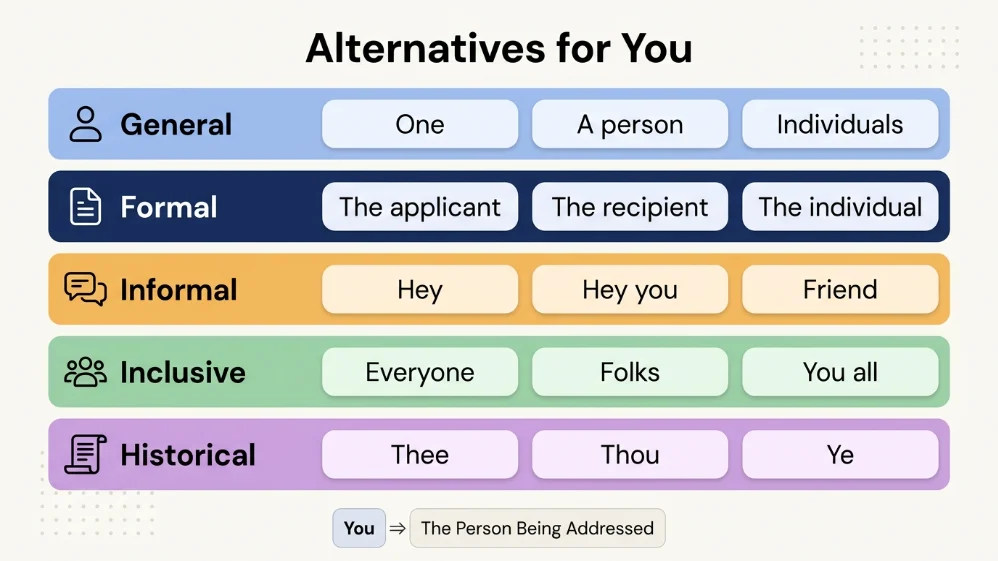
Language becomes more engaging when you choose words that match the situation and tone. While synonyms of you may seem unusual at first, many alternatives can replace or represent “you” in different contexts, including formal writing, speeches, literature, customer communication, and creative content. Selecting the right substitute improves clarity, avoids repetition, and makes every sentence sound more polished and natural.
This guide explores the best synonyms of you with clear meanings, practical examples, and usage tips for everyday, academic, and professional writing. Whether you’re rewriting content, improving dialogue, or expanding your vocabulary, these carefully explained alternatives will help you communicate with greater precision while keeping your writing smooth, engaging, and easy to understand.
Best Alternatives for You
The best alternatives for you depend on context. For formal writing, one works for general statements. For inclusive language, we or our can include the speaker. For impersonal statements, people or they are good choices. For addressing a specific person, you is almost always the best choice.
What Does You Mean?
You means the person or people being spoken to. It is the second-person pronoun used to address someone directly.
Part of Speech: Pronoun (second person)
Common Uses:
As a subject pronoun:
You are the best candidate for the job.
You need to finish this project today.
As an object pronoun:
I will help you with your work.
She gave you the instructions.
In everyday English, you is one of the most frequently used words. It appears in conversation, writing, instructions, marketing, and personal communication.
Core Meaning of You
At its heart, you is used to address the person or people the speaker is talking to. It is direct and personal. Unlike many other languages, English uses the same word for singular and plural you.
Sometimes you refers to one person, and sometimes it refers to a group. This ambiguity can be useful or confusing depending on the context. In some cases, writers may want to avoid using you to make their writing more formal, more inclusive, or less direct.
Grammar and Usage Notes
Part of Speech: Pronoun
Common Sentence Patterns:
- you + verb: You are right.
- verb + you: I see you.
- preposition + you: This is for you.
Common Collocations:
- you are
- you have
- you can
- you will
- you should
- you need to
- you want to
- you know
- you think
When “You” Sounds Natural:
Use you when directly addressing someone. Examples include:
- Personal conversation
- Customer service
- Marketing and advertising
- Instructions and guides
- Everyday communication
- Friendly writing
When Another Word Works Better:
Sometimes an alternative sounds more precise or formal.
- One works for formal, general statements.
- We works for inclusive, collaborative statements.
- They works for third-person plural statements.
- People works for general, impersonal statements.
- He or she works for specific gendered subjects.
Best Alternatives for You
| Alternative | Meaning | Tone | Best Use Case | Example Sentence |
|---|---|---|---|---|
| One | A general person | Formal | Academic, philosophical | One must consider the options. |
| We | Including the speaker | Inclusive | Collaborative statements | We should all work together. |
| They | Third-person plural | Neutral | General statements | They say that practice makes perfect. |
| People | General group | Neutral | Impersonal statements | People often make mistakes. |
| He/She | Specific gender | Neutral | Gendered subjects | He should think carefully. |
| Individual | A single person | Formal | Formal, legal contexts | Each individual is responsible. |
| Someone | An unspecified person | Neutral | General, indefinite | Someone should take charge. |
| Anybody | Any person | Neutral | General statements | Anybody can learn this skill. |
| Thou | You (archaic) | Old-fashioned | Historical, poetic | Thou art wise. |
| Ye | You (archaic, plural) | Old-fashioned | Historical, poetic | Hear ye, hear ye! |
When to Use Alternatives to You
Formal Writing
In formal academic or professional writing, one is often used to make general statements sound more formal and impersonal.
Example:
✔ One should always check one’s sources.
✘ You should always check your sources. (if addressing a general audience)
Other formal alternatives:
He or she (traditional formal):
Everyone should do his or her best.
They (modern formal):
Everyone should do their best.
Avoiding Direct Address
Sometimes writers avoid using you to sound more inclusive or less personal.
Example:
❌ You should always be honest.
✔ One should always be honest.
Inclusive Language
When speaking for a group, use we to include yourself.
Example:
✔ We value our customers.
✘ You value your customers. (if the speaker is not included)
Impersonal Statements
For general statements that apply to everyone, people or they can replace you.
Example:
❌ You need to be careful when driving.
✔ People need to be careful when driving.
Historical or Poetic Contexts
In historical or poetic writing, thou or ye can be used for stylistic effect.
Example:
Thou art wise beyond thy years.
Hear ye, hear ye!
Formal Alternatives for You
Formal alternatives are useful in academic papers, business communication, legal documents, reports, and professional writing.
One
Best for: Academic, philosophical, formal statements
One means a general person. It is used to make statements impersonal and formal.
Example:
One’s success depends on one’s efforts.
It is important for one to consider all options.
He or She
Best for: Traditional formal writing
He or she is used when the subject could be male or female.
Example:
Everyone should bring his or her own materials.
They
Best for: Modern formal writing
They is now widely accepted as a singular, gender-neutral pronoun.
Example:
Everyone should bring their own materials.
Individuals
Best for: Formal, legal, professional contexts
Individuals means specific people, often in a formal context.
Example:
Each individual is responsible for their own actions.
Informal Alternatives for You
In casual writing and everyday conversation, you is almost always the best choice. However, sometimes alternatives like people or everyone can be used for stylistic variation.
People
Tone: Casual to neutral
People is a common way to make general statements.
Example:
People often forget to be kind.
Everyone
Tone: Casual and inclusive
Everyone is a gentle way to include all people.
Example:
Everyone needs to contribute.
Folks
Tone: Casual and friendly
Folks is an informal way to address a group.
Example:
Alright folks, let’s get started.
Common Mistakes When Using Alternatives for You
Using “You” with an Impersonal Subject
When the subject is not “you,” using you creates confusion.
❌ The employee should submit your report.
✔ The employee should submit their report.
Using “One” Too Formally in Casual Writing
One can sound overly formal or pretentious in everyday conversation.
❌ One’s dinner was delicious.
✔ Your dinner was delicious. (if addressing someone)
Misusing “He” or “She” with Gender-Neutral Subjects
Traditional usage of “he” alone is now considered outdated and potentially offensive.
❌ Everyone should bring his own lunch.
✔ Everyone should bring their own lunch.
Overusing Alternatives
Sometimes it’s best to just use you. Overusing alternatives can make writing sound awkward or forced.
Example:
❌ One should always do one’s best in one’s work.
✔ You should always do your best in your work.
Quick Summary of Alternatives for You
| Alternative | When to Use | Example |
|---|---|---|
| One | Formal, general statements | One must be careful. |
| We | Inclusive first-person plural | We should all help. |
| They | Third-person plural or singular | They say it’s true. |
| People | General, impersonal | People often agree. |
| He/She | Specific gendered subject | He should decide. |
| Individuals | Formal, legal contexts | Each individual is responsible. |
| Someone | Unspecified person | Someone should help. |
| Thou | Historical/poetic | Thou art wise. |
FAQs
What is the formal alternative for you?
The formal alternative for you is one in general statements. For specific subjects, use he, she, or they as appropriate.
What is the inclusive alternative for you?
The inclusive alternative is we, which includes the speaker in the group.
Can I use “they” instead of “you”?
Yes, if you are making a general statement about people. Example: “They say that practice makes perfect” instead of “You say that practice makes perfect.”
What is the plural alternative for you?
The plural alternative for you is you itself (since you can be singular or plural) or y’all in some dialects.
Is “one” still used?
Yes, especially in formal academic and philosophical writing, though it is less common in everyday conversation.
Conclusion
While you is a fundamental and often irreplaceable word, understanding alternatives like one, we, they, people, and he/she helps you write with greater precision and formality. The right choice depends on your subject, tone, and audience.
Before replacing you, think about who or what you are referring to. A carefully chosen alternative can make your writing sound more formal, inclusive, or precise. Whether you’re writing an essay, a business report, or everyday messages, selecting the right word will help your ideas connect more effectively with readers.
Read More Related Articles:
Synonyms for Empty | Meaning, Examples, and Better Word …
Synonyms for Regret | Meaning, Examples, and Better Word Choices










19 thoughts on “Synonyms of You| Best Alternatives with Meanings and Examples”