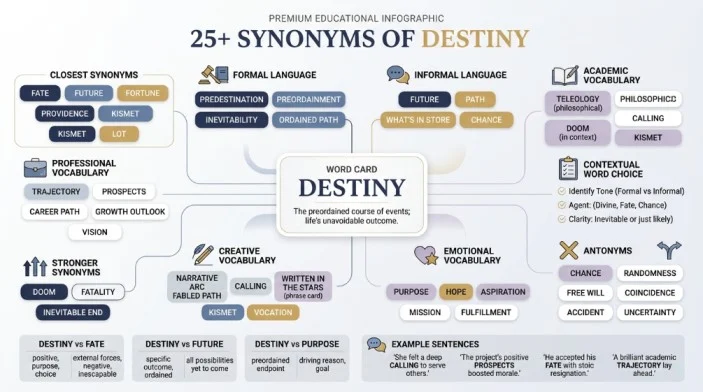
A writer can mention the same word several times without noticing it. In an essay, email, caption, resume, story, or conversation, repeating “destiny” can make otherwise thoughtful writing feel predictable. The right alternative can make the message more precise and better suited to its audience.
Searching for synonyms of destiny is useful because words such as fate, fortune, providence, calling, and future overlap with destiny but do not always mean exactly the same thing. Choosing among them depends on whether you are writing academically, speaking casually, describing a life purpose, discussing an unavoidable outcome, or creating an emotional story.
This guide explains those differences clearly so you can choose a word for its actual meaning, tone, and context rather than simply replacing one word with another.
What Are the Best Synonyms of “Destiny”?
Destiny means the future course or outcome believed to be determined by forces beyond a person’s complete control. The closest synonyms include fate, fortune, providence, kismet, lot, and future. For formal writing, fate or providence often works well. For emotional or creative writing, calling, fate, and kismet can be more expressive.
The best alternative depends on the idea you want to communicate. Fate suggests a predetermined outcome, fortune emphasizes what happens to someone, providence suggests divine guidance, and calling describes a purpose a person feels drawn toward.
Meaning, Tone, and Context
Simple Definition
Destiny refers to a future course, role, or outcome that is believed to be destined to happen. The word often carries the idea that some events are predetermined or shaped by forces outside ordinary human control.
For example:
She believed it was her destiny to become a teacher.
Here, destiny suggests more than an ordinary career choice. It implies that teaching was somehow the path she was meant to follow.
Part of Speech
Destiny is primarily a noun.
Common grammatical patterns include:
- destiny as a noun: “He accepted his destiny.”
- destined as an adjective or participial form: “She was destined for success.”
- destine as a verb: “The decision destined the project for failure.”
The most common form in everyday vocabulary questions is the noun destiny.
Overall Tone
Destiny is generally neutral in grammatical tone but elevated and philosophical in emotional tone.
It can sound inspirational, dramatic, spiritual, romantic, or literary depending on the sentence.
Compare:
She chose medicine because she enjoyed science.
with:
She chose medicine because she believed it was her destiny.
The second sentence adds a sense of purpose and inevitability.
Positive, Neutral, or Negative?
Destiny is usually neutral, but context can make it positive or negative.
Positive:
He believed his destiny was to help others.
Neutral:
The novel explores the relationship between choice and destiny.
Negative:
The character feared that poverty was his destiny.
The word itself does not guarantee a positive outcome.
Formality Level
Destiny is neutral to semi formal in ordinary writing. It is also common in literary, philosophical, religious, motivational, and emotional contexts.
It is less common in highly technical professional writing when a more precise word such as outcome, trajectory, or projected future communicates the intended meaning more directly.
Common Uses
Native English speakers commonly use destiny when discussing:
- life purpose
- predetermined outcomes
- personal journeys
- historical events
- spiritual beliefs
- romantic relationships
- success and failure
- fictional characters
- major life decisions
- philosophical ideas
Word Forms
Relevant forms include:
- destiny, noun
- destined, adjective or participial form
- destine, verb
- destined for, common phrase meaning likely or intended to reach a particular result
There is no need to force every grammatical form into ordinary writing. In most cases, destiny and destined are the useful forms.
When and How to Use “Destiny”
Destiny works best when you want to communicate a future path, purpose, or outcome that seems predetermined or larger than an ordinary decision.
Professional
She viewed her leadership role as an opportunity to shape the company’s future rather than simply accept her destiny.
Professional writing usually benefits from restraint. Here, destiny works because the sentence is reflective rather than technical.
Academic
The novel examines whether human choices can overcome destiny.
In academic writing, destiny can be appropriate when discussing literature, philosophy, religion, history, or cultural beliefs.
Workplace
Marcus felt that moving into management was part of his professional destiny.
This sounds personal and reflective. In a formal performance review, career direction or professional goals would usually be more precise.
Personal
After years of searching, she felt she had finally found her destiny.
The word naturally fits personal reflections about purpose and life direction.
I have always felt that teaching was part of my destiny.
This can work in a personal email, especially when the message is emotional or inspirational. It may sound too dramatic in a routine business email.
Resume
Instead of:
My destiny is to become a successful marketing manager.
Prefer:
My goal is to build a career in strategic marketing.
A resume should usually emphasize skills, goals, achievements, and evidence rather than predetermined destiny.
Social Media
Sometimes the path you never planned becomes the destiny you were meant to discover.
Destiny works naturally in motivational captions because its emotional tone adds impact.
Best Synonyms of “Destiny”
No synonym of destiny is identical in every situation. Each alternative highlights a slightly different idea.
Best for Professional Writing: Future
Future is usually safer in professional communication because it is broad, neutral, and easy to understand.
We are focused on building a stronger future for the company.
Best for Academic Writing: Fate
Fate is especially useful when discussing literature, philosophy, mythology, or the idea that events are predetermined.
The tragedy presents fate as a force that limits human choice.
Best for Business Communication: Outlook
Outlook works when destiny refers to what is likely to happen rather than an unavoidable predetermined path.
The company’s financial outlook remains positive.
Best for Casual Conversation: Fate
Fate is natural in everyday speech when people are talking about unexpected events or relationships.
Maybe fate brought us to the same place.
Best for Emotional Writing: Calling
Calling emphasizes a personal sense of purpose rather than unavoidable events.
She always felt that caring for children was her calling.
Best for Creative Writing: Fate
Fate carries dramatic weight and works particularly well in stories involving conflict, prophecy, or unavoidable outcomes.
Best for Resume Writing: Purpose
Purpose is generally more professional than destiny when describing career motivation.
My purpose is to create accessible digital experiences for diverse audiences.
Best for Workplace Communication: Career Path
When destiny refers to professional direction, career path provides a more concrete alternative.
She has developed a clear career path in organizational leadership.
Stronger Meaning: Fate
Fate often creates a stronger sense that an outcome cannot be avoided.
Softer Meaning: Future
Future is less dramatic and does not necessarily imply predetermination.
When Not to Use “Destiny”
When You Mean a Simple Future
“Destiny” can sound too dramatic if you simply mean what will happen later.
Less effective:
The company’s destiny depends on next quarter’s sales.
Better:
The company’s future depends on next quarter’s sales.
Future is clearer because the sentence concerns an ordinary projection, not a predetermined fate.
When You Mean a Career Goal
Less effective:
My destiny is to become a financial analyst.
Better:
My goal is to become a financial analyst.
Goal communicates deliberate intention, while destiny suggests that the outcome is somehow predetermined.
When You Mean a Business Prediction
Less effective:
The destiny of the company looks uncertain.
Better:
The company’s outlook looks uncertain.
Outlook is more natural in business contexts.
When You Mean Personal Motivation
Less effective:
Her destiny is to help young writers.
Better:
Her purpose is to help young writers.
Purpose focuses on motivation and intention rather than an externally determined future.
When the Word Sounds Too Dramatic
Less effective:
It was my destiny to finish the quarterly report.
Better:
It was my responsibility to finish the quarterly report.
Destiny is unnecessarily dramatic for routine workplace duties.
When You Need a Measurable Concept
Less effective:
The project’s destiny depends on user adoption.
Better:
The project’s success depends on user adoption.
Success gives the reader a measurable outcome instead of an abstract philosophical idea.
When You Mean Personal Choice
Less effective:
Her destiny was to study engineering.
Better:
She chose to study engineering.
If the sentence is about an intentional decision, choice is more accurate.
Words Commonly Confused With “Destiny”
Fate
Difference: Fate usually emphasizes events that seem predetermined or unavoidable.
When to Use It: Use fate for inevitable outcomes, especially in literature, storytelling, philosophy, and emotional conversation.
Example:
The hero could not escape his fate.
Future
Difference: Future simply refers to time or events that have not happened yet. It does not automatically imply predetermination.
When to Use It: Use future for plans, possibilities, predictions, and what comes later.
Example:
She is thinking carefully about her future.
Fortune
Difference: Fortune focuses on a person’s luck, circumstances, or success and failure.
When to Use It: Use fortune when discussing favorable or unfavorable circumstances.
Example:
Her fortune changed after she found a new business partner.
Purpose
Difference: Purpose describes the reason something exists or the meaningful goal a person chooses to pursue.
When to Use It: Use purpose for motivation, mission, and intentional direction.
Example:
His purpose is to make education easier to access.
Calling
Difference: Calling suggests a strong inner feeling that a particular role or activity is one’s meaningful life work.
When to Use It: Use it for careers, service, creative work, or personal missions.
Example:
Teaching became her calling after she volunteered at a local school.
Providence
Difference: Providence often carries a religious meaning involving divine guidance or care.
When to Use It: Use it when the context specifically involves faith, divine direction, or spiritual belief.
Example:
He saw the unexpected opportunity as an act of providence.
Best Synonyms of “Destiny” by Context
| Context | Best Synonym | Why It Works | Example |
|---|---|---|---|
| Formal writing | Fate | Expresses predetermined outcomes clearly | The novel explores fate and human choice. |
| Academic writing | Fate | Fits philosophical and literary analysis | The study examines ideas about fate. |
| Professional communication | Future | Neutral and practical | We are planning for the company’s future. |
| Business emails | Outlook | Useful for projections and expectations | The market outlook remains stable. |
| Resume writing | Purpose | Communicates motivation professionally | My purpose is to improve customer experiences. |
| Workplace communication | Career path | Makes professional direction concrete | She has chosen a career path in finance. |
| Casual conversation | Fate | Natural and familiar | Maybe fate brought us together. |
| Everyday speaking | Future | Simple and widely understood | I am thinking about my future. |
| Creative writing | Fate | Adds dramatic weight | Fate pulled the two strangers together. |
| Storytelling | Fortune | Highlights changing circumstances | His fortune changed overnight. |
| Emotional writing | Calling | Expresses meaningful personal purpose | Writing became her calling. |
| Strong emphasis | Fate | Suggests inevitability | He believed it was his fate. |
| Mild tone | Future | Avoids dramatic implications | She is planning her future. |
| Social media captions | Calling | Works well for inspirational messages | Follow your calling. |
| American English | Fate | Common and natural in general use | They joked that fate had intervened. |
| British English | Fate | Also widely understood and used | The story centers on fate and choice. |
How to Choose the Best Synonym of “Destiny”
Start with the exact idea you want to communicate.
- If you mean an unavoidable outcome, choose fate.
- If you mean what will happen later, choose future.
- If you mean luck or changing circumstances, choose fortune.
- If you mean a meaningful life purpose, choose purpose or calling.
- If you mean divine guidance, choose providence.
- If you mean a professional direction, choose career path.
- If you mean a prediction about what is likely to happen, choose outlook or prospects.
Next, consider your audience. A resume needs concrete professional language, while a novel can comfortably use emotionally powerful vocabulary.
Finally, check emotional strength. Future is relatively neutral. Fate sounds more inevitable. Calling feels more personal and purposeful. The best synonym is therefore the one that preserves your intended meaning while matching your tone.
Real Life Examples of “Destiny”
School
Original:
The story shows how the main character struggles with destiny.
Improved alternative:
The story shows how the main character struggles with fate.
Fate is often more precise when a literary character is dealing with an unavoidable outcome.
College
The essay explores whether people can change their destiny through personal choices.
A more academic version could be:
The essay explores whether people can change their future through personal choices.
Workplace
She believed her promotion was part of her destiny.
More practical:
She believed the promotion marked an important step in her career path.
Business
The company’s destiny depends on its ability to adapt.
More precise:
The company’s future depends on its ability to adapt.
I have always believed that helping people was part of my destiny.
For a professional email:
I have always felt that helping people was part of my purpose.
Resume
Avoid:
My destiny is to become a successful project manager.
Prefer:
My career goal is to become a highly effective project manager.
Conversation
Maybe it was fate that we met at the same conference.
This is a natural conversational use because fate often suggests an unexpected connection.
Storytelling
The prince spent years trying to escape the destiny written for him.
A more dramatic alternative:
The prince spent years trying to escape the fate written for him.
Blogging
Your career does not have to follow a fixed destiny.
A practical alternative:
Your career does not have to follow a fixed path.
Social Media
Your past does not have to define your destiny.
A softer alternative:
Your past does not have to define your future.
25 Best Synonyms of “Destiny”
The list below includes close synonyms and context dependent alternatives. Some words overlap with destiny only in particular meanings, so the usage column explains where each one works best.
| Synonym | Simple Meaning | Best Used For | Example Sentence |
|---|---|---|---|
| Fate | A predetermined outcome | Inevitable events | She believed fate had brought them together. |
| Future | What is yet to happen | Neutral everyday writing | He is planning his future carefully. |
| Fortune | Luck or changing circumstances | Success and luck | Fortune favored the young entrepreneur. |
| Providence | Divine guidance or care | Religious contexts | She trusted providence during difficult times. |
| Kismet | Fate or destiny, especially in a romantic or spiritual sense | Informal and literary contexts | They joked that their meeting was kismet. |
| Lot | A person’s assigned circumstances | Formal, literary, or traditional contexts | He accepted his lot without complaint. |
| Calling | A deeply felt purpose | Career and personal purpose | Nursing became her calling. |
| Purpose | A meaningful reason or goal | Professional and personal writing | Her purpose is to make learning accessible. |
| Path | A course through life | Personal development | He chose a different path after college. |
| Course | The direction events take | Formal and analytical writing | The decision changed the course of her life. |
| Trajectory | The direction or development of something | Academic and professional contexts | Her career trajectory changed after the promotion. |
| Prospects | Expected future possibilities | Business and career writing | The company’s prospects look promising. |
| Outlook | Expected future condition | Business and professional writing | The economic outlook remains uncertain. |
| Outcome | The result of events | Objective writing | The final outcome depended on several decisions. |
| Result | What happens because of something | General communication | The result was different from what they expected. |
| End | The final point or result | Literary and philosophical writing | The character could not escape his tragic end. |
| Destination | The place or point toward which something moves | Metaphorical writing | Her destination was never as important as the journey. |
| Direction | The course something takes | Career and personal planning | He finally found a clear direction. |
| Role | A position or function someone is meant to fulfill | Personal and professional contexts | She found her role in the community. |
| Mission | An important purpose or task | Professional and inspirational writing | His mission is to improve public education. |
| Vocation | A profession or strong sense of occupational purpose | Formal and career contexts | Teaching became her vocation. |
| Calling | A strong sense of meaningful work | Emotional and personal contexts | Writing felt like a calling rather than a job. |
| Design | An intended arrangement or plan | Literary, philosophical, or religious contexts | He believed events followed a larger design. |
| Scheme | An organized plan or arrangement | Literary or philosophical contexts | The character questioned the larger scheme of events. |
| Predetermination | The idea that events are decided in advance | Academic and philosophical writing | The debate centers on predetermination and free will. |
Important usage note: Calling appears twice conceptually in common synonym lists because it is one of the clearest alternatives for destiny when destiny means life purpose. In a strict lexical list, however, it should be treated as a context based alternative rather than an interchangeable synonym. For exact replacement, fate, future, fortune, providence, and kismet are generally closer.
Synonyms of “Destiny” by Usage
Professional vs Personal Synonyms
Professional writing usually benefits from concrete terms.
Use:
- future
- career path
- direction
- trajectory
- prospects
- outlook
- purpose
Personal writing can use more emotional choices.
Use:
- fate
- calling
- kismet
- fortune
- path
- destiny
For example:
I am excited about my professional trajectory.
sounds more appropriate in a career discussion than:
I am excited about my professional destiny.
Formal vs Conversational Synonyms
For reports, essays, and presentations, consider:
- fate
- trajectory
- outcome
- course
- future
- prospects
- providence, when the religious context requires it
For conversations and texting, consider:
- fate
- future
- luck
- calling
- path
- kismet
A phrase such as “It was kismet” is expressive and conversational. It would be unusual in a scientific report.
Academic Synonyms
Academic writing needs precision. The best choice depends on the discipline.
For literature:
- fate
- predetermined outcome
- course
- end
For philosophy:
- fate
- predetermination
- providence
- free will, when discussing the opposing concept
For social science or business:
- trajectory
- outcome
- prospects
- future
For example:
The study examines how perceived control influences expectations about the future.
This is generally clearer than using destiny if the research concerns expectations rather than metaphysical belief.
Professional and Business Synonyms
Resumes
Use:
- purpose
- career path
- professional direction
- goals
- trajectory
Avoid dramatic phrases such as my destiny unless the resume belongs to a highly creative field.
Interviews
Purpose and career direction work well.
I see this role as an important step in my career path.
Meetings
Use future, direction, outlook, or trajectory.
We need to discuss the future direction of the project.
Presentations
Use vision, direction, or outlook depending on the subject.
Performance Reviews
Use career trajectory or professional growth.
This role has strengthened my professional trajectory.
Client Communication
Use neutral vocabulary such as future, outlook, direction, and expected outcome.
Business Emails
Avoid destiny when a practical term communicates the idea more directly.
Instead of:
This decision will determine the destiny of the project.
Write:
This decision will determine the future of the project.
Creative and Literary Synonyms
Creative writing gives you more freedom to use expressive language.
Strong options include:
- fate
- fortune
- kismet
- calling
- lot
- path
- end
- design
These words can change the emotional color of a sentence.
She walked toward her future.
- feels calm and open.
She walked toward her fate.
- feels darker and more inevitable.
She walked toward her calling.
- feels purposeful and hopeful.
Slang or Modern Synonyms
Destiny does not have a large set of true slang synonyms in standard American English.
Expressions such as meant to be can work informally, especially when discussing relationships or life events.
Maybe we were meant to be.
This is acceptable in conversation, captions, and informal writing. It should generally be avoided in academic or highly professional writing unless you are quoting or analyzing informal language.
Strongest to Mildest Synonyms
Destiny related words differ in how strongly they suggest inevitability.
| Intensity | Words | General Effect |
|---|---|---|
| Mild | Future, direction, path | Suggests possibilities without inevitability |
| Mild to Moderate | Purpose, prospects, outlook | Suggests a likely or intended direction |
| Moderate | Fortune, course, calling | Adds meaning, circumstance, or purpose |
| Strong | Destiny, fate, lot | Suggests a predetermined path |
| Very Strong | Predetermination, unavoidable fate | Emphasizes events decided in advance |
This scale is contextual rather than absolute. A writer can make a normally neutral word sound powerful through surrounding language.
Emotional vs Neutral Synonyms
Emotional Synonyms
These words can add feeling, drama, spirituality, or personal meaning:
- fate
- kismet
- calling
- fortune
- destiny
- providence
- lot
Use them when the emotional interpretation is part of your message.
She felt that the unexpected meeting was kismet.
Neutral Synonyms
These words communicate information with less emotional weight:
- future
- direction
- outcome
- result
- trajectory
- prospects
- outlook
- course
Use these in professional, academic, and analytical writing when precision matters more than drama.
The company’s future depends on customer retention.
Antonyms of “Destiny”
Destiny does not have 15 perfect dictionary antonyms. Its closest opposite ideas involve uncertainty, choice, chance, flexibility, and the absence of predetermination. The following are conceptual opposites, not all exact lexical antonyms.
| Antonym or Opposing Concept | Meaning | Example Sentence |
|---|---|---|
| Choice | A decision made freely | Her choice changed the direction of her career. |
| Free will | The ability to make independent decisions | The story explores free will instead of predetermined fate. |
| Chance | An event without a predictable plan | Their meeting happened by chance. |
| Uncertainty | Lack of knowledge about what will happen | Uncertainty made the future difficult to predict. |
| Randomness | Lack of an intended pattern | Randomness influenced the final result. |
| Freedom | The ability to act without predetermined control | He valued freedom more than a fixed path. |
| Possibility | Something that may happen | Several possibilities remained open. |
| Contingency | Something dependent on another condition | The outcome was a contingency of market demand. |
| Flexibility | Ability to change direction | Flexibility allowed her to reconsider her plans. |
| Volition | A person’s deliberate choice | He acted through his own volition. |
| Indeterminacy | Lack of a fixed outcome | The theory emphasizes indeterminacy rather than predestination. |
| Spontaneity | Acting without prior planning | Their decision came from spontaneity. |
| Agency | Ability to influence one’s own actions or circumstances | Personal agency shaped her career decisions. |
| Improvisation | Creating a response without a fixed plan | Improvisation changed the course of the performance. |
| Unpredictability | Difficulty of knowing what will happen | The market’s unpredictability affected the business plan. |
Comparison: “Destiny” vs Similar Words
Destiny vs Fate
Main Difference:
Both suggest a future determined beyond ordinary control. Fate more strongly emphasizes inevitability, while destiny can also suggest a meaningful life purpose.
Which Is Stronger?
Fate often sounds more unavoidable.
Which Is More Formal?
Both are acceptable in formal writing. Fate is especially common in literary and philosophical analysis.
When to Use Each:
Use destiny for purpose or life direction. Use fate for unavoidable outcomes.
Examples
Destiny:
She believed leadership was her destiny.
Fate:
The hero could not escape his fate.
Destiny vs Future
Main Difference:
Future simply refers to what comes later. Destiny suggests a predetermined or meaningful path.
Which Is Stronger?
Destiny is much stronger emotionally.
Which Is More Formal?
Future is more neutral and broadly suitable.
When to Use Each:
Use future for plans and predictions. Use destiny for philosophical, emotional, or spiritual ideas.
Examples
Destiny:
He believed he had a special destiny.
Future:
He is planning carefully for his future.
Destiny vs Fortune
Main Difference:
Fortune emphasizes luck, circumstances, or success and failure. Destiny emphasizes a predetermined course.
Which Is Stronger?
Destiny usually carries greater philosophical weight.
Which Is More Formal?
Both can appear in formal writing, particularly literary contexts.
When to Use Each:
Use fortune when luck or circumstances are central.
Examples
Destiny:
She believed her destiny was to lead.
Fortune:
His fortune changed after the investment succeeded.
Destiny vs Purpose
Main Difference:
Purpose concerns meaning, intention, or a goal. Destiny can imply that the path was already determined.
Which Is Stronger?
Destiny sounds more predetermined.
Which Is More Formal?
Purpose is generally more useful in professional writing.
When to Use Each:
Use purpose for goals and motivation. Use destiny for predetermined life paths.
Examples
Destiny:
He felt that public service was his destiny.
Purpose:
His purpose is to improve public services.
Destiny vs Calling
Main Difference:
A calling is a strong inner sense that a particular activity or role is meaningful. Destiny is broader and can include events beyond personal choice.
Which Is Stronger?
Neither is always stronger. Calling is more personal, while destiny is more expansive.
Which Is More Formal?
Purpose or vocation may be better in formal professional writing.
When to Use Each:
Use calling for meaningful work or personal missions.
Examples
Destiny:
She wondered whether the move was part of her destiny.
Calling:
She knew that teaching was her calling.
Destiny vs Providence
Main Difference:
Providence usually involves divine guidance or care. Destiny does not necessarily have a religious meaning.
Which Is Stronger?
Providence is stronger when spiritual belief is intended.
Which Is More Formal?
Both can appear in formal writing, but providence requires the appropriate religious or philosophical context.
When to Use Each:
Use providence when discussing divine direction.
Examples
Destiny:
He believed his destiny was connected to the community.
Providence:
She regarded the opportunity as an example of divine providence.
Common Phrases and Expressions with “Destiny”
Destiny Awaits
Meaning:
This phrase suggests that an important future event or role is waiting to happen.
Example Sentence:
The young athlete believed a major opportunity was waiting because destiny awaited beyond the next competition.
Fulfill Your Destiny
Meaning:
To achieve or live out the role or future someone believes they are meant to have.
Example Sentence:
She worked hard because she wanted to fulfill her destiny as a writer.
Shape Your Destiny
Meaning:
To influence the direction of your own life rather than passively accepting what happens.
Example Sentence:
Education can help people shape their destiny.
Destiny Calls
Meaning:
A dramatic expression suggesting that someone is being drawn toward an important purpose or event.
Example Sentence:
When the opportunity appeared, he felt that destiny was calling.
Accept Your Destiny
Meaning:
To stop resisting an outcome or role believed to be predetermined.
Example Sentence:
The hero finally accepted his destiny and returned home.
A Shared Destiny
Meaning:
A future or outcome believed to be common to several people or groups.
Example Sentence:
The two communities recognized their shared destiny.
Masters of Our Own Destiny
Meaning:
An expression emphasizing personal control over life decisions.
Example Sentence:
The speaker encouraged the audience to become masters of their own destiny.
Destiny and Choice
Meaning:
A common phrase in philosophical and literary discussions about whether people control their lives.
Example Sentence:
The novel constantly contrasts destiny and choice.
Common Mistakes to Avoid
Mistake 1: Using Destiny When You Mean Goal
Incorrect:
My destiny is to earn a master’s degree.
Better:
My goal is to earn a master’s degree.
Why:
A degree is normally a chosen objective, not an unavoidable future.
Mistake 2: Using Fate When You Mean a Neutral Future
Incorrect:
We need to plan the fate of the company.
Better:
We need to plan the future of the company.
Why:
Fate can imply inevitability or dramatic consequences. Future is more neutral.
Mistake 3: Using an Informal Alternative in Academic Writing
Incorrect:
The characters were totally meant to be together.
Better:
The characters appear destined to be together.
Why:
Meant to be is conversational. Destined is more appropriate for formal literary analysis.
Mistake 4: Choosing an Overly Dramatic Word
Incorrect:
It was my fate to submit the report by Friday.
Better:
I was responsible for submitting the report by Friday.
Why:
Fate is too dramatic for an ordinary workplace responsibility.
Mistake 5: Repeating Destiny Too Often
Incorrect:
Her destiny shaped her destiny, and she eventually accepted her destiny.
Better:
Her fate shaped her journey, and she eventually accepted it.
Why:
Strategic variation improves readability without forcing unrelated synonyms.
Mistake 6: Confusing Purpose With Predetermination
Incorrect:
His purpose was already decided before he made any choices.
Better:
He believed his destiny had already been decided.
Why:
Purpose usually describes meaning or intention. Destiny can express a predetermined outcome.
Mistake 7: Using Slang in Professional Writing
Incorrect:
It was totally meant to be that I got this job.
Better:
I felt that this role was a natural fit for my career goals.
Why:
The revised version communicates enthusiasm while remaining professional.
Frequently Asked Questions
1. What are the best synonyms of “destiny”?
The best synonyms of destiny include fate, future, fortune, providence, kismet, lot, calling, and purpose. The closest choice depends on whether you mean inevitability, luck, life purpose, or future direction.
2. What are the best formal synonyms of “destiny”?
The strongest formal synonyms of destiny include fate, providence, trajectory, course, predetermination, and future, depending on context. For academic writing, choose the word that precisely describes the idea rather than simply replacing destiny.
3. What are common informal synonyms of “destiny”?
Common conversational alternatives include fate, future, path, calling, and meant to be. Kismet can also work in informal or literary contexts, particularly when discussing relationships or unexpected connections.
4. What is another word for “destiny” in professional writing?
In professional writing, future, direction, trajectory, purpose, career path, outlook, or prospects often work better than destiny. These alternatives sound practical and communicate measurable or actionable ideas more clearly.
5. What is the difference between “destiny” and “fate”?
Destiny can suggest a person’s meaningful future or life purpose, while fate more strongly suggests an unavoidable outcome. For example, a career may be someone’s destiny, while an unavoidable tragedy may be their fate.
6. What is the opposite of “destiny”?
Destiny has no single perfect opposite. Depending on context, opposing ideas include choice, free will, chance, uncertainty, freedom, agency, possibility, and unpredictability because these emphasize control or an unfixed future.
Conclusion
Destiny describes a future course, outcome, or purpose that seems predetermined or deeply meaningful. The closest alternatives include fate for inevitability, future for a neutral time ahead, fortune for luck, providence for divine guidance, and calling or purpose for personal meaning.
The most accurate synonyms of destiny depend on your audience, tone, and purpose. A resume usually needs career path or goals, while a novel may benefit from fate or kismet. Professional writing often favors future, trajectory, or outlook because these words are more concrete.
The best vocabulary habit is simple: do not replace a word just because another word looks similar in a thesaurus. First identify the exact meaning and emotional tone you need, then choose the alternative that communicates that idea most naturally.
Read More Related Articles:
- 50+ Synonyms of This | Meanings, Uses, Examples, and Best …
- Synonyms for Empty | Meaning, Examples, and Better Word …
- Synonyms for Creativity | Meaning, Examples, and Better …