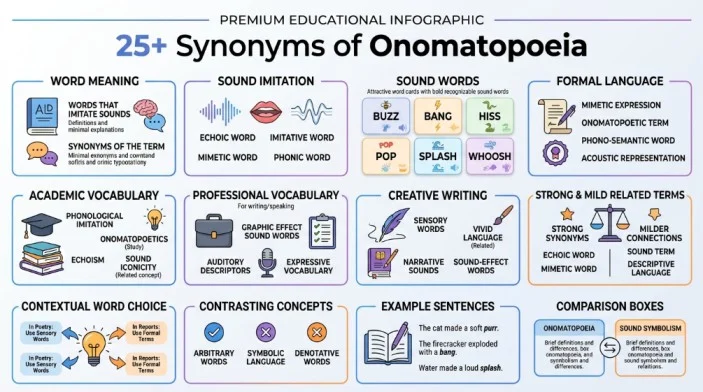
A writer may describe a door as making an “important” sound, but a stronger sentence can let readers actually hear it: creak, bang, click, or crash. When searching for synonyms of onomatopoeia, however, it is useful to understand that onomatopoeia is a literary and linguistic term, so many alternatives describe the same concept rather than serving as exact replacements.
The best word depends on what you mean. You might be discussing words that imitate sounds, a specific sound word, or a broader writing technique that creates an auditory effect. Understanding these distinctions helps students, teachers, writers, and content creators choose terminology that is accurate rather than simply choosing a word that sounds similar.
What Are the Best Synonyms of “Onomatopoeia”?
Onomatopoeia refers to a word or expression that imitates or strongly suggests the sound associated with what it describes, such as buzz, hiss, clang, or splash. Useful related terms include sound imitation, echoic word, sound word, and imitative expression, while specific examples are called onomatopoeic words.
Meaning, Tone, and Context
Simple Definition
Onomatopoeia is the use of a word whose sound imitates, resembles, or evokes the sound connected with its meaning.
Words such as buzz, hiss, bang, pop, tick-tock, and whoosh are familiar examples. Their sounds help readers or listeners associate the word with the action, object, or event being described.
It is important to distinguish between onomatopoeia and an individual onomatopoeic word. Onomatopoeia names the linguistic or literary phenomenon, while buzz and crash are examples of words that use this feature.
Part of Speech
Onomatopoeia is primarily a noun.
Example:
“The poem uses onomatopoeia to make the storm sound vivid.”
The related adjective is onomatopoeic or onomatopoetic, with onomatopoeic being a common choice in modern English.
Example:
“The author uses onomatopoeic words to recreate the sounds of the forest.”
Overall Tone
The term itself is neutral and descriptive. It does not express positive or negative emotion on its own.
The emotional effect comes from the particular sound word and the context in which it appears.
For example:
“The gentle drip of rain filled the room.”
The sound may feel peaceful.
By contrast:
“The window shattered with a crash.”
The sound creates tension and alarm.
Formality Level
Onomatopoeia is a neutral to formal term. It is especially common in:
- English classes
- Literary analysis
- Linguistics
- Creative writing
- Poetry discussions
- Children’s literature
- Comic books
- Language lessons
- Academic writing
In casual conversation, people are more likely to describe something as a “sound word” or simply give the sound itself.
Common Uses
Onomatopoeia commonly appears when writers want to make language more vivid or auditory.
Common examples include:
- Buzz, the sound associated with bees or machinery
- Hiss, a sharp breathlike sound
- Bang, a sudden loud impact
- Crash, a loud breaking or striking sound
- Pop, a short explosive sound
- Splash, the sound associated with liquid movement
- Whisper, a very soft voice or sound
- Click, a short mechanical sound
- Clang, a sharp metallic sound
- Whoosh, the sound of something moving quickly through air
Word Forms
| Form | Example |
|---|---|
| Noun | onomatopoeia |
| Adjective | onomatopoeic |
| Related noun | onomatopoeist, uncommon |
| Plural | onomatopoeias |
The adjective onomatopoeic is particularly useful when describing a word, phrase, poem, or writing technique.
When and How to Use “Onomatopoeia”
Use onomatopoeia when you are discussing the technique or category of sound imitation rather than simply naming a sound.
Professional
“The presentation uses onomatopoeia sparingly to make the product demonstration more engaging.”
Academic
“The poem’s onomatopoeia reinforces the speaker’s description of the battlefield.”
Workplace
“The marketing team considered using onomatopoeia in the children’s educational campaign.”
Personal
“I love the onomatopoeia in that comic because the action feels much more lively.”
“The revised lesson plan includes an activity on onomatopoeia and other literary devices.”
Resume
“Created educational content teaching students how to identify onomatopoeia in poetry.”
Social Media
“Words like boom, crash, and whoosh show how fun onomatopoeia can make creative writing.”
Best Synonyms of “Onomatopoeia”
There is an important vocabulary point here: onomatopoeia does not have many perfect synonyms. It names a specific linguistic phenomenon, so many commonly suggested alternatives are actually related terms, descriptive phrases, or near equivalents.
Professional Writing: Sound Imitation
Sound imitation is a clear alternative when explaining the concept to a general audience.
“The author uses sound imitation to make the scene more vivid.”
It is especially useful when technical terminology might confuse readers.
Academic Writing: Imitative Language
Imitative language can describe language that reproduces or evokes sounds.
“The poet relies on imitative language to recreate the movement of the waves.”
It works well when discussing a broader literary technique.
Business Communication: Sound Effects
Sound effects can be appropriate when discussing multimedia, advertising, games, or video content.
“The advertisement uses sound effects to reinforce the visual action.”
This is not a perfect synonym for onomatopoeia, because sound effects can be recorded sounds rather than words.
Casual Conversation: Sound Words
Sound words is an accessible informal expression.
“Kids often enjoy books filled with sound words like boom and splash.”
It is useful when speaking to beginners or young learners.
Emotional Writing: Evocative Sound Language
Evocative sound language emphasizes the ability of sound-related words to create a sensory response.
“The writer uses evocative sound language to make the storm feel immediate.”
Creative Writing: Sound Imagery
Sound imagery is useful when the emphasis is on creating an auditory experience for the reader.
“The poem’s sound imagery makes the forest seem alive.”
However, sound imagery is broader than onomatopoeia because it does not require the words themselves to imitate sounds.
Resume Writing: Literary Sound Technique
For a resume, literary sound technique can explain the skill without relying on specialized terminology alone.
“Applied literary sound techniques to create engaging educational content.”
Workplace Communication: Audio Representation
Audio representation may work in technical or multimedia contexts when discussing how written or visual content represents sound.
“The animation uses visual and audio representation to reinforce the action.”
Again, this is a related concept rather than a strict synonym.
Stronger Meaning: Vivid Sound Imitation
When you want to emphasize the expressive quality, vivid sound imitation makes the effect clearer.
“The poem uses vivid sound imitation to recreate the violence of the storm.”
Softer Meaning: Sound Description
Sound description is broader and less technical.
“The story includes detailed sound description throughout the opening scene.”
It is appropriate when the writing describes sounds without necessarily imitating them.
When Not to Use “Onomatopoeia”
When You Mean Any Sound Effect
Not every sound effect is onomatopoeia.
Less precise:
“The recorded explosion is an example of onomatopoeia.”
Better:
“The recorded explosion is a sound effect.”
Why:
Onomatopoeia concerns language, while a recorded explosion is an actual audio effect.
When You Mean a General Description of Sound
If the writer merely describes a sound, sound description may be more accurate.
Less precise:
“The sentence uses onomatopoeia because it describes the quiet wind.”
Better:
“The sentence uses sound imagery to describe the quiet wind.”
Why:
A description of sound does not necessarily imitate that sound.
When You Need a Specific Sound Word
If you are looking for a word such as bang or hiss, do not replace it with onomatopoeia.
Less precise:
“What is the onomatopoeia for a sudden explosion?”
Better:
“A sound word such as bang or boom can represent a sudden explosion.”
Why:
Onomatopoeia is the category or phenomenon, not the name of one particular sound.
When Writing for Beginners
The technical term may be unnecessarily difficult for young learners.
Formal:
“Identify the examples of onomatopoeia.”
Simpler:
“Find the words that imitate sounds.”
Why:
The second version communicates the task immediately.
When Discussing Recorded Audio
Use sound effect, audio effect, or recorded sound when referring to actual audio.
Better:
“The game uses realistic sound effects during combat.”
Why:
The sounds are produced or recorded rather than represented through words.
Words Commonly Confused With “Onomatopoeia”
| Word | Difference | When to Use It | Example |
|---|---|---|---|
| Alliteration | Repetition of beginning consonant sounds, not necessarily imitation of real sounds. | Poetry and stylistic analysis. | “Peter picked purple plums.” |
| Assonance | Repetition of vowel sounds within nearby words. | Poetry and creative writing. | “The mellow wedding bells.” |
| Consonance | Repetition of consonant sounds, often within or at the ends of words. | Literary analysis. | “The stroke of luck.” |
| Sound imagery | Language that creates an auditory impression. | Descriptive and literary writing. | “The distant waves whispered against the shore.” |
| Allusion | An indirect reference to a known person, event, text, or idea. | Essays and literary analysis. | “The character faces his own Odyssey.” |
| Personification | Giving human qualities to nonhuman things. | Creative and descriptive writing. | “The wind whispered through the trees.” |
Best Synonyms of “Onomatopoeia” by Context
| Context | Best Synonym or Related Term | Why It Works | Example |
|---|---|---|---|
| Formal writing | Sound imitation | Clearly explains the concept | “The poem uses sound imitation effectively.” |
| Academic writing | Onomatopoeic language | Precise literary terminology | “The poet uses onomatopoeic language.” |
| Professional communication | Sound effect | Useful for media and advertising | “The video uses sound effects.” |
| Business emails | Sound element | Broad and accessible | “The lesson includes a sound element.” |
| Resume writing | Literary sound technique | Describes a transferable writing skill | “Applied literary sound techniques.” |
| Workplace communication | Sound effect | Natural for multimedia contexts | “The presentation includes sound effects.” |
| Casual conversation | Sound word | Easy for general audiences | “That comic has lots of sound words.” |
| Everyday speaking | Imitative word | Simple explanation | “Boom is an imitative word.” |
| Creative writing | Sound imagery | Emphasizes sensory effect | “Sound imagery strengthens the scene.” |
| Storytelling | Vivid sound language | Highlights atmosphere | “Vivid sound language builds suspense.” |
| Emotional writing | Evocative sound language | Emphasizes emotional response | “The writer uses evocative sound language.” |
| Strong emphasis | Vivid sound imitation | Highlights auditory impact | “The scene contains vivid sound imitation.” |
| Mild tone | Sound description | Broad and neutral | “The story includes sound description.” |
| Social media captions | Sound word | Short and accessible | “Boom is a classic sound word.” |
| American English | Onomatopoeic word | Natural modern terminology | “Buzz is an onomatopoeic word.” |
How to Choose the Best Synonym of “Onomatopoeia”
The best alternative depends on what you are actually describing.
If You Mean the Literary Device
Use onomatopoeia.
“The poem uses onomatopoeia to imitate the sounds of battle.”
If You Mean a Specific Word
Use onomatopoeic word or sound word.
“Hiss is an onomatopoeic word.”
If You Mean a Broader Literary Effect
Use sound imagery.
“The author creates strong sound imagery throughout the chapter.”
If You Mean Recorded Audio
Use sound effect.
“The film uses realistic sound effects.”
If You Need a Simple Explanation
Use sound imitation.
“The writer uses sound imitation to make the scene more vivid.”
The most accurate choice comes from meaning first, followed by audience, tone, purpose, and level of technical detail.
Real Life Examples of “Onomatopoeia”
School
Basic:
“The teacher asked students to identify onomatopoeia in the poem.”
More precise:
“The students identified buzz, clang, and splash as onomatopoeic words.”
College
“The literature class examined how onomatopoeia contributes to the poem’s rhythm and atmosphere.”
Workplace
“The content team used onomatopoeic language to make the children’s learning material more engaging.”
Business
“The advertising campaign uses sound effects and written sound words to emphasize the product’s action.”
“Please review the examples of onomatopoeia before tomorrow’s writing workshop.”
Resume
“Developed creative writing exercises focused on imagery, rhythm, and onomatopoeia.”
Conversation
“I like how the author uses crack and boom to make the scene feel realistic.”
Storytelling
“The branches snapped, the leaves rustled, and the old gate creaked open.”
Blogging
“Onomatopoeia can make descriptive writing more vivid because readers can almost hear the action.”
Social Media
“Pop, bang, and whoosh are simple examples of sound words that can add energy to a caption or comic.”
25 Best Synonyms and Related Terms for “Onomatopoeia”
Because onomatopoeia is a specialized linguistic term, this table distinguishes close equivalents from broader related expressions. Not every item is a perfect dictionary synonym.
| Term | Simple Meaning | Best Used For | Example Sentence |
|---|---|---|---|
| Sound imitation | Reproducing a sound through language | General explanations | “The poem uses sound imitation effectively.” |
| Sound word | A word associated with a sound | Beginners and casual use | “Buzz is a familiar sound word.” |
| Onomatopoeic word | A word that imitates or evokes a sound | Linguistics and education | “Hiss is an onomatopoeic word.” |
| Imitative word | A word that imitates something, especially sound | Language discussions | “The author chose an imitative word.” |
| Onomatopoeic language | Language containing sound imitation | Literary analysis | “Onomatopoeic language strengthens the poem.” |
| Imitative language | Language that reproduces or suggests sounds | Academic writing | “The passage contains imitative language.” |
| Sound imagery | Language that creates an auditory impression | Creative writing | “Sound imagery makes the setting vivid.” |
| Sound description | Language describing sounds | General writing | “The novel contains detailed sound description.” |
| Sound expression | An expression representing or evoking sound | General discussion | “The comic uses sound expressions throughout.” |
| Sound representation | Written representation of a sound | Linguistics and media | “The text provides a written sound representation.” |
| Auditory imagery | Language connected with the sense of hearing | Literary analysis | “Auditory imagery creates a tense atmosphere.” |
| Evocative sound language | Sound language that creates a strong impression | Creative writing | “Evocative sound language brings the storm alive.” |
| Vivid sound language | Strongly descriptive sound vocabulary | Storytelling | “Vivid sound language makes the chase exciting.” |
| Sound effect | A produced or represented sound used for effect | Film, games, advertising | “The video includes several sound effects.” |
| Audio effect | A manipulated or produced audio element | Multimedia | “The editor added an audio effect.” |
| Verbal sound effect | A sound effect represented through words | Comics and scripts | “The comic uses a verbal sound effect.” |
| Written sound effect | A written representation of a sound | Comics and captions | “Boom! is a written sound effect.” |
| Echoic expression | An expression that echoes a sound | Linguistic discussion | “The word functions as an echoic expression.” |
| Sound symbolism | Association between sound patterns and meaning | Linguistics | “Sound symbolism can influence word associations.” |
| Phonaesthetics | The study or appreciation of pleasing or expressive sound patterns | Advanced literary discussion | “The writer pays attention to phonaesthetics.” |
| Auditory expression | Language or representation related to hearing | Formal discussion | “The passage uses auditory expression.” |
| Imitative expression | An expression that imitates something | Language teaching | “The exercise focuses on imitative expressions.” |
| Sound-based language | Language organized around sound effects or associations | General description | “The story uses sound-based language.” |
| Expressive sound vocabulary | Vocabulary chosen for auditory effect | Creative writing | “Expressive sound vocabulary adds energy.” |
| Sonic imagery | Imagery centered on sound | Creative and literary writing | “Sonic imagery gives the scene a strong atmosphere.” |
Synonyms of “Onomatopoeia” by Usage
Professional vs Personal Synonyms
In professional or academic settings, onomatopoeic language, sound imitation, and sound imagery are more precise.
In personal conversation, sound words is easier to understand.
For example:
Professional:
“The lesson introduces students to onomatopoeic language.”
Personal:
“The book has lots of fun sound words.”
Formal vs Conversational Synonyms
Use onomatopoeia, onomatopoeic language, and imitative language in reports, essays, and presentations.
Use sound words or words that imitate sounds in casual explanations and texting.
Academic Synonyms
For research and literary analysis, useful terms include:
- Onomatopoeia
- Onomatopoeic language
- Onomatopoeic word
- Sound symbolism
- Auditory imagery
- Sound imagery
- Imitative language
These terms allow writers to distinguish between the specific linguistic device and broader sound related effects.
Professional and Business Synonyms
- In business communication, terminology depends heavily on the field.
- For advertising, use sound effect, verbal sound effect, or sound word.
- For educational content, onomatopoeia and onomatopoeic word are appropriate.
- For resumes, explain the practical skill instead of relying on the technical term alone.
Example:
“Created engaging educational content using sound imagery and other literary techniques.”
Creative and Literary Synonyms
Creative writers can use:
- Sound imagery
- Auditory imagery
- Sonic imagery
- Vivid sound language
- Evocative sound language
- Onomatopoeic language
These terms are useful when discussing how writing makes readers imagine what they hear.
Slang or Modern Synonyms
There is no widely accepted slang synonym for onomatopoeia.
Expressions such as sound word are informal and accessible, but they should not automatically replace onomatopoeia in academic writing.
Strongest to Mildest Synonyms
Unlike adjectives such as important, onomatopoeia related terms do not have a reliable intensity scale. Their differences are mainly about scope and precision, not emotional strength.
Mild or Broad
- Sound description
- Sound expression
- Sound based language
Moderate
- Sound imagery
- Auditory imagery
- Imitative language
More Specific
- Sound imitation
- Onomatopoeic language
- Onomatopoeic word
Most Technical
- Onomatopoeia
- Sound symbolism
- Echoic expression
The technicality of the term should match the audience. A beginner may understand sound word immediately, while a linguistics student may need the more precise term onomatopoeia.
Emotional vs Neutral Synonyms
Emotional or Expressive Terms
These terms emphasize the sensory or artistic effect:
- Vivid sound language
- Evocative sound language
- Sonic imagery
- Auditory imagery
- Sound imagery
Example:
“The writer’s evocative sound language makes the storm feel frightening.”
Neutral Terms
These terms describe the concept without adding much emotional emphasis:
- Sound imitation
- Sound word
- Onomatopoeic word
- Imitative language
- Sound description
Example:
“The worksheet asks students to identify onomatopoeic words.”
Antonyms of “Onomatopoeia”
There is no standard set of true antonyms for onomatopoeia because it names a linguistic phenomenon rather than a quality that naturally has an opposite. Terms such as nonimitative language can describe the absence of sound imitation, but they are not strict dictionary antonyms.
For accuracy, it is better to discuss contrasting concepts rather than falsely presenting unrelated terms as antonyms.
| Contrasting Concept | Meaning | Example Sentence |
|---|---|---|
| Nonimitative language | Language that does not imitate sounds | “The passage uses nonimitative language.” |
| Literal description | Direct description without sound imitation | “The writer gives a literal description of the noise.” |
| Silent imagery | Imagery focused on nonauditory senses | “The scene relies on visual imagery rather than sound.” |
| Visual imagery | Language appealing mainly to sight | “The paragraph is dominated by visual imagery.” |
| Tactile imagery | Language appealing to touch | “The author uses tactile imagery to describe the rough bark.” |
| Gustatory imagery | Language appealing to taste | “The description contains vivid gustatory imagery.” |
| Olfactory imagery | Language appealing to smell | “The writer uses olfactory imagery to evoke the bakery.” |
| Abstract language | Language focused on ideas rather than sensory imitation | “The essay uses abstract language to discuss justice.” |
| Expository description | Informational description designed to explain | “The article uses expository description.” |
| Plain description | Direct, uncomplicated description | “The report uses plain description instead of literary effects.” |
| Nonfigurative language | Language without a figurative device | “The instructions rely on nonfigurative language.” |
| Direct statement | A straightforward statement of information | “The author makes a direct statement.” |
| Factual description | Description focused on observable facts | “The report provides factual description.” |
| Literal language | Words used in their direct sense | “The instructions use literal language.” |
| Silent representation | Representation without an auditory element | “The illustration provides a silent representation of the event.” |
Comparison: “Onomatopoeia” vs Similar Words
Onomatopoeia vs Alliteration
Main Difference
Onomatopoeia imitates or evokes a sound, while alliteration repeats similar beginning consonant sounds across nearby words.
Which Is Stronger?
Neither is inherently stronger. They create different effects.
Which Is More Formal?
Both terms are appropriate for academic and literary analysis.
When to Use Each
Use onomatopoeia when sound imitation matters.
Use alliteration when repeated initial sounds create rhythm or emphasis.
Examples
Onomatopoeia:
“The bees buzzed around the flowers.”
Alliteration:
“Silver snakes slid silently.”
Onomatopoeia vs Assonance
Main Difference
Assonance involves repeated vowel sounds. It does not require words to imitate real-world sounds.
Which Is Stronger?
Neither has a fixed intensity.
Which Is More Formal?
Both are standard literary terms.
When to Use Each
Use assonance when vowel repetition creates a sound pattern.
Examples
Onomatopoeia:
“The water splashed against the rocks.”
Assonance:
“The rain stayed late.”
Onomatopoeia vs Consonance
Main Difference
Consonance repeats consonant sounds, often within or at the ends of words. Onomatopoeia is based on sound imitation.
Which Is Stronger?
Neither.
Which Is More Formal?
Both work in literary analysis.
When to Use Each
Choose consonance when analyzing repeated consonant sounds.
Examples
Onomatopoeia:
“The branch cracked suddenly.”
Consonance:
“The black rock struck the deck.”
Onomatopoeia vs Sound Imagery
Main Difference
Sound imagery creates an auditory impression, but the words do not necessarily imitate an actual sound.
Which Is Stronger?
Onomatopoeia is more specific.
Which Is More Formal?
Both are suitable for academic writing.
When to Use Each
Use sound imagery when discussing the broader sensory effect.
Examples
Onomatopoeia:
“The pan went clang.”
Sound imagery:
“Far away, the church bells faded into the evening air.”
Onomatopoeia vs Sound Effect
Main Difference
A sound effect can be an actual recorded or produced sound. Onomatopoeia is a feature of language.
Which Is Stronger?
Neither.
Which Is More Formal?
Both are appropriate in their respective fields.
When to Use Each
Use sound effect for film, television, games, advertising, and multimedia.
Use onomatopoeia for language and literary analysis.
Examples
Onomatopoeia:
“The comic uses boom to represent the explosion.”
Sound effect:
“The editor added an explosion sound effect.”
Onomatopoeia vs Personification
Main Difference
Personification gives human traits to nonhuman things. Onomatopoeia represents or imitates sounds.
Which Is Stronger?
Neither.
Which Is More Formal?
Both are common literary terms.
When to Use Each
Use personification when an object, animal, or abstract idea behaves like a person.
Examples
Onomatopoeia:
“The leaves rustled in the wind.”
Personification:
“The wind whispered through the trees.”
Common Phrases and Expressions with “Onomatopoeia”
Phrase: Examples of Onomatopoeia
Meaning
This phrase refers to individual words that imitate or evoke sounds.
Example Sentence
Teachers often introduce onomatopoeia with examples such as buzz, bang, and splash.
Phrase: Use of Onomatopoeia
Meaning
This refers to how a writer incorporates sound imitation into a text.
Example Sentence
“The use of onomatopoeia makes the comic scene more energetic.”
Phrase: Onomatopoeic Word
Meaning
A word whose sound imitates or suggests the sound associated with its meaning.
Example Sentence
“Hiss is a common onomatopoeic word.”
Phrase: Onomatopoeic Language
Meaning
Language containing words or expressions that imitate or evoke sounds.
Example Sentence
“The poem’s onomatopoeic language creates a vivid sense of movement.”
Phrase: Onomatopoeic Effect
Meaning
The auditory or expressive effect created through sound imitation.
Example Sentence
“The repeated clack creates an onomatopoeic effect.”
Phrase: Onomatopoeic Expression
Meaning
An expression that represents or imitates a sound.
Example Sentence
“The writer uses an onomatopoeic expression to capture the noise of the machinery.”
Common Mistakes to Avoid
1. Treating Every Sound Word as Exactly the Same
Incorrect:
“Every word describing a sound is automatically onomatopoeia.”
Better:
“Words such as buzz, bang, and hiss are common examples of onomatopoeia.”
Why:
Not every description of a sound imitates that sound.
2. Confusing Onomatopoeia With Sound Effects
Incorrect:
“The recorded thunder is onomatopoeia.”
Better:
“The recorded thunder is a sound effect.”
Why:
Onomatopoeia is a linguistic feature, while a recording is an audio element.
3. Confusing Onomatopoeia With Alliteration
Incorrect:
“Peter picked purple peppers is an example of onomatopoeia.”
Better:
“Peter picked purple peppers is an example of alliteration.”
Why:
The sentence repeats the initial consonant sound but does not imitate a real-world sound.
4. Using “Onomatopoeia” for a Single Sound Word Without Clarification
Incorrect:
“Give me an onomatopoeia for a bee.”
Better:
“Give me an onomatopoeic word for a bee’s sound.”
Why:
The second version distinguishes the linguistic category from the individual word.
5. Using Technical Vocabulary With Young Learners
Incorrect:
“Identify the onomatopoeic expressions in the passage.”
Better:
“Find the words that imitate sounds.”
Why:
Simple wording may be more effective for beginners.
6. Treating Sound Imagery as an Exact Synonym
Incorrect:
“Sound imagery and onomatopoeia always mean exactly the same thing.”
Better:
“Sound imagery is broader than onomatopoeia because it can describe sounds without imitating them.”
Why:
The distinction improves linguistic accuracy.
7. Assuming Onomatopoeia Must Always Be Written as an Isolated Sound
Incorrect:
“Onomatopoeia only appears in comics.”
Better:
“Onomatopoeia appears in poetry, fiction, comics, advertising, children’s literature, and everyday language.”
Why:
Sound imitation is used across many forms of communication.
Frequently Asked Questions
1. What are the best synonyms of “onomatopoeia”?
There are few exact synonyms of onomatopoeia because it names a specific linguistic phenomenon. Useful alternatives include sound imitation, imitative language, sound word, and onomatopoeic language, depending on context.
2. What are the best formal synonyms of “onomatopoeia”?
Formal alternatives include sound imitation, onomatopoeic language, imitative language, and onomatopoeic expression. In academic writing, however, retaining the precise term onomatopoeia is often clearer.
3. What are common informal synonyms of “onomatopoeia”?
Sound word and word that imitates a sound are accessible informal alternatives. They work especially well when explaining the concept to children, beginners, or general audiences.
4. What is another word for “onomatopoeia” in professional writing?
In professional writing, sound imitation is a useful plain-language alternative. In educational, literary, or linguistic contexts, onomatopoeic language is usually more precise.
5. What is the difference between “onomatopoeia” and “sound imagery”?
Onomatopoeia involves language that imitates or evokes a sound, while sound imagery is broader and creates an auditory impression without requiring direct sound imitation. A text can contain sound imagery without using onomatopoeia.
6. What is the opposite of “onomatopoeia”?
Onomatopoeia has no standard direct antonym. Instead, writers can describe the absence of sound imitation with terms such as nonimitative language, literal description, or plain description, depending on the context.
Conclusion
Onomatopoeia is the linguistic and literary use of words that imitate or evoke sounds. Examples such as buzz, crash, hiss, pop, and splash can make writing more vivid, immediate, and sensory.
There are relatively few exact synonyms of onomatopoeia because it describes a specialized concept. Sound imitation, imitative language, and onomatopoeic language are useful alternatives, while sound imagery, sound words, and sound effects describe related but not identical ideas.
The best vocabulary choice depends on your audience and purpose. For academic writing, use precise literary terminology. eginners, explain the concept in plain language. For creative writing, focus on the auditory effect your words create. A useful vocabulary habit is to learn not only alternative words, but also the difference between them, because precision is what makes a synonym genuinely useful.
Read More Related Articles:
- 25+ Synonyms of Resume | Meanings, Uses, Examples, and …
- 25+ Synonyms of Bridge | Meanings, Uses, Examples, and …
- 25+ Synonyms of Sincerely | Meanings, Uses, Examples, and …







6 thoughts on “Synonyms of Onomatopoeia | Meaning, Examples & Creative Word Choices to Elevate Your Writing in 2026”