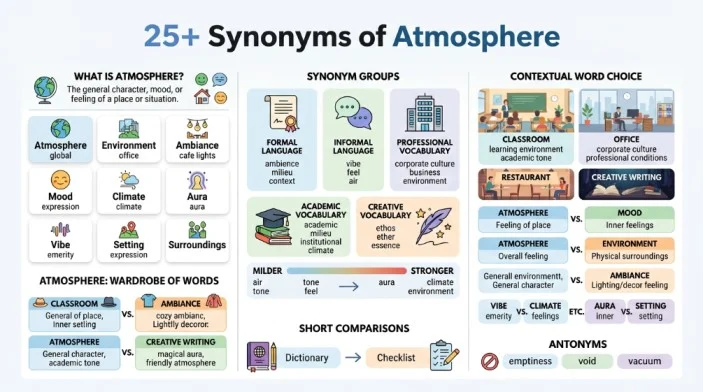
When the same word appears again and again in an email, essay, caption, resume, blog post, or school assignment, the writing can quickly feel repetitive. That is why people search for synonyms of atmosphere when they want a more precise way to describe a room, place, environment, mood, or emotional feeling.
The best alternative depends on what you mean. A business report may need environment or climate, while a creative story may sound better with ambiance, aura, or mood. Choosing carefully can make your writing clearer, more vivid, and more natural without changing the original idea.
What Are the Best Synonyms of “Atmosphere”?
The best synonyms of atmosphere include ambiance, mood, environment, aura, climate, setting, surroundings, tone, vibe, and milieu. For formal writing, use environment or climate. For creative writing, ambiance, aura, and mood work well. Casual speech, vibe and feel are natural choices.
The word atmosphere has several meanings, so no single synonym works everywhere. It can refer to the air surrounding a planet, the mood of a place, or the general feeling created by people, surroundings, and circumstances.
For professional communication, environment, climate, and setting are often useful. Academic writers may prefer environment, context, or climate, depending on the subject. Creative writers can choose ambiance, aura, mood, or spirit when they want more descriptive language.
Meaning, Tone, and Context
Simple Definition
Atmosphere generally describes the surrounding conditions or the overall feeling associated with a place, situation, or experience.
For example:
The restaurant has a relaxed atmosphere.
Here, atmosphere refers to the general feeling created by the lighting, music, decor, staff, and customers.
The word can also describe the layer of gases surrounding a planet:
Earth’s atmosphere contains gases that support life.
These two meanings are related historically and conceptually, but they require different synonyms.
Part of Speech
Atmosphere is primarily a noun.
Examples:
- The atmosphere in the office was friendly.
- Mars has a very thin atmosphere.
- The music created a peaceful atmosphere.
Overall Tone
Atmosphere is usually neutral. It does not automatically communicate something positive or negative.
A place can have:
- a welcoming atmosphere
- a tense atmosphere
- a gloomy atmosphere
- a lively atmosphere
- a professional atmosphere
- a mysterious atmosphere
The adjective or surrounding description determines the emotional quality.
Formality Level
Atmosphere is a neutral, versatile word. It works in casual conversation, academic writing, professional communication, journalism, fiction, and everyday descriptions.
Examples:
Casual:
The café has a great atmosphere.
Professional:
The company is committed to maintaining a collaborative atmosphere.
Academic:
Social interaction can influence the atmosphere of a classroom.
Creative:
A strange atmosphere filled the abandoned house.
Common Uses
Native English speakers commonly use atmosphere when discussing:
- restaurants
- offices
- schools
- classrooms
- homes
- parties
- hotels
- workplaces
- cities
- neighborhoods
- events
- stories
- movies
- social situations
- planetary science
- environmental science
The correct synonym depends heavily on which meaning is intended.
Word Forms
The main related forms include:
- Noun: atmosphere
- Plural noun: atmospheres
- Adjective: atmospheric
- Related adjective: atmospheric
Examples:
The restaurant has a warm atmosphere.
The film has an atmospheric quality.
When and How to Use “Atmosphere”
Use atmosphere when you want to describe the overall feeling, character, or surrounding conditions of a place or situation.
It is particularly useful when several factors combine to create an impression. Lighting, sound, behavior, architecture, weather, people, and social expectations can all contribute to an atmosphere.
Professional
The company has created a supportive atmosphere where employees can share ideas.
Here, atmosphere refers to the general workplace environment.
Academic
Classroom atmosphere can influence how comfortable students feel participating in discussions.
The word works naturally in education research and academic discussion.
Workplace
The new manager has helped create a more open atmosphere during team meetings.
This focuses on the emotional and social quality of the workplace.
Personal
I loved the peaceful atmosphere of my grandmother’s garden.
The word describes the overall feeling of the place.
Thank you for helping create such a welcoming atmosphere at the event.
This is appropriate when discussing a gathering or shared experience.
Resume
Helped maintain a positive atmosphere for customers and team members.
On a resume, atmosphere can work when describing customer service, hospitality, events, education, or leadership.
Social Media
The cozy atmosphere at this little bookstore made the afternoon perfect.
For social media, more conversational alternatives such as vibe or feel can sound even more natural.
Best Synonyms of “Atmosphere”
A synonym should replace atmosphere without changing the intended meaning. Because atmosphere has several meanings, the strongest alternative depends on context.
| Context | Recommended Synonym | Why It Works |
|---|---|---|
| Professional writing | Environment | Clear and neutral |
| Academic writing | Environment | Precise for social or physical conditions |
| Business communication | Climate | Useful for organizational attitudes and relationships |
| Casual conversation | Vibe | Natural and conversational |
| Emotional writing | Mood | Directly expresses emotional feeling |
| Creative writing | Ambiance | Adds a descriptive sense of place |
| Resume writing | Environment | Sounds professional and clear |
| Workplace communication | Climate | Useful for organizational culture and relationships |
| Stronger descriptive meaning | Aura | Suggests a noticeable quality or impression |
| Softer meaning | Feel | Simple and understated |
Professional Writing: Environment
Environment is often a safer professional alternative because it can describe the conditions in which people work, learn, or operate.
The company provides a collaborative work environment.
This sounds more natural in many business contexts than “collaborative work atmosphere.”
Academic Writing: Environment
Environment works well in education, psychology, sociology, science, and organizational studies.
A supportive learning environment can encourage student participation.
It is especially useful when the discussion involves conditions rather than emotion alone.
Business Communication: Climate
Climate is particularly effective when atmosphere refers to attitudes, relationships, or organizational conditions.
The company has developed a positive workplace climate.
Climate is common when discussing leadership, morale, trust, and organizational culture.
Casual Conversation: Vibe
Vibe is informal and modern.
This coffee shop has a relaxed vibe.
It works especially well in conversations, reviews, captions, and social media. It is usually inappropriate for formal academic or business writing.
Emotional Writing: Mood
Mood is a strong choice when the focus is emotional feeling.
The dark lighting created a mysterious mood.
Mood is also common when discussing books, films, music, art, and storytelling.
Creative Writing: Ambiance
Ambiance describes the distinctive feeling or character of a place, especially when created by lighting, decoration, music, architecture, or surroundings.
Soft music and candlelight gave the restaurant an elegant ambiance.
Resume Writing: Environment
For resumes, environment is generally clearer and more professional than vibe or feel.
Created a welcoming customer environment during high volume events.
Workplace Communication: Climate
When discussing relationships, morale, communication, or leadership, climate can be more precise.
The new leadership team improved the workplace climate.
When Not to Use “Atmosphere”
Atmosphere is flexible, but sometimes another word communicates the idea more precisely.
When Atmosphere Is Too General
Less precise:
The office has a good atmosphere.
The reader may not know whether you mean friendly coworkers, comfortable furniture, good management, or a pleasant physical space.
Better:
The office has a collaborative environment where employees feel comfortable sharing ideas.
When Atmosphere Is Too Vague
Less precise:
The restaurant has a nice atmosphere.
Better:
The restaurant has a cozy ambiance with soft lighting and quiet music.
Ambiance explains the sensory quality more clearly.
When Atmosphere Is Too Informal
Atmosphere itself is not particularly informal, but a casual context may benefit from a more natural word.
Formal sounding:
The beach has a relaxing atmosphere.
More conversational:
The beach has a really relaxing vibe.
When You Need a Specific Emotional Meaning
If you specifically mean an emotional state, mood can be better.
General:
The atmosphere of the novel changes throughout the story.
More precise:
The mood of the novel becomes increasingly tense.
When You Mean Organizational Conditions
In a workplace context, climate may communicate the idea more accurately.
General:
The atmosphere at the company has changed.
More precise:
The organizational climate has changed since the new leadership team arrived.
When You Mean Physical Surroundings
If the focus is on the place itself, environment or surroundings may be stronger.
General:
The atmosphere around the school is peaceful.
More specific:
The school is surrounded by quiet residential neighborhoods and green spaces.
Words Commonly Confused With “Atmosphere”
Atmosphere vs Environment
Difference: Atmosphere often emphasizes the overall feeling or character of a place. Environment focuses more broadly on the physical, social, or working conditions surrounding someone.
When to Use It: Use environment when discussing conditions, systems, or surroundings.
Example:
The school provides a supportive learning environment.
Atmosphere vs Mood
Difference: Mood usually refers to an emotional state or emotional quality. Atmosphere can include mood but may also involve physical surroundings and social conditions.
When to Use It: Use mood when emotion is the main focus.
Example:
The music created a peaceful mood.
Atmosphere vs Ambiance
Difference: Ambiance usually emphasizes the distinctive character or feeling of a physical place.
When to Use It: Use ambiance for restaurants, hotels, stores, homes, events, and other spaces.
Example:
The hotel is known for its elegant ambiance.
Atmosphere vs Aura
Difference: Aura suggests a distinctive quality or impression surrounding a person, place, or thing. It can sound more expressive or mysterious than atmosphere.
When to Use It: Use aura when describing an unusual presence or intangible quality.
Example:
The old building has an aura of mystery.
Atmosphere vs Climate
Difference: Climate can describe prevailing attitudes, conditions, or relationships, especially within organizations and societies.
When to Use It: Use climate for workplace culture, political conditions, social attitudes, or organizational relationships.
Example:
The company has a healthy workplace climate.
Atmosphere vs Setting
Difference: Setting identifies the place, time, and circumstances in which something happens. Atmosphere describes the feeling or character produced by that setting.
When to Use It: Use setting when identifying where and when a story or event occurs.
Example:
The mountain village provides the setting for the novel.
Best Synonyms of “Atmosphere” by Context
| Context | Best Synonym | Why It Works | Example |
|---|---|---|---|
| Formal writing | Environment | Neutral and precise | The work environment supports collaboration. |
| Academic writing | Environment | Works well for social and physical conditions | The learning environment affects participation. |
| Professional communication | Climate | Describes organizational conditions | The workplace climate has improved. |
| Business emails | Environment | Clear and professional | We want to create a welcoming environment. |
| Resume writing | Environment | Professional and measurable in context | Maintained a positive customer environment. |
| Workplace communication | Climate | Useful for morale and relationships | The team has a healthy workplace climate. |
| Casual conversation | Vibe | Natural and informal | The café has a relaxed vibe. |
| Everyday speaking | Feel | Simple and conversational | I like the feel of this neighborhood. |
| Creative writing | Ambiance | Adds sensory detail | The restaurant had a romantic ambiance. |
| Storytelling | Mood | Highlights emotional effect | The storm changed the mood of the scene. |
| Emotional writing | Mood | Directly communicates emotion | The music created a nostalgic mood. |
| Strong emphasis | Aura | Suggests a powerful intangible quality | The performer had an intense aura. |
| Mild tone | Feel | Understated and flexible | The room has a comfortable feel. |
| Social media captions | Vibe | Concise and contemporary | Weekend vibe at the lake. |
| American English | Atmosphere, vibe | Both are natural, depending on formality | The hotel has a friendly atmosphere. |
| British English | Atmosphere, ambiance | Both are widely understood and used | The restaurant has a pleasant ambiance. |
How to Choose the Best Synonym of “Atmosphere”
Choosing a synonym becomes easier when you identify what you actually want to communicate.
Step 1: Identify the Meaning
Ask whether atmosphere refers to:
- physical surroundings
- emotional feeling
- social conditions
- organizational culture
- artistic effect
- planetary gases
For planetary science, words such as air or gaseous envelope may be appropriate. For a restaurant, ambiance or vibe may work better.
Step 2: Consider Your Audience
A school essay needs different vocabulary from an Instagram caption.
For formal readers, consider environment, climate, or context.
For casual readers, vibe, feel, or mood may sound more natural.
Step 3: Match the Emotional Strength
If you want a neutral description, use environment or setting.
If you want emotional emphasis, use mood, aura, or spirit.
Step 4: Match the Purpose
A resume should prioritize clarity and professionalism.
A novel can use more expressive language.
A business report should avoid slang.
A social media caption can be more conversational.
Step 5: Read the Sentence Naturally
A technically related synonym may still sound awkward.
Compare:
The restaurant has a beautiful climate.
This is unusual if you mean the restaurant’s emotional feeling.
Better:
The restaurant has a beautiful ambiance.
The best synonym is not simply a word with a similar dictionary meaning. It is the word that fits the sentence naturally.
Real Life Examples of “Atmosphere”
School
The teacher created a supportive classroom atmosphere that encouraged students to participate.
A stronger alternative is:
The teacher created a supportive learning environment that encouraged students to participate.
College
The university has an energetic atmosphere during orientation week.
Here, atmosphere describes the general feeling surrounding the event.
Workplace
The manager worked hard to create a respectful atmosphere.
A professional alternative is:
The manager worked hard to create a respectful workplace environment.
Business
The hotel wants to create a welcoming atmosphere for international guests.
Here, atmosphere works naturally because hospitality often involves the overall guest experience.
Thank you for helping create such a positive atmosphere during the meeting.
The word sounds professional and natural in this context.
Resume
Supported a friendly atmosphere by assisting customers and resolving concerns quickly.
A more precise resume version might be:
Helped create a welcoming customer environment through responsive service.
Conversation
I love the atmosphere in this neighborhood.
A casual alternative is:
I love the vibe in this neighborhood.
Storytelling
A tense atmosphere filled the room as everyone waited for the announcement.
For stronger literary effect:
A tense mood settled over the room as everyone waited for the announcement.
Blogging
The café’s relaxed atmosphere makes it a comfortable place to work.
A more descriptive version is:
The café’s cozy ambiance makes it a comfortable place to work.
Social Media
Loving the peaceful atmosphere here.
A more casual caption could be:
Loving the peaceful vibe here.
25 Best Synonyms of “Atmosphere”
The following list covers the major senses of atmosphere. Some alternatives are closer matches in certain contexts than others, so the best choice depends on whether you mean mood, environment, social conditions, physical surroundings, or a distinctive quality.
| Synonym | Simple Meaning | Best Used For | Example Sentence |
|---|---|---|---|
| Ambiance | The distinctive feeling of a place | Restaurants, hotels, creative writing | The restaurant has a warm ambiance. |
| Mood | The emotional feeling of a place or situation | Stories, films, emotions | The music changed the mood of the room. |
| Environment | The surrounding physical or social conditions | Academic and professional writing | The school provides a supportive environment. |
| Climate | The prevailing social or organizational conditions | Workplaces and institutions | The company has a positive workplace climate. |
| Aura | A distinctive intangible quality | People, places, creative writing | The old theater has an unusual aura. |
| Vibe | A general feeling or impression | Casual conversation and social media | This café has a relaxed vibe. |
| Feel | The general impression something creates | Everyday speech | I really like the feel of this neighborhood. |
| Setting | The place and circumstances surrounding an event | Stories and descriptions | The coastal town is an ideal setting for the novel. |
| Surroundings | The things and conditions around a person or place | Physical descriptions | The quiet surroundings made the retreat peaceful. |
| Milieu | A person’s social or cultural environment | Academic and formal writing | The artist developed within an influential cultural milieu. |
| Tone | The general quality or attitude expressed | Writing, speech, communication | The serious tone of the meeting affected everyone. |
| Spirit | The characteristic feeling or attitude of a group | Teams, communities, events | The festival captured the spirit of the community. |
| Character | The distinctive qualities of a place or situation | Places and institutions | The historic district has a unique character. |
| Tenor | The general direction or character of a situation | Formal and academic writing | The tenor of the discussion became more positive. |
| Temper | The prevailing mood or emotional condition | Formal descriptions | The temper of the meeting changed after the announcement. |
| Air | A particular impression or quality | Literary and descriptive writing | The house had an air of mystery. |
| Feeling | The emotional impression created by something | Everyday communication | The room had a welcoming feeling. |
| Energy | The level of activity or emotional force | Events and social settings | The concert had incredible energy. |
| Presence | A noticeable quality or impression | People and places | The building has a powerful presence. |
| Quality | A distinctive characteristic or impression | General descriptions | The room has a calm quality. |
| Context | The surrounding circumstances that shape meaning | Academic and professional writing | The social context influenced the discussion. |
| Gait | The prevailing manner or character of a situation | Formal usage in limited contexts | The conversation took on a cautious gait. |
| Airiness | A light, open quality | Physical or descriptive writing | The windows gave the room an airiness that felt refreshing. |
| Gloom | A dark or depressing quality | Emotional and literary writing | The empty house was filled with gloom. |
| Warmth | A friendly or welcoming quality | Hospitality and emotional writing | Her warmth changed the atmosphere immediately. |
Some entries above are context specific rather than interchangeable in every sentence. For example, climate is particularly useful for social conditions, while ambiance focuses more strongly on a physical place. This distinction is essential when selecting accurate vocabulary.
Synonyms of “Atmosphere” by Usage
Professional vs Personal Synonyms
Professional writing generally benefits from words such as environment, climate, setting, and context.
The organization promotes a collaborative work environment.
Personal conversation allows more expressive choices:
This place has such a good vibe.
Use ambiance when describing a physical location, especially when discussing design, lighting, sound, or hospitality.
Formal vs Conversational Synonyms
For reports and essays, choose:
- environment
- climate
- milieu
- context
- setting
For casual conversations and texting, choose:
- vibe
- feel
- mood
Compare:
The restaurant has an inviting ambiance.
with:
This restaurant has a great vibe.
Both communicate a positive impression, but they create different levels of formality.
Academic Synonyms
Academic writing requires precision. The best synonym depends on the field.
Environment works well when discussing education, psychology, science, or social conditions.
Students performed better in a supportive learning environment.
Climate works well for organizational, political, or social conditions.
The political climate influenced public discussion.
Milieu can be useful in humanities and social sciences when discussing a particular cultural or social setting.
The writer developed within a complex intellectual milieu.
Avoid using vibe in academic writing unless you are directly discussing informal language or quoting someone.
Professional and Business Synonyms
Resumes
Use environment when describing a workplace or customer setting.
Helped maintain a positive customer environment.
Interviews
Use culture, environment, or climate when discussing workplace conditions.
I perform best in a collaborative work environment.
Meetings
Use tone or climate when discussing the character of communication.
The tone of the meeting became more constructive.
Presentations
Use environment when referring to the setting in which people work or learn.
A positive learning environment can improve engagement.
Performance Reviews
Use climate, environment, or spirit depending on the subject.
She contributed to a supportive team environment.
Client Communication
Use environment, experience, or ambiance when describing customer facing spaces.
The redesigned space creates a more welcoming environment for clients.
Business Emails
Use atmosphere when it naturally describes an event or gathering.
Thank you for helping create a welcoming atmosphere at the conference.
Creative and Literary Synonyms
Creative writing gives you more freedom to select expressive vocabulary.
Mood
Best when emotional feeling is central.
An uneasy mood settled over the village.
Aura
Useful for mystery, personality, or intangible qualities.
The castle carried an aura of forgotten history.
Ambiance
Works well when physical details create a specific experience.
Candlelight and soft music created an intimate ambiance.
Spirit
Useful for communities, celebrations, and shared emotions.
The celebration captured the joyful spirit of the town.
Air
A literary choice for a subtle quality.
The room had an air of quiet expectation.
These choices allow writers to communicate more than a simple statement that a place has an atmosphere.
Slang or Modern Synonyms
The most relevant informal alternative is vibe.
Vibe
Meaning: The general feeling or impression produced by a person, place, situation, or experience.
Acceptable in: Conversation, texting, reviews, social media, casual blogs, and informal captions.
This bookstore has a cozy vibe.
Avoid in: Academic essays, formal reports, resumes, legal documents, and most professional correspondence.
For a business report, replace:
The office has a positive vibe.
with:
The office has a positive work environment.
Strongest to Mildest Synonyms
There is no universal intensity scale because these words emphasize different qualities rather than simply becoming stronger versions of atmosphere. However, they can be grouped by how strongly they express an impression.
Mild
- feel
- environment
- setting
- surroundings
These usually communicate information without strong emotional emphasis.
Moderate
- atmosphere
- mood
- ambiance
- climate
- character
These can communicate a clear overall quality.
Strong
- aura
- spirit
- energy
- presence
These can suggest a more noticeable or distinctive quality.
Very Strong in Expressive Contexts
- intensity
- gloom
- warmth
- tension
These are not universal replacements for atmosphere. They are useful when the atmosphere has a specific emotional character.
For example:
The room had an atmosphere of tension.
can become:
The room was filled with tension.
The second sentence makes the emotional quality more direct and powerful.
Emotional vs Neutral Synonyms
Emotional Synonyms
Use these when you want the reader to feel the quality rather than simply understand it.
- mood
- aura
- spirit
- energy
- warmth
- gloom
- tension
Example:
The house had an eerie aura.
Neutral Synonyms
Use these when you want to communicate information without adding much emotional interpretation.
- environment
- setting
- surroundings
- context
- climate
- character
Example:
The research examined the social environment of the participants.
Neutral vocabulary is especially useful in academic, professional, and technical writing.
Antonyms of “Atmosphere”
Because atmosphere has multiple meanings, it does not have one universal opposite. The following terms work as contextual opposites when atmosphere means a noticeable, pleasant, lively, or emotionally meaningful quality.
| Antonym | Meaning | Example Sentence |
|---|---|---|
| Vacuum | A space with little or no matter | The chamber was placed under a vacuum. |
| Void | An empty or unoccupied space | The abandoned hall felt like a void. |
| Emptiness | A lack of substance, activity, or feeling | The room’s emptiness made it feel lifeless. |
| Sterility | A lack of warmth, character, or vitality | The office had a sense of sterility. |
| Lifelessness | A lack of energy or vitality | The deserted street had an unsettling lifelessness. |
| Flatness | A lack of emotional or energetic quality | The presentation suffered from emotional flatness. |
| Dullness | A lack of interest or liveliness | The room’s dullness made the event feel forgettable. |
| Blandness | A lack of distinctive character | The design was criticized for its blandness. |
| Cheerlessness | A lack of happiness or warmth | The gray room had an unmistakable cheerlessness. |
| Isolation | Separation from others or surroundings | The isolation of the building made it feel disconnected. |
| Silence | Absence of sound or activity | The sudden silence removed the lively feeling of the room. |
| Inactivity | Lack of movement or activity | The inactivity made the normally busy space feel empty. |
| Absence | Lack of something that would normally be present | The absence of music changed the character of the restaurant. |
| Coldness | Lack of warmth or friendliness | His coldness made the conversation uncomfortable. |
| Detachment | Lack of emotional involvement | Her detachment gave the discussion a distant quality. |
These are contextual opposites, not universal dictionary antonyms. For the scientific meaning of atmosphere, vacuum is the clearest direct contrast.
Comparison: “Atmosphere” vs Similar Words
Atmosphere vs Environment
Main Difference: Atmosphere focuses on the overall feeling or character, while environment emphasizes surrounding conditions.
Which Is Stronger? Neither is inherently stronger. Atmosphere is more impression based.
Which Is More Formal? Environment is often more suitable for technical, academic, and professional writing.
When to Use Each: Use atmosphere for feelings and impressions. Use environment for physical, social, or working conditions.
Examples
Atmosphere:
The restaurant has a warm atmosphere.
Environment:
The company provides a supportive work environment.
Atmosphere vs Mood
Main Difference: Mood is primarily emotional. Atmosphere can include emotion, surroundings, social behavior, and sensory details.
Which Is Stronger? Mood is often more direct when describing emotion.
Which Is More Formal? Both are neutral and widely accepted.
When to Use Each: Use mood for emotional states, especially in literature and psychology. Use atmosphere for the broader impression.
Examples
Atmosphere:
The old house had a mysterious atmosphere.
Mood:
The dark music created a mysterious mood.
Atmosphere vs Ambiance
Main Difference: Ambiance usually describes the distinctive character of a physical place.
Which Is Stronger? Ambiance can sound more sensory and descriptive.
Which Is More Formal? Both can work in polished writing, although atmosphere is more universally straightforward.
When to Use Each: Use ambiance for restaurants, hotels, homes, stores, and events.
Examples
Atmosphere:
The café has a peaceful atmosphere.
Ambiance:
The café’s soft lighting creates a peaceful ambiance.
Atmosphere vs Aura
Main Difference: Aura suggests a distinctive, often intangible quality associated with someone or something.
Which Is Stronger? Aura can sound more mysterious or expressive.
Which Is More Formal? Atmosphere is usually more neutral and broadly suitable.
When to Use Each: Use aura for personality, mystery, prestige, or unusual presence.
Examples
Atmosphere:
The museum has a quiet atmosphere.
Aura:
The museum has an aura of mystery.
Atmosphere vs Climate
Main Difference: Climate often describes prevailing attitudes and conditions across a group or organization.
Which Is Stronger? Neither is inherently stronger.
Which Is More Formal? Climate is especially useful in formal discussions of organizations, politics, and society.
When to Use Each: Use climate for long term social or organizational conditions.
Examples
Atmosphere:
The meeting had a tense atmosphere.
Climate:
The organization has a tense political climate.
Atmosphere vs Vibe
Main Difference: Vibe is an informal word for a general feeling or impression.
Which Is Stronger? Vibe is not stronger, but it can sound more immediate and conversational.
Which Is More Formal? Atmosphere is much more suitable for formal writing.
When to Use Each: Use vibe in casual speech, social media, reviews, and informal writing.
Examples
Atmosphere:
The hotel has a peaceful atmosphere.
Vibe:
The hotel has a peaceful vibe.
Common Phrases and Expressions with “Atmosphere”
A Relaxed Atmosphere
Meaning: A setting where people feel comfortable and free from pressure.
Example Sentence:
The café provides a relaxed atmosphere for students.
A Friendly Atmosphere
Meaning: A place where people interact warmly and positively.
Example Sentence:
The restaurant is known for its friendly atmosphere.
A Positive Atmosphere
Meaning: A setting characterized by encouragement, optimism, or cooperation.
Example Sentence:
The manager encourages a positive atmosphere at work.
A Tense Atmosphere
Meaning: A situation in which people feel nervous, worried, or uncomfortable.
Example Sentence:
A tense atmosphere filled the room before the final decision.
A Welcoming Atmosphere
Meaning: A place or event that makes visitors feel comfortable and accepted.
Example Sentence:
The staff created a welcoming atmosphere for new customers.
A Warm Atmosphere
Meaning: A friendly, comfortable, or emotionally inviting setting.
Example Sentence:
The small library has a warm atmosphere.
The Atmosphere in a Room
Meaning: The overall feeling or emotional quality of a room.
Example Sentence:
You could immediately sense the change in atmosphere in the room.
The Atmosphere of a Place
Meaning: The distinctive feeling or character associated with a location.
Example Sentence:
The historic neighborhood has a unique atmosphere.
Common Mistakes to Avoid
1. Choosing a Vague Synonym Instead of a Precise One
Incorrect:
The office has a nice atmosphere.
Better:
The office has a collaborative environment.
Why: Environment explains the workplace condition more clearly.
2. Confusing Atmosphere With Mood
Incorrect:
The employee’s atmosphere was unhappy.
Better:
The employee’s mood was unhappy.
Why: Mood describes a person’s emotional state. Atmosphere usually describes the surrounding quality of a place or situation.
3. Using an Informal Synonym in Formal Writing
Incorrect:
The research was conducted in a friendly vibe.
Better:
The research was conducted in a supportive environment.
Why: Vibe is conversational and does not fit formal academic language.
4. Selecting an Overly Dramatic Synonym
Incorrect:
The classroom had a terrifying aura.
Better:
The classroom had a tense atmosphere.
Why: Aura can imply a stronger, more mysterious quality than the situation requires.
5. Repeating Atmosphere Too Often
Incorrect:
The atmosphere was peaceful. The atmosphere was quiet. The atmosphere was welcoming.
Better:
The atmosphere was peaceful and welcoming, with soft music playing in the background.
Why: Combining related ideas improves flow and avoids unnecessary repetition.
6. Choosing the Wrong Emotional Tone
Incorrect:
The funeral had a cheerful vibe.
Better:
The funeral had a solemn atmosphere.
Why: Cheerful and solemn communicate opposite emotional qualities. The synonym must match the situation.
7. Using Slang in Academic or Professional Writing
Incorrect:
The company has a great vibe for employees.
Better:
The company provides a positive work environment.
Why: The second version is clearer and more appropriate for professional communication.
Frequently Asked Questions
What is a good synonym for atmosphere?
Good options include ambiance, mood, environment, setting, climate, and surroundings, depending on the context.
What are the best atmosphere synonyms for an essay?
For an essay, environment, ambiance, setting, mood, and climate are useful alternatives. Choose the word that matches the exact meaning.
What is another word for atmosphere in an essay?
Environment or ambiance can replace atmosphere in many essays. Mood works better when discussing feelings or emotional tone.
What is a synonym for atmospheric?
Depending on the context, airy, environmental, ambient, or surrounding can work as alternatives to atmospheric.
What is an emotional climate synonym?
Mood, emotional tone, atmosphere, and sentiment can describe an emotional climate, especially in writing about people, groups, or situations.
What is a synonym of atmosphere?
Common synonyms for atmosphere include ambiance, mood, environment, setting, surroundings, and climate.
What are the best synonyms of “atmosphere”?
The best synonyms of atmosphere depend on context. Environment works well professionally, mood emphasizes emotion, ambiance describes a place, climate fits organizations, and vibe works in casual conversation.
What are the best formal synonyms of “atmosphere”?
The strongest formal synonyms of atmosphere include environment, climate, setting, milieu, context, and tone. The right choice depends on whether you mean physical surroundings, social conditions, emotional quality, or organizational conditions.
What are common informal synonyms of “atmosphere”?
Common informal synonyms include vibe, feel, mood, and sometimes energy. Vibe is especially natural in American English conversation, social media captions, casual reviews, and texting.
What is another word for “atmosphere” in professional writing?
Environment is often the best professional alternative to atmosphere. Climate is more precise when discussing workplace attitudes, morale, relationships, leadership, or organizational culture.
What is the difference between “atmosphere” and “environment”?
Atmosphere usually describes the overall feeling or character of a place or situation. Environment focuses more broadly on the physical, social, or working conditions surrounding people or activities.
What is the opposite of “atmosphere”?
There is no single opposite for every meaning of atmosphere. For the scientific meaning, vacuum is a clear contrast. For a social or emotional meaning, emptiness, lifelessness, dullness, or cheerlessness may provide contextual opposites.
Conclusion
Atmosphere is a versatile noun that can describe the air surrounding a planet, the feeling of a place, or the general quality created by people, surroundings, and circumstances. Its best synonym depends on the intended meaning.
For professional and academic writing, environment and climate are often strong choices. For creative descriptions, ambiance, mood, aura, and spirit can add more character. In casual American English, vibe and feel are natural alternatives.
No synonym works perfectly in every sentence. Before replacing atmosphere, consider your audience, tone, purpose, and the exact idea you want to communicate. A useful vocabulary habit is to ask yourself whether you are describing a place, feeling, social condition, or physical environment before choosing the alternative.
Read More Related Articles:
- Synonyms for Creativity | Meaning, Examples, and Better …
- 25+ Synonyms of Perseverance | Meanings, Uses, Examples …