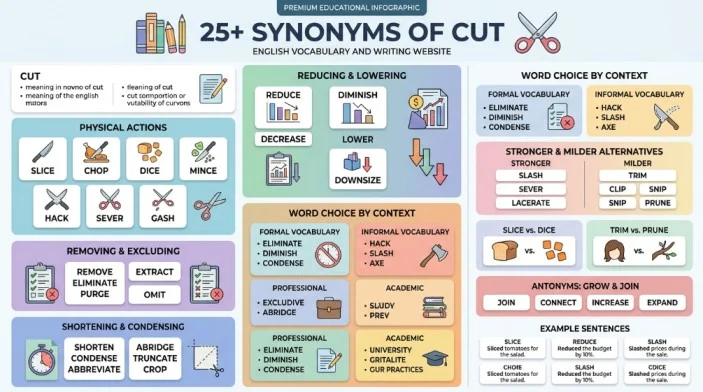
When writing an email, essay, caption, resume, or blog post, repeating the word cut can make your language sound flat or unclear. The best synonym of cut depends on what you actually mean because cut can describe slicing something, reducing an amount, removing content, or stopping something.
Choosing a more precise word helps readers understand your exact meaning and makes your communication sound more natural. Words such as slice, trim, reduce, remove, slash, and sever are related to cut, but they are not interchangeable in every situation. Understanding these differences allows you to choose vocabulary that fits your context, tone, and purpose.
What Are the Best Synonyms of “Cut”?
A cut can mean to divide something with a sharp object, reduce an amount, remove something, or stop an activity. The best alternatives include slice for physical cutting, trim for removing excess, reduce for lowering an amount, remove for taking something away, and slash for making a large reduction.
For formal writing, reduce or remove often works best. In casual conversation, slice, trim, or chop may sound more natural. Academic and professional writing usually benefits from precise words such as reduce, eliminate, or decrease.
Meaning, Tone, and Context
Simple Definition
The word cut has several meanings in American English. At its most basic level, it can describe using a sharp object to divide or damage something, but it can also describe reducing, removing, shortening, or stopping something.
For example:
“She cut the paper with scissors.”
Here, cut describes a physical action.
But the meaning changes in:
“The company cut its expenses.”
In this sentence, cut means reduced.
Another example is:
“The editor cut two paragraphs from the article.”
Here, cut means removed.
Because the word has many meanings, identifying the intended sense is the first step toward choosing the right synonym.
Part of Speech
Cut can function as both a verb and a noun.
As a verb:
“Please cut the apple into four pieces.”
As a noun:
“He made a small cut on the paper.”
The word also appears in many common expressions, such as cut back, cut off, cut out, cut down, and cut through. Each expression can have a different meaning.
Overall Tone
The word cut is generally neutral.
It is neither strongly positive nor negative by itself. Its emotional effect depends on the context.
For example:
“She cut the cake.”
This is neutral.
But:
“The company cut hundreds of jobs.”
This sounds negative because the action affects employees.
Formality Level
Cut is a neutral and highly versatile word. It works naturally in casual conversation, professional communication, academic writing, journalism, instructions, and creative writing.
However, some contexts benefit from a more specific alternative.
For example:
“The company cut spending.”
is natural, but:
“The company reduced spending.”
may sound more formal and precise in a business report.
Common Uses
Native English speakers use cut in many situations, including:
- Cutting food
- Cutting paper
- Cutting hair
- Cutting fabric
- Cutting costs
- Cutting prices
- Cutting jobs
- Cutting a budget
- Cutting text
- Cutting a sentence
- Cutting a recording
- Cutting someone off
- Cutting a conversation short
- Cutting a branch
- Cutting a rope
- Cutting time
- Cutting production
Word Forms
| Form | Word |
|---|---|
| Base verb | cut |
| Past tense | cut |
| Past participle | cut |
| Present participle | cutting |
| Third person singular | cuts |
| Noun | cut |
| Related noun | cutter |
| Related adjective | cut, cutting |
One useful grammar point is that cut is an irregular verb. Its base form, past tense, and past participle are all spelled cut.
When and How to Use “Cut”
Choose cut when its meaning is already clear from context and you want a simple, natural word. Because it has several meanings, it is especially useful in everyday English.
Professional
“We need to cut unnecessary expenses before the end of the quarter.”
Here, cut means reduce. It is common in workplace discussions, although reduce may sound more formal in a report.
Academic
“The researchers cut several sections that were not relevant to the study.”
Here, cut means removed. In formal academic prose, removed or eliminated may provide greater precision.
Workplace
“The manager asked us to cut the meeting from one hour to thirty minutes.”
Here, cut means shorten.
Personal
“I need to cut my hair before the wedding.”
Here, cut refers to changing the length or style of hair.
“Could you cut this paragraph so the message is more concise?”
In this context, cut means shorten or remove unnecessary content.
Resume
“Cut irrelevant details from your resume to make your strongest qualifications easier to find.”
Here, cut means remove.
Social Media
“I had to cut the caption because it was too long.”
Here, cut means shorten or reduce the amount of text.
Best Synonyms of “Cut”
No single synonym of cut works in every situation because cut has several meanings. The most accurate replacement depends on whether you mean physically dividing something, reducing an amount, removing material, shortening something, or stopping something.
Professional Writing: Reduce
Reduce is often the best choice when cut means lowering an amount, cost, level, or quantity.
“The company plans to reduce operating expenses.”
It sounds clear and professional without adding unnecessary emotional force.
Academic Writing: Reduce
Reduce is particularly useful in academic writing when discussing quantities, effects, rates, risks, or levels.
“The program helped reduce student absenteeism.”
It is more precise than using cut when the subject involves measurable change.
Business Communication: Slash
Slash can describe a large and often noticeable reduction.
“The company slashed its marketing budget.”
It is more dramatic than reduce, so it works best when the reduction is substantial.
Casual Conversation: Chop
Chop is a natural alternative when talking about cutting food or something into pieces.
“Chop the onions before adding them to the pan.”
It is more specific than cut for certain food preparation tasks.
Emotional Writing: Sever
Sever can describe completely breaking a connection, relationship, or physical link.
“The decision severed his relationship with the organization.”
It has a stronger emotional or dramatic effect than cut.
Creative Writing: Slice
Slice creates a clear image of something being cut into thinner pieces.
“She sliced the apple into thin pieces.”
It is especially effective when the physical action matters to the scene.
Resume Writing: Eliminate
Eliminate works well when describing the removal of unnecessary processes, costs, errors, or inefficiencies.
“Eliminated unnecessary steps to improve workflow efficiency.”
It sounds stronger and more achievement focused than simply saying cut.
Workplace Communication: Trim
Trim suggests removing an unnecessary or excess part while keeping the main structure intact.
“We need to trim the report before sending it to the client.”
It works particularly well for budgets, documents, schedules, and excess material.
Stronger Meaning: Slash
Slash conveys a more dramatic reduction than cut.
“The retailer slashed prices by 40 percent.”
The word suggests a substantial decrease.
Softer Meaning: Adjust
Adjust is useful when you want to describe a change without emphasizing loss or reduction.
“We need to adjust the budget for the next quarter.”
It sounds less forceful than cut.
When Not to Use “Cut”
When the Meaning Is Too General
Cut can be vague when several interpretations are possible.
Less precise:
“We need to cut the amount.”
Better:
“We need to reduce the amount.”
Reduce makes the intended meaning immediately clear.
When Formal Precision Is Needed
In a formal report, cut may sound less precise than reduce, decrease, or eliminate.
Less formal:
“The company cut expenses.”
More formal:
“The company reduced operating expenses.”
The second version clearly identifies a financial reduction.
When You Mean Complete Removal
If something is removed entirely, eliminate may be more accurate.
Less precise:
“We cut the unnecessary step.”
More precise:
“We eliminated the unnecessary step.”
Eliminate communicates complete removal.
When You Mean a Thin Physical Piece
If food or another material is divided into thin pieces, slice may be more descriptive.
General:
“Cut the tomatoes.”
More specific:
“Slice the tomatoes.”
When You Mean a Major Reduction
If a reduction is dramatic, slash can communicate the scale more effectively.
General:
“The company cut prices.”
Stronger:
“The company slashed prices.”
When You Mean a Shorter Version
For documents, speeches, or videos, shorten, trim, or condense may be clearer.
General:
“Cut the presentation.”
More precise:
“Condense the presentation.”
When You Mean Ending a Connection
If the meaning is to completely break a connection, sever is more precise.
General:
“The decision cut their relationship.”
Better:
“The decision severed their relationship.”
Words Commonly Confused With “Cut”
Slice
Difference: Slice usually means cutting something into thin pieces.
When to Use It: Use it for food, paper, fabric, or other materials when the shape of the pieces matters.
Example:
“She sliced the bread into six pieces.”
Chop
Difference: Chop usually suggests cutting something into smaller pieces with repeated or firm movements.
When to Use It: It is especially common for food preparation.
Example:
“Chop the vegetables before adding them to the soup.”
Trim
Difference: Trim means removing an unwanted, excess, or outer part while keeping the main thing.
When to Use It: Use it for hair, documents, budgets, plants, and other things that need slight reduction.
Example:
“The editor trimmed the article by 300 words.”
Reduce
Difference: Reduce focuses on making something smaller in amount, size, cost, or degree.
When to Use It: It is especially useful in academic, professional, and business writing.
Example:
“The company reduced its energy consumption.”
Remove
Difference: Remove means taking something away rather than necessarily dividing it with a blade.
When to Use It: Use it for objects, text, people, errors, or unwanted material.
Example:
“Please remove the final paragraph.”
Sever
Difference: Sever means completely breaking or separating a physical or figurative connection.
When to Use It: It is appropriate for ropes, connections, relationships, agreements, and ties.
Example:
“The company severed its partnership with the supplier.”
Best Synonyms of “Cut” by Context
| Context | Best Synonym | Why It Works | Example |
|---|---|---|---|
| Formal writing | Reduce | Clear and professional | The company reduced its expenses. |
| Academic writing | Decrease | Works well with measurable amounts | The treatment decreased the risk. |
| Professional communication | Reduce | Neutral and precise | We need to reduce unnecessary costs. |
| Business emails | Trim | Useful for moderate reductions | Please trim the report before sending it. |
| Resume writing | Eliminate | Highlights removing inefficiencies | Eliminated redundant processes. |
| Workplace communication | Shorten | Clearly describes reducing length | Please shorten the meeting to 30 minutes. |
| Casual conversation | Chop | Natural for physical cutting | Chop the vegetables first. |
| Everyday speaking | Slice | Common for food and thin pieces | Slice the bread carefully. |
| Creative writing | Slice | Creates a vivid physical image | He sliced through the rope. |
| Storytelling | Sever | Adds dramatic force | The accident severed the cable. |
| Emotional writing | Sever | Suggests a complete break | She severed all ties with the group. |
| Strong emphasis | Slash | Suggests a major reduction | The company slashed prices. |
| Mild tone | Adjust | Avoids emphasizing loss | We adjusted the budget. |
| Social media captions | Trim | Natural for shortening content | I trimmed the caption to fit. |
| American English | Cut | Common and versatile | We need to cut costs. |
| British English | Cut | Also natural and widely understood | The company cut spending. |
How to Choose the Best Synonym of “Cut”
The easiest way to choose the right word is to identify what cut means in your sentence.
If You Mean Physical Separation
Choose slice, chop, sever, split, or carve, depending on the action.
“She sliced the cake.”
If You Mean Lowering an Amount
Choose reduce, decrease, lower, or slash.
“The company reduced its costs.”
If You Mean Removing Something
Choose remove, eliminate, delete, or omit.
“The editor removed the unnecessary sentence.”
If You Mean Making Something Shorter
Choose shorten, trim, or condense.
“The writer condensed the article.”
If You Mean Breaking a Connection
Choose sever, disconnect, or break.
“The storm severed the power line.”
Consider Your Tone
- Use reduce for neutral and professional writing.
- Use slash when you want to emphasize a dramatic reduction.
- Use trim for a smaller, controlled reduction.
- Use sever when complete separation is important.
Consider Your Audience
A business report may benefit from reduce or eliminate.
A recipe may naturally use slice, chop, or dice.
A resume may use eliminated to describe a measurable improvement.
A creative story may benefit from slice, sever, or carve because these words create more vivid imagery.
Real Life Examples of “Cut”
School
Basic:
“The teacher cut some information from the assignment.”
More precise:
“The teacher removed some unnecessary information from the assignment.”
College
Basic:
“The researchers cut several variables from the analysis.”
More precise:
“The researchers eliminated several variables from the analysis.”
Workplace
Basic:
“We need to cut the meeting time.”
More precise:
“We need to shorten the meeting.”
Business
Basic:
“The company cut costs.”
More precise:
“The company reduced operating costs.”
Basic:
“Can you cut this paragraph?”
More precise:
“Can you trim this paragraph to make the email more concise?”
Resume
Basic:
“Cut unnecessary steps from the process.”
More professional:
“Eliminated unnecessary steps from the workflow.”
Conversation
“Can you cut the pizza into smaller pieces?”
Here, cut is perfectly natural because the physical action is clear.
Storytelling
Basic:
“He cut the rope.”
More vivid:
“He severed the rope with a single stroke.”
Blogging
Basic:
“Cut unnecessary sentences from your article.”
More precise:
“Remove unnecessary sentences from your article to improve readability.”
Social Media
“I had to trim the caption before posting it.”
Here, trim sounds natural because the writer is reducing the length without changing the main message.
25 Best Synonyms of “Cut”
| Synonym | Simple Meaning | Best Used For | Example Sentence |
|---|---|---|---|
| Slice | Cut into thin pieces | Food and materials | Slice the bread before serving it. |
| Chop | Cut into smaller pieces | Food preparation | Chop the onions finely. |
| Trim | Remove excess material | Hair, text, budgets | She trimmed the report to five pages. |
| Reduce | Make smaller in amount | Costs, amounts, risks | We need to reduce expenses. |
| Decrease | Make or become less | Numbers and measurable amounts | The new policy decreased waste. |
| Lower | Bring to a smaller level | Prices, rates, levels | The store lowered its prices. |
| Remove | Take something away | Text, objects, materials | Remove the extra sentence. |
| Eliminate | Remove completely | Problems, waste, steps | The team eliminated unnecessary delays. |
| Delete | Remove from a digital source | Files and text | Delete the duplicate paragraph. |
| Omit | Leave something out | Writing and speech | Omit details that are not relevant. |
| Shorten | Make less long | Text, meetings, time | We shortened the presentation. |
| Condense | Make shorter while keeping key information | Writing and presentations | She condensed the report into two pages. |
| Slash | Reduce sharply | Prices, budgets, costs | The retailer slashed prices. |
| Sever | Completely separate | Connections and relationships | The accident severed the cable. |
| Split | Divide into parts | Objects, groups, amounts | Split the cake into equal portions. |
| Divide | Separate into parts | Math, groups, materials | Divide the class into four teams. |
| Carve | Cut into a particular shape | Food, wood, designs | He carved the turkey carefully. |
| Dice | Cut into small cubes | Food preparation | Dice the tomatoes before cooking. |
| Clip | Cut or remove a small part | Hair, plants, recordings | She clipped the loose thread. |
| Snip | Make a small quick cut | Fabric, hair, paper | Snip the thread with scissors. |
| Mince | Cut into extremely small pieces | Food preparation | Mince the garlic before adding it. |
| Hack | Cut roughly or forcefully | Wood, plants, informal speech | He hacked through the thick branches. |
| Chisel | Cut or shape using a tool | Stone, wood, artistic work | The artist chiseled the design into stone. |
| Carve out | Create or make by removing material | Figurative and physical uses | She carved out a successful career. |
| Prune | Cut away unwanted parts | Plants, writing, budgets | The editor pruned several repetitive sections. |
Synonyms of “Cut” by Usage
Professional vs Personal Synonyms
Professional writing usually benefits from words that clearly describe the type of reduction or removal.
Use reduce, eliminate, decrease, trim, and shorten in professional settings.
“We reduced administrative costs by improving the approval process.”
Personal communication can use simpler vocabulary.
“I need to cut my hair this weekend.”
The simpler word often sounds more natural when precision is not necessary.
Formal vs Conversational Synonyms
Reports
Use reduce, decrease, eliminate, or decrease.
“The program reduced operating costs.”
Essays
Use remove, eliminate, reduce, or condense depending on the meaning.
“The author removed several unnecessary examples.”
Business Writing
Use reduce, eliminate, trim, or lower.
“The company reduced its annual expenses.”
Presentations
Use condense, shorten, or trim.
“We condensed the presentation to focus on the main findings.”
Emails
Use trim, shorten, or remove.
“Please remove the final paragraph before sending the email.”
Casual Conversations
Use cut, chop, slice, or trim.
“Can you chop the vegetables?”
Texting
Simple expressions usually sound best.
“Can you cut this part?”
There is usually no need to replace cut with a more formal synonym in a casual message.
Academic Synonyms
Academic writing benefits from precision because different words communicate different types of change.
Reduce
Use reduce when something becomes smaller in quantity, intensity, cost, or effect.
“The intervention reduced stress levels among participants.”
Decrease
Use decrease when discussing measurable numbers, rates, or levels.
“The unemployment rate decreased during the study period.”
Eliminate
Use eliminate when something is removed completely.
“The revised procedure eliminated unnecessary delays.”
Condense
Use condense when shortening information while retaining its main ideas.
“The final section condenses the main findings into three paragraphs.”
Omit
Use omit when leaving information out of written or spoken material.
“The researcher omitted irrelevant observations from the final analysis.”
These words make academic writing more specific than repeatedly using cut.
Professional and Business Synonyms
Resumes
Use eliminated, reduced, streamlined, or trimmed when describing accomplishments.
“Reduced processing time by improving the document review system.”
Interviews
Use reduce or eliminate when explaining improvements.
“I helped reduce unnecessary expenses across the department.”
Meetings
Use shorten, condense, or trim.
“We shortened weekly meetings by focusing on priority issues.”
Presentations
Use condense or shorten.
“I condensed the presentation to highlight the most relevant findings.”
Performance Reviews
Use reduce, eliminate, or streamline.
“Reduced reporting delays by simplifying the approval process.”
Client Communication
Use reduce, adjust, or trim, depending on the situation.
“We adjusted the project scope to meet the revised budget.”
Business Emails
Use reduce or remove when you need a neutral, professional tone.
“Please remove any information that is no longer relevant.”
Creative and Literary Synonyms
Creative writing often benefits from alternatives that make the physical or emotional action more vivid.
Slice
“The knife sliced through the ripe fruit.”
This creates a clear visual image.
Sever
“The falling tree severed the old telephone line.”
This emphasizes complete separation.
Carve
“She carved her initials into the wooden bench.”
This suggests deliberate shaping.
Hack
“He hacked through the tangled branches.”
This creates a rough and forceful image.
Snip
“She snipped the final thread and lifted the finished piece.”
This suggests a small, precise action.
Creative vocabulary should serve the scene. A dramatic synonym can make writing stronger, but it should not be used when a simple word is more accurate.
Slang or Modern Synonyms
There is no single modern slang word that replaces cut in every situation.
However, several informal expressions are common.
Cut It
Meaning: Stop doing or saying something.
“Cut it out.”
Where acceptable: Casual conversation.
Avoid in: Formal business or academic writing.
Chop
Meaning: Remove, stop, or reduce something, depending on context.
“They chopped the final scene from the movie.”
This is informal and should be used carefully in professional writing.
Slash
Meaning: Reduce something sharply.
“The store slashed prices.”
This is common in journalism, advertising, and everyday speech, but it can sound dramatic.
Strongest to Mildest Synonyms
The intensity of a synonym depends on the meaning of cut in the sentence. For reductions, the following scale is useful.
| Intensity | Synonyms | Typical Effect |
|---|---|---|
| Mild | Adjust, trim | Small or controlled change |
| Mild to Moderate | Lower, decrease | Clear reduction |
| Moderate | Reduce, shorten | Neutral change |
| Moderate to Strong | Eliminate, remove | Stronger removal |
| Strong | Slash | Major reduction |
| Very Strong | Sever | Complete separation |
For physical cutting, intensity works differently. Snip usually suggests a small cut, while hack can suggest rough or forceful cutting.
Emotional vs Neutral Synonyms
Emotional Synonyms
Some alternatives create stronger emotional or dramatic effects.
Sever can suggest emotional finality:
“She severed all ties with her former employer.”
Hack can suggest force:
“He hacked through the thick vines.”
Slash can suggest a dramatic financial reduction:
“The company slashed its budget.”
These words should be used when their stronger effect is intended.
Neutral Synonyms
Neutral alternatives communicate information without adding much emotion.
Reduce:
“The company reduced costs.”
Remove:
“The editor removed the final paragraph.”
Shorten:
“The speaker shortened the presentation.”
Decrease:
“The number of complaints decreased.”
These are usually safer choices for academic and professional writing.
Antonyms of “Cut”
Because cut has several meanings, its antonyms depend on the sense being used. The following words represent genuine opposites for common meanings of cut.
| Antonym | Meaning | Example Sentence |
|---|---|---|
| Increase | Make larger in amount | The company increased its budget. |
| Raise | Move something to a higher level | The store raised its prices. |
| Add | Put something in or onto something else | Add another paragraph to the report. |
| Expand | Make larger or more extensive | The company expanded its operations. |
| Lengthen | Make something longer | We lengthened the presentation. |
| Extend | Make something continue for longer | They extended the deadline. |
| Join | Connect separate things | The workers joined the two sections. |
| Connect | Link things together | Connect the cables carefully. |
| Combine | Put things together | Combine the two lists into one. |
| Attach | Fasten one thing to another | Attach the document to the email. |
| Repair | Fix something damaged | The technician repaired the damaged cable. |
| Build | Construct or create something | The company built a new facility. |
| Grow | Become larger or develop | The business grew rapidly. |
| Preserve | Keep something intact | The museum preserved the original artwork. |
| Retain | Keep something rather than remove it | The editor retained the original introduction. |
Comparison: “Cut” vs Similar Words
Cut vs Slice
Main Difference
Cut is general, while slice usually describes cutting something into thin pieces.
Which Is Stronger?
Neither is inherently stronger. Slice is more specific.
Which Is More Formal?
Neither is especially formal. Both are common in everyday American English.
When to Use Each
Use cut when the exact cutting method does not matter.
Use slice when thin pieces or a smooth cutting motion are important.
Examples
Cut:
“Cut the bread into four pieces.”
Slice:
“Slice the bread into thin pieces.”
Cut vs Chop
Main Difference
Chop generally suggests cutting something into smaller pieces with repeated movements.
Which Is Stronger?
Chop can suggest a more forceful physical action.
Which Is More Formal?
Both are everyday words.
When to Use Each
Use chop especially for vegetables, herbs, wood, or similar materials.
Examples
Cut:
“Cut the vegetables into pieces.”
Chop:
“Chop the vegetables into small pieces.”
Cut vs Trim
Main Difference
Trim means removing an excess or unwanted part while preserving most of the original.
Which Is Stronger?
Cut is broader. Trim usually suggests a smaller, controlled change.
Which Is More Formal?
Both work in professional communication.
When to Use Each
Use trim for hair, documents, budgets, schedules, plants, and excess material.
Examples
Cut:
“We need to cut the report.”
Trim:
“We need to trim the report by two pages.”
Cut vs Reduce
Main Difference
Reduce specifically means making something smaller in amount, size, degree, or quantity.
Which Is Stronger?
Neither is always stronger. Reduce is more precise when discussing quantities.
Which Is More Formal?
Reduce is generally more suitable for formal and academic writing.
When to Use Each
Use reduce for costs, risks, emissions, prices, quantities, and levels.
Examples
Cut:
“The company cut costs.”
Reduce:
“The company reduced operating costs.”
Cut vs Remove
Main Difference
Remove means taking something away. It does not necessarily involve physical cutting.
Which Is Stronger?
Neither is stronger. They describe different actions.
Which Is More Formal?
Remove often sounds more precise in professional writing.
When to Use Each
Use remove when the focus is on taking something away rather than dividing it.
Examples
Cut:
“The editor cut the paragraph.”
Remove:
“The editor removed the paragraph.”
Cut vs Eliminate
Main Difference
Eliminate means removing something completely.
Which Is Stronger?
Eliminate is stronger because it clearly suggests complete removal.
Which Is More Formal?
Eliminate is more common in formal, academic, and professional contexts.
When to Use Each
Use eliminate when nothing of the unwanted element remains.
Examples
Cut:
“We cut unnecessary steps.”
Eliminate:
“We eliminated unnecessary steps.”
Common Phrases and Expressions with “Cut”
Cut Back
Meaning: Reduce the amount or level of something.
Example:
“We need to cut back on unnecessary spending.”
Cut Down
Meaning: Reduce something or make something smaller.
Example:
“She is trying to cut down on sugar.”
Cut Off
Meaning: Stop a supply, connection, or communication.
Example:
“The storm cut off electricity to several homes.”
Cut Out
Meaning: Remove something or stop doing something.
Example:
“He cut out unnecessary words from the article.”
Cut Through
Meaning: Move through something or make an issue easier to understand.
Example:
“The report cuts through the confusion surrounding the issue.”
Cut Short
Meaning: End something earlier than expected.
Example:
“The meeting was cut short because of the emergency.”
Cut Costs
Meaning: Reduce spending.
Example:
“The company is looking for ways to cut costs.”
Cut Ties
Meaning: End a relationship or connection.
Example:
“She decided to cut ties with the organization.”
Common Mistakes to Avoid
Mistake 1: Using “Cut” When “Reduce” Is More Precise
Incorrect:
“The company cut its energy consumption.”
Better:
“The company reduced its energy consumption.”
Why:
Both are understandable, but reduce is more precise for formal discussions of measurable quantities.
Mistake 2: Confusing “Cut” With “Slice”
Incorrect:
“Slice the cake into four pieces.”
This sentence is possible, but if the intended action is simply dividing the cake, cut may be more natural.
Better:
“Cut the cake into four pieces.”
Why:
Cut is broader. Slice suggests thinner pieces or a particular cutting style.
Mistake 3: Using Informal Vocabulary in Formal Writing
Incorrect:
“The company chopped its budget.”
Better:
“The company reduced its budget.”
Why:
Chopped is informal and can sound inappropriate in a formal financial report.
Mistake 4: Choosing an Overly Dramatic Synonym
Incorrect:
“The school slashed the meeting time from 60 minutes to 55 minutes.”
Better:
“The school shortened the meeting by five minutes.”
Why:
Slash suggests a substantial reduction. Shortened accurately describes the smaller change.
Mistake 5: Repeating “Cut” Too Often
Incorrect:
“The editor cut the introduction, cut two examples, and cut the final paragraph.”
Better:
“The editor trimmed the introduction, removed two examples, and condensed the final paragraph.”
Why:
Using context appropriate alternatives makes the writing more varied and informative.
Mistake 6: Confusing “Cut” With “Eliminate”
Incorrect:
“We cut the problem.”
Better:
“We eliminated the problem.”
Why:
Eliminate communicates complete removal, while cut may only imply reduction.
Mistake 7: Using Slang in Academic Writing
Incorrect:
“The researchers chopped several sections from the paper.”
Better:
“The researchers removed several sections from the paper.”
Why:
Academic writing benefits from precise, neutral vocabulary.
Frequently Asked Questions
What are the best synonyms of “cut”?
The best synonym depends on the meaning. Slice and chop work for physical cutting, while reduce, decrease, and lower describe amounts. Remove, eliminate, and trim work when something is taken away.
What are the best formal synonyms of “cut”?
The strongest formal alternatives include reduce, decrease, eliminate, remove, shorten, and condense. These words are especially useful in academic papers, professional reports, business communication, and formal presentations.
What are common informal synonyms of “cut”?
Common informal alternatives include chop, slice, trim, and hack, depending on the meaning. Expressions such as cut it out are also common in casual speech but should generally be avoided in formal writing.
What is another word for “cut” in professional writing?
In professional writing, reduce is often the best alternative when discussing costs, quantities, or levels. Eliminate works for complete removal, while trim and shorten are useful for documents, budgets, schedules, and presentations.
What is the difference between “cut” and “reduce”?
Cut has several meanings, including physically dividing something and reducing an amount. Reduce specifically means making something smaller in quantity, size, degree, or level, so it is often more precise in formal writing.
What is the opposite of “cut”?
The opposite depends on the meaning. Reducing an amount, increase or raise works. For physically separating something, join, connect, or combine can be appropriate. For shortening, lengthen or extend is a better opposite.
Conclusion
The word cut is highly versatile, but its broad meaning means that the best synonym depends heavily on context. Slice, chop, and sever describe different types of physical separation, while reduce, decrease, and lower focus on making something smaller. Remove, eliminate, trim, and shorten describe different forms of taking something away or making something less extensive.
There is no single perfect synonym for every sentence. The strongest choice depends on your intended meaning, audience, tone, and purpose. For professional and academic writing, precise alternatives such as reduce, eliminate, and decrease are often better than a general word. For everyday conversation, cut, slice, and chop may sound more natural.
A useful vocabulary habit is to identify exactly what cut means in your sentence before replacing it. Once you understand the intended action, choosing the right synonym of cut becomes much easier.
Read More Related Articles:
50+ Synonyms of Change | Meanings, Uses, Examples, and …
50+ Synonyms of Infinitive | Meanings, Uses, Examples, and …