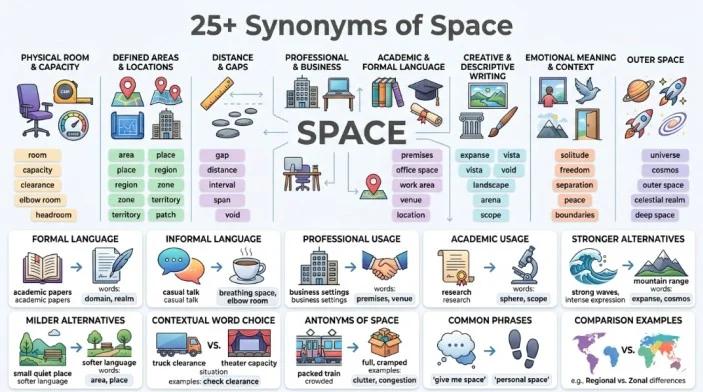
Space is a flexible English word that can describe an empty area, physical distance, room for movement, outer space, or even personal freedom. Choosing the right synonym depends on the exact meaning you want to express. A word like room may fit everyday writing, while distance, area, gap, vacancy, or cosmos can create a very different meaning and tone. Understanding these distinctions helps you write with greater precision instead of replacing a word with a synonym that only seems similar.
In professional, academic, creative, and everyday writing, context matters just as much as meaning. Synonyms of Space can make descriptions clearer, reduce repetition, and help your language sound more natural. This guide examines accurate alternatives, their meanings, tones, common uses, and practical examples so you can choose the right word for the situation.
What Are the Best Synonyms of “Space”?
The best synonym of space depends on its meaning. Use room for available physical capacity, area for a particular place, gap for an opening or separation, distance for physical separation, and expanse for a large open area. In astronomy, cosmos, universe, and outer space are appropriate alternatives.
Meaning, Tone, and Context
Simple Definition
The word space has several common meanings. It can refer to an area that is available or unoccupied, the distance between things, a particular physical area, or the vast region beyond Earth’s atmosphere.
For example:
“There isn’t enough space in the garage.”
Here, space means available room.
In another sentence:
“Leave some space between the chairs.”
The word refers to the distance or gap separating objects.
It can also refer to the universe:
“Scientists continue to explore space.”
In this context, space means the region beyond Earth’s atmosphere.
Part of Speech
Space can function primarily as both a noun and a verb.
As a noun:
“We need more space in the office.”
As a verb:
“Please space the chairs evenly.”
Overall Tone
The word space is generally neutral. It does not automatically communicate positive or negative emotion.
Its tone changes according to context.
For example:
“The room has plenty of space.”
This sounds neutral or positive.
“I need some space right now.”
This can have an emotional meaning and may suggest a desire for privacy or distance.
Formality Level
Space is a neutral word that works in formal, semi formal, and informal communication.
It is suitable for:
- Academic writing
- Business communication
- Emails
- Everyday conversations
- Technical discussions
- Creative writing
- Social media
- Real estate descriptions
- Science and astronomy
Because it is so versatile, the challenge is usually not whether space is appropriate. The challenge is choosing a more precise word when the context calls for one.
Common Uses
Native English speakers use space to describe:
- Physical room
- Empty areas
- Offices and buildings
- Parking areas
- Storage capacity
- Distance between objects
- Personal privacy
- Gaps between words or lines
- Outer space
- The universe
- Open areas
- Time or scheduling intervals in some contexts
- Opportunities or capacity for activities
Word Forms
| Word | Part of Speech | Example |
|---|---|---|
| Space | Noun | “There is enough space here.” |
| Space | Verb | “Space the plants evenly.” |
| Spacious | Adjective | “The apartment is spacious.” |
| Spaciousness | Noun | “The spaciousness of the room is impressive.” |
| Spaced | Adjective or past participle | “The chairs were evenly spaced.” |
When and How to Use “Space”
Use space when you need a broad, flexible word for an area, room, distance, gap, or the region beyond Earth. It is often the safest choice when the exact type of space does not need to be emphasized.
Professional
“We need additional space for the new equipment.”
Here, space refers to an available physical area.
Academic
“The researchers examined how people respond to shared space.”
This use can refer to physical or social environments.
Workplace
“The team needs more space for collaborative meetings.”
A more specific alternative could be room if the writer is talking about physical capacity.
Personal
“After a stressful week, I need some space to think.”
Here, space refers to personal distance or privacy rather than physical room.
“Could you let me know whether there is enough space for the additional files?”
In this context, space can refer to available capacity.
Resume
“Redesigned office layouts to create more usable space.”
Here, the word describes physical area.
Social Media
“Sometimes you need a little space to reset and focus.”
This is an informal and emotional use referring to personal distance or privacy.
Best Synonyms of “Space”
No single synonym works in every situation because space has several meanings. The most accurate alternative depends on whether you mean physical room, an area, distance, an opening, a large open region, personal privacy, or outer space.
Professional Writing: Room
Use room when you mean available physical capacity.
“The new office provides enough room for additional employees.”
It sounds natural in workplace and business communication.
Academic Writing: Area
Use area when referring to a defined physical or conceptual location.
“The study focused on an urban area with limited public resources.”
It is more specific than space when boundaries or location matter.
Business Communication: Capacity
Use capacity when you are talking about how much something can hold.
“The facility has the capacity to accommodate 500 guests.”
This is more precise than simply saying space.
Casual Conversation: Room
Room is usually the most natural everyday alternative.
“Do we have enough room for another chair?”
Emotional Writing: Distance
Use distance when space means emotional separation.
“She needed some distance before making a decision.”
This makes the emotional meaning clearer.
Creative Writing: Expanse
Expanse works well when describing a broad, open area.
“Beyond the hills stretched a silent expanse of golden grass.”
It adds a more descriptive quality than the simple word space.
Resume Writing: Area
Use area when describing a physical or professional field.
“Improved the usable area of the production facility.”
If you mean a field of expertise, area also works naturally:
“Specialized in the area of digital marketing.”
Workplace Communication: Room
Use room for physical availability and capacity when discussing limits.
“We need more room for the growing team.”
Stronger Meaning: Expanse
When you want to emphasize a large, open region, expanse is stronger and more descriptive than the general word space.
“The hikers crossed a vast expanse of desert.”
Softer Meaning: Area
Area is a straightforward and neutral alternative that avoids adding unnecessary emphasis.
“The seating area is available for visitors.”
When Not to Use “Space”
Although space is highly flexible, replacing it with a more precise word can make your sentence clearer.
When Space Sounds Too General
Less precise:
“We need more space.”
Better:
“We need more room for the new desks.”
Why:
Room clearly indicates available physical capacity.
When Space Sounds Too Vague
Less precise:
“The company operates in a new space.”
Better:
“The company operates in a new office.”
Why:
Space could mean an office, building, market, industry, or online environment. A specific noun removes the ambiguity.
When Space Is Too Weak for a Large Open Area
Less precise:
“They walked across a large space.”
Better:
“They walked across a vast expanse.”
Why:
Expanse creates a stronger sense of size and openness.
When Space Refers to a Gap
Less precise:
“There is space between the two buildings.”
Better:
“There is a gap between the two buildings.”
Why:
Gap specifically emphasizes the separation between two things.
When Space Refers to Physical Separation
Less precise:
“Keep some space between the vehicles.”
Better:
“Keep some distance between the vehicles.”
Why:
Distance more clearly communicates separation.
When Space Refers to Personal Privacy
Less precise:
“I need some space.”
Better:
“I need some privacy.”
Why:
If the speaker specifically wants to be alone, privacy communicates the intended meaning more directly.
When Space Means Outer Space
Less precise:
“The spacecraft traveled through space.”
This sentence is perfectly natural, but if the context requires greater specificity, you can use:
“The spacecraft traveled through outer space.”
Why:
Outer space clearly identifies the astronomical sense.
Words Commonly Confused With “Space”
Room
Difference:
Room usually means available physical capacity, while space has many broader meanings.
When to Use It:
Use room when talking about whether something can fit.
Example:
“There isn’t enough room for another table.”
Area
Difference:
Area generally identifies a particular physical or conceptual region.
When to Use It:
Use area when the boundaries or location of a place matter.
Example:
“The children played in the designated area.”
Place
Difference:
Place refers to a location or position, while space can emphasize availability, openness, or separation.
When to Use It:
Use place when referring to a location or somewhere for something to go.
Example:
“Please put the boxes in their proper place.”
Gap
Difference:
Gap specifically refers to an opening or separation between things.
When to Use It:
Use gap when emphasizing what separates two objects, people, or ideas.
Example:
“There is a small gap between the doors.”
Distance
Difference:
Distance measures or describes separation between points, people, or objects.
When to Use It:
Use distance when the main idea is how far apart things are.
Example:
“Maintain a safe distance from the machine.”
Expanse
Difference:
Expanse emphasizes a broad, open, and often uninterrupted area.
When to Use It:
Use it in descriptive, geographical, or literary writing.
Example:
“An enormous expanse of ocean stretched before them.”
Best Synonyms of “Space” by Context
| Context | Best Synonym | Why It Works | Example |
|---|---|---|---|
| Formal writing | Area | Neutral and precise | “The protected area covers several acres.” |
| Academic writing | Region | Identifies a defined geographical or conceptual area | “The study examined the coastal region.” |
| Professional communication | Room | Clearly describes available capacity | “We need more room for equipment.” |
| Business emails | Capacity | Emphasizes available limits | “The venue has enough capacity for attendees.” |
| Resume writing | Area | Works naturally for physical or professional fields | “Improved the usable area of the facility.” |
| Workplace communication | Room | Natural for physical availability | “There is enough room for the team.” |
| Casual conversation | Room | Common and natural in everyday speech | “Do we have room for one more person?” |
| Everyday speaking | Place | Simple and flexible for location | “Put it in a safe place.” |
| Creative writing | Expanse | Creates a vivid sense of openness | “A vast expanse of land surrounded them.” |
| Storytelling | Distance | Works well for physical or emotional separation | “He kept his distance from the crowd.” |
| Emotional writing | Privacy | Clarifies the need for personal separation | “She needed some privacy after the argument.” |
| Strong emphasis | Expanse | Highlights size and openness | “The endless expanse seemed to have no boundary.” |
| Mild tone | Area | Neutral and straightforward | “The seating area is nearby.” |
| Social media captions | Room | Simple and conversational | “Making room for new possibilities.” |
| American English | Room | Common for available physical capacity | “There isn’t enough room in the car.” |
| British English | Room | Also natural for physical capacity | “There isn’t enough room in the car.” |
How to Choose the Best Synonym of “Space”
Choosing another word for space becomes easier when you first identify the exact meaning you want.
1. Ask What Kind of Space You Mean
- If you mean available physical capacity, choose room.
- If you mean a defined location, choose area.
- If you mean separation, choose distance.
- If you mean an opening between things, choose gap.
- If you mean a broad open region, choose expanse.
- If you mean the region beyond Earth, choose outer space.
2. Consider Your Audience
A casual conversation usually favors simple words such as room or place.
An academic paper may benefit from area, region, or domain, depending on the subject.
A professional document may require capacity, clearance, or area for greater precision.
3. Match the Emotional Tone
The word space can describe both physical and emotional situations.
Compare:
“I need some space.”
with:
“I need some privacy.”
The first can have several meanings. The second clearly communicates a desire to be alone.
4. Consider Formality
Use familiar words when simplicity is more important than sophistication.
For example:
“We need more room.”
is usually better than:
“We require additional expanse.”
The second sentence sounds unnatural because expanse is not normally used for ordinary indoor capacity.
5. Choose Natural Usage Over Fancy Vocabulary
A synonym is only useful if native speakers would naturally use it in that context.
Do not replace space simply to make a sentence sound more sophisticated. Precision matters more than complexity.
Real Life Examples of “Space”
School
Original:
“There is not enough space for all the students.”
More precise:
“There is not enough room for all the students.”
Room sounds more natural when discussing physical capacity.
College
Original:
“The university created a new space for student activities.”
Improved:
“The university created a new area for student activities.”
Area works well when referring to a designated location.
Workplace
Original:
“Our office needs more space.”
Improved:
“Our office needs more room for additional employees.”
Business
Original:
“The company has limited space for inventory.”
Improved:
“The company has limited storage capacity for inventory.”
The revised sentence explains exactly what kind of limitation exists.
Original:
“Please leave some space between the paragraphs.”
Improved:
“Please leave a small gap between the paragraphs.”
The best choice depends on whether the writer means visual separation or formatting.
Resume
Original:
“Created more space in the warehouse.”
Improved:
“Created additional usable area in the warehouse.”
This version sounds more specific in a professional context.
Conversation
Original:
“I need some space after the argument.”
Improved:
“I need some distance after the argument.”
Distance makes the emotional meaning clearer.
Storytelling
Original:
“A huge space opened before them.”
Improved:
“A vast expanse opened before them.”
The second version creates a stronger visual image.
Blogging
Original:
“Many businesses are entering the online space.”
Improved:
“Many businesses are entering the online market.”
When space means an industry or competitive environment, market may be more precise.
Social Media
Original:
“Sometimes you need space to grow.”
Alternative:
“Sometimes you need room to grow.”
Both are natural. Space sounds slightly more reflective, while room is more conversational.
25 Best Synonyms of “Space”
Because space has multiple meanings, the following alternatives are grouped according to the sense they can express. Some are direct substitutes in specific contexts rather than interchangeable in every sentence.
| Synonym | Simple Meaning | Best Used For | Example Sentence |
|---|---|---|---|
| Room | Available physical capacity | Homes, offices, vehicles | “We have enough room for another desk.” |
| Area | A particular section or location | Buildings, geography, general writing | “The picnic area is near the lake.” |
| Place | A location or position | Everyday conversation | “Put the package in a safe place.” |
| Region | A defined geographical or conceptual area | Geography, academic writing | “The region receives heavy rainfall.” |
| Zone | A designated area with a particular purpose | Planning, safety, business | “This is a restricted zone.” |
| Expanse | A large open area | Creative and descriptive writing | “They crossed a wide expanse of grassland.” |
| Extent | The size or range of an area | Formal and academic writing | “The researchers measured the extent of the damage.” |
| Gap | An opening or separation | Objects, text, ideas | “There is a narrow gap between the walls.” |
| Distance | Separation between two points | Physical and emotional contexts | “Keep a safe distance from the edge.” |
| Opening | An empty or available passage | Buildings, structures | “We found an opening between the trees.” |
| Vacancy | An available unoccupied position or place | Housing, jobs, parking | “The building has one office vacancy.” |
| Capacity | The amount something can hold | Business, venues, storage | “The stadium has a seating capacity of 40,000.” |
| Clearance | Required empty distance around something | Construction, safety, equipment | “The machine needs additional clearance.” |
| Elbowroom | Enough physical freedom to move | Informal conversation | “The larger office gives everyone more elbowroom.” |
| Berth | A designated place, especially for a vehicle or vessel | Transportation, boating | “The ship moved into its assigned berth.” |
| Domain | A particular field or area of activity | Academic and professional writing | “Artificial intelligence is a rapidly developing domain.” |
| Realm | A particular area of thought, activity, or experience | Formal and creative writing | “The discovery opened a new realm of possibilities.” |
| Universe | The totality of physical existence | Astronomy | “Scientists continue to study the universe.” |
| Cosmos | The universe viewed as an ordered whole | Astronomy and literary writing | “The telescope revealed distant regions of the cosmos.” |
| Outer space | The region beyond Earth’s atmosphere | Science and astronomy | “The astronauts traveled into outer space.” |
| Vacuum | A region with extremely little matter | Physics | “The experiment was conducted in a vacuum.” |
| Interval | A period or separation between things | Time, mathematics, music | “There was a short interval between sessions.” |
| Headroom | Vertical space above something | Buildings, vehicles, construction | “The basement has limited headroom.” |
| Scope | The range covered by an activity or subject | Business and academic writing | “The project expanded beyond its original scope.” |
| Market | An area of commercial activity | Business | “The company entered a new international market.” |
Synonyms of “Space” by Usage
Professional vs Personal Synonyms
Professional writing often requires precision. Personal communication usually benefits from familiar vocabulary.
For physical capacity in a workplace, room, capacity, and area are useful.
“The department needs additional room for new employees.”
For personal relationships, space, privacy, and distance may be more appropriate.
“He needed some distance before discussing the issue.”
The best word depends on whether you are describing a physical resource or a personal need.
Formal vs Conversational Synonyms
Use more precise vocabulary when the writing requires a formal tone.
Reports:
“The study examined the geographic region.”
Essays:
“The concept occupies an important domain within modern philosophy.”
Business writing:
“The facility has limited capacity.”
Presentations:
“The organization has room for improvement.”
Emails:
“Please leave enough room for the signature.”
Casual conversations:
“Do we have enough room in the car?”
Texting:
“I need some space right now.”
Simple words are often the most natural choice in informal communication.
Academic Synonyms
Academic writing benefits from vocabulary that clearly identifies the type of space being discussed.
Area
Use area for a defined physical or conceptual location.
“The study examined an urban area with limited access to public transportation.”
Region
Use region for geographic or broader defined locations.
“The coastal region experienced significant population growth.”
Domain
Use domain for an intellectual, academic, or professional field.
“The theory has applications across several scientific domains.”
Extent
Use extent when discussing how large or widespread something is.
“Researchers evaluated the extent of environmental damage.”
Interval
Use interval when discussing a separation in time, mathematics, or another structured sequence.
“Measurements were recorded at regular intervals.”
These choices are more precise than using space repeatedly in academic writing.
Professional and Business Synonyms
Resumes
Use area, domain, or scope depending on the meaning.
“Expanded the scope of customer service operations.”
Interviews
Use field, area, or domain when discussing professional expertise.
“My primary area of expertise is digital marketing.”
Meetings
Use room, capacity, or venue when discussing physical arrangements.
“The conference room has enough capacity for the entire team.”
Presentations
Use market, sector, field, or area when space refers to an industry.
“The company is becoming a major competitor in the renewable energy market.”
Performance Reviews
Use area when discussing skills or development.
“Communication is an area where further development could improve performance.”
Client Communication
Use capacity when discussing what a service or facility can accommodate.
“The current system has enough capacity to support the additional users.”
Business Emails
Use room for physical availability and scope for the range of a project.
“There is room to expand the project scope next quarter.”
Creative and Literary Synonyms
Creative writing allows more expressive alternatives.
Expanse
Use expanse for large open landscapes.
“The endless expanse of desert shimmered beneath the afternoon sun.”
Realm
Use realm for imaginative worlds or abstract areas.
“She entered a strange realm where time seemed to stand still.”
Cosmos
Use cosmos for poetic references to the universe.
“He looked into the silent cosmos and wondered what lay beyond the stars.”
Distance
Use distance to create emotional or physical separation.
“Years of silence had created an uncomfortable distance between them.”
Opening
Use opening when an empty passage or opportunity appears.
“A narrow opening between the rocks revealed the valley beyond.”
These words add specificity without making the writing unnecessarily complicated.
Slang or Modern Synonyms
There is no single universal slang synonym for space. Modern speakers often use informal expressions based on the specific meaning.
Elbowroom
Meaning: Enough physical room to move comfortably.
Acceptable in: Casual speech and informal writing.
Avoid in: Academic papers, formal reports, and highly professional documents.
“The new apartment gives us plenty of elbowroom.”
A Place
In casual speech, people may use a place when they mean an available location.
“Is there a place for my bag?”
This is natural in conversation but may be less precise in formal writing.
Strongest to Mildest Synonyms
The intensity of a synonym depends on the sense of space being used. There is no universal strength ranking because room, gap, distance, and expanse describe different concepts.
Mild
- Area
- Place
- Room
These are neutral and practical.
Moderate
- Region
- Zone
- Distance
- Opening
- Capacity
These provide more specific information.
Strong
- Expanse
- Vastness
- Clearance
- Extent
These can emphasize size, separation, or openness.
Very Strong or Specialized
- Cosmos
- Universe
- Outer space
These are not stronger synonyms in every context. They belong to the astronomical sense of space.
The key point is that synonym choice should be based on meaning, not simply intensity.
Emotional vs Neutral Synonyms
Emotional Synonyms
Some alternatives can communicate emotional distance or personal significance.
- Distance
- Privacy
- Elbowroom
- Room
For example:
“I need some distance after what happened.”
This carries more emotional meaning than:
“I need some space.”
Neutral Synonyms
These words usually communicate information without adding strong emotion.
- Area
- Region
- Zone
- Room
- Capacity
- Interval
- Extent
For example:
“The building has enough capacity for 300 people.”
The sentence communicates a practical fact rather than an emotional response.
Antonyms of “Space”
Because space has several meanings, its opposites depend on the particular sense being used. The following words represent genuine or contextually established opposites across its major meanings.
| Antonym | Meaning | Example Sentence |
|---|---|---|
| Crowding | A condition in which too many people or things occupy an area | Crowding made it difficult to move through the station. |
| Congestion | Excessive concentration of people, vehicles, or objects | Traffic congestion filled the narrow streets. |
| Confinement | Being restricted within limited boundaries | The animals were kept in confinement. |
| Restriction | A condition that limits freedom or available area | New restrictions reduced access to the facility. |
| Compression | The act of pressing things into a smaller area | Compression reduced the volume of the material. |
| Fullness | The condition of being completely occupied | The fullness of the storage room made organization difficult. |
| Occupancy | The state of being occupied | The building reached maximum occupancy. |
| Closure | The state of being closed rather than open | The closure of the passage blocked access. |
| Blockage | Something that prevents passage through an opening | A fallen tree caused a blockage on the road. |
| Obstruction | Something that blocks movement or an open path | The construction created an obstruction near the entrance. |
| Crowdedness | The quality of having too many people or objects in one place | The crowdedness of the room made conversation difficult. |
| Tightness | A lack of available room or freedom of movement | The tightness of the hallway made moving furniture difficult. |
| Proximity | The state of being very close together | The buildings were positioned in close proximity. |
| Contact | Physical touching or direct connection rather than separation | The wires must remain in contact for the circuit to work. |
| Containment | The state of being enclosed within boundaries | The system was designed for secure containment. |
Comparison: “Space” vs Similar Words
Space vs Room
Main Difference
Space has several meanings, while room usually refers to available physical capacity or an actual enclosed part of a building.
Which Is Stronger?
Neither is inherently stronger.
Which Is More Formal?
Both are neutral. Space is broader, while room is often more conversational for physical capacity.
When to Use Each
Use space when the meaning could involve an area, gap, distance, or outer space.
Use room when something needs enough physical capacity to fit.
Examples
Space:
“There is not enough space between the vehicles.”
Room:
“There is not enough room in the garage.”
Space vs Area
Main Difference
Area identifies a particular section or region. Space can emphasize availability or openness.
Which Is Stronger?
Neither is stronger.
Which Is More Formal?
Area is often more precise in academic and professional writing.
When to Use Each
Use area when referring to a defined location.
Use space when emphasizing availability or openness.
Examples
Space:
“We need more space for the equipment.”
Area:
“The equipment will be stored in a designated area.”
Space vs Place
Main Difference
Place focuses on location. Space often focuses on area, availability, separation, or openness.
Which Is Stronger?
Neither.
Which Is More Formal?
Both are neutral.
When to Use Each
Use place when you mean where something is located or should be put.
Use space when you mean an available area.
Examples
Space:
“There is enough space for another chair.”
Place:
“Put the chair in its proper place.”
Space vs Gap
Main Difference
A gap is specifically an opening or separation between things. Space is broader.
Which Is Stronger?
Gap is more specific.
Which Is More Formal?
Both are neutral.
When to Use Each
Use gap when something lies between two objects or points.
Examples
Space:
“Leave some space between the paragraphs.”
Gap:
“There is a small gap between the paragraphs.”
Space vs Distance
Main Difference
Distance emphasizes how far apart things are. Space can refer to the area between them.
Which Is Stronger?
Neither.
Which Is More Formal?
Both work in formal and informal contexts.
When to Use Each
Use distance when separation is the central idea.
Examples
Space:
“Leave some space between the chairs.”
Distance:
“Maintain a safe distance from the machinery.”
Space vs Expanse
Main Difference
Expanse describes a broad, open area and often creates a stronger visual impression.
Which Is Stronger?
Expanse is more descriptive when emphasizing size.
Which Is More Formal?
Both can work in formal writing, but expanse is more literary or descriptive.
When to Use Each
Use expanse for landscapes, oceans, deserts, skies, and other broad areas.
Examples
Space:
“A large space surrounded the building.”
Expanse:
“A vast expanse of grassland stretched beyond the road.”
Common Phrases and Expressions with “Space”
1. Personal Space
Meaning: The physical or psychological distance a person prefers around themselves.
Example:
“Some people need more personal space than others.”
2. Outer Space
Meaning: The region beyond Earth’s atmosphere.
Example:
“The spacecraft was designed for long missions in outer space.”
3. Make Space
Meaning: Create enough room for someone or something.
Example:
“Please make space for the new equipment.”
4. Take Up Space
Meaning: Occupy an area.
Example:
“The old furniture takes up too much space.”
5. Need Some Space
Meaning: Want privacy or temporary emotional distance.
Example:
“After the disagreement, she said she needed some space.”
6. Space Out
Meaning: Separate things by leaving intervals between them, or become temporarily inattentive depending on context.
Example:
“Please space out the chairs evenly.”
7. Open Space
Meaning: An area without many buildings or obstacles.
Example:
“The neighborhood has several areas of open space.”
8. Storage Space
Meaning: An area available for storing objects.
Example:
“The apartment has limited storage space.”
Common Mistakes to Avoid
1. Replacing Space With Any Synonym
Incorrect:
“The desert was a large room.”
Better:
“The desert was a vast expanse.”
Why:
Room describes available physical capacity, not a broad natural landscape.
2. Confusing Space With Place
Incorrect:
“There is no space where I left my keys.”
Better:
“There is no place where I left my keys.”
Why:
Place refers to location, while space generally refers to an area, capacity, or separation.
3. Using Expanse for Indoor Capacity
Incorrect:
“There isn’t enough expanse in my office.”
Better:
“There isn’t enough room in my office.”
Why:
Expanse is normally associated with broad open areas, not ordinary indoor capacity.
4. Using Informal Elbowroom in Formal Writing
Incorrect:
“The company needs more elbowroom for its equipment.”
Better:
“The company needs more room for its equipment.”
Why:
Elbowroom is informal and conversational.
5. Confusing Distance With Gap
Incorrect:
“Keep a safe gap from the moving vehicle.”
Better:
“Keep a safe distance from the moving vehicle.”
Why:
Distance is the natural choice when referring to how far a person or object should remain from another object.
6. Using Space When a Business Term Is More Precise
Incorrect:
“The company is growing in the technology space.”
Better:
“The company is growing in the technology market.”
Why:
When space refers to an industry or competitive environment, market can communicate the intended business meaning more directly.
7. Overusing Space in One Paragraph
Incorrect:
“The space has more space for equipment, and the space near the entrance gives visitors space to wait.”
Better:
“The facility has more room for equipment, while the area near the entrance gives visitors a comfortable waiting area.”
Why:
Using context specific vocabulary prevents repetition and makes the writing easier to understand.
Frequently Asked Questions
What is another word for space?
Depending on the context, another word for space can be room, area, place, gap, distance, or expanse. The best choice depends on the intended meaning.
What is a synonym for space?
Common space synonyms include room, area, place, gap, interval, expanse, and vacancy. Each has a slightly different use.
What is another word for spaces?
Another word for spaces can be areas, rooms, gaps, places, intervals, or openings, depending on the sentence and context.
What is a synonym of space?
A synonym of space may be room, area, place, gap, or expanse. For physical space, room or area is often suitable.
What is a synonym for space in writing?
In writing, a synonym for space could be room, gap, interval, area, or distance. The correct option depends on what “space” describes.
What are some synonyms for space?
Some useful synonyms for space are room, area, place, gap, interval, expanse, distance, and vacancy.
What are the best synonyms of “space”?
The best synonyms depend on meaning. Room works for physical capacity, area for a defined location, gap for separation, distance for physical or emotional separation, and expanse for a broad open area.
What are the best formal synonyms of “space”?
Formal alternatives include area, region, extent, capacity, domain, and expanse, depending on context. In professional or academic writing, choose the word that identifies the exact type of space being discussed.
What are common informal synonyms of “space”?
Common informal alternatives include room, place, and elbowroom. The best choice depends on meaning. Room is especially natural when talking about whether something can fit in a physical location.
What is another word for “space” in professional writing?
In professional writing, area, capacity, room, scope, or domain may work better than space. Choose based on whether you mean physical availability, organizational range, or a professional field.
What is the difference between “space” and “room”?
Space has a wider range of meanings, including area, distance, separation, and outer space. Room usually refers to available physical capacity or an enclosed part of a building.
What is the opposite of “space”?
There is no single opposite for every meaning of space. Depending on context, possible opposites include crowding, congestion, confinement, closure, obstruction, and compression.
Conclusion
The word space is highly versatile because it can describe physical room, an area, a gap, distance, personal privacy, or the vast region beyond Earth. That flexibility makes it useful, but it can also make the word too general when a more precise alternative is available.
The best synonym depends on the intended meaning. Use room for physical capacity, area for a defined location, gap for an opening, distance for separation, capacity for limits, expanse for broad open areas, and cosmos or universe for the astronomical sense.
There is no single perfect synonym of space for every sentence. Before replacing the word, identify its meaning, consider your audience, match the level of formality, and choose the alternative that sounds natural in that specific context. A useful vocabulary habit is to ask yourself what kind of space you actually mean before selecting another word.
Read More Related Articles:
- 50+ Synonyms of Change | Meanings, Uses, Examples, and …
- 50+ Synonyms of Infinitive | Meanings, Uses, Examples, and …