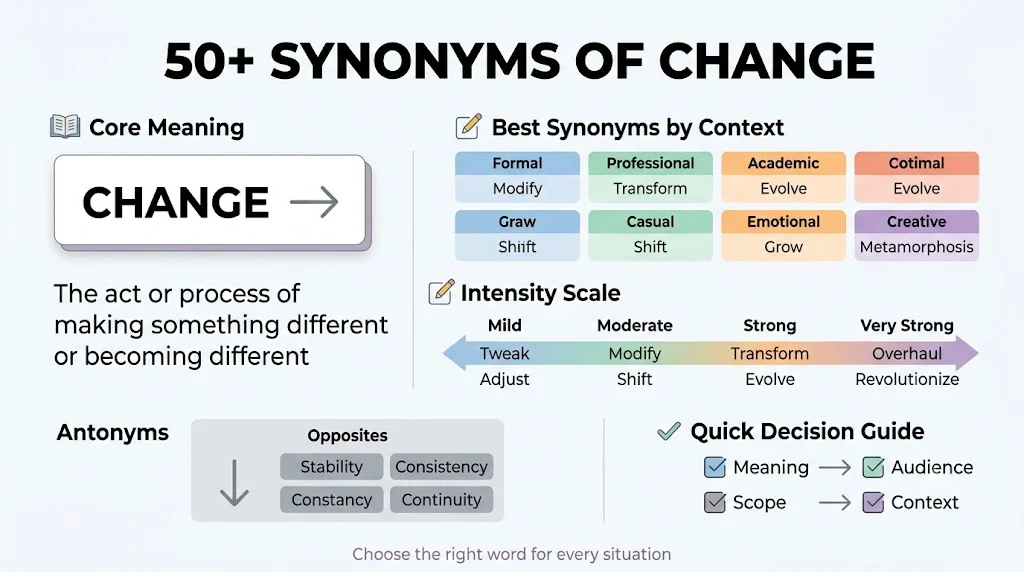
Change is part of every stage of life, but finding the right word for it can make your writing much stronger. Whether you are describing a small adjustment, a major transformation, or a shift in plans, choosing the right synonyms for change depends on context, tone, and meaning. A good change synonym should fit the sentence naturally rather than simply replace the original word.
This guide explores practical change synonyms and the most useful synonyms of change for everyday, academic, professional, and creative writing. If you are searching for a synonym for change, synonym of change, or another word for change, you will find options grouped by meaning and usage. We also cover changes synonym choices and explain when different changes synonyms work best. By the end, you’ll know what’s another word for change and how to choose it with confidence.
What Are the Best Synonyms of “Change”?
Change describes making something different or becoming different. The best synonyms include alter, modify, transform, adjust, shift, evolve, adapt, and transition. Choose modify for small adjustments, transform for dramatic changes, evolve for gradual development, and adapt for responding to new circumstances.
Meaning, Tone, and Context
Simple Definition
The word change describes the act or process of making something different. It also refers to the result of becoming different, the replacement of one thing with another, or the process of transformation.
Part of Speech
Change can be used as a noun or a verb.
Overall Tone
The word usually has a neutral tone. It can be positive, negative, or neutral depending on the context.
Formality Level
Change is considered neutral, making it suitable for both formal and informal communication. It appears naturally in business writing, academic papers, workplace discussions, everyday conversations, and personal communication.
Common Uses
Native English speakers commonly use change when talking about:
- Career change
- Life change
- Climate change
- Social change
- Organizational change
- Personal change
- Change of plans
- Change in behavior
- Change in policy
- Change in attitude
Word Forms
| Form | Word |
|---|---|
| Noun | change |
| Verb | change |
| Adjective | changeable |
| Adverb | changeably |
| Related Form | changing |
| Opposite Form | stability, constancy |
When and How to Use “Change”
The word change works well whenever you want to show that something has become different. However, choosing a more specific synonym can make your message clearer and more impactful.
Professional
“The company implemented significant changes to its operational procedures.”
Academic
“The study examined the effects of climate change on coastal communities.”
Workplace
“We need to change our approach to meet the new requirements.”
Personal
“Moving to a new city was a positive change in my life.”
“Please review the changes to the project timeline.”
Resume
“Drove organizational change that improved efficiency by 15%.”
Social Media
“Change is never easy, but it’s often necessary for growth.”
Best Synonyms of Change
The word change is useful because it fits almost every type of writing, but no single synonym works perfectly in every situation. Some alternatives emphasize small adjustments, while others highlight dramatic transformations, gradual evolution, or adaptation. Choosing the right synonym helps your writing sound more natural and precise.
Professional Writing: Modify
Modify is one of the strongest professional alternatives to change. It indicates a specific, often deliberate adjustment.
Example:
“We need to modify the proposal to meet the client’s requirements.”
Why it works:
Business writing benefits from precise language, and modify clearly communicates intentional adjustment.
Academic Writing: Evolve
In essays, research papers, and reports, evolve is often a better choice than change because it highlights gradual development over time.
Example:
“Human societies have evolved significantly over the past century.”
Why it works:
It sounds objective, formal, and academically appropriate.
Business Communication: Transform
Transform expresses dramatic, often positive change and indicates a complete overhaul.
Example:
“The new leadership team transformed the company’s culture.”
Why it works:
It immediately communicates significant and positive change.
Casual Conversation: Shift
For everyday speaking, shift sounds natural without becoming overly formal.
Example:
“There’s been a shift in public opinion on the issue.”
Why it works:
Native speakers frequently use shift to describe noticeable changes in opinion or focus.
Emotional Writing: Grow
When discussing personal development, grow is usually more expressive than change.
Example:
“The experience helped me grow as a person.”
Why it works:
It emphasizes personal development and positive transformation.
Creative Writing: Metamorphosis
Creative writing often benefits from descriptive vocabulary. Metamorphosis helps create stronger imagery.
Example:
“The protagonist underwent a complete metamorphosis.”
Why it works:
It captures the reader’s attention and adds depth to storytelling.
Resume Writing: Revamp
Recruiters frequently see revamp because it quickly highlights proactive improvement.
Example:
“Revamped the company’s onboarding process to reduce turnover.”
Why it works:
It sounds concise, professional, and action-oriented.
Workplace Communication: Adjust
Adjust emphasizes that something has been made more suitable.
Example:
“We need to adjust our strategy based on the market feedback.”
Why it works:
It communicates flexibility while maintaining a professional tone.
Stronger Meaning: Overhaul
When you need stronger emphasis, overhaul is one of the best replacements for change.
Example:
“The company is planning to overhaul its entire IT infrastructure.”
Why it works:
It suggests complete and significant change.
Softer Meaning: Tweak
Sometimes you want to acknowledge a small change without making it sound significant.
Example:
“We just need to tweak a few minor details.”
Why it works:
It gives balanced emphasis without exaggeration.
When Not to Use “Change”
Although change is versatile, it is not always the most effective word. In many situations, a more specific synonym communicates your message more clearly.
When It Sounds Too General
Sometimes change is too broad and fails to explain what kind of change occurred.
Less Effective
“We need to change the process.”
Better
“We need to overhaul the process to improve efficiency.”
Why
Overhaul clearly explains the scope and intensity of the change.
When Greater Precision Is Needed
If the situation requires specifying the type of change, change may sound too vague.
Less Effective
“She changed her career.”
Better
“She transitioned to a new career in marketing.”
Why
Transitioned specifies that it was a deliberate move.
In Academic Writing
Academic writing usually favors more precise vocabulary.
Less Effective
“The organization changed over time.”
Better
“The organization evolved over several decades.”
Why
Evolved is more objective and commonly used in academic contexts.
On a Resume
General wording often reduces the impact of your achievements.
Less Effective
“Changed company policies.”
Better
“Transformed company policies to improve efficiency.”
Why
Transformed immediately highlights significant impact.
In Creative Writing
Using change repeatedly can make storytelling feel flat.
Less Effective
“Her life changed after the accident.”
Better
“Her life was transformed after the accident.”
Why
Transformed creates stronger imagery and leaves a lasting impression.
When Expressing Personal Growth
If something involved personal development, choose a more expressive word.
Less Effective
“I changed after the experience.”
Better
“I grew as a person after the experience.”
Why
Grow communicates personal development more naturally.
Words Commonly Confused with “Change”
| Word | Difference | When to Use It | Example |
|---|---|---|---|
| Alter | Means to make a small or moderate change. | Making adjustments, minor modifications. | “We need to alter the schedule slightly.” |
| Modify | Means to make partial changes. | Professional contexts, adjustments. | “The design was modified to meet requirements.” |
| Transform | Means to make a complete change. | Significant, dramatic changes. | “The renovation transformed the building.” |
| Shift | Means to move or change position. | Opinions, focus, priorities. | “There was a shift in consumer behavior.” |
| Evolve | Means to develop gradually. | Long-term development, growth. | “The company evolved over time.” |
| Convert | Means to change form or function. | Function, purpose, belief systems. | “They converted the warehouse into offices.” |
Best Synonyms of Change by Context
| Context | Best Synonym | Why It Works | Example |
|---|---|---|---|
| Formal Writing | Modify | Sounds precise and professional. | “We must modify the approach.” |
| Academic Writing | Evolve | Fits research and essays naturally. | “The species evolved over time.” |
| Professional Communication | Transform | Highlights significant impact. | “The strategy transformed the business.” |
| Business Emails | Adjust | Concise and professional. | “Please adjust the timeline accordingly.” |
| Resume Writing | Transform | Emphasizes major achievements. | “Transformed operational efficiency.” |
| Workplace Communication | Revise | Stresses careful review. | “We need to revise the plan.” |
| Casual Conversation | Shift | Sounds natural in daily speech. | “There’s been a shift in his attitude.” |
| Everyday Speaking | Turn | Common informal alternative. | “Things took a turn for the better.” |
| Creative Writing | Metamorphosis | Adds vivid description. | “His metamorphosis was remarkable.” |
| Storytelling | Transition | Shows a period of change. | “The transition was difficult but necessary.” |
| Emotional Writing | Grow | Expresses personal development. | “I grew through the experience.” |
| Strong Emphasis | Overhaul | Indicates complete change. | “The system needs a complete overhaul.” |
| Mild Tone | Tweak | Gives moderate emphasis. | “We just need to tweak a few things.” |
| Social Media Captions | Shift | Sounds engaging and natural. | “Today was a shift in perspective.” |
| American English | Change | Frequently used in business and media. | “This is a game-changing decision.” |
| British English | Adapt | Common in formal and everyday usage. | “We must adapt to the new circumstances.” |
Synonyms of Change by Usage
The word change works in almost every situation, but choosing a more specific synonym makes your writing stronger and more natural. The sections below explain which alternatives fit different types of communication.
Professional vs Personal Synonyms
- Professional communication requires precise vocabulary, while personal conversations sound better with simpler, more relatable words.
Professional Synonyms
| Synonym | Best Used For | Why It Works |
|---|---|---|
| Modify | Reports, policies | Shows intentional adjustment. |
| Transform | Business priorities | Highlights significant impact. |
| Revise | Meetings, presentations | Shows careful review. |
| Restructure | Organizational change | Indicates major reorganization. |
| Optimize | Process improvement | Indicates improvement. |
Recommendation
Use modify, transform, or revise in resumes, business emails, presentations, and reports because they sound more precise than change.
Personal Synonyms
| Synonym | Best Used For | Example |
|---|---|---|
| Grow | Personal development | “I grew through the experience.” |
| Shift | Daily conversations | “There’s been a shift in my thinking.” |
| Turn | Casual speaking | “Things took an unexpected turn.” |
| Evolve | Life changes | “My perspective evolved over time.” |
Recommendation
In conversations with friends and family, natural words like grow, shift, and evolve often sound better than overly formal alternatives.
Formal vs Conversational Synonyms
Choosing the right level of formality helps your writing match the audience.
| Situation | Best Synonyms |
|---|---|
| Reports | Modify, Evolve |
| Essays | Evolve, Transform |
| Business Writing | Transform, Restructure |
| Presentations | Shift, Evolve |
| Professional Emails | Modify, Adjust |
| Casual Conversations | Shift, Turn |
| Text Messages | Shift, Change |
Example
Formal:
“The organization evolved significantly over the decade.”
Conversational:
“Things really shifted after that conversation.”
Academic Synonyms
Academic writing benefits from vocabulary that sounds precise and objective.
Evolve
Commonly used when discussing gradual development over time.
Example
“The theory evolved as new evidence emerged.”
Transform
Best for describing dramatic, complete changes.
Example
“The new policy transformed the educational landscape.”
Adapt
Ideal when describing adjustment to new circumstances.
Example
“Species must adapt to survive environmental changes.”
Transition
Appropriate when describing periods of change.
Example
“The transition to online learning was challenging.”
Modify
Useful when discussing small or partial changes.
Example
“The researchers modified the experimental design.”
Recommendation
For essays and research papers, evolve, transform, and adapt usually sound stronger and more authoritative than change.
Professional and Business Synonyms
Business communication often requires concise and specific language.
Transform
Perfect for describing dramatic positive changes.
Example
“The new CEO transformed the company’s culture.”
Optimize
Highlights improvement and efficiency.
Example
“We need to optimize our supply chain operations.”
Restructure
Describes major organizational change.
Example
“The company restructured its management hierarchy.”
Revise
Shows careful review and adjustment.
Example
“We revised the proposal based on client feedback.”
Streamline
Indicates making something more efficient.
Example
“The new system streamlined the approval process.”
Recommendation
Use these words in resumes, interviews, meetings, presentations, business emails, and client communication to sound more professional.
Creative and Literary Synonyms
Creative writing benefits from expressive vocabulary that creates emotion and imagery.
Metamorphosis
Adds dramatic transformation imagery.
Example
“The protagonist underwent a complete metamorphosis.”
Transfiguration
Suggests a beautiful or profound change.
Example
“Her transfiguration from student to leader was inspiring.”
Evolution
Describes gradual, meaningful development.
Example
“The evolution of his character was beautifully written.”
Revolution
Suggests a complete and radical change.
Example
“The revolution in thinking changed everything.”
Metamorphosis
Suggests a magical or dramatic transformation.
Example
“The metamorphosis of the garden was breathtaking.”
These words make stories, speeches, and descriptive writing more engaging.
Slang or Modern Synonyms
There are very few true slang synonyms for change, but native speakers often use casual expressions.
| Expression | Meaning | Appropriate For | Avoid In |
|---|---|---|---|
| Switch-up | A change in approach | Everyday conversations | Academic papers |
| Game-changer | Something that changes everything | Friends, social media | Business reports |
| Turnaround | A significant improvement | Casual speech | Formal writing |
Example
Casual:
“That job offer was a real game-changer.”
Formal:
“The job offer was a significant career opportunity.”
Strongest to Mildest Synonyms
The following scale shows how different synonyms express different levels of change.
| Intensity | Synonyms |
|---|---|
| Mild | Tweak, Adjust, Modify |
| Moderate | Change, Shift, Revise |
| Strong | Transform, Evolve, Restructure |
| Very Strong | Revolutionize, Overhaul, Metamorphosis |
Understanding the Scale
- Tweak means small adjustments.
- Adjust means moderate changes.
- Modify means intentional changes.
- Shift means noticeable changes.
- Transform means dramatic changes.
- Evolve means gradual development.
- Overhaul means complete changes.
- Revolutionize means radical changes.
- Metamorphosis means complete transformation.
Emotional vs Neutral Synonyms
Some synonyms express feelings, while others simply communicate information.
Emotional Synonyms
| Synonym | Best Used For |
|---|---|
| Transform | Personal growth |
| Evolve | Life changes |
| Grow | Personal development |
| Revolutionize | Inspirational changes |
| Metamorphosis | Dramatic personal change |
These words add emotion and help readers connect with the message.
Neutral Synonyms
| Synonym | Best Used For |
|---|---|
| Modify | Instructions |
| Adjust | Professional contexts |
| Shift | General changes |
| Revise | Documents |
| Alter | Minor changes |
Neutral words communicate change without adding unnecessary emotion.
Antonyms of Change
| Antonym | Meaning | Example Sentence |
|---|---|---|
| Stability | State of being stable | The stability of the system was reassuring. |
| Constancy | Quality of being unchanging | Her constancy through the years was admirable. |
| Consistency | Being consistent | Consistency is important for building trust. |
| Continuity | Uninterrupted existence | The continuity of tradition was maintained. |
| Preservation | Keeping something the same | The preservation of the building was prioritized. |
| Maintenance | Keeping in good condition | Regular maintenance is essential. |
| Routine | A fixed pattern | He fell into a comfortable routine. |
| Permanence | Lasting forever | The permanence of the monument was impressive. |
| Steadiness | Being steady and unchanging | The steadiness of her employment was beneficial. |
| Uniformity | Being consistent and unchanging | The uniformity of the design was pleasing. |
| Fixity | State of being fixed | The fixity of the rules was frustrating. |
| Immutability | Inability to change | The immutability of the law was challenged. |
| Monotony | Lack of variety | The monotony of the routine was boring. |
| Stagnation | Lack of movement or progress | The stagnation of the company was concerning. |
| Sameness | Lack of variety | The sameness of the menu was disappointing. |
Comparison: “Change” vs Similar Words
Although change is a versatile word, several similar words carry different shades of meaning. Understanding these differences helps you choose the most accurate word for each situation.
Change vs Transform
Main Difference
Change describes any alteration. Transform suggests a complete and dramatic change.
Which Is Stronger?
Transform is much stronger.
Which Is More Formal?
Both work in formal contexts.
When to Use Each
Use change for general alterations.
Use transform for dramatic, positive changes.
Examples
Change:
“The schedule changed slightly.”
Transform:
“The new manager transformed the team’s performance.”
Change vs Modify
Main Difference
Change is general. Modify suggests specific, intentional adjustments.
Which Is Stronger?
Modify is more precise.
Which Is More Formal?
Modify is more common in professional contexts.
When to Use Each
Use change for general changes.
Use modify for specific adjustments.
Examples
Change:
“We need to change the design.”
Modify:
“We need to modify the design to meet specifications.”
Change vs Evolve
Main Difference
Change can be sudden or gradual. Evolve specifically suggests gradual development.
Which Is Stronger?
Evolve is more specific.
Which Is More Formal?
Evolve is common in academic contexts.
When to Use Each
Use change for any alteration.
Use evolve for gradual development.
Examples
Change:
“The company changed its strategy.”
Evolve:
“The company evolved its strategy over time.”
Change vs Shift
Main Difference
Change can mean any alteration. Shift suggests a movement or change in position.
Which Is Stronger?
Shift is more specific.
Which Is More Formal?
Shift is common in professional contexts.
When to Use Each
Use change for general changes.
Use shift for changes in focus or opinion.
Examples
Change:
“Her attitude changed.”
Shift:
“There was a shift in her attitude.”
Change vs Adapt
Main Difference
Change is general. Adapt suggests changing to suit new conditions.
Which Is Stronger?
Adapt is more specific.
Which Is More Formal?
Adapt is common in professional contexts.
When to Use Each
Use change for general changes.
Use adapt for adjusting to circumstances.
Examples
Change:
“The employees changed their approach.”
Adapt:
“The employees adapted their approach to meet new demands.”
Change vs Alter
Main Difference
Change is general. Alter suggests a small or moderate change.
Which Is Stronger?
Alter is more precise.
Which Is More Formal?
Alter is common in professional contexts.
When to Use Each
Use change for general changes.
Use alter for minor adjustments.
Examples
Change:
“We changed the plans.”
Alter:
“We altered the plans slightly.”
Common Phrases and Expressions with “Change”
| Phrase | Meaning | Example Sentence |
|---|---|---|
| Change of heart | A change in opinion or attitude | He had a change of heart and agreed to help. |
| Change of pace | A shift in routine or speed | A vacation was a welcome change of pace. |
| Change for the better | An improvement | The new policy was a change for the better. |
| Change for the worse | A decline | The weather took a change for the worse. |
| Change of plans | An alteration to plans | We had a change of plans and decided to stay home. |
| Change in direction | A shift in focus | The company made a change in direction. |
| Climate change | Long-term environmental change | Climate change is a global concern. |
| Organizational change | Changes within an organization | The organizational change was challenging. |
| Life-changing event | An event that transforms life | Becoming a parent was a life-changing event. |
| Change management | Process of managing change | Effective change management is essential. |
Common Mistakes to Avoid
1. Using a General Word Instead of a Specific One
Incorrect
“We need to change the process.”
Better
“We need to overhaul the process to improve efficiency.”
Why
Overhaul clearly explains the scope and intensity of the change.
2. Using Informal Words in Formal Writing
Incorrect
“We need to tweak the proposal.”
Better
“We need to modify the proposal.”
Why
Formal documents require precise and professional vocabulary.
3. Choosing an Overly Strong Synonym
Incorrect
“The meeting time was revolutionized.”
Better
“The meeting time was changed.”
Why
Reserve revolutionize for dramatic, significant changes.
4. Repeating “Change” Too Often
Incorrect
“Change is hard because change requires effort and change takes time.”
Better
“Transformation is hard because change requires effort and adaptation takes time.”
Why
Using varied vocabulary improves readability and style.
5. Confusing “Change” with “Shift”
Incorrect
“We need to shift the entire strategy.” (when actually moderate change)
Better
“We need to change the entire strategy.”
Why
Shift suggests a change in position or focus, not complete change.
6. Using Emotional Words in Academic Writing
Incorrect
“The company underwent a wonderful transformation.”
Better
“The company underwent a significant transformation.”
Why
Academic writing generally prefers objective language.
7. Overusing Strong Synonyms
Incorrect
“Every minor task required transformation.”
Better
“Most tasks required minor adjustments, but some needed major transformation.”
Why
Saving stronger words for genuinely significant situations makes them more effective.
Frequently Asked Questions
What is another word for change?
Common alternatives include alter, modify, transform, adjust, shift, and vary, depending on the context.
What is a synonym for change?
A suitable synonym for change can be alteration, adjustment, transformation, modification, or shift.
What are the synonyms of change?
Common synonyms of change include alter, modify, transform, adjust, shift, replace, and vary.
What are some changes synonyms?
Useful changes synonyms include alterations, modifications, adjustments, transformations, and variations.
What are the best synonyms for change?
The best choice depends on context. Alter, modify, transform, shift, and adjust are widely useful options.
What is a change synonym for writing?
For formal writing, modification, alteration, adjustment, transformation, and transition can be effective alternatives.
What are the best synonyms of “change”?
The best synonyms of change include transform, modify, evolve, shift, adapt, transition, and revise. The right choice depends on your audience, tone, and writing purpose.
What are the best formal synonyms of “change”?
Strong formal alternatives include modify, transform, evolve, restructure, and optimize. These words work well in academic papers, reports, and business communication.
What are common informal synonyms of “change”?
Common informal alternatives include shift, turn, tweak, and switch-up. These expressions sound natural in everyday conversations and social media posts.
What is another word for “change” in professional writing?
In professional communication, excellent alternatives include modify, transform, optimize, restructure, and streamline. These words make reports, emails, resumes, and presentations sound more precise and polished.
What is the difference between “change” and “transform”?
Change is a broad term that describes making something different. Transform emphasizes a complete and dramatic change, often for the better.
What is the opposite of “change”?
The most common opposites include stability, consistency, constancy, continuity, and permanence. Each describes a state of being unchanged.
Conclusion
The word change is one of the most common nouns and verbs in English, but using it repeatedly can make your writing feel repetitive. Learning the best synonyms of change helps you express your ideas with greater accuracy, stronger style, and better clarity.
You’re writing an essay, preparing a business presentation, updating your resume, or having a casual conversation. No single synonym fits every situation. Words like modify, transform, evolve, shift, adapt, and transition each carry unique meanings and should be chosen based on your audience, tone, and purpose.
A simple way to improve your vocabulary is to pause before writing change and ask yourself what kind of change you mean. Choosing the most appropriate synonym will make your writing more engaging, professional, and natural.
Read More Related Articles:
- Synonyms for Liked| Meaning, Examples, and Better Word …
- 50+ Synonyms of Information | Meanings, Uses, Examples …










4 thoughts on “50+ Synonyms of Change | Find the Perfect Word for Every Context 2026”