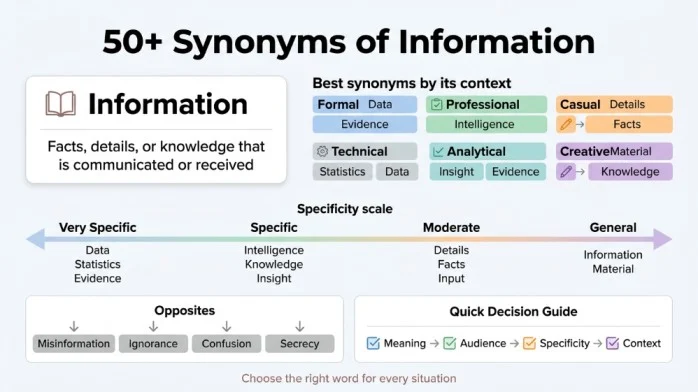
Synonyms of Information can make your writing clearer, more precise, and less repetitive. The word “information” is useful in almost every type of communication, but repeating it too often can make an article, report, email, or academic paper feel flat. Depending on the context, words such as data, details, facts, knowledge, evidence, findings, and intelligence can communicate slightly different ideas. Choosing the right alternative is not simply about replacing one word with another. Meaning, tone, audience, and context all matter.
This guide to Synonyms of Information focuses on practical word choices that work in real writing. It explains the subtle differences between common alternatives and shows where each one fits best. Whether you are writing professionally, studying, creating content, or improving your everyday English, understanding these distinctions can help you express ideas with greater accuracy and confidence.
What Are the Best Synonyms of “Information”?
Information describes facts, details, or knowledge that is communicated or received. The best synonyms include data, details, facts, intelligence, knowledge, evidence, insight, material, figures, and statistics. Choose data for technical contexts, intelligence for strategic use, evidence for persuasive writing, details for everyday communication, and insight for analytical writing.
Meaning, Tone, and Context
Simple Definition
The word information describes facts, details, or knowledge that is communicated, received, or obtained about a particular subject or situation.
Part of Speech
Information is a noun.
Overall Tone
The word usually has a neutral tone. It simply conveys facts or knowledge without adding emotion or emphasis.
Formality Level
Information is considered neutral, making it suitable for both formal and informal communication. It appears naturally in business writing, academic papers, workplace discussions, everyday conversations, emails, and presentations.
Common Uses
Native English speakers commonly use information when talking about:
- Information technology
- Information systems
- Information security
- Information gathering
- Information sharing
- Information management
- Information sources
- Information processing
- Information retrieval
- Information analysis
Word Forms
| Word Form | Example |
|---|---|
| Noun | information |
| Adjective | informative |
| Adverb | informatively |
| Related Verb | inform |
| Related Form | informative, informed, informing |
| Opposite Form | misinformation, disinformation |
When and How to Use “Information”
The word information works well whenever you want to refer to facts or knowledge about something. However, choosing a more specific synonym can make your message clearer and more impactful.
Professional
“The client provided all the necessary information before the meeting.”
Academic
“The research gathered valuable information about the effects of the new policy.”
Workplace
“Please review the information in the employee handbook before your first day.”
Personal
“I received some interesting information about the upcoming neighborhood event.”
“Please find the requested information attached to this email.”
Resume
“Managed information systems that improved company-wide communication.”
Social Media
“Sharing helpful information is my favorite way to connect with others.”
Best Synonyms of Information
The word information is useful because it fits almost every type of writing, but no single synonym works perfectly in every situation. Some alternatives emphasize facts, while others highlight knowledge, evidence, or strategic value. Choosing the right synonym helps your writing sound more natural and precise.
Professional Writing: Data
Data is one of the strongest professional alternatives to information. It refers to factual information, especially numerical, collected for analysis.
Example:
“The data clearly shows an increase in customer satisfaction.”
Why it works:
Business writing benefits from precise language, and data sounds professional and analytical.
Academic Writing: Evidence
In essays, research papers, and reports, evidence is often a better choice than information because it highlights proof or support for claims.
Example:
“The evidence supports the hypothesis that the treatment is effective.”
Why it works:
It sounds objective, formal, and academically appropriate.
Business Communication: Intelligence
Intelligence expresses valuable and often strategic information.
Example:
“Market intelligence suggests that we should expand into new regions.”
Why it works:
It immediately communicates strategic value and insight.
Casual Conversation: Details
For everyday speaking, details sounds natural without becoming overly formal.
Example:
“Can you give me more details about the party?”
Why it works:
Native English speakers frequently use details to describe specific pieces of information.
Emotional Writing: Insight
When discussing personal experiences or understanding, insight is usually more expressive than information.
Example:
“Her insights about the situation helped me understand it better.”
Why it works:
It emphasizes understanding and deep knowledge instead of just facts.
Creative Writing: Material
Creative writing often benefits from descriptive vocabulary. Material helps create a sense of substance and depth.
Example:
“The writer gathered material from her travels around the world.”
Why it works:
It captures the reader’s attention and adds depth to storytelling.
Resume Writing: Knowledge
Recruiters frequently see the word knowledge because it highlights expertise and skills.
Example:
“Possess extensive knowledge of software development processes.”
Why it works:
It sounds concise, professional, and achievement-focused.
Workplace Communication: Facts
Facts emphasizes that something is true and reliable.
Example:
“Let’s focus on the facts before making any decisions.”
Why it works:
It communicates truth and reliability while maintaining a professional tone.
Stronger Meaning: Statistics
When you need stronger emphasis, statistics is one of the best replacements for information.
Example:
“The statistics show a clear trend in consumer behavior.”
Why it works:
It suggests measurable, numerical data.
Softer Meaning: Input
Sometimes you want to refer to information without making it sound overly formal or technical.
Example:
“We appreciate your input on this project.”
Why it works:
It gives a balanced, collaborative emphasis without exaggeration.
When Not to Use “Information”
Although information is versatile, it is not always the most effective word. In many situations, a more specific synonym communicates your message more clearly.
When It Sounds Too General
Sometimes information is too broad and fails to explain what kind of facts or knowledge you mean.
Less Effective
“We received the information.”
Better
“We received the data from the study.”
Why
Data clearly specifies that the information is numerical and analytical.
When Greater Specificity Is Needed
If the situation requires precise identification, information may sound too vague.
Less Effective
“The information is helpful.”
Better
“The facts are helpful.”
Why
Facts clearly indicates that the information is true and reliable.
In Academic Writing
Academic writing usually favors more precise vocabulary.
Less Effective
“The information was collected.”
Better
“The data was collected.”
Why
Data is more objective and commonly used in research writing.
On a Resume
General wording often reduces the impact of your achievements.
Less Effective
“Managed information systems.”
Better
“Managed data systems.”
Why
Data immediately highlights technical expertise.
In Creative Writing
Using information repeatedly can make storytelling feel flat.
Less Effective
“He gathered information for his story.”
Better
“He gathered material for his story.”
Why
Material creates stronger imagery and leaves a lasting impression.
When Expressing Personal Feelings
If something matters because of understanding rather than just facts, choose a more expressive word.
Less Effective
“Your information helped me.”
Better
“Your insight helped me.”
Why
Insight communicates deep understanding more naturally.
Words Commonly Confused With “Information”
| Word | Difference | When to Use It | Example |
|---|---|---|---|
| Data | Factual information, often numerical | Technical and analytical contexts | “The data shows a clear pattern.” |
| Intelligence | Valuable or strategic information | Business, military, security contexts | “Market intelligence is crucial for growth.” |
| Evidence | Information that proves something | Academic, legal, persuasive writing | “The evidence supports the argument.” |
| Knowledge | Information combined with understanding | Personal, professional, educational contexts | “Her knowledge of the subject is impressive.” |
| Insight | Deep understanding of something | Analytical, emotional, reflective writing | “His insight changed my perspective.” |
| Material | Information used as a resource | Creative writing, research, content creation | “The author gathered material for her book.” |
Best Synonyms of Information by Context
| Context | Best Synonym | Why It Works | Example |
|---|---|---|---|
| Formal Writing | Data | Sounds precise and professional. | “The data was thoroughly analyzed.” |
| Academic Writing | Evidence | Fits research and essays naturally. | “The evidence was compelling.” |
| Professional Communication | Intelligence | Highlights strategic value. | “Business intelligence is essential.” |
| Business Emails | Details | Concise and professional. | “Please send the details.” |
| Resume Writing | Knowledge | Emphasizes expertise. | “Possess extensive knowledge.” |
| Workplace Communication | Facts | Stresses truth and reliability. | “Let’s examine the facts.” |
| Casual Conversation | Details | Sounds natural in daily speech. | “I need more details.” |
| Everyday Speaking | Facts | Common informal alternative. | “Just give me the facts.” |
| Creative Writing | Material | Adds vivid description. | “She gathered material for her book.” |
| Storytelling | Insight | Shows a turning point. | “That insight changed everything.” |
| Emotional Writing | Insight | Expresses personal value. | “Her insight was invaluable.” |
| Strong Emphasis | Statistics | Indicates measurable data. | “The statistics are alarming.” |
| Mild Tone | Input | Gives moderate emphasis. | “We value your input.” |
| Social Media Captions | Details | Sounds engaging and natural. | “I’ll share the details soon!” |
| American English | Data | Frequently used in business and media. | “The data is clear.” |
| British English | Evidence | Common in formal and everyday usage. | “The evidence is compelling.” |
Synonyms of Information by Usage
The word information works in almost every situation, but choosing a more specific synonym makes your writing stronger and more natural. The sections below explain which alternatives fit different types of communication.
Professional vs Personal Synonyms
- Professional communication requires precise vocabulary, while personal conversations sound better with simpler, more relatable words.
Professional Synonyms
| Synonym | Best Used For | Why It Works |
|---|---|---|
| Data | Reports, policies | Shows that something is factual. |
| Intelligence | Business priorities | Emphasizes strategic value. |
| Knowledge | Meetings, presentations | Highlights expertise. |
| Evidence | Professional reports | Sounds formal and objective. |
| Statistics | Business communication | Indicates measurable value. |
Recommendation
Use data, intelligence, or evidence in resumes, business emails, presentations, and reports because they sound more precise than information.
Personal Synonyms
| Synonym | Best Used For | Example |
|---|---|---|
| Details | Relationships | “I need more details.” |
| Facts | Daily conversations | “Just give me the facts.” |
| Input | Casual speaking | “I appreciate your input.” |
| Insight | Personal events | “Her insight helped me.” |
| News | Shared experiences | “I have some exciting news.” |
Recommendation
In conversations with friends and family, natural words like details, facts, and input often sound better than overly formal alternatives.
Formal vs Conversational Synonyms
Choosing the right level of formality helps your writing match the audience.
| Situation | Best Synonyms |
|---|---|
| Reports | Data, Evidence |
| Essays | Evidence, Knowledge |
| Business Writing | Intelligence, Data |
| Presentations | Data, Intelligence |
| Professional Emails | Details, Information |
| Casual Conversations | Details, Facts |
| Text Messages | Info, Details |
Example
Formal:
“The data is significant for future research.”
Conversational:
“I’ll send you the details later.”
Academic Synonyms
Academic writing benefits from vocabulary that sounds precise and objective.
Evidence
Commonly used when supporting claims with proof.
Example
“The evidence clearly indicates a pattern.”
Data
Best for presenting numerical or factual information.
Example
“The data was collected over a six-month period.”
Knowledge
Ideal when describing understanding of a subject.
Example
“Knowledge of the subject is essential for the exam.”
Insight
Useful when discussing deeper understanding.
Example
“The research provided valuable insight into the problem.”
Material
Appropriate when referring to source content.
Example
“The researcher gathered material from multiple sources.”
Recommendation
For essays and research papers, data, evidence, and knowledge usually sound stronger and more authoritative than information.
Professional and Business Synonyms
Business communication often requires concise and specific language.
Data
Perfect for reports, analysis, and decision-making.
Example
“The data suggests we should increase our marketing budget.”
Intelligence
Highlights strategic value.
Example
“Competitive intelligence gave us an advantage.”
Evidence
Shows something is necessary for business success.
Example
“The evidence supports our expansion strategy.”
Knowledge
Frequently appears in resumes and presentations.
Example
“She has extensive knowledge of the industry.”
Statistics
Shows measurable results.
Example
“The statistics confirm our growth trajectory.”
Recommendation
Use these words in resumes, interviews, meetings, presentations, business emails, and client communication to sound more professional.
Creative and Literary Synonyms
Creative writing benefits from expressive vocabulary that creates emotion and imagery.
Material
Adds depth and substance.
Example
“She gathered material from her travels.”
Insight
Expresses deep understanding.
Example
“The novel offers profound insight into human nature.”
Knowledge
Highlights wisdom and understanding.
Example
“His knowledge of history enriched the story.”
Evidence
Creates a sense of truth.
Example
“The evidence of her love was everywhere.”
Details
Adds richness to storytelling.
Example
“The details of the landscape were beautifully described.”
These words make stories, speeches, and descriptive writing more engaging.
Slang or Modern Synonyms
There are very few true slang synonyms for information, but native speakers often use casual expressions.
| Expression | Meaning | Appropriate For | Avoid In |
|---|---|---|---|
| Info | Information | Everyday conversations | Academic papers |
| The scoop | Inside information | Friends, social media | Business reports |
| The lowdown | Essential information | Casual speech | Formal writing |
| Intel | Intelligence | Informal contexts | Official documents |
| Deets | Details | Casual conversation | Professional communication |
Example
Casual:
“What’s the lowdown on the new project?”
Formal:
“What information do you have about the new project?”
Strongest to Mildest Synonyms
The following scale shows how different synonyms express different levels of specificity and value.
| Specificity | Synonyms |
|---|---|
| Very Specific | Data, Statistics, Evidence |
| Specific | Intelligence, Knowledge, Insight |
| Moderate | Details, Facts, Input |
| General | Information, Material |
| Very General | Info, News, Updates |
Understanding the Scale
- Data, Statistics, Evidence are very specific and measurable.
- Intelligence, Knowledge, Insight are specific and valuable.
- Details, Facts, Input are moderate and practical.
- Information, Material are general and broad.
- Info, News, Updates are very general and casual.
Emotional vs Neutral Synonyms
Some synonyms express understanding, while others simply communicate facts.
Emotional Synonyms
| Synonym | Best Used For |
|---|---|
| Insight | Deep understanding |
| Knowledge | Wisdom and expertise |
| Intelligence | Strategic value |
| Evidence | Proof and truth |
These words add depth and help readers connect with the message.
Neutral Synonyms
| Synonym | Best Used For |
|---|---|
| Data | Technical contexts |
| Details | Everyday use |
| Facts | General use |
| Material | Content creation |
| Statistics | Numerical data |
Neutral words communicate facts without adding unnecessary emotion.
Antonyms of Information
| Antonym | Meaning | Example Sentence |
|---|---|---|
| Misinformation | False or incorrect information | The article was filled with misinformation. |
| Disinformation | Deliberately false information | The campaign spread disinformation. |
| Ignorance | Lack of knowledge | His ignorance of the topic was obvious. |
| Confusion | Lack of clarity | The instructions caused confusion. |
| Secret | Information kept hidden | The plan remained a secret. |
| Mystery | Something unexplained | The disappearance remains a mystery. |
| Rumor | Unconfirmed information | The rumor spread quickly. |
| Gossip | Casual, often unconfirmed talk | The gossip about the celebrity was everywhere. |
| Falsehood | Untrue statement | His falsehood was quickly exposed. |
| Lie | Deliberate untruth | She told a lie about her whereabouts. |
| Misunderstanding | Incorrect interpretation | The misunderstanding caused problems. |
| Ambiguity | Unclear meaning | The ambiguity of the message was frustrating. |
| Suppression | Hiding information | The suppression of evidence was illegal. |
| Censorship | Blocking information | The censorship of the news was controversial. |
| Omission | Leaving out information | The omission of key facts was concerning. |
Comparison: “Information” vs Similar Words
Although information is a versatile word, several similar words carry different shades of meaning. Understanding these differences helps you choose the most accurate word for each situation.
Information vs Data
Main Difference
Information is a general word that describes facts or knowledge. Data emphasizes factual information, especially numerical, collected for analysis.
Which Is Stronger?
Data is stronger because it suggests measurable, analytical information.
Which Is More Formal?
Data is more common in technical, scientific, and professional writing.
When to Use Each
Use information for general communication.
Use data when discussing analysis, research, or numbers.
Examples
Information:
“The information was helpful.”
Data:
“The data revealed a clear trend.”
Information vs Intelligence
Main Difference
Information is neutral and general. Intelligence is valuable, often strategic information.
Which Is Stronger?
Intelligence is stronger because it suggests strategic value.
Which Is More Formal?
Both work well in formal writing, but intelligence is more specialized.
When to Use Each
Use information for everyday facts.
Use intelligence for business, military, or strategic contexts.
Examples
Information:
“I received the information I needed.”
Intelligence:
“The intelligence helped us make a better decision.”
Information vs Evidence
Main Difference
Information is neutral. Evidence is information that proves something.
Which Is Stronger?
Evidence is stronger because it suggests proof.
Which Is More Formal?
Evidence is more common in academic and legal writing.
When to Use Each
Choose evidence when making a persuasive argument.
Examples
Information:
“The information was interesting.”
Evidence:
“The evidence was compelling.”
Information vs Knowledge
Main Difference
Information is about facts. Knowledge is information combined with understanding.
Which Is Stronger?
Knowledge is stronger because it suggests comprehension.
Which Is More Formal?
Both fit professional writing.
When to Use Each
Use knowledge when discussing expertise or wisdom.
Examples
Information:
“She shared the information.”
Knowledge:
“She demonstrated extensive knowledge.”
Information vs Insight
Main Difference
Information is factual. Insight is deep, often intuitive understanding.
Which Is Stronger?
Insight is stronger because it suggests profound understanding.
Which Is More Formal?
Both work well in formal writing.
When to Use Each
Use insight when discussing deep understanding or new perspectives.
Examples
Information:
“The information was helpful.”
Insight:
“Her insight changed my perspective.”
Information vs Details
Main Difference
Information is broad. Details are specific pieces of information.
Which Is Stronger?
Details is more specific.
Which Is More Formal?
Both are neutral, but details is slightly more casual.
When to Use Each
Use details when you want specific facts.
Examples
Information:
“I need more information.”
Details:
“I need more details.”
Common Phrases and Expressions with “Information”
| Phrase | Meaning | Example Sentence |
|---|---|---|
| Information technology | The use of computers to store and share information | “He works in information technology.” |
| Information security | Protecting information from unauthorized access | “Information security is a top priority.” |
| Information overload | Too much information to process | “I’m experiencing information overload.” |
| Information age | The modern era of digital information | “We live in the information age.” |
| Inside information | Exclusive or confidential information | “She had inside information about the deal.” |
| Additional information | More information about something | “We require additional information.” |
| Up-to-date information | Current and accurate information | “Please provide up-to-date information.” |
Common Mistakes to Avoid
1. Using a General Word Instead of a Specific One
Incorrect
“This report contains important information.”
Better
“This report contains important data.”
Why
Data clearly explains that the information is analytical.
2. Using Informal Words in Formal Writing
Incorrect
“I’ll send you the info.”
Better
“I will send you the information.”
Why
Formal documents require precise and professional vocabulary.
3. Choosing an Overly Technical Word
Incorrect
“The statistics were helpful.”
Better
“The information was helpful.”
Why
Reserve statistics for numerical data.
4. Repeating “Information” Too Often
Incorrect
“The information was clear. information was helpful. The information was complete.”
Better
“The data was clear. The details were helpful. The facts were complete.”
Why
Using varied vocabulary improves readability and style.
5. Confusing “Information” with “Intelligence”
Incorrect
“She had inside information about the market.”
Better
“She had inside intelligence about the market.”
Why
Intelligence emphasizes strategic value.
6. Using Emotional Words in Academic Writing
Incorrect
“The insight was meaningful.”
Better
“The data was significant.”
Why
Academic writing generally prefers objective language.
7. Overusing Technical Synonyms
Incorrect
“Every piece of data is crucial.”
Better
“Every piece of information is important.”
Why
Saving technical words for genuinely data-heavy contexts makes them more effective.
Frequently Asked Questions
What is another word for information?
Common alternatives include data, details, facts, knowledge, evidence, and material, depending on the context.
What are the most common information synonyms?
Common information synonyms include details, facts, data, knowledge, and findings.
What are synonyms of information in formal writing?
For formal writing, data, findings, evidence, details, documentation, and knowledge can work well, depending on the meaning.
What is a synonym for information?
A useful synonym for information is details, while data, facts, knowledge, or evidence may be more precise in specific contexts.
What is another word for information in a sentence?
The best another word for information depends on context. For example, details may describe specific facts, while data usually refers to collected information.
What is an information other term?
Other terms for information include data, facts, details, knowledge, intelligence, findings, and evidence.
What are information similar words?
Information similar words include data, facts, details, knowledge, evidence, findings, and intelligence.
What are the best synonyms of “information”?
The best synonyms of information include data, details, facts, intelligence, knowledge, evidence, and insight. The right choice depends on your audience, tone, and writing purpose.
What are the best formal synonyms of “information”?
Strong formal alternatives include data, evidence, intelligence, statistics, and knowledge. These words work well in academic papers, reports, and business communication.
What are common informal synonyms of “information”?
Common informal alternatives include info, details, facts, the scoop, and the lowdown. These expressions sound natural in everyday conversations and social media posts.
What is another word for “information” in professional writing?
In professional communication, excellent alternatives include data, intelligence, knowledge, evidence, and statistics. These words make reports, emails, resumes, and presentations sound more precise and polished.
What is the difference between “information” and “data”?
Information is a broad term that describes facts or knowledge. Data emphasizes factual information, especially numerical, collected for analysis. Data is more specific and technical.
What is the opposite of “information”?
The most common opposites include misinformation, disinformation, ignorance, confusion, and secrecy. Each describes a lack of accurate knowledge.
Conclusion
The word information is one of the most common nouns in English, but using it repeatedly can make your writing feel repetitive. Learning the best synonyms of information helps you express your ideas with greater accuracy, stronger style, and better clarity.
You’re writing an essay, preparing a business presentation, updating your resume, or having a casual conversation, no single synonym fits every situation. Words like data, intelligence, evidence, knowledge, insight, and details each carry unique meanings and should be chosen based on your audience, tone, and purpose.
A simple way to improve your vocabulary is to pause before writing information and ask yourself what kind of facts or knowledge you are referring to. Choosing the most appropriate synonym will make your writing more engaging, professional, and natural.
Read More Related Articles:
- Synonyms for Creativity | Meaning, Examples, and Better …
- Synonyms for Marginalized| Meaning, Examples, and Better …











1 thought on “50+ Synonyms of Information | Smarter Word Choices for Clear Writing in 2026”