Sometimes the simplest words create the biggest impact, but using the same term repeatedly can make your writing feel repetitive. Exploring synonyms of plain helps you express ideas with greater clarity, precision, and style. Whether you’re describing a simple design, ordinary appearance, or straightforward language, choosing the right alternative keeps your content fresh while matching the exact tone you want.
Learning synonyms of plain is useful for students, writers, professionals, and anyone who wants stronger communication. From formal writing to everyday conversations, the right replacement can improve readability, enhance creativity, and make every sentence sound more natural, polished, and engaging without changing its original meaning.
What Are the Best Synonyms of “Plain”?
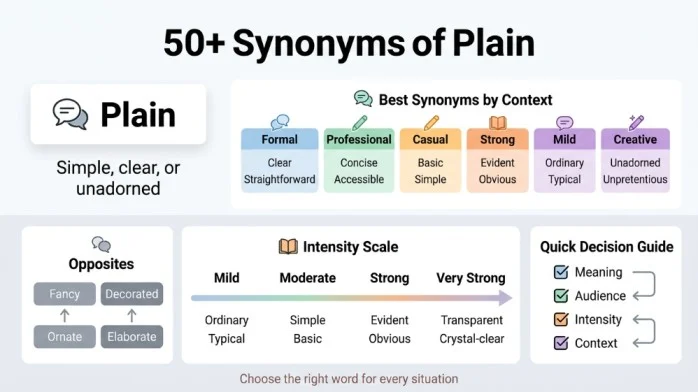
Plain describes something that is simple, uncomplicated, clear, or lacking decoration. The best synonyms include simple, clear, ordinary, unadorned, basic, evident, straightforward, and unpretentious. Choose simple for ease of understanding, clear for obvious meaning, ordinary for something not special, unadorned for lack of decoration, and straightforward for directness.
Meaning, Tone, and Context
Simple Definition
The word plain describes something that is simple, uncomplicated, clear, easy to understand, or lacking decoration and ornamentation. It can refer to appearance, language, food, writing, or meaning.
Part of Speech
Plain is primarily an adjective, but it can also function as a noun and an adverb.
| Form | Example |
|---|---|
| Adjective | The design is plain but elegant. |
| Noun | They crossed the vast plain. |
| Adverb | That is plain wrong. |
Overall Tone
The word usually has a neutral to slightly negative tone. It can suggest simplicity and honesty, but it can also imply dullness or lack of interest.
Formality Level
Plain is considered neutral, making it suitable for both formal and informal communication. It appears naturally in business writing, academic papers, workplace discussions, everyday conversations, emails, and presentations.
Common Uses
Native English speakers commonly use plain when talking about:
- Plain language
- Plain design
- Plain food
- Plain appearance
- Plain sight
- Plain truth
- Plain fact
- Plain clothing
- Plain packaging
- Plain paper
Word Forms
| Word Form | Example |
|---|---|
| Adjective | plain |
| Noun | plainness |
| Adverb | plainly |
| Related Form | plainly, plainness |
| Opposite Form | fancy, decorated, ornate |
When and How to Use “Plain”
The word plain works well whenever you want to describe something that is simple, clear, or unadorned. However, choosing a more specific synonym can make your message clearer and more impactful.
Professional
“The report used plain language to make the findings accessible to all employees.”
Academic
“The plain text version of the document was easier for participants to read.”
Workplace
“We need a plain explanation of the new policy that everyone can understand.”
Personal
“I prefer plain food without too many sauces or spices.”
“Please provide a plain summary of the key points before the meeting.”
Resume
“Developed plain-language training materials that improved employee comprehension.”
Social Media
“Sometimes the plain truth is exactly what we need to hear.”
Best Synonyms of Plain
The word plain is useful because it fits almost every type of writing, but no single synonym works perfectly in every situation. Some alternatives emphasize simplicity, while others highlight clarity, ordinariness, or lack of decoration. Choosing the right synonym helps your writing sound more natural and precise.
Professional Writing: Clear
Clear is one of the strongest professional alternatives to plain. It shows that something is easy to understand without confusion.
Example:
“Please provide a clear explanation of the project timeline.”
Why it works:
Business writing benefits from precise language, and clear communicates understandability effectively.
Academic Writing: Simple
In essays, research papers, and reports, simple is often a better choice than plain because it highlights ease of understanding.
Example:
“The researcher used simple language to make the study accessible.”
Why it works:
It sounds objective, formal, and academically appropriate.
Business Communication: Straightforward
Straightforward expresses directness and honesty without unnecessary complexity.
Example:
“We need a straightforward approach to solving this issue.”
Why it works:
It immediately communicates clarity and honesty.
Casual Conversation: Basic
For everyday speaking, basic sounds natural without becoming overly formal.
Example:
“I just want a basic phone that makes calls and sends texts.”
Why it works:
Native English speakers frequently use basic to describe something simple and functional.
Emotional Writing: Unadorned
When discussing personal experiences, memories, or relationships, unadorned is usually more expressive than plain.
Example:
“Her unadorned storytelling captured everyone’s attention.”
Why it works:
It emphasizes honesty and lack of pretension.
Creative Writing: Unpretentious
Creative writing often benefits from descriptive vocabulary. Unpretentious helps create stronger imagery.
Example:
“The unpretentious cottage stood quietly among the grand houses.”
Why it works:
It captures the reader’s attention and adds depth to storytelling.
Resume Writing: Clear
Recruiters frequently see the word clear because it quickly highlights communication skills.
Example:
“Created clear and concise training documents for new employees.”
Why it works:
It sounds concise, professional, and skill-focused.
Workplace Communication: Straightforward
Straightforward emphasizes directness and honesty without unnecessary complexity.
Example:
“We need a straightforward solution that everyone can implement.”
Why it works:
It communicates necessity while maintaining a professional tone.
Stronger Meaning: Evident
When you need stronger emphasis, evident is one of the best replacements for plain.
Example:
“The benefits of the new system were evident after just one week.”
Why it works:
It suggests something is clearly visible or obvious.
Softer Meaning: Ordinary
Sometimes you want to describe something without making it sound extremely simple or boring.
Example:
“It was an ordinary day, nothing special happened.”
Why it works:
It gives balanced emphasis without exaggeration.
When Not to Use “Plain”
Although plain is versatile, it is not always the most effective word. In many situations, a more specific synonym communicates your message more clearly.
When It Sounds Too Negative
Sometimes plain can suggest dullness or lack of interest.
Less Effective:
“The design is plain.”
Better:
“The design is minimalist.”
Why:
Minimalist sounds intentional and stylish rather than boring.
When You Want to Emphasize Clarity
If the situation involves understanding or communication, plain may sound too vague.
Less Effective:
“The instructions are plain.”
Better:
“The instructions are clear.”
Why:
Clear directly communicates ease of understanding.
When Describing Attractiveness
Plain can sound unflattering when describing someone’s appearance.
Less Effective:
“She has a plain face.”
Better:
“She has an understated look.”
Why:
Understated sounds more respectful and nuanced.
When Discussing Food
Plain food can sound unappetizing.
Less Effective:
“We ate plain chicken.”
Better:
“We ate simple chicken.”
Why:
Simple sounds more positive and appealing.
When Expressing Personal Feelings
If something matters because of honesty rather than simplicity, choose a more expressive word.
Less Effective:
“The plain truth is hard to hear.”
Better:
“The honest truth is hard to hear.”
Why:
Honest communicates sincerity more naturally.
When You Want to Sound Professional
In professional contexts, plain can sound too informal.
Less Effective:
“Please use plain language.”
Better:
“Please use accessible language.”
Why:
Accessible sounds more professional and inclusive.
Words Commonly Confused With “Plain”
| Word | Difference | When to Use It | Example |
|---|---|---|---|
| Simple | Focuses on ease and lack of complexity. | Describing things that are easy to understand. | “The instructions are simple.” |
| Clear | Focuses on being easy to perceive or understand. | Communication and visual clarity. | “Her explanation was clear.” |
| Ordinary | Means not special or unusual. | Describing everyday things. | “It was an ordinary day.” |
| Evident | Means clearly seen or understood. | Describing obvious facts. | “The damage was evident.” |
| Basic | Means fundamental or simplest level. | Describing essential elements. | “We need basic information.” |
| Unadorned | Means without decoration. | Describing simple design or style. | “She wore an unadorned dress.” |
Best Synonyms of Plain by Context
| Context | Best Synonym | Why It Works | Example |
|---|---|---|---|
| Formal Writing | Clear | Sounds precise and professional. | “The report provided a clear analysis.” |
| Academic Writing | Simple | Fits research and essays naturally. | “The study used simple language.” |
| Professional Communication | Straightforward | Highlights directness and honesty. | “We need a straightforward answer.” |
| Business Emails | Clear | Concise and professional. | “Please provide a clear update.” |
| Resume Writing | Clear | Emphasizes communication skills. | “Created clear training materials.” |
| Workplace Communication | Straightforward | Stresses directness. | “He gave a straightforward explanation.” |
| Casual Conversation | Basic | Sounds natural in daily speech. | “I just want a basic phone.” |
| Everyday Speaking | Simple | Common informal alternative. | “It’s a simple process.” |
| Creative Writing | Unadorned | Adds descriptive depth. | “Her unadorned words moved everyone.” |
| Storytelling | Unpretentious | Shows authenticity. | “The unpretentious village charmed visitors.” |
| Emotional Writing | Honest | Expresses sincerity. | “His honest words touched her heart.” |
| Strong Emphasis | Evident | Indicates something is obvious. | “The improvement was evident.” |
| Mild Tone | Ordinary | Gives moderate emphasis. | “It was an ordinary experience.” |
| Social Media Captions | Simple | Sounds engaging and natural. | “Simple joys are the best.” |
| American English | Basic | Frequently used in everyday speech. | “That’s basic stuff.” |
| British English | Straightforward | Common in formal and everyday usage. | “It’s a straightforward matter.” |
Synonyms of Plain by Usage
The word plain works in almost every situation, but choosing a more specific synonym makes your writing stronger and more natural. The sections below explain which alternatives fit different types of communication.
Professional vs Personal Synonyms
Communication requires precise vocabulary, while personal conversations sound better with simpler, more relatable words.
Professional Synonyms:
| Synonym | Best Used For | Why It Works |
|---|---|---|
| Clear | Reports, policies | Shows that something is easy to understand. |
| Straightforward | Business priorities | Emphasizes directness and honesty. |
| Accessible | Meetings, presentations | Highlights inclusivity and clarity. |
| Concise | Professional communication | Focuses on brevity. |
| Direct | Workplace communication | Indicates straightforwardness. |
Recommendation:
Use clear, straightforward, or concise in resumes, business emails, presentations, and reports because they sound more precise than plain.
Personal Synonyms:
| Synonym | Best Used For | Example |
|---|---|---|
| Simple | Daily conversations | “I prefer simple food.” |
| Basic | Everyday speaking | “That’s basic information.” |
| Ordinary | Personal events | “It was an ordinary day.” |
| Easy | Casual communication | “The task was easy.” |
| Honest | Personal relationships | “His honest words meant a lot.” |
Recommendation:
In conversations with friends and family, natural words like simple, basic, and ordinary often sound better than overly formal alternatives.
Formal vs Conversational Synonyms
Choosing the right level of formality helps your writing match the audience.
| Situation | Best Synonyms |
|---|---|
| Reports | Clear, Straightforward |
| Essays | Simple, Clear |
| Business Writing | Concise, Direct |
| Presentations | Straightforward, Clear |
| Professional Emails | Clear, Concise |
| Casual Conversations | Basic, Simple |
| Text Messages | Simple, Basic |
Example:
Formal:
“The findings were evident in the data.”
Conversational:
“That’s pretty obvious.”
Academic Synonyms
Academic writing benefits from vocabulary that sounds precise and objective.
Clear
Commonly used when discussing research results or measurable impact.
Example:
“The researcher provided a clear explanation of the methodology.”
Simple
Best for explaining basic principles or core concepts.
Example:
“Critical thinking is simple to understand but difficult to master.”
Straightforward
Ideal when describing something that is direct and uncomplicated.
Example:
“The instructions were straightforward and easy to follow.”
Evident
Useful when discussing outcomes or long-term effects.
Example:
“The benefits of the treatment were evident after three months.”
Recommendation:
For essays and research papers, clear, simple, and straightforward usually sound stronger and more authoritative than plain.
Professional and Business Synonyms
Business communication often requires concise and specific language.
Clear
Perfect for procedures, policies, and requirements.
Example:
“Clear communication is essential for customer satisfaction.”
Straightforward
Highlights directness and honesty.
Example:
“We need a straightforward approach to problem-solving.”
Concise
Describes something brief and to the point.
Example:
“The report was concise and easy to understand.”
Direct
Emphasizes honesty and clarity.
Example:
“His direct answer surprised everyone.”
Accessible
Shows something is easy to understand or reach.
Example:
“The training materials were accessible to all employees.”
Recommendation:
Use these words in resumes, interviews, meetings, presentations, business emails, and client communication to sound more professional.
Creative and Literary Synonyms
Creative writing benefits from expressive vocabulary that creates emotion and imagery.
Unadorned
Adds description of simplicity without decoration.
Example:
“The unadorned room felt peaceful and calm.”
Unpretentious
Shows lack of pretension or showiness.
Example:
“The unpretentious cottage charmed the visitors.”
Understated
Describes something modest and restrained.
Example:
“Her understated elegance was admired by everyone.”
Minimalist
Highlights intentional simplicity in design.
Example:
“The minimalist design appealed to modern tastes.”
Spartan
Suggests extreme simplicity, often harsh.
Example:
“The spartan living conditions were challenging.”
These words make stories, speeches, and descriptive writing more engaging.
Slang or Modern Synonyms
There are very few true slang synonyms for plain, but native speakers often use casual expressions.
| Expression | Meaning | Appropriate For | Avoid In |
|---|---|---|---|
| Basic | Simple, straightforward | Everyday conversations | Academic papers |
| No-frills | Without extra features | Casual speech | Business reports |
| Straight-up | Honest and direct | Friends, social media | Formal writing |
Example:
Casual:
“That’s just basic stuff.”
Formal:
“That information is fundamental.”
Strongest to Mildest Synonyms
The following scale shows how different synonyms express different levels of meaning.
| Intensity | Synonyms |
|---|---|
| Mild | Ordinary, Typical, Average |
| Moderate | Simple, Basic, Clear |
| Strong | Straightforward, Evident, Obvious |
| Very Strong | Transparent, Manifest, Crystal-clear |
Understanding the Scale:
- Ordinary simply describes something not special.
- Simple shows ease of understanding.
- Clear highlights obvious meaning.
- Evident indicates something is clearly seen.
- Straightforward emphasizes directness.
- Transparent means completely clear and easy to understand.
- Manifest means easily understood or obvious.
- Crystal-clear means perfectly clear.
Emotional vs Neutral Synonyms
Some synonyms express feelings, while others simply communicate information.
Emotional Synonyms:
| Synonym | Best Used For |
|---|---|
| Honest | Relationships, personal communication |
| Unpretentious | Describing people or places |
| Sincere | Expressing genuine feelings |
| Genuine | Describing authenticity |
These words add emotion and help readers connect with the message.
Neutral Synonyms:
| Synonym | Best Used For |
|---|---|
| Clear | Academic writing |
| Simple | Instructions |
| Straightforward | Business communication |
| Basic | Professional documents |
| Evident | Research and reports |
| Ordinary | General writing |
Neutral words communicate information without adding unnecessary emotion.
Antonyms of Plain
| Antonym | Meaning | Example Sentence |
|---|---|---|
| Fancy | Elaborate and decorative | She wore a fancy dress to the party. |
| Decorated | Covered with ornaments | The decorated room looked festive. |
| Ornate | Highly decorated | The ornate ceiling was breathtaking. |
| Elaborate | Detailed and complex | The elaborate design impressed everyone. |
| Complicated | Difficult to understand | The complicated instructions confused me. |
| Complex | Made of many parts | The complex system required training. |
| Sophisticated | Advanced and refined | The sophisticated technology amazed us. |
| Luxurious | Very comfortable and expensive | The luxurious hotel was unforgettable. |
| Elegant | Graceful and stylish | She made an elegant entrance. |
| Intricate | Very detailed and complicated | The intricate pattern was beautiful. |
| Ornamental | Used for decoration | The ornamental vase was fragile. |
| Showy | Bright and impressive | The showy display attracted attention. |
| Gaudy | Brightly colored and showy | The gaudy decorations were too much. |
| Ostentatious | Meant to impress others | His ostentatious wealth annoyed people. |
| Opulent | Very expensive and luxurious | The opulent palace was breathtaking. |
Comparison: “Plain” vs Similar Words
Plain vs Simple
Main Difference:
Plain describes something that is unadorned and lacks decoration. Simple describes something that is easy to understand or not complicated.
Which Is Stronger?
Simple is often more positive because it emphasizes ease.
Which Is More Formal?
Simple is more common in academic and professional writing.
When to Use Each:
Use plain for appearance and lack of decoration. Use simple for ease of understanding.
Examples:
- Plain: “The plain room had no furniture.”
- Simple: “The simple solution solved the problem.”
Plain vs Clear
Main Difference:
Plain emphasizes lack of decoration or complexity. Clear emphasizes being easy to perceive or understand.
Which Is Stronger?
Clear is stronger for communication and understanding.
Which Is More Formal?
Clear is more commonly used in formal writing.
When to Use Each:
Use plain for appearance and lack of adornment. Use clear for communication.
Examples:
- Plain: “She wore a plain dress.”
- Clear: “His explanation was clear.”
Plain vs Ordinary
Main Difference:
Plain suggests something is unadorned or uninteresting. Ordinary suggests something is average or not special.
Which Is Stronger?
Ordinary is often used to describe something typical.
Which Is More Formal?
Both are neutral, but ordinary is more common in everyday speech.
When to Use Each:
Use plain for lack of decoration. Use ordinary for something not unusual.
Examples:
- Plain: “The plain walls needed paint.”
- Ordinary: “It was an ordinary Tuesday.”
Plain vs Evident
Main Difference:
Plain means simple or unadorned. Evident means clearly seen or understood.
Which Is Stronger?
Evident is stronger for obviousness.
Which Is More Formal?
Evident is more formal and academic.
When to Use Each:
Use plain for appearance. Use evident for obvious facts.
Examples:
- Plain: “The plain truth is hard to hear.”
- Evident: “The damage was evident.”
Plain vs Basic
Main Difference:
Plain emphasizes lack of decoration. Basic emphasizes the fundamental level.
Which Is Stronger?
Basic is often used to describe essential elements.
Which Is More Formal?
Basic is neutral and widely used.
When to Use Each:
Use plain for appearance. Use basic for fundamentals.
Examples:
- Plain: “The plain design was functional.”
- Basic: “We need basic training.”
Plain vs Unadorned
Main Difference:
Plain is general and widely used. Unadorned is more specific and descriptive.
Which Is Stronger?
Unadorned is more descriptive and literary.
Which Is More Formal?
Unadorned is more formal and creative.
When to Use Each:
Use plain for general simplicity. Use unadorned for descriptive writing.
Examples:
- Plain: “The plain room was clean.”
- Unadorned: “The unadorned walls told a story.”
Common Phrases and Expressions with “Plain”
| Phrase | Meaning | Example Sentence |
|---|---|---|
| Plain English | Clear, simple language | “Please explain it in plain English.” |
| Plain sight | Clearly visible | “The answer was in plain sight.” |
| Plain truth | Honest truth without decoration | “He told her the plain truth.” |
| Plain and simple | Clear and straightforward | “The facts are plain and simple.” |
| Plain food | Simple food without decoration | “She served plain food to the guests.” |
| Plain as day | Completely obvious | “The mistake was plain as day.” |
| Plain Jane | Ordinary-looking person | “She was a plain Jane growing up.” |
| Plain speaking | Honest and direct speech | “His plain speaking won him respect.” |
Common Mistakes to Avoid
Using a General Word Instead of a Specific One
Incorrect:
“The meaning is plain.”
Better:
“The meaning is clear.”
Why:
Clear specifically communicates ease of understanding.
Using Informal Words in Formal Writing
Incorrect:
“That’s basic stuff.”
Better:
“That information is fundamental.”
Why:
Formal documents require precise and professional vocabulary.
Choosing an Overly Negative Word
Incorrect:
“She has a plain face.”
Better:
“She has an understated look.”
Why:
Understated sounds more respectful and less dismissive.
Repeating “Plain” Too Often
Incorrect:
“The plain design was plain because the client wanted something plain.”
Better:
“The simple design was functional because the client wanted something unadorned.”
Why:
Using varied vocabulary improves readability and style.
Confusing “Plain” with “Simple”
Incorrect:
“The plain instructions were easy to follow.”
Better:
“The simple instructions were easy to follow.”
Why:
Simple is more appropriate for ease of understanding.
Using Emotional Words in Academic Writing
Incorrect:
“The results were plain to see.”
Better:
“The results were evident.”
Why:
Academic writing generally prefers objective language.
Frequently Asked Questions
What are the best synonyms of “plain”?
The best synonyms of plain include simple, clear, ordinary, unadorned, basic, evident, straightforward, and unpretentious. The right choice depends on your audience, tone, and writing purpose.
What are the best formal synonyms of “plain”?
Strong formal alternatives include clear, straightforward, simple, evident, and concise. These words work well in academic papers, reports, and business communication.
What are common informal synonyms of “plain”?
Common informal alternatives include basic, simple, ordinary, and regular. These expressions sound natural in everyday conversations and social media posts.
What is another word for “plain” in professional writing?
In professional communication, excellent alternatives include clear, straightforward, concise, and accessible. These words make reports, emails, resumes, and presentations sound more precise and polished.
What is the difference between “plain” and “simple”?
Plain emphasizes lack of decoration or adornment. Simple emphasizes ease of understanding or lack of complexity. Simple is often more positive and more common in academic writing.
What is the opposite of “plain”?
The most common opposites include fancy, decorated, ornate, elaborate, complicated, and complex. Each describes something with more decoration, detail, or complexity.
Conclusion
The word plain is one of the most common adjectives in English, but using it repeatedly can make your writing feel repetitive. Learning the best synonyms of plain helps you express your ideas with greater accuracy, stronger style, and better clarity.
You’re writing an essay, preparing a business presentation, updating your resume, or having a casual conversation, no single synonym fits every situation. Words like clear, simple, straightforward, evident, basic, and unadorned each carry unique meanings and should be chosen based on your audience, tone, and purpose.
A simple way to improve your vocabulary is to pause before writing plain and ask yourself whether you mean simple, clear, ordinary, or unadorned. Choosing the most appropriate synonym will make your writing more engaging, professional, and natural.
Read More Related Articles:
Synonyms for Regret | Meaning, Examples, and Better Word Choices
Best Words to Replace “Align” in Every Context