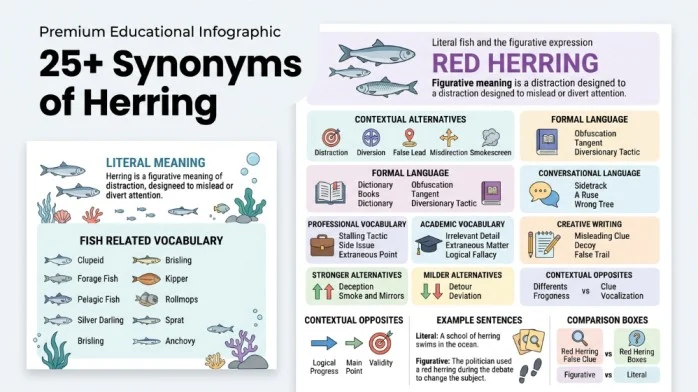
When writing an essay, story, blog post, or conversation about seafood, mystery clues, or misleading arguments, the word “herring” can mean more than it first appears. Searching for synonyms of herring requires understanding which meaning you intend, because herring normally refers to a silver colored sea fish, while red herring refers to something that distracts attention from the main issue.
That distinction matters when choosing another word. A fish related term may work when discussing food or marine life, but words such as distraction, diversion, or false clue are more appropriate when discussing the figurative expression red herring. This guide separates these meanings so you can choose natural, accurate vocabulary instead of forcing a synonym where none truly exists.
What Are the Best Synonyms of “Herring”?
The best alternative for herring depends on its meaning. As a fish, herring has no perfect everyday synonym, although related terms such as oily fish or specific herring species can provide context. In red herring, useful alternatives include distraction, diversion, false clue, false lead, misdirection, and smokescreen.
Meaning, Tone, and Context
Simple Definition
Herring is a noun referring to a long, silver colored sea fish that commonly swims in groups and is also eaten as food. The word can refer to the fish itself or its flesh when used as food.
The expression red herring has a separate figurative meaning. It describes a fact, idea, subject, or clue that draws attention away from the main issue being considered.
Part of Speech
Herring is a noun.
Examples:
“Fresh herring was served for dinner.”
“The detective realized that the clue was a red herring.”
Overall Tone
The literal word herring is neutral. It simply identifies a type of fish or food.
Red herring is also generally neutral in tone, although it often carries a negative implication because it describes something that distracts people from the real issue.
Formality Level
Herring is a neutral vocabulary word that works in everyday, culinary, scientific, fishing, and academic contexts.
Red herring is also standard English and can appear in casual conversations, essays, journalism, debates, business discussions, and analytical writing.
Common Uses
Native English speakers commonly use herring when discussing:
- Seafood
- Fishing
- Marine biology
- Food preparation
- Traditional dishes
- Fish markets
- Fisheries
- Ocean ecosystems
- Herring species
- Red herring clues
- Misleading arguments
- Distracting information
Word Forms
| Form | Example |
|---|---|
| Noun | herring |
| Plural noun | herring or herrings |
| Compound noun | red herring |
| Compound noun | herring gull |
| Compound noun | herring fishery |
| Food expression | pickled herring |
| Food expression | smoked herring |
The plural can be herring or herrings, depending on usage. Cambridge lists both forms.
When and How to Use “Herring”
Use herring when you are talking about the fish itself, its meat as food, or a compound expression involving herring.
When the intended meaning is distraction, use the full expression red herring rather than treating herring alone as a synonym for distraction.
Professional Context
“The report included several references to the herring fishery.”
Academic Context
“Researchers examined changes in herring populations over several seasons.”
Workplace Context
“That issue may be a red herring and could distract us from the actual problem.”
Personal Context
“My grandfather used to prepare pickled herring for family gatherings.”
Email Context
“I think the discussion about the old software is a red herring because the current problem concerns the database.”
Resume Context
A resume would rarely use herring unless the applicant worked in fisheries, seafood production, marine science, or a related field.
Example:
“Conducted field research involving coastal herring populations.”
Social Media Context
“Pickled herring is definitely an acquired taste.”
For figurative use:
“That argument is just a red herring.”
Best Synonyms of “Herring”
There is an important vocabulary distinction here. Herring, in its literal sense, is the name of a particular type of fish, so ordinary English does not provide 25 perfect interchangeable synonyms.
For example, salmon, sardine, mackerel, and anchovy are other fish, not synonyms for herring. Cambridge places these words among related sea fish rather than treating them as replacements for herring.
For the figurative expression red herring, however, there are several useful alternatives.
Professional Writing: Misdirection
Misdirection works well when describing an argument, strategy, or statement designed to shift attention away from the central matter.
Example:
“The discussion became an exercise in misdirection.”
Academic Writing: Diversion
Diversion can describe a shift away from the central subject.
Example:
“The additional debate became a diversion from the primary research question.”
Business Communication: Distraction
Distraction is direct and easy to understand when something pulls attention away from a business problem.
Example:
“That complaint is a distraction from the underlying customer service issue.”
Casual Conversation: Distraction
In everyday speech, distraction is usually more natural than an elaborate alternative.
Example:
“I think that’s just a distraction from what really happened.”
Emotional Writing: Smokescreen
Smokescreen suggests that someone is deliberately hiding the real issue.
Example:
“His explanation felt like a smokescreen for the real problem.”
Creative Writing: False Lead
False lead is especially useful in mysteries, detective stories, and suspense writing.
Example:
“The strange letter turned out to be a false lead.”
Resume Writing: Diversion
A resume generally would not need red herring. If describing analytical work, diversion may sometimes fit when discussing misleading information.
Example:
“Identified misleading data points that diverted attention from operational risks.”
Workplace Communication: Distraction
Distraction is clear and professional enough for workplace discussions.
Example:
“Let’s avoid distractions and focus on the client’s actual concern.”
Stronger Meaning: Misdirection
Misdirection can imply purposeful redirection of attention.
Example:
“The witness’s statement appeared to be deliberate misdirection.”
Softer Meaning: Side Issue
Side issue is useful when the matter may simply be less relevant rather than intentionally misleading.
Example:
“That is a side issue, not the main concern.”
When Not to Use “Herring”
When You Mean Any Fish
Do not use herring as a general synonym for every fish.
Incorrect:
“We bought some herring for dinner,” when you actually mean salmon.
Better:
“We bought some salmon for dinner.”
Why:
Herring identifies a particular type of fish. Related fish are not automatically synonyms.
When You Mean a Distraction
Do not use herring alone to mean distraction.
Incorrect:
“That point is a herring.”
Better:
“That point is a red herring.”
Why:
The figurative expression is red herring, not simply herring. Cambridge specifically defines red herring as something that takes attention away from the central point.
When You Mean a False Clue
Use false clue or false lead when you want the meaning to be immediately obvious.
Less precise:
“The detective found a herring.”
Better:
“The detective followed a false lead.”
When You Mean an Irrelevant Topic
Use irrelevant issue, side issue, or distraction when the subject is simply unrelated to the main point.
Example:
“That question is a side issue.”
When You Mean a Deliberate Cover
Use smokescreen when the idea suggests deliberate concealment.
Example:
“The announcement was a smokescreen for the company’s larger problem.”
When You Need Technical Fish Vocabulary
Avoid replacing herring with a broader fish category if precision matters.
For scientific or fisheries writing, keep herring when the species or fish group is specifically being discussed.
Words Commonly Confused With “Herring”
Sardine
Difference: Sardines and herring are different fish, although both are small, schooling, oily fish.
When to Use It: Use sardine when specifically referring to sardines.
Example:
“We served grilled sardines with lemon.”
Mackerel
Difference: Mackerel is another oily sea fish, but it is not a synonym for herring.
When to Use It: Use it when identifying mackerel species or food.
Example:
“The fisherman caught several mackerel.”
Anchovy
Difference: Anchovies are small saltwater fish with a strong flavor. They are related as food categories but are not herring.
When to Use It: Use anchovy for that specific fish.
Example:
“The sauce contains anchovies for extra flavor.”
Red Herring
Difference: A red herring can literally refer to a smoked herring, but figuratively it means something that distracts attention from the main issue.
When to Use It: Use it in arguments, mysteries, debates, investigations, and analytical writing.
Example:
“The witness’s claim was a red herring.”
False Lead
Difference: A false lead is misleading information that causes someone to pursue the wrong direction.
When to Use It: It is particularly useful in detective stories and investigations.
Example:
“The suspicious email turned out to be a false lead.”
Distraction
Difference: A distraction takes attention away from something else but does not necessarily involve deception.
When to Use It: Use it when discussing irrelevant or attention stealing information.
Example:
“The argument became a distraction from the main problem.”
Best Synonyms of “Herring” by Context
| Context | Best Synonym or Alternative | Why It Works | Example |
|---|---|---|---|
| Literal fish | Herring | Most precise term | “The boat returned with herring.” |
| Food | Herring | Correct food name | “We had pickled herring.” |
| Formal writing | Red herring | Correct figurative expression | “The objection was a red herring.” |
| Academic writing | Diversion | Clearly describes a shift away from the main topic | “The debate became a diversion.” |
| Professional communication | Distraction | Direct and easy to understand | “That concern is a distraction.” |
| Business emails | Distraction | Natural workplace wording | “The issue is a distraction from the actual problem.” |
| Resume writing | Misleading information | More explicit than red herring | “Reviewed misleading information during audits.” |
| Workplace communication | Distraction | Clear and neutral | “Let’s avoid this distraction.” |
| Casual conversation | Red herring | Common figurative expression | “That’s just a red herring.” |
| Everyday speaking | Distraction | Simple and natural | “That’s a distraction.” |
| Creative writing | False lead | Strong choice for mysteries | “The letter was a false lead.” |
| Storytelling | Red herring | Familiar mystery term | “The author planted a red herring.” |
| Emotional writing | Smokescreen | Suggests concealment | “His apology was a smokescreen.” |
| Strong emphasis | Misdirection | Suggests purposeful redirection | “The statement was deliberate misdirection.” |
| Mild tone | Side issue | Less accusatory | “That’s only a side issue.” |
| Social media captions | Red herring | Short and recognizable | “That argument is a red herring.” |
| American English | Red herring | Standard American expression | “The claim was a red herring.” |
| British English | Red herring | Also standard British usage | “The argument was a red herring.” |
How to Choose the Best Synonym of “Herring”
Choosing an alternative begins with identifying the meaning.
Step 1: Are You Talking About the Fish?
If yes, use herring.
Do not replace it with another fish simply to avoid repetition.
Step 2: Are You Talking About Food?
Use herring, or specify the preparation if appropriate.
- Pickled herring
- Smoked herring
- Salted herring
Step 3: Are You Talking About a Misleading Argument?
Use red herring.
Example:
“That claim is a red herring.”
Step 4: Are You Talking About a Distraction?
Use distraction or diversion.
These choices are clearer when the figurative meaning is more important than the idiom.
Step 5: Are You Writing a Mystery?
Use false lead, false clue, or red herring.
These terms help readers understand that the clue points in the wrong direction.
Step 6: Are You Suggesting Deliberate Deception?
Use misdirection or smokescreen.
These words communicate a stronger suggestion that attention is being intentionally redirected.
Step 7: Consider Your Audience
- For general readers, distraction is simple.
- For mystery readers, red herring and false lead are natural.
- For academic writing, diversion or irrelevant issue may be clearer.
- For professional writing, distraction, misdirection, or irrelevant issue often communicates the idea more directly.
Real Life Examples of “Herring”
School
“The teacher explained that the clue in the story was a red herring.”
College
“The author uses a red herring to challenge the reader’s first interpretation.”
Workplace
“The discussion about office decorations became a distraction from the budget problem.”
Business
“The company described the complaint as a distraction from the larger operational issue.”
“I believe the discussion of the old contract is a red herring because the current issue concerns the new agreement.”
Resume
“Analyzed fisheries data involving herring populations and coastal ecosystems.”
Conversation
“That sounds like a red herring to me.”
Storytelling
“The detective followed the mysterious stranger, only to discover that he was a false lead.”
Blogging
“The debate over the website’s color scheme is a distraction from the site’s slow loading speed.”
Social Media
“Calling the minor detail a major problem is a red herring.”
25 Best Synonyms and Contextual Alternatives for “Herring”
A strict vocabulary point is necessary before this table: there are not 25 exact dictionary synonyms for the literal fish called herring. Listing unrelated fish as synonyms would be inaccurate. The table therefore identifies the most useful exact, near equivalent, or context based alternatives associated with herring and especially red herring, while clearly showing how each should be used.
| Term | Simple Meaning | Best Used For | Example Sentence |
|---|---|---|---|
| Herring | A particular silver colored sea fish | Literal fish references | “The fishermen caught herring offshore.” |
| Red herring | A misleading distraction or clue | Arguments and mysteries | “The clue was a red herring.” |
| Distraction | Something that takes attention away | General figurative use | “The complaint became a distraction.” |
| Diversion | Something that redirects attention | Formal and analytical writing | “The issue was a diversion from the main debate.” |
| Misdirection | Deliberately directing attention elsewhere | Investigations and analysis | “The statement appeared to be misdirection.” |
| False clue | A clue that leads toward the wrong conclusion | Mysteries | “The photograph was a false clue.” |
| False lead | Information that sends an investigation in the wrong direction | Detective writing | “The anonymous tip was a false lead.” |
| Misleading clue | A clue that creates a wrong impression | Analytical writing | “The document provided a misleading clue.” |
| Smokescreen | Something used to hide the real issue | Debate and criticism | “The announcement was a smokescreen.” |
| Decoy | Something intended to draw attention away | Strategy and storytelling | “The suspect planted a decoy.” |
| Side issue | A matter that is not central | Mild criticism | “That question is only a side issue.” |
| Irrelevant issue | A matter unrelated to the main subject | Academic and professional writing | “The complaint is an irrelevant issue.” |
| Irrelevant point | A detail that does not address the main topic | Essays and debates | “That is an irrelevant point.” |
| Off topic | Not connected to the subject being discussed | Conversation and writing | “The discussion became off topic.” |
| Digression | A departure from the main subject | Formal writing | “The final paragraph is a digression.” |
| Deflection | An attempt to shift attention elsewhere | Interviews and debates | “His response was a deflection.” |
| Diversionary tactic | A tactic intended to redirect attention | Business and politics | “The accusation may be a diversionary tactic.” |
| Misleading argument | Reasoning that points attention in the wrong direction | Debates | “That is a misleading argument.” |
| Distraction tactic | A method for shifting attention | Professional analysis | “The proposal may be a distraction tactic.” |
| Off topic argument | An argument unrelated to the central question | Discussions | “The complaint was an off topic argument.” |
| Irrelevant detail | Information that does not matter to the main issue | Editing and writing | “Remove the irrelevant detail.” |
| Secondary issue | A matter less central than the main issue | Formal discussions | “The budget is a secondary issue here.” |
| Wrong lead | A lead that points toward the wrong answer | Informal investigations | “The first tip was a wrong lead.” |
| Misleading information | Information that creates an inaccurate impression | Professional contexts | “The report contained misleading information.” |
| Attention diversion | A shift designed to pull focus elsewhere | Analytical writing | “The announcement served as an attention diversion.” |
Synonyms of “Herring” by Usage
Professional vs Personal Synonyms
In professional settings, clarity is usually more valuable than figurative language.
Use distraction, diversion, misdirection, or irrelevant issue when explaining a workplace problem.
In personal conversation, red herring is natural when the listener understands the idiom.
Example:
Professional:
“That issue is distracting us from the primary concern.”
Conversational:
“That’s just a red herring.”
Formal vs Conversational Synonyms
- For reports and essays, use terms such as:
- Diversion
- Irrelevant issue
- Misdirection
- Digression
- Deflection
- For casual conversations, use:
- Distraction
- Red herring
- Side issue
- False lead
- For texting, distraction or red herring is usually easier to understand than specialized terms such as digression.
Academic Synonyms
Academic writing benefits from precise alternatives.
Diversion works when a discussion moves away from the central research question.
Digression describes movement away from the main topic.
Irrelevant issue is useful when a point does not contribute to the argument.
Misdirection works when an argument appears designed to direct attention elsewhere.
Example:
“The claim about the author’s personal life is a distraction from the evidence presented in the study.”
Professional and Business Synonyms
For resumes, avoid using red herring unless the role specifically involves investigation, analysis, or communication.
- In interviews, distraction and irrelevant issue are clear.
- In meetings, side issue provides a polite way to redirect discussion.
- In presentations, key issue and central issue can be useful contrasts to red herring.
- In client communication, avoid unnecessarily accusatory words such as smokescreen unless the evidence strongly supports that interpretation.
Creative and Literary Synonyms
Mystery and thriller writers frequently use red herring, false lead, false clue, and decoy to describe misleading elements.
False lead feels especially natural for detective investigations.
Red herring is more idiomatic and recognizable.
Decoy can describe an object, person, or action deliberately placed to attract attention.
Example:
“The broken window was a red herring planted to make the burglary look accidental.”
Slang or Modern Synonyms
There is no widely accepted slang synonym for herring itself.
For the figurative meaning, casual expressions such as distraction or throwing someone off can communicate a similar idea.
“That detail is just throwing everyone off.”
This kind of wording works in conversation but should generally be avoided in formal academic writing.
Strongest to Mildest Synonyms
Because herring is primarily a concrete noun, an intensity scale does not naturally apply to the fish itself. For the figurative meaning of red herring, the alternatives can be arranged by how strongly they imply intentional misdirection.
Mild
- Side issue
- Irrelevant detail
- Secondary issue
Moderate
- Distraction
- Diversion
- Digression
Strong
- Misleading clue
- False lead
- Deflection
- Misdirection
Very Strong
- Smokescreen
- Deliberate deception
- Diversionary tactic
The strongest expressions suggest purposeful manipulation, while milder terms may simply indicate that something is not central to the discussion.
Emotional vs Neutral Synonyms
Emotional Synonyms
Some alternatives imply suspicion or deliberate manipulation.
- Smokescreen
- Misdirection
- Deception
- Diversionary tactic
Example:
“His explanation seemed like a smokescreen.”
This wording suggests more than simple irrelevance.
Neutral Synonyms
Neutral alternatives include:
- Distraction
- Diversion
- Side issue
- Irrelevant detail
- Digression
- Secondary issue
These terms are better when you want to describe a problem without accusing someone of deliberately misleading others.
Antonyms of “Herring”
The literal noun herring does not have genuine lexical antonyms. A fish does not have a natural opposite word in the same way that hot contrasts with cold.
For red herring, however, there are useful contextual opposites. These are not strict dictionary antonyms. They represent information or ideas that keep attention on the central issue.
| Contextual Opposite | Meaning | Example Sentence |
|---|---|---|
| Relevant clue | A clue connected to the issue | “The fingerprint was a relevant clue.” |
| Valid lead | A useful direction for an investigation | “The witness provided a valid lead.” |
| Genuine clue | Evidence that actually helps solve the problem | “The note contained a genuine clue.” |
| Relevant evidence | Evidence connected to the question | “The court considered relevant evidence.” |
| Direct evidence | Evidence that directly supports a conclusion | “The video provided direct evidence.” |
| Key evidence | Evidence that is especially useful | “The email became key evidence.” |
| Central issue | The main matter being discussed | “We need to return to the central issue.” |
| Main point | The primary idea | “Let’s focus on the main point.” |
| Core issue | The fundamental problem | “Trust is the core issue here.” |
| Relevant detail | Information that directly matters | “Include only relevant details.” |
| Pertinent fact | A fact directly related to the matter | “The report contains several pertinent facts.” |
| Direct answer | A response that addresses the question | “She gave a direct answer.” |
| Decisive evidence | Evidence capable of resolving an issue | “The new testimony was decisive evidence.” |
| On topic | Directly related to the subject | “Please keep your comments on topic.” |
| Substantive point | A meaningful point about the actual issue | “He raised a substantive point.” |
Comparison: “Herring” vs Similar Words
Herring vs Sardine
Main Difference
Both are small sea fish, but they are different types of fish.
Which Is Stronger?
Neither. They identify different fish rather than different levels of the same concept.
Which Is More Formal?
Neither is inherently more formal.
When to Use Each
Use herring when discussing herring specifically. Use sardine when referring to sardines.
Examples
Herring:
“The market sells fresh herring.”
Sardine:
“We ordered grilled sardines.”
Herring vs Mackerel
Main Difference
Both can be discussed as oily sea fish, but mackerel and herring are distinct fish.
Which Is Stronger?
Neither.
Which Is More Formal?
Neither.
When to Use Each
Use the exact fish name required by the context.
Examples
Herring:
“The fishermen studied the herring population.”
Mackerel:
“The boat returned with several mackerel.”
Herring vs Red Herring
Main Difference
Herring normally refers to a fish. Red herring can refer literally to smoked herring or figuratively to a distraction or misleading clue.
Which Is Stronger?
They have different meanings, so intensity is not the main distinction.
Which Is More Formal?
Both are standard English expressions.
When to Use Each
Use herring for the fish. Use red herring for the figurative idea.
Examples
Herring:
“We ate smoked herring.”
Red herring:
“The strange message was a red herring.”
Herring vs Distraction
Main Difference
Herring identifies a fish, while distraction identifies something that takes attention away from another subject.
Which Is Stronger?
Distraction has no direct intensity comparison with the literal fish.
Which Is More Formal?
Both are standard, depending on meaning.
When to Use Each
Use distraction when explaining the figurative concept clearly.
Examples
Herring:
“The restaurant serves pickled herring.”
Distraction:
“The argument became a distraction.”
Herring vs False Lead
Main Difference
A false lead specifically points someone in the wrong direction, especially during an investigation.
Which Is Stronger?
False lead is more specific than the broad idea of distraction.
Which Is More Formal?
Both can work in professional or literary writing.
When to Use Each
Use false lead for detective stories, investigations, and misleading evidence.
Examples
Herring:
“The chef prepared herring.”
False lead:
“The anonymous letter was a false lead.”
Herring vs Misdirection
Main Difference
Misdirection emphasizes the act of directing attention away from the real subject.
Which Is Stronger?
Misdirection can imply intentional manipulation.
Which Is More Formal?
Misdirection is useful in analytical, professional, and literary contexts.
When to Use Each
Use misdirection when deliberate redirection is central to the meaning.
Examples
Herring:
“The fishermen caught herring.”
Misdirection:
“The statement was an example of deliberate misdirection.”
Common Phrases and Expressions with “Herring”
Red Herring
Meaning: Something that distracts attention from the central issue or creates a misleading direction.
Example:
“The argument about the minor expense was a red herring.”
Red Herrings
Meaning: Multiple misleading clues, details, or arguments.
Example:
“The mystery contains several red herrings.”
Pickled Herring
Meaning: Herring preserved in a pickling solution.
Example:
“Pickled herring is served as part of the traditional meal.”
Smoked Herring
Meaning: Herring preserved and flavored through smoking.
Example:
“The store sells smoked herring.”
Herring Fishery
Meaning: A commercial or organized fishery involving herring.
Example:
“The coastal community depended on the herring fishery.”
Herring Gull
Meaning: A gull species commonly associated with coastal and inland environments.
Example:
“A herring gull landed near the shoreline.”
Herring Bone
Meaning: A pattern made from repeated angled lines resembling the bones of a fish.
Example:
“The designer chose a herringbone pattern for the floor.”
Common Mistakes to Avoid
1. Treating Every Fish as a Herring
Incorrect:
“We bought herring,” when the fish was actually salmon.
Better:
“We bought salmon.”
Why:
Herring is a specific fish, not a general word for seafood.
2. Using “Herring” Alone for a Distraction
Incorrect:
“That argument is a herring.”
Better:
“That argument is a red herring.”
Why:
The figurative expression is red herring.
3. Calling Sardines Synonyms of Herring
Incorrect:
“Sardine is another word for herring.”
Better:
“Sardines and herring are different fish.”
Why:
They are related food and fish categories, but they are not interchangeable terms.
4. Using “Red Herring” for Every Irrelevant Detail
Incorrect:
“Every small detail is a red herring.”
Better:
“That small detail is irrelevant to the main issue.”
Why:
A red herring usually suggests that something actively distracts from the central issue. A detail can simply be irrelevant without functioning as a red herring.
5. Using “Smokescreen” Without Implying Concealment
Incorrect:
“The side question was a smokescreen,” when there is no evidence of concealment.
Better:
“The side question was a distraction.”
Why:
Smokescreen can imply an attempt to hide the real issue.
6. Using “False Lead” for a Simple Change of Topic
Incorrect:
“Her comment about lunch was a false lead.”
Better:
“Her comment about lunch was a distraction.”
Why:
False lead is most natural when information sends someone in the wrong direction, particularly in an investigation.
7. Assuming All Figurative Alternatives Are Exact Synonyms
Incorrect:
“Distraction, misdirection, and red herring mean exactly the same thing.”
Better:
“These terms overlap, but they emphasize different aspects of being led away from the central issue.”
Why:
Good synonym selection requires attention to nuance, context, and intent.
Frequently Asked Questions
1. What are the best synonyms of “herring”?
For the literal fish, there is no large set of exact English synonyms. For red herring, useful alternatives include distraction, diversion, false lead, false clue, misdirection, and smokescreen.
2. What are the best formal synonyms of “herring”?
If you mean the fish, use herring because it is already the precise term. If you mean red herring figuratively, formal alternatives include diversion, misdirection, irrelevant issue, and deflection.
3. What are common informal synonyms of “herring”?
For the figurative meaning, distraction, side issue, and false lead are accessible alternatives. In casual conversation, red herring itself is also natural and widely understood.
4. What is another word for “herring” in professional writing?
There is no universal professional replacement for the fish. When discussing a misleading point, use distraction, diversion, misdirection, or irrelevant issue, depending on the intended meaning.
5. What is the difference between “herring” and “red herring”?
Herring normally refers to a silver colored sea fish. Red herring can refer to smoked herring, but more commonly in figurative English it means something that distracts attention from the central issue.
6. What is the opposite of “herring”?
The literal fish herring has no true dictionary antonym. For red herring, contextual opposites include relevant clue, valid lead, genuine evidence, central issue, main point, and direct answer.
Conclusion
The meaning of herring depends heavily on context. Literally, it refers to a particular sea fish that is also eaten as food. In the expression red herring, it takes on a figurative meaning involving distraction, misdirection, or a misleading clue.
The best alternative therefore depends on what you are trying to say. Use herring for the fish, red herring for the familiar figurative expression, distraction for a general shift in attention, false lead for an investigative clue, diversion for formal discussion, and misdirection when deliberate redirection is important.
There is no benefit in forcing unrelated fish names into a synonym list simply to create more entries. For accurate vocabulary, always choose the word that matches the exact meaning, audience, tone, and purpose. A useful vocabulary habit is to identify the intended sense first, then look for alternatives that preserve that meaning. This is especially important when searching for synonyms of herring.
Read More Related Articles:
50+ Synonyms of Love | Powerful Words to Express Every …
Synonyms for Thus | Meaning, Examples, and Better Word …