A writer may use could several times in one email, essay, conversation, or school assignment without realizing how many different meanings the word can carry. In one sentence, it can describe past ability. In another, it can express possibility, make a polite request, or suggest an option.
Understanding the synonyms of could is therefore less about replacing one word with another and more about identifying the meaning behind the sentence. Words and phrases such as was able to, might, may, possibly, and was capable of can make your meaning more precise. The best alternative depends on whether you are discussing ability, possibility, permission, a request, or a conditional situation.
What Are the Best Synonyms of “Could”?
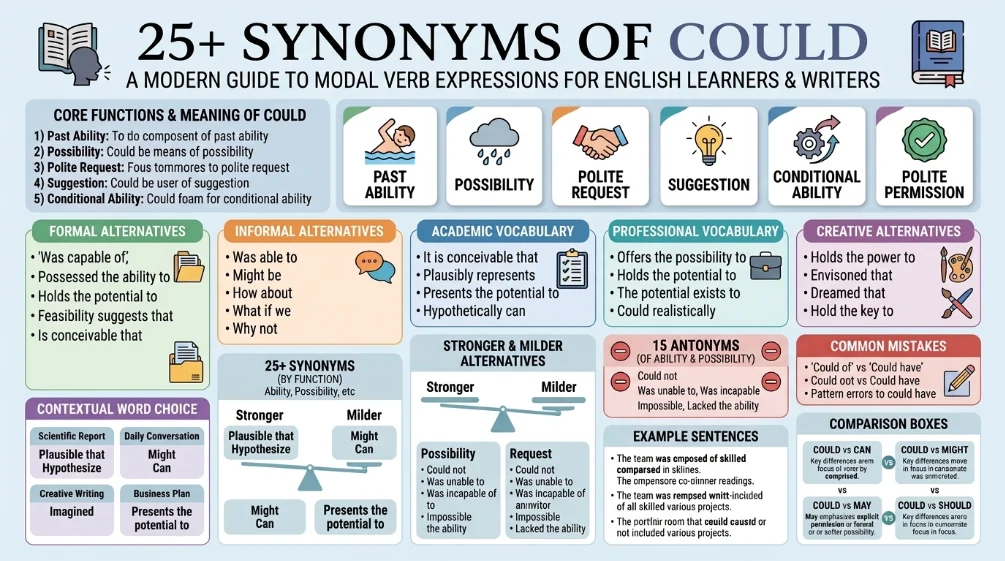
Could is a modal verb used to express past ability, possibility, polite requests, suggestions, and conditional situations. The best alternatives depend on meaning. Use was able to for past ability, might or may for possibility, possibly for uncertainty, and would be able to for conditional ability.
Meaning, Tone, and Context
Simple Definition
Could is a modal auxiliary verb with several functions. It commonly describes an ability that existed in the past, something that may happen, a possible situation, a polite request, or an option being suggested.
For example:
“When I was younger, I could swim very well.”
Here, could describes past ability.
In:
“It could rain this afternoon.”
Could expresses possibility.
In:
“Could you send me the report?”
Could makes a request sound polite.
Because the word has several functions, there is no single replacement that works in every sentence.
Part of Speech
Could is a modal auxiliary verb.
It is used with the base form of another verb.
Examples:
“She could drive.”
“They could arrive tomorrow.”
“We could discuss the issue later.”
It does not normally take an infinitive with “to” directly after it.
Incorrect:
“She could to drive.”
Correct:
“She could drive.”
Overall Tone
The tone of could is usually neutral and flexible.
Depending on the sentence, it can sound:
- neutral when describing ability
- tentative when expressing possibility
- polite when making a request
- thoughtful when making a suggestion
- conditional when discussing an imagined situation
Formality Level
Could is neutral and works comfortably in both formal and informal English.
It appears in:
- academic writing
- professional emails
- workplace conversations
- everyday speech
- customer service
- personal communication
- polite requests
Common Uses
Native English speakers commonly use could in five major ways.
Past Ability
“She could read before she started school.”
Possibility
“The meeting could take longer than expected.”
Polite Requests
“Could you please review this document?”
Suggestions
“We could meet after lunch.”
Conditional Ability
“I could help if I finished my work early.”
Word Forms
Because could is a modal auxiliary, it does not have the same range of noun, adjective, and adverb forms that many ordinary verbs have.
Related expressions include:
can, present ability or possibility
- could not, negative form
- could have, past possibility or an unrealized possibility
- could be, possible state
- could do, possible action
- could have done, past possibility or unrealized opportunity
There is no ordinary noun or adjective form of could.
When and How to Use “Could”
The correct use of could depends on the meaning you want to communicate. The following examples show how it functions in different real world situations.
Professional
“Could you send the revised proposal by Thursday?”
Here, could makes the request polite and professional.
Academic
“These findings could indicate a relationship between sleep and academic performance.”
Here, could expresses a possibility rather than presenting the conclusion as certain.
Workplace
“We could move the meeting to Friday if everyone is available.”
Here, could presents an option or suggestion.
Personal
“When we lived near the beach, we could walk there every evening.”
Here, could describes an ability or opportunity that existed in the past.
“Could you confirm whether the attached information is correct?”
This is a polite request suitable for professional correspondence.
Resume
Directly using could is usually less effective on a resume because resumes generally emphasize demonstrated accomplishments rather than hypothetical ability.
Instead of:
“Could manage multiple projects.”
Use:
“Managed multiple projects simultaneously.”
Social Media
“This could be the beginning of something exciting.”
Here, could creates a sense of possibility and anticipation.
Best Synonyms of “Could”
There is an important distinction when discussing could synonyms. Unlike a simple adjective such as happy or important, could has several grammatical functions, so its alternatives must be selected according to context.
Professional Writing: “Was able to” or “Would be able to”
Use was able to when describing a completed past ability or achievement.
“The team was able to complete the project ahead of schedule.”
Use would be able to for a conditional future ability.
“The team would be able to complete the project with additional resources.”
Academic Writing: “May” or “Might”
Use may when presenting a reasonable possibility.
“The findings may indicate a change in consumer behavior.”
Use might when the possibility sounds more tentative.
“The findings might indicate a change in consumer behavior.”
Business Communication: “May” or “Would be able to”
For professional statements about possibility, may often sounds clear and measured.
“The new system may reduce processing time.”
For conditional ability:
“The department would be able to process more applications with additional staff.”
Casual Conversation: “Can” or “Might”
In some contexts, can naturally replaces could when the meaning is present ability.
“I can help you tomorrow.”
For possibility, might is often a natural alternative.
“It might rain later.”
Emotional Writing: “Might”
Might can create a reflective or uncertain emotional tone.
“Perhaps this might be the moment everything changes.”
Creative Writing: “Might” or “Was able to”
Creative writing often benefits from choosing an alternative based on the intended mood.
“She might finally discover the truth.”
For a completed ability:
“He was able to escape before dawn.”
Resume Writing: “Managed” or “Achieved”
Instead of using could to describe what you were capable of doing, describe what you actually accomplished.
Weak:
“Could manage a large team.”
Stronger:
“Managed a large team of twelve employees.”
Workplace Communication: “Was able to” or “May”
Use was able to for demonstrated results.
“We were able to resolve the issue within two hours.”
Use may when discussing possibility.
“The change may affect next month’s schedule.”
Stronger Meaning: “Was able to successfully”
When you want to emphasize successful completion, was able to can be more specific than could.
“The technician was able to restore the system.”
Softer Meaning: “Might”
- When you want to make a possibility sound less certain, might is often a useful alternative.
“The delay might affect the launch date.”
When Not to Use “Could”
When You Mean Certain Past Success
Could can describe general past ability, but it is often not the clearest choice for one specific successful event.
Less precise:
“Yesterday, I could fix the computer.”
Better:
“Yesterday, I was able to fix the computer.”
The second version clearly describes a successful completed action.
When You Mean Present Ability
When discussing current ability, can is normally more direct.
Less appropriate:
“I could help you right now.”
This can sound like a tentative offer rather than a straightforward statement of present ability.
Better:
“I can help you right now.”
When You Want to Express Strong Certainty
Could often suggests possibility rather than certainty.
Less precise:
“The package could arrive tomorrow.”
If the arrival is confirmed:
“The package will arrive tomorrow.”
When a Formal Statement Needs Precision
In professional or academic writing, repeatedly using could can make claims sound unnecessarily uncertain.
Less precise:
“The policy could improve workplace communication.”
More direct when evidence supports the claim:
“The policy is expected to improve workplace communication.”
When You Are Describing a Proven Achievement
Resumes should focus on actual accomplishments.
Less effective:
“Could increase customer satisfaction.”
Better:
“Increased customer satisfaction by improving response times.”
When You Need to Give a Clear Instruction
Could creates politeness, but it does not always communicate a firm requirement.
Less direct:
“Could you submit the form by Friday?”
If submission is mandatory:
“Please submit the form by Friday.”
Words Commonly Confused With “Could”
Can
Difference:
Can commonly expresses present ability or a current possibility. Could often refers to past ability, tentative possibility, or polite requests.
When to use it:
Use can for current ability.
Example:
“I can speak Spanish.”
Might
Difference:
Might usually expresses possibility. It does not normally describe past ability in the way could does.
When to use it:
Use might when something is possible but uncertain.
Example:
“She might join us later.”
May
Difference:
May expresses possibility and can also be used for permission. Could can express possibility too, but often sounds more tentative.
When to use it:
Use may for formal statements about possibility or permission.
Example:
“The results may change after further testing.”
Would
Difference:
Would commonly describes conditional situations, expected behavior, or repeated past behavior. Could focuses more on ability or possibility.
When to use it:
Use would when discussing a condition or imagined result.
Example:
“I would travel more if I had additional vacation time.”
Should
Difference:
Should expresses expectation, advice, or recommendation. Could usually expresses possibility, ability, or an option.
When to use it:
Use should when recommending an action.
Example:
“You should review the document before submitting it.”
Might Have
Difference:
Might have describes a possible past event. Could have can also describe past possibility, ability, or an opportunity that was not used.
When to use it:
Use might have when focusing primarily on uncertainty about what happened.
Example:
“She might have missed the train.”
Best Synonyms of “Could” by Context
| Context | Best Synonym or Alternative | Why It Works | Example |
|---|---|---|---|
| Formal writing | May | Expresses possibility clearly | “The change may affect future results.” |
| Academic writing | May | Sounds measured and objective | “The evidence may support this interpretation.” |
| Professional communication | Was able to | Shows demonstrated ability | “The team was able to resolve the issue.” |
| Business emails | Would you be able to | Makes a request polite | “Would you be able to review the file?” |
| Resume writing | Managed | Shows actual achievement | “Managed several client accounts.” |
| Workplace communication | Can | Clearly states current ability | “I can complete the task today.” |
| Casual conversation | Can | Natural for present ability | “I can help you later.” |
| Everyday speaking | Might | Natural for uncertain possibility | “It might rain tonight.” |
| Creative writing | Might | Creates uncertainty and suspense | “He might never return.” |
| Storytelling | Was able to | Shows successful action | “She was able to escape.” |
| Emotional writing | Might | Creates a reflective tone | “It might have been the best day of her life.” |
| Strong emphasis | Was able to successfully | Highlights completed success | “The team was able to successfully complete the project.” |
| Mild tone | Might | Makes a possibility more tentative | “We might consider another option.” |
| Social media captions | Might | Creates curiosity | “This might be my favorite view yet.” |
| American English | Could | Natural across most contexts | “Could you help me with this?” |
How to Choose the Best Synonym of “Could”
The best alternative depends on the meaning behind could. Use this simple decision guide.
If You Mean Past Ability
Choose:
was able to
“She was able to complete the task.”
If You Mean Present Ability
Choose:
can
“She can complete the task.”
If You Mean Possibility
Choose:
may, might, or possibly
“The plan might work.”
If You Mean a Polite Request
Choose:
would you be able to
“Would you be able to send the document?”
If You Mean a Conditional Ability
Choose:
would be able to
“We would be able to finish earlier with more staff.”
If You Mean a Suggestion
Choose:
can, might, or a direct suggestion
“We could meet tomorrow.”
Alternative:
“We might meet tomorrow.”
If You Mean a Completed Achievement
Choose a specific action verb.
Instead of:
“She could improve sales.”
Write:
“She improved sales.”
This is especially useful in resumes and professional profiles.
Real Life Examples of “Could”
School
Original:
“Students could improve their grades by studying regularly.”
Alternative:
“Students may improve their grades by studying regularly.”
Use may when presenting the result as a possibility.
College
“Researchers could identify additional patterns through further analysis.”
A more academic alternative is:
“Researchers may identify additional patterns through further analysis.”
Workplace
“We could finish the project by Friday.”
This presents Friday completion as a possible outcome.
Business
“The new strategy could increase customer retention.”
A formal alternative is:
“The new strategy may increase customer retention.”
“Could you please confirm the meeting time?”
A formal alternative is:
“Would you be able to confirm the meeting time?”
Resume
Instead of:
“Could manage multiple projects.”
Use:
“Managed multiple projects while meeting competing deadlines.”
The second version demonstrates an actual accomplishment.
Conversation
“Could you help me carry this?”
This is a polite everyday request.
Storytelling
“She could hear footsteps approaching from the hallway.”
Here, could describes what she was able to perceive at that moment.
Blogging
These simple changes could make your writing clearer.”
This works because the sentence describes a possible result.
Social Media
“This could be the most exciting chapter yet.”
The word creates anticipation without claiming certainty.
25 Best Synonyms of “Could”
Because could is a modal verb with several meanings, the following list contains accurate contextual alternatives rather than pretending that every expression can replace could in every sentence.
| Synonym or Alternative | Simple Meaning | Best Used For | Example Sentence |
|---|---|---|---|
| Was able to | Successfully had the ability | Completed past actions | “She was able to solve the problem.” |
| Was capable of | Had the ability | Past ability | “He was capable of handling difficult cases.” |
| Had the ability to | Possessed an ability | Formal explanations | “The device had the ability to detect movement.” |
| Managed to | Succeeded despite difficulty | Successful past actions | “They managed to finish before noon.” |
| Succeeded in | Successfully accomplished something | Formal writing | “The team succeeded in reducing costs.” |
| Can | Has present ability | Current ability | “I can help you today.” |
| May | Is possibly true | Formal possibility | “The results may change.” |
| Might | Is possibly true with less certainty | Tentative possibility | “The plan might work.” |
| Possibly | Perhaps | General possibility | “The issue could possibly return.” |
| Perhaps | Maybe | Tentative suggestions | “Perhaps we could try again.” |
| Potentially | Possibly capable of happening | Professional writing | “The change could potentially reduce costs.” |
| It is possible that | Something may happen or be true | Formal writing | “It is possible that demand will increase.” |
| It is possible to | An action can potentially occur | Formal explanations | “It is possible to complete the process online.” |
| Would be able to | Would have the ability | Conditional situations | “We would be able to help with more staff.” |
| Was in a position to | Had the opportunity or ability | Formal contexts | “The team was in a position to negotiate.” |
| Had the opportunity to | Had a chance to act | Past opportunity | “She had the opportunity to study abroad.” |
| Had a chance to | Had an opportunity | Everyday English | “We had a chance to discuss the issue.” |
| Was permitted to | Had permission | Permission contexts | “Employees were permitted to work remotely.” |
| Was allowed to | Had permission | Everyday communication | “We were allowed to leave early.” |
| Was free to | Had freedom to choose | Permission and choice | “You were free to decline the offer.” |
| Would have the ability to | Would possess ability under a condition | Formal conditional writing | “The system would have the ability to process more data.” |
| Could potentially | Might possibly | Tentative professional writing | “The proposal could potentially improve efficiency.” |
| Might be able to | May have the ability | Tentative ability | “I might be able to help tomorrow.” |
| Be capable of | Have the ability | General ability | “The software is capable of processing large files.” |
| Have the capacity to | Have sufficient ability or resources | Formal and technical writing | “The system has the capacity to handle more users.” |
Synonyms of “Could” by Usage
Professional vs Personal Synonyms
Professional communication often benefits from precise alternatives to could.
- Use was able to when describing a completed accomplishment.
“The department was able to reduce processing time.”
- Use may when discussing a possible outcome.
“The adjustment may improve efficiency.”
- Use would be able to for conditional situations.
“The team would be able to respond faster with additional staff.”
In personal conversation, simpler expressions often sound more natural.
“I can help.”
“It might work.”
“Maybe we can try tomorrow.”
Formal vs Conversational Synonyms
Formal writing often uses may, might, was able to, and would be able to.
Conversational English frequently uses can, might, maybe, and was able to.
For example:
Formal:
“The revised procedure may improve efficiency.”
Conversational:
“The new process might work better.”
Business email:
“Would you be able to provide the information by Friday?”
Casual conversation:
“Can you send it to me later?”
Academic Synonyms
Academic writing requires careful distinction between possibility and established fact.
Good alternatives include:
May
“The results may indicate a shift in consumer behavior.”
Might
“The difference might reflect changes in the sample.”
Was able to
“The research team was able to identify three common patterns.”
Potentially
“The intervention could potentially improve long term outcomes.”
Avoid replacing every instance of could with a stronger word if the evidence remains uncertain. Academic accuracy depends on expressing the correct level of certainty.
Professional and Business Synonyms
Resumes
Avoid could when describing achievements.
Instead of:
“Could increase sales.”
Use:
“Increased sales.”
Interviews
Could can be useful when discussing hypothetical situations.
“I could adapt quickly to that environment.”
Meetings
Use could when presenting an option.
“We could postpone the discussion until next week.”
Presentations
Use may when describing a possible outcome.
“This change may reduce operating costs.”
Performance Reviews
Use was able to when describing completed results.
“She was able to resolve several complex customer issues.”
Client Communication
Use could for polite requests.
“Could you confirm the delivery address?”
Business Emails
Use would be able to when making a particularly courteous request.
“Would you be able to share the updated figures?”
Creative and Literary Synonyms
Creative writing often uses modal verbs to control suspense and certainty.
Might can create mystery:
“He might return before sunrise.”
Was able to can emphasize successful action:
“She was able to reach the village before the storm.”
Could can describe perception or possibility:
“He could hear the ocean beyond the trees.”
Perhaps can create a reflective voice:
“Perhaps this was the moment she had been waiting for.”
Slang or Modern Synonyms
There is no true slang synonym for could that works across its grammatical meanings.
Casual English may use expressions such as:
Maybe
“Maybe we can go tomorrow.”
Can
“Can you help me?”
Might
“It might happen.”
These are informal or conversational alternatives in particular contexts, but they are not universal replacements for could.
Strongest to Mildest Alternatives
Because could expresses different meanings, there is no universal intensity scale. The following scale applies mainly when could is being used to express possibility.
Mild Possibility
Might
“It might happen.”
This presents a possibility without much confidence.
Moderate Possibility
Could
“It could happen.”
This presents something as realistically possible.
More Direct Possibility
May
“It may happen.”
This can sound somewhat more direct or formal, depending on context.
Stronger Certainty
Is likely to
“It is likely to happen.”
This goes beyond the basic meaning of could because it suggests a higher probability.
Certainty
Will
“It will happen.”
This no longer expresses mere possibility. It presents the event as expected or certain.
Emotional vs Neutral Alternatives
Emotional Alternatives
Some alternatives can add a sense of hope, uncertainty, possibility, or anticipation.
Might
“This might be the opportunity we’ve been waiting for.”
Perhaps
“Perhaps everything will work out.”
Could
“This could change everything.”
These expressions work well in personal writing, storytelling, speeches, and social media.
Neutral Alternatives
Use neutral alternatives when you want to communicate information without creating unnecessary emotion.
May
“The change may affect production.”
Was able to
“The team was able to complete the analysis.”
Can
“The software can process the files automatically.”
These choices work well in academic, technical, and professional communication.
Antonyms of “Could”
Could does not have one universal antonym because its meaning changes by context. The following alternatives represent genuine opposites for its major meanings, including inability, impossibility, lack of permission, and absence of opportunity.
| Antonym or Opposite | Meaning | Example Sentence |
|---|---|---|
| Could not | Was unable to or was not possible | “She could not attend the meeting.” |
| Couldn’t | Informal form of could not | “I couldn’t finish the report.” |
| Was unable to | Did not have the ability | “He was unable to complete the task.” |
| Was incapable of | Lacked the required ability | “The old system was incapable of handling the workload.” |
| Lacked the ability to | Did not possess an ability | “The device lacked the ability to detect the problem.” |
| Failed to | Did not successfully complete an action | “The team failed to meet the deadline.” |
| Was unsuccessful in | Did not achieve the intended result | “She was unsuccessful in securing funding.” |
| Was not able to | Did not manage to do something | “We were not able to resolve the issue.” |
| Was not permitted to | Did not have permission | “Employees were not permitted to enter the area.” |
| Was not allowed to | Did not have permission | “Students were not allowed to use phones during the exam.” |
| Was forbidden to | Was officially prohibited | “Visitors were forbidden to enter the restricted area.” |
| Was impossible | Could not happen or be done | “Completing the work in one hour was impossible.” |
| Was unlikely | Had little chance of happening | “A quick recovery was unlikely.” |
| Had no opportunity to | Did not have a chance | “She had no opportunity to discuss the issue.” |
| Had no capacity to | Did not have sufficient ability or resources | “The system had no capacity to handle additional users.” |
Comparison: “Could” vs Similar Words
Could vs Can
Main Difference
Can usually describes present ability or possibility. Could often describes past ability, a tentative possibility, or a more polite request.
Which Is Stronger?
Can generally sounds more direct and confident.
Which Is More Formal?
Neither is inherently more formal. Both are standard English.
When to Use Each
Use can for current ability.
Use could for past ability, tentative possibilities, and polite requests.
Examples
Could:
“When I was younger, I could run five miles easily.”
Can:
“I can run five miles now.”
Could vs Might
Main Difference
Both can express possibility. Might usually emphasizes uncertainty, while could often presents something as one realistic possibility among several.
Which Is Stronger?
Neither is always stronger. Context determines the level of certainty.
Which Is More Formal?
Both are acceptable in formal writing.
When to Use Each
Use might when emphasizing uncertainty.
Use could when describing a possible outcome or option.
Examples
Could:
“The delay could affect the schedule.”
Might:
“The delay might affect the schedule.”
Could vs May
Main Difference
Both express possibility. May often sounds more formal or measured, while could frequently emphasizes potential.
Which Is Stronger?
Neither is universally stronger.
Which Is More Formal?
May is often preferred in formal and academic writing.
When to Use Each
Use may for formal possibility statements.
Use could when emphasizing a potential outcome.
Examples
Could:
“The decision could change the outcome.”
May:
“The decision may change the outcome.”
Could vs Would
Main Difference
Could focuses on ability or possibility. Would commonly focuses on what happens under a condition or what someone is willing or expected to do.
Which Is Stronger?
Neither is stronger because they communicate different meanings.
Which Is More Formal?
Both can be used formally.
When to Use Each
Use could for possibility or ability.
Use would for conditional results.
Examples
Could:
“We could finish early.”
Would:
“We would finish early if everyone arrived on time.”
Could vs Should
Main Difference
Could presents an option or possibility. Should gives advice or expresses expectation.
Which Is Stronger?
Should is more directive when used for advice.
Which Is More Formal?
Both are common in professional writing.
When to Use Each
Use could to suggest.
Use should to recommend.
Examples
Could:
“You could contact the manager.”
Should:
“You should contact the manager.”
Could vs Was Able To
Main Difference
Could commonly describes general ability in the past. Was able to often emphasizes successful completion of a specific past action.
Which Is Stronger?
Was able to is more specific when describing an actual successful event.
Which Is More Formal?
Both are standard, but was able to can provide greater precision in professional writing.
When to Use Each
Use could for general past ability.
Use was able to for a specific successful result.
Examples
Could:
“When she was young, she could swim very well.”
Was able to:
“Yesterday, she was able to repair the damaged equipment.”
Common Phrases and Expressions with “Could”
Could You Please
Meaning
A polite way to ask someone to do something.
Example Sentence
“Could you please send me the updated report?”
Could Be
Meaning
Indicates that something is possible.
Example Sentence
“This could be the solution we’ve been looking for.”
Could Have
Meaning
Describes a past possibility, ability, or opportunity that may not have been realized.
Example Sentence
“We could have avoided the delay with better planning.”
Could Have Been
Meaning
Describes a possible past state or outcome.
Example Sentence
“The situation could have been much worse.”
Could You
Meaning
A polite request for action.
Example Sentence
“Could you check the attachment before the meeting?”
Could Be Used To
Meaning
Describes a possible purpose or application.
Example Sentence
“This method could be used to improve data collection.”
Could Lead To
Meaning
Indicates a possible consequence.
Example Sentence
“The policy could lead to higher operating costs.”
Could Result In
Meaning
Describes a possible outcome.
Example Sentence
“A delay could result in additional expenses.”
Common Mistakes to Avoid
1. Using “Could” for Every Past Ability
Incorrect
“When I was five, I could win the race yesterday.”
Better
“Yesterday, I was able to win the race.”
Why
A specific successful event is often clearer with was able to.
2. Confusing “Could” With “Can”
Incorrect
“I could speak English very well now.”
Better
“I can speak English very well now.”
Why
The sentence describes present ability, so can is more direct.
3. Treating “Could” as Certain
Incorrect
“The company could definitely open the new branch next month.”
Better
“The company is scheduled to open the new branch next month.”
Why
Could expresses possibility, while scheduled to communicates a planned event.
4. Using “Could” for a Mandatory Instruction
Less Effective
“Could you submit the form by Friday?”
Better
“Please submit the form by Friday.”
Why
The first sentence sounds like a polite request. The second makes the requirement clearer.
5. Using “Could” on a Resume for Achievements
Incorrect
“Could improve customer satisfaction.”
Better
“Improved customer satisfaction.”
Why
A resume should emphasize demonstrated results rather than hypothetical ability.
6. Confusing “Could” With “Should”
Incorrect
“You could complete the form before submitting your application.”
Better
“You should complete the form before submitting your application.”
Why
If you are giving advice or a recommendation, should is more appropriate.
7. Using “Could” When “Might” Better Shows Uncertainty
Less Precise
“She could possibly be at home.”
Better
“She might be at home.”
Why
Might naturally communicates uncertainty without unnecessarily adding another possibility marker.
Frequently Asked Questions
1. What are the best synonyms of “could”?
The best synonyms of could depend on meaning. Use was able to for completed past ability, can for present ability, may or might for possibility, and would be able to for conditional ability.
2. What are the best formal synonyms of “could”?
Formal alternatives include may, might, was able to, would be able to, and it is possible that. The correct choice depends on whether you are expressing possibility, ability, or a conditional situation.
3. What are common informal synonyms of “could”?
Common conversational alternatives include can, might, maybe, and was able to, depending on meaning. There is no single informal synonym because could performs several different grammatical functions.
4. What is another word for “could” in professional writing?
In professional writing, use was able to for completed achievements, may for possibilities, would be able to for conditional ability, and can for current capability.
5. What is the difference between “could” and “can”?
Can usually expresses present ability or possibility, while could commonly expresses past ability, tentative possibility, polite requests, or conditional situations. For example, “I can help” describes current ability, while “I could help” sounds more tentative.
6. What is the opposite of “could”?
There is no single opposite in every context. Depending on meaning, common opposites include could not, was unable to, was incapable of, was not permitted to, and was impossible.
Conclusion
Could is a flexible modal verb used for past ability, possibility, polite requests, suggestions, and conditional situations. Because its meaning changes with context, there is no single replacement that works everywhere.
The best synonyms of could include was able to for completed past ability, can for present ability, may and might for possibility, and would be able to for conditional ability. In professional writing, replacing vague uses of could with a precise verb can make your message clearer and more confident.
The easiest vocabulary improvement is to identify what could means in your sentence first. Then choose the alternative that communicates that exact meaning, rather than selecting a synonym simply because it sounds more advanced.
Read More Related Articles:
- Synonyms for Empty | Meaning, Examples, and Better Word …
- Synonyms for Creativity | Meaning, Examples, and Better …
- 25+ Synonyms of Perseverance | Meanings, Uses, Examples …