A student may write the same word repeatedly in an essay, while a professional may need a more precise term for a formal request or official document. When searching for synonyms of petition, the goal is usually not just to find another word, but to choose one that matches the situation, tone, and purpose.
Words such as request, appeal, plea, application, and motion can overlap with petition, but they are not interchangeable in every context. Understanding these differences helps you write more naturally, whether you are preparing an academic assignment, submitting an official request, writing a business email, or describing a public campaign.
What Are the Best Synonyms of “Petition”?
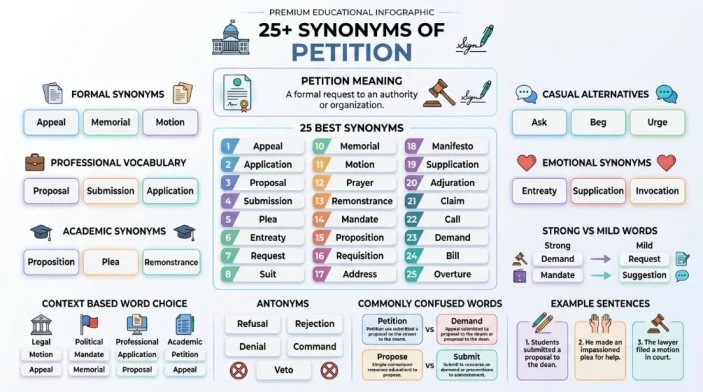
A petition is a formal written or spoken request asking a person, organization, or authority to take a particular action. The best alternatives depend on context. Use request for general communication, appeal for formal or urgent requests, plea for emotional situations, application for official consideration, and motion for formal legal or parliamentary settings.
Meaning, Tone, and Context
Simple Definition
A petition is a formal request made to someone with authority. It can be a written document signed by multiple people, an official request submitted to an institution, or, in some contexts, an earnest request made by one person.
The word can refer both to the request itself and to the act of formally asking for something.
Part of Speech
Petition can function as both a noun and a verb.
As a noun:
“Residents submitted a petition to the city council.”
As a verb:
“The residents petitioned the city council to improve the road.”
Overall Tone
The tone of petition is generally formal and neutral. However, it can become emotional when the request involves hardship, injustice, or an urgent need.
Formality Level
Petition is primarily a formal word. It is common in government, law, politics, public campaigns, organizations, and official procedures.
It is less common in ordinary conversation when a simple request would sound more natural.
Common Uses
Native English speakers commonly use petition in contexts involving:
- Government requests
- Legal proceedings
- Public campaigns
- Political causes
- Community concerns
- Institutional decisions
- Formal appeals
- Court filings
- Student or employee requests
- Requests signed by multiple people
Word Forms
| Word Form | Example |
|---|---|
| Noun | petition |
| Verb | petition |
| Noun | petitioner |
| Related noun | petitioning |
| Adjective | petitionary, in specialized formal usage |
The most useful everyday forms are petition, petitioned, petitioning, and petitioner.
When and How to Use “Petition”
Use petition when the request is formal, directed toward an authority, or connected to a group effort or official process.
Professional
“The organization submitted a petition requesting changes to the workplace policy.”
Academic
“Students organized a petition asking the university to extend library hours.”
Workplace
“Employees petitioned management for improved safety measures.”
Personal
“She petitioned the local authority for permission to make the necessary repairs.”
“I am writing to request your support for the petition concerning the proposed policy.”
Resume
“Coordinated a community petition that gathered more than 2,000 signatures.”
Social Media
“Our community launched a petition calling for safer pedestrian crossings.”
Best Synonyms of “Petition”
No single synonym perfectly replaces petition in every sentence. The most accurate alternative depends on whether you are emphasizing a general request, an emotional appeal, an official application, a legal action, or a collective public demand.
Professional Writing: Request
Request is the safest professional alternative when you simply want to describe asking someone to do something.
“The company submitted a formal request for additional funding.”
It is broader than petition and works naturally in emails, reports, and workplace communication.
Academic Writing: Appeal
Appeal works well when a person or group asks an authority to reconsider a decision or take action.
“The students submitted an appeal against the disciplinary decision.”
It is especially useful when the request involves a decision that has already been made.
Business Communication: Request
Request is generally more natural than petition in ordinary business correspondence.
“We submitted a request for additional information.”
Use petition when the matter involves a formal collective campaign or official process.
Casual Conversation: Ask
Ask is the most natural everyday alternative.
“We asked the manager to change the schedule.”
Calling this action a petition would sound unnecessarily formal unless an actual formal document or organized campaign was involved.
Emotional Writing: Plea
Plea conveys urgency, emotion, or desperation.
“The family’s plea for assistance touched everyone in the community.”
It should not replace petition when the request is simply formal and unemotional.
Creative Writing: Entreaty
Entreaty is a literary and expressive alternative meaning an earnest or serious request.
“His final entreaty was met with silence.”
It works better in literary prose than in ordinary business writing.
Resume Writing: Advocacy
Advocacy is useful when describing efforts to support a cause or influence change.
“Led an advocacy campaign supporting improved access to public transportation.”
It is not a direct synonym in every context, but it can describe the broader activity surrounding a petition.
Workplace Communication: Request
For routine workplace situations, request is usually clearer.
“Employees submitted a request for flexible scheduling.”
Use petition when employees collectively make a formal demand directed at management.
Stronger Meaning: Plea
Plea can be stronger emotionally than petition.
“The organization issued a plea for immediate assistance.”
Softer Meaning: Request
Request is generally less dramatic and more neutral.
“I would like to make a request for additional information.”
When Not to Use “Petition”
Although petition is useful for formal requests, it can sound unnatural when the situation does not involve a formal process, authority, or organized request.
When the Word Is Too General
Sometimes petition does not explain what kind of request is being made.
Less Precise:
“I sent a petition to my supervisor.”
Better:
“I submitted a request to my supervisor for a schedule change.”
Why:
Request clearly describes an ordinary workplace action.
When the Word Sounds Too Formal
Using petition in casual conversation can sound overly serious.
Less Natural:
“I petitioned my brother to lend me his car.”
Better:
“I asked my brother to lend me his car.”
Why:
Ask is the natural conversational choice.
When the Word Is Too Weak Emotionally
A petition may not communicate desperation or emotional urgency.
Less Effective:
“The family made a petition for help.”
Better:
“The family made an emotional plea for help.”
Why:
Plea directly communicates emotional urgency.
When a Legal Filing Is More Precise
A specific legal term may be preferable when describing a particular court procedure.
Less Precise:
“The lawyer submitted a petition.”
Better:
“The lawyer filed a motion asking the court to dismiss the case.”
Why:
Motion can identify a specific formal request made during legal proceedings.
When You Mean an Application
A petition is not always the same as an application for consideration.
Less Precise:
“She submitted a petition for the scholarship.”
Better:
“She submitted a scholarship application.”
Why:
An application is the standard term when someone is seeking admission, funding, employment, or another opportunity through an established process.
Words Commonly Confused With “Petition”
Request
Difference: A request is any act of asking for something. A petition is generally more formal and may involve an authority or group.
When to Use It: Use request for everyday, professional, and general communication.
Example:
“The employee made a request for additional training.”
Appeal
Difference: An appeal commonly asks someone to reconsider a decision or respond to a serious concern.
When to Use It: Use appeal when challenging a decision or seeking special consideration.
Example:
“She filed an appeal after her application was rejected.”
Plea
Difference: A plea usually carries emotional urgency or desperation.
When to Use It: Use plea when emotion is central to the request.
Example:
“The organization made a plea for emergency donations.”
Application
Difference: An application is a formal submission requesting consideration for something such as a job, program, permit, or scholarship.
When to Use It: Use application when following an established process.
Example:
“He submitted an application for the graduate program.”
Motion
Difference: A motion is a formal proposal or request made within a legal, governmental, or organizational procedure.
When to Use It: Use motion when referring to a formal procedural request.
Example:
“The attorney filed a motion before the hearing.”
Demand
Difference: A demand is stronger than a petition because it expresses that something is required rather than simply requested.
When to Use It: Use demand when the speaker strongly insists on a particular action.
Example:
“Workers issued a demand for safer conditions.”
Best Synonyms of “Petition” by Context
| Context | Best Synonym | Why It Works | Example |
|---|---|---|---|
| Formal writing | Appeal | Sounds official and purposeful | “The group submitted an appeal.” |
| Academic writing | Request | Clear and neutral | “Students made a request for additional resources.” |
| Professional communication | Request | Natural in business settings | “We submitted a request for clarification.” |
| Business emails | Request | Polite and standard | “I am writing to request an update.” |
| Resume writing | Advocacy | Describes organized support for a cause | “Led advocacy efforts for safer roads.” |
| Workplace communication | Request | Appropriate for routine needs | “Employees made a request for flexible hours.” |
| Casual conversation | Ask | Natural in everyday speech | “I asked the manager for help.” |
| Everyday speaking | Ask | Simple and conversational | “She asked for more time.” |
| Creative writing | Entreaty | Adds literary emotion | “His entreaty went unanswered.” |
| Storytelling | Plea | Creates emotional intensity | “Her plea changed his mind.” |
| Emotional writing | Plea | Highlights urgency | “Their plea for help was heartfelt.” |
| Strong emphasis | Demand | Expresses forceful insistence | “The workers made a demand for change.” |
| Mild tone | Request | Neutral and polite | “She made a polite request.” |
| Social media captions | Call for action | Clear and accessible | “The campaign is a call for action.” |
| American English | Petition | Standard term for organized formal requests | “Residents signed a petition.” |
| British English | Petition | Also widely used for formal and public requests | “Residents organized a petition.” |
How to Choose the Best Synonym of “Petition”
Choosing the right alternative starts with identifying what the original word is doing in your sentence.
1: Identify the Meaning
- If you simply mean asking for something, choose request.
- If you mean asking an authority to reconsider, choose appeal.
- If the request is emotional, choose plea.
- If it is a formal legal or procedural proposal, consider motion.
2: Consider the Audience
- For a professor or employer, request is usually appropriate.
- For a court, government agency, or formal organization, petition, appeal, or motion may be more precise depending on the procedure.
- For friends and family, ask sounds much more natural.
3: Consider Emotional Strength
- Use request for a neutral tone.
- Use petition for formal emphasis.
- Use appeal for serious reconsideration.
- Use plea for strong emotional urgency.
- Use demand when the speaker is insisting on action.
4: Match the Writing Purpose
- A business email usually needs request.
- A public campaign may need petition.
- A court procedure may require motion or petition, depending on the legal context.
- A personal story may sound better with plea or entreaty.
5: Choose the Most Natural Word
Do not choose a synonym simply because it sounds more sophisticated. The strongest vocabulary choice is the one that communicates the exact idea naturally and clearly.
Real Life Examples of “Petition”
School
Basic:
“Students created a petition asking the school to extend lunch hours.”
Stronger alternative:
“Students organized a formal request asking the administration to extend lunch hours.”
College
“Several students signed a petition requesting more study space in the library.”
The original word works well because the request is organized and collective.
Workplace
“Employees submitted a petition calling for improved safety equipment.”
Here, petition emphasizes collective action directed toward management.
Business
“The trade association submitted a formal request for additional time to review the proposed regulation.”
Request sounds more natural when describing ordinary professional correspondence.
“I am writing to request a review of the current scheduling policy.”
Using request keeps the email polite and professional.
Resume
“Coordinated a community petition supporting safer pedestrian crossings.”
Here, petition is appropriate because it describes a concrete organized initiative.
Conversation
“We asked the landlord to fix the heating system.”
Ask sounds much more natural than petition in casual speech.
Storytelling
“After months of hardship, the villagers made an emotional plea for assistance.”
Plea adds emotional force that petition does not necessarily provide.
Blogging
“Residents launched a petition calling for better public transportation.”
The word works naturally when discussing a public campaign.
Social Media
“Thousands of people have signed the petition calling for changes to the policy.”
For social media, petition is still appropriate when referring to an actual organized campaign.
25 Best Synonyms of “Petition”
| Synonym | Simple Meaning | Best Used For | Example Sentence |
|---|---|---|---|
| Request | An act of asking for something | General and professional communication | “She submitted a request for additional information.” |
| Appeal | A serious request for action or reconsideration | Legal, official, and serious situations | “The family filed an appeal against the decision.” |
| Plea | An urgent or emotional request | Emotional writing and serious situations | “The organization made a plea for support.” |
| Application | A formal request for consideration | Jobs, schools, permits, grants | “He submitted an application for the program.” |
| Motion | A formal procedural proposal | Courts and formal organizations | “The attorney filed a motion before the hearing.” |
| Demand | A forceful request | Labor, political, or confrontational contexts | “Workers made a demand for safer conditions.” |
| Entreaty | An earnest request | Literary and formal writing | “Her entreaty finally changed his mind.” |
| Solicitation | A formal request for support or contributions | Fundraising and organizations | “The charity sent a solicitation for donations.” |
| Appeal for help | A direct request for assistance | Public or emergency situations | “The shelter issued an appeal for help.” |
| Call | A public request for action | Campaigns and public communication | “The group made a call for reform.” |
| Call for action | A request encouraging people to act | Advocacy and social media | “The campaign became a call for action.” |
| Advocacy | Public support for a cause | Social and political campaigns | “Her advocacy focused on housing access.” |
| Representation | A formal presentation of concerns | Government and organizational contexts | “The committee made a representation to officials.” |
| Submission | Something formally presented for consideration | Institutions and official processes | “The organization made a submission to the board.” |
| Proposal | A suggested plan or action | Business and organizations | “The committee presented a proposal for reform.” |
| Protest | An expression of opposition | Political and social movements | “Residents organized a protest against the proposal.” |
| Grievance | A formal complaint about unfair treatment | Workplaces and institutions | “The employee filed a grievance with human resources.” |
| Complaint | An expression of dissatisfaction | Customer service and official communication | “She submitted a complaint about the service.” |
| Supplication | A humble or earnest request | Religious or literary writing | “The character offered a supplication for mercy.” |
| Imploration | A very urgent request | Literary or highly emotional writing | “His imploration for forgiveness was sincere.” |
| Entreating | The act of earnestly asking | Literary contexts | “Her entreating words revealed her desperation.” |
| Exhortation | A strong encouragement to act | Speeches and persuasive writing | “The speech was an exhortation to support reform.” |
| Memorial | A formal statement or request presented to an authority | Historical and formal contexts | “The committee submitted a memorial to the council.” |
| Representation | A formal statement made on behalf of someone | Legal and official communication | “The organization made representations to the agency.” |
| Submission for consideration | A formal presentation for review | Government and institutional contexts | “The group prepared a submission for consideration.” |
Important Usage Note
Not every word in the table is interchangeable with petition in every sentence. Some are broader alternatives, such as request and proposal, while others describe related actions or specialized forms of requesting.
For the closest everyday replacements, request, appeal, and plea are generally the most useful. In legal, governmental, or organizational contexts, the exact procedural meaning matters, so terms such as motion, application, or submission should be used only when they accurately describe the process.
Synonyms of “Petition” by Usage
Professional vs Personal Synonyms
Professional settings usually favor precise, neutral terms.
Best professional choices:
- Request
- Appeal
- Application
- Submission
- Motion
- Proposal
Best personal choices:
- Ask
- Plea
- Appeal
- Request
- Entreaty
For a routine workplace message, request is usually better than petition. If several employees formally approach management together, petition becomes more appropriate.
Formal vs Conversational Synonyms
Reports
Use request, appeal, submission, or petition, depending on the situation.
Essays
Use petition, appeal, request, or plea when the meaning fits.
Business Writing
Request is usually the most natural choice.
Presentations
Use appeal, call, or petition when discussing campaigns or public action.
Emails
Use request for ordinary professional communication.
Casual Conversations
Use ask rather than petition.
Texting
Expressions such as ask, request, or plead may work depending on the tone.
Academic Synonyms
Academic writing benefits from precision rather than unnecessarily complicated vocabulary.
Request
Useful for describing a straightforward academic or institutional request.
“Students submitted a request for additional research materials.”
Appeal
Useful when a student or researcher asks an authority to reconsider a decision.
“The student submitted an appeal following the committee’s decision.”
Petition
Best when describing a formal collective effort.
“Students organized a petition requesting changes to university policy.”
Submission
Useful when a formal document is presented for institutional review.
“The committee reviewed the submission before making its recommendation.”
Proposal
Best when someone suggests a specific plan rather than simply requesting action.
“The researchers presented a proposal for a new study.”
Professional and Business Synonyms
Resumes
Use advocacy, petition, or campaign when describing organized efforts.
“Led a community advocacy campaign involving more than 1,000 participants.”
Interviews
Use request, appeal, or advocacy depending on what you are describing.
Meetings
Use proposal, request, or motion when discussing formal organizational action.
Presentations
Use appeal, call for action, or proposal for persuasive communication.
Performance Reviews
Use request when discussing a request for training, resources, or responsibilities.
Client Communication
Request is usually the safest and most professional choice.
Business Emails
Use phrases such as:
“I am writing to request…”
“We would like to request…”
“We respectfully request…”
These are more natural than using petition for routine business communication.
Creative and Literary Synonyms
Creative writing gives you more freedom to emphasize emotion and character.
Entreaty
Creates a formal, literary feeling.
“Her entreaty echoed through the silent room.”
Plea
Adds emotional urgency.
“His plea for mercy was impossible to ignore.”
Imploration
Creates a highly emotional and dramatic effect.
“Her imploration revealed how deeply she feared losing him.”
Appeal
Can sound serious without becoming overly dramatic.
“His final appeal was directed toward the council.”
Supplication
Works particularly well in literary, historical, or religious contexts.
“He offered a quiet supplication before the journey began.”
Slang or Modern Synonyms
There is no single widely accepted slang word that directly replaces petition.
In modern informal English, people may use expressions such as ask, call for, or push for depending on the context.
Push for means to actively support or seek a particular change.
“The group is pushing for better public transportation.”
This expression is suitable for casual conversation, journalism, and social media. It is less appropriate when you need to describe an actual formal petition document.
Strongest to Mildest Synonyms
The intensity of these words depends partly on context.
| Level | Word | Typical Effect |
|---|---|---|
| Mild | Ask | Simple and conversational |
| Mild | Request | Neutral and polite |
| Moderate | Petition | Formal and organized |
| Moderate | Appeal | Serious or persuasive |
| Strong | Plea | Emotionally urgent |
| Strong | Demand | Forceful and insistent |
| Very Strong | Imploration | Extremely emotional or desperate |
A request does not necessarily imply urgency. A plea often does. A demand goes further by expressing insistence rather than simply asking.
Emotional vs Neutral Synonyms
Emotional Synonyms
These alternatives add feeling or urgency:
- Plea
- Entreaty
- Imploration
- Supplication
- Appeal
Use them in personal stories, speeches, persuasive writing, and situations involving hardship or strong emotion.
Neutral Synonyms
These alternatives communicate the basic idea without adding much emotion:
- Request
- Petition
- Application
- Submission
- Proposal
- Motion
They are generally better for professional, academic, legal, and institutional communication.
Antonyms of “Petition”
Because petition is a noun and verb describing a formal request, it does not have a perfect single antonym. The following words represent contrasting actions or ideas, such as refusing, rejecting, withholding, or opposing a request.
| Antonym | Meaning | Example Sentence |
|---|---|---|
| Refusal | A decision not to grant a request | “The committee issued a refusal after reviewing the proposal.” |
| Rejection | A decision not to accept something | “The applicant received a rejection from the board.” |
| Denial | Refusing to grant a request | “The request ended in denial.” |
| Decline | Politely refusing something | “The organization decided to decline the request.” |
| Refuse | To say no to a request | “The manager refused the proposal.” |
| Reject | To decide not to accept something | “The council rejected the proposal.” |
| Oppose | To actively disagree with something | “Several residents opposed the plan.” |
| Prohibit | To officially prevent something | “The new rule prohibits the activity.” |
| Prevent | To stop something from happening | “The policy prevented the requested change.” |
| Withdraw | To remove a request or proposal | “The group withdrew its request.” |
| Retract | To formally take back a statement or request | “The organization retracted its earlier proposal.” |
| Ignore | To give no attention to something | “Officials ignored the community’s concerns.” |
| Dismissal | Treating something as unworthy of consideration | “The complaint ended in dismissal.” |
| Opposition | Active disagreement with a proposal | “The proposal faced strong opposition.” |
| Counterproposal | An alternative proposal offered instead | “The committee presented a counterproposal.” |
Comparison: “Petition” vs Similar Words
Petition vs Request
Main Difference
A petition is generally more formal and may involve multiple people, an authority, or an official process. A request can be any act of asking for something.
Which Is Stronger?
Petition often carries greater formal weight, while request is broader.
Which Is More Formal?
Petition is generally more formal.
When to Use Each
Use request for everyday and professional communication. Use petition for organized or formal appeals directed toward an authority.
Examples
Petition:
“Residents signed a petition asking the city to improve the road.”
Request:
“I submitted a request for a parking permit.”
Petition vs Appeal
Main Difference
A petition can be a formal request for action. An appeal often asks an authority to reconsider a decision or respond to a serious concern.
Which Is Stronger?
Appeal can sound more urgent or persuasive.
Which Is More Formal?
Both can be highly formal.
When to Use Each
Use appeal when reconsideration is central to the situation.
Examples
Petition:
“Residents submitted a petition for a new park.”
Appeal:
“The applicant filed an appeal against the decision.”
Petition vs Plea
Main Difference
A plea emphasizes emotion, urgency, or desperation.
Which Is Stronger?
Plea is generally more emotionally intense.
Which Is More Formal?
Petition is more institutionally formal, while plea can be formal or emotional.
When to Use Each
Use plea when feelings are central to the request.
Examples
Petition:
“The students submitted a petition to the administration.”
Plea:
“The family made a desperate plea for assistance.”
Petition vs Application
Main Difference
An application asks to be considered for something through an established process. A petition generally asks an authority to take action.
Which Is Stronger?
Neither is inherently stronger.
Which Is More Formal?
Both can be formal.
When to Use Each
Use application for jobs, schools, permits, grants, and similar opportunities.
Examples
Petition:
“The community submitted a petition.”
Application:
“She submitted an application for the scholarship.”
Petition vs Motion
Main Difference
A motion is a formal proposal or request within a legal, governmental, or organizational procedure.
Which Is Stronger?
Neither is inherently stronger. Motion is more procedurally specific.
Which Is More Formal?
Motion is highly formal in its specialized contexts.
When to Use Each
Use motion when referring to a formal procedural action.
Examples
Petition:
“The group submitted a petition to the council.”
Motion:
“The attorney filed a motion with the court.”
Petition vs Demand
Main Difference
A petition formally asks for action. A demand expresses a stronger insistence that something happen.
Which Is Stronger?
Demand is stronger and more forceful.
Which Is More Formal?
Both can appear in formal contexts, but petition is more neutral.
When to Use Each
Use demand when the speaker intends to emphasize firmness or nonnegotiable expectations.
Examples
Petition:
“Workers submitted a petition requesting changes.”
Demand:
“Workers issued a demand for immediate improvements.”
Common Phrases and Expressions with “Petition”
Petition for Change
Meaning
A formal request asking an authority or organization to make a change.
Example Sentence
“Residents organized a petition for change after several traffic accidents.”
Sign a Petition
Meaning
To add your name to a formal request supporting a particular cause or action.
Example Sentence
“Thousands of residents signed a petition supporting the new proposal.”
Start a Petition
Meaning
To create and organize a formal request for signatures or support.
Example Sentence
“The students started a petition to extend library hours.”
Submit a Petition
Meaning
To formally deliver a petition to the relevant authority.
Example Sentence
“The community submitted a petition to the city council.”
File a Petition
Meaning
To formally submit a petition, especially in legal or official contexts.
Example Sentence
“The organization filed a petition with the court.”
Petition the Government
Meaning
To formally ask a government body to take action.
Example Sentence
“The residents petitioned the government for improved infrastructure.”
Online Petition
Meaning
A petition created and signed digitally.
Example Sentence
“The online petition attracted thousands of signatures.”
Petition Drive
Meaning
An organized effort to collect signatures for a petition.
Example Sentence
“Volunteers organized a petition drive throughout the neighborhood.”
Common Mistakes to Avoid
1. Treating Every Request as a Petition
Incorrect:
“I petitioned my coworker to send me the file.”
Better:
“I asked my coworker to send me the file.”
Why:
A normal workplace request does not usually require the formal word petition.
2. Confusing a Petition With an Application
Incorrect:
“She submitted a petition for the university scholarship.”
Better:
“She submitted an application for the university scholarship.”
Why:
An application is the standard term for requesting consideration through an established selection process.
3. Using “Plea” Without Emotional Meaning
Incorrect:
“I sent a plea for the updated sales report.”
Better:
“I sent a request for the updated sales report.”
Why:
Plea can imply emotional urgency and sounds excessive for a routine business request.
4. Using “Demand” When You Mean a Polite Request
Incorrect:
“I demand that you send the report.”
Better:
“I request that you send the report.”
Why:
Demand can sound aggressive, while request maintains a professional tone.
5. Repeating “Petition” Too Often
Incorrect:
“The group created a petition. The petition asked for change. The petition received many signatures.”
Better:
“The group created a petition asking for change. The campaign quickly attracted thousands of signatures.”
Why:
Replacing repeated nouns with natural alternatives improves flow.
6. Using a Legal Term Without a Legal Context
Incorrect:
“I filed a motion asking my boss for vacation.”
Better:
“I submitted a request for vacation.”
Why:
Motion has a specialized procedural meaning and should not be used simply to sound formal.
7. Choosing a Synonym Only Because It Sounds Sophisticated
Incorrect:
“I issued an entreaty for a meeting.”
Better:
“I made a request for a meeting.”
Why:
Entreaty is literary and unusual in routine professional communication. Natural vocabulary is more effective than unnecessarily complicated vocabulary.
Frequently Asked Questions
1. What are the best synonyms of “petition”?
The best synonyms of petition include request, appeal, plea, application, and motion, depending on context. Use request for general situations, appeal for reconsideration, and plea when emotional urgency matters.
2. What are the best formal synonyms of “petition”?
The strongest formal alternatives include appeal, submission, application, motion, and request. The correct choice depends on the setting, especially whether the request involves a court, organization, government body, or established procedure.
3. What are common informal synonyms of “petition”?
The most natural informal alternative is ask. Depending on the situation, speakers may also use request or plead, although plead adds stronger emotion and should not be used for every ordinary request.
4. What is another word for “petition” in professional writing?
Request is usually the best professional alternative when describing an ordinary workplace or business request. Use petition, appeal, or submission when the situation involves a formal collective or institutional process.
5. What is the difference between “petition” and “request”?
A request is a broad term for asking for something, while a petition is usually more formal and may involve an authority, official process, or group campaign. A petition often carries greater procedural significance.
6. What is the opposite of “petition”?
There is no perfect single antonym for petition, but contrasting terms include rejection, refusal, denial, opposition, and decline. These words describe refusing, opposing, or not granting the requested action.
Conclusion
A petition is generally a formal request directed toward an authority, organization, or decision maker, often involving an official process or collective support. Depending on context, useful alternatives include request, appeal, plea, application, motion, and demand.
The best synonyms of petition are not interchangeable. Use request for ordinary professional communication, appeal when seeking reconsideration, plea for emotional urgency, application for formal consideration, and motion for specific procedural settings.
The simplest vocabulary improvement tip is to identify the exact purpose of the request before choosing a synonym. Ask whether you are requesting, appealing, pleading, applying, proposing, or demanding, then select the word that communicates that meaning most precisely.
Read More Related Articles:
- Synonyms for Empty | Meaning, Examples, and Better Word …
- Synonyms for Creativity | Meaning, Examples, and Better …
- 25+ Synonyms of Perseverance | Meanings, Uses, Examples …