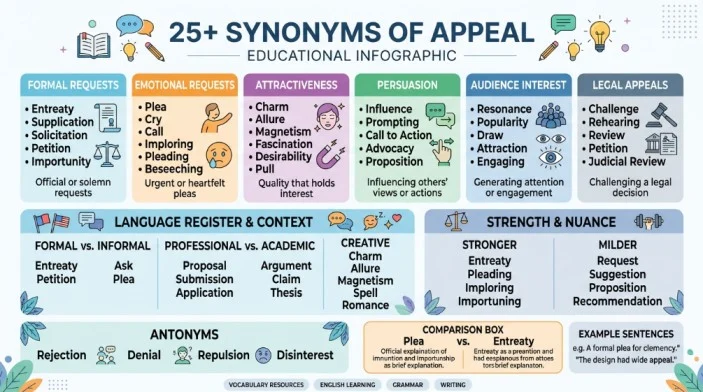
You may use the word appeal several times while writing an email, essay, legal document, advertisement, or social media caption. The problem is that synonym of appeal can mean different things depending on whether you are asking for help, describing attractiveness, or discussing a legal case.
Choosing the right alternative makes your writing more precise. Words such as request, attract, charm, plead, petition, and challenge can all relate to appeal, but they do not mean exactly the same thing. Understanding these differences helps you select a word that matches your intended meaning, audience, tone, and context.
What Are the Best Synonyms of “Appeal”?
The best synonym for appeal depends on its meaning. For a formal request, use petition, plead, or request. For attractiveness, use charm, attract, or allure. In legal writing, challenge or petition may fit, while entreat and beg can express an emotional request. Always choose the alternative that matches the specific sense of appeal.
Meaning, Tone, and Context
Simple Definition
Appeal has several important meanings in English.
As a verb, appeal can mean to make a serious or urgent request, ask someone for support, attract someone’s interest, or formally ask a higher court to review a legal decision.
As a noun, appeal can refer to a request for help or support, attractiveness, or a legal request for a higher court to reconsider a decision.
Because the word has several meanings, there is no single synonym that works in every sentence.
Part of Speech
Appeal can function as both a noun and a verb.
As a noun:
“The organization made an appeal for donations.”
As a verb:
“The organization appealed for donations.”
It can also describe attractiveness:
“The product has strong visual appeal.”
And it has a specific legal meaning:
“The defendant filed an appeal.”
Overall Tone
The tone of appeal depends on its meaning.
When it means a serious request, it can sound formal, persuasive, or emotional.
When it means attractiveness, it is usually neutral or positive.
In legal contexts, it is generally formal and technical.
Formality Level
Appeal is a neutral to formal word.
It works naturally in:
- Academic writing
- Professional communication
- Business writing
- Legal documents
- News reporting
- Everyday conversation
- Advertising
- Creative writing
Some alternatives, such as beg, are much more emotional or informal. Others, such as petition, are more formal and specialized.
Common Uses
Native English speakers commonly use appeal in several ways:
- Appeal for help
- Appeal for support
- Appeal for donations
- Appeal a court decision
- Appeal to voters
- Appeal to customers
- Appeal to emotions
- Appeal to someone’s interests
- Have broad appeal
- Have visual appeal
- Have popular appeal
- Appeal to a particular audience
Word Forms
| Form | Example |
|---|---|
| Noun | The appeal received widespread support. |
| Verb | The organization appealed for assistance. |
| Adjective related form | Appealing |
| Related noun | Appeal |
| Related adjective | Appealing |
The adjective appealing commonly means attractive, interesting, or pleasing.
When and How to Use “Appeal”
Use appeal when you want to describe a serious request, attractiveness, persuasive power, or a formal legal challenge.
Professional
“The company appealed to employees for additional support during the transition.”
Here, appealed means made a serious request.
Academic
“The author appeals to historical evidence to support the argument.”
In this context, appeal to means rely on or make use of something for support.
Workplace
“The manager appealed to the team to meet the revised deadline.”
The word communicates a serious request without necessarily sounding desperate.
Personal
“She appealed to her brother to reconsider his decision.”
This suggests a personal and often emotional request.
“We are appealing to our customers for feedback on the new service.”
This is appropriate when asking a group of people for cooperation or support.
Resume
“Developed campaigns that appealed to younger consumers.”
Here, appealed to means attracted or interested a particular audience.
Social Media
“The new design really appeals to people who prefer simple, modern visuals.”
In this sentence, appeals to means attracts or interests.
Best Synonyms of “Appeal”
No synonym is identical to appeal in every situation. The best alternative depends heavily on which meaning of appeal you intend.
Professional Writing: Request
Request is a strong general alternative when appeal means asking someone for something.
“The organization requested additional funding.”
It is clear, neutral, and suitable for professional emails, reports, and workplace communication.
Academic Writing: Argue
When appeal refers to using evidence or reasoning to support an idea, argue may be more appropriate.
“The researcher argues that early intervention improves outcomes.”
It clearly communicates the presentation of a position or reasoned claim.
Business Communication: Attract
Use attract when appeal to means to interest customers or audiences.
“The campaign attracts younger consumers.”
This is more direct than saying the campaign appeals to consumers.
Casual Conversation: Please
Please can work when appeal to means give someone enjoyment or satisfaction.
“That style really pleases her.”
However, appeal is often more natural when discussing preferences.
Emotional Writing: Plead
Plead is useful when a request is urgent, emotional, or serious.
“He pleaded with his family to give him another chance.”
It is considerably stronger emotionally than request.
Creative Writing: Allure
Allure describes a powerful or mysterious attraction.
“The old house had an undeniable allure.”
It works particularly well in descriptive and literary writing.
Resume Writing: Attract
When describing marketing or communication results, attract is often more direct.
“Created content that attracted thousands of new visitors.”
Workplace Communication: Request
For ordinary workplace requests, request is usually clearer than appeal.
“We requested additional time to complete the project.”
Stronger Meaning: Plead
Use plead when the request involves strong emotion or urgency.
“The family pleaded for additional time.”
Softer Meaning: Ask
Ask is simpler and less formal.
“I asked the manager for another opportunity.”
It works well in everyday conversation.
When Not to Use “Appeal”
Although appeal is versatile, it is not always the clearest choice.
When It Sounds Too General
If you simply mean “ask for something,” request may be clearer.
Less precise:
“We appealed for more information.”
Better:
“We requested more information.”
Why: Request directly communicates the action without suggesting emotional or persuasive pressure.
When It Sounds Too Emotional
If the request is routine, plead or appeal may sound unnecessarily dramatic.
Less effective:
“I pleaded with the manager for a copy of the report.”
Better:
“I requested a copy of the report from the manager.”
When You Mean Attractiveness
Appeal can mean attractiveness, but sometimes attract, charm, or allure gives the sentence more precision.
General:
“The product has broad appeal.”
More specific:
“The product attracts a wide range of customers.”
When Legal Precision Matters
Legal appeal has a specific meaning. Do not casually replace it with complaint or request.
Less precise:
“The defendant made a complaint against the ruling.”
Better:
“The defendant filed an appeal against the ruling.”
When the Word Is Too Vague
In marketing writing, saying something “appeals to people” may not explain why.
Vague:
“The campaign appeals to customers.”
More specific:
“The campaign attracts customers who value affordable, sustainable products.”
The second version tells readers exactly who responds to the campaign.
When a Simpler Word Works Better
In everyday conversation, ask may sound more natural than appeal.
Formal:
“She appealed to her parents for permission.”
Natural conversation:
“She asked her parents for permission.”
Words Commonly Confused With “Appeal”
Request
Difference: A request is an act of asking for something. An appeal often carries a stronger sense of persuasion, urgency, attractiveness, or formal review.
When to Use It: Use request for ordinary professional or personal asks.
Example: “We requested additional information from the client.”
Plead
Difference: Plead usually expresses stronger emotion or urgency than appeal.
When to Use It: Use it when someone is making an emotional or desperate request.
Example: “She pleaded with him to stay.”
Attract
Difference: Attract means draw interest or attention. It does not normally mean make a serious request.
When to Use It: Use it when discussing customers, audiences, attention, or physical attraction.
Example: “The colorful display attracted new customers.”
Petition
Difference: A petition is a formal written request, often directed toward an authority or institution.
When to Use It: Use it for organized or official requests.
Example: “Residents submitted a petition asking the city to improve the park.”
Entreat
Difference: Entreat means ask someone earnestly or urgently. It is more formal and literary than appeal.
When to Use It: Use it in formal, emotional, or literary writing.
Example: “She entreated the committee to reconsider its decision.”
Allure
Difference: Allure describes an attractive quality that draws people in.
When to Use It: Use it when describing beauty, mystery, charm, or fascination.
Example: “The city’s historic architecture has a unique allure.”
Best Synonyms of “Appeal” by Context
| Context | Best Synonym | Why It Works | Example |
|---|---|---|---|
| Formal writing | Petition | Communicates a formal request | The group submitted a petition. |
| Academic writing | Argue | Works for presenting reasoning | The author argues for reform. |
| Professional communication | Request | Clear and neutral | We requested additional details. |
| Business emails | Request | Appropriate for routine asks | We request your confirmation. |
| Resume writing | Attract | Shows audience response | Created campaigns that attracted new customers. |
| Workplace communication | Ask | Natural for ordinary requests | She asked her manager for feedback. |
| Casual conversation | Ask | Simple and conversational | I asked him to reconsider. |
| Everyday speaking | Please | Expresses a desire or preference | That option doesn’t really please me. |
| Creative writing | Allure | Adds descriptive appeal | The forest had a mysterious allure. |
| Storytelling | Charm | Highlights attractive qualities | Her kindness charmed everyone. |
| Emotional writing | Plead | Expresses urgency | He pleaded for another chance. |
| Strong emphasis | Entreat | Suggests earnest appeal | They entreated the judge to reconsider. |
| Mild tone | Request | Neutral and restrained | She requested a meeting. |
| Social media captions | Attract | Works for audience engagement | This design attracts attention. |
| American English | Appeal | Common across formal and casual contexts | The idea appeals to many Americans. |
| British English | Appeal | Also standard and widely understood | The decision was appealed. |
How to Choose the Best Synonym of “Appeal”
The most useful way to choose a synonym is to identify what appeal means in your sentence before replacing it.
If You Mean “Ask”
Choose:
- Ask
- Request
- Plead
- Entreat
- Petition
Use ask for everyday situations, request for neutral or professional communication, and plead or entreat when the request is emotional.
If You Mean “Attract”
Choose:
- Attract
- Charm
- Allure
- Fascinate
- Interest
Use attract for general audience response. Choose allure or charm when you want more expressive language.
If You Mean “Legal Review”
Keep appeal when discussing a formal request for a higher court to review a decision. Depending on the sentence, challenge can sometimes describe the action, but it does not always carry the same specific legal meaning.
If You Mean “Have Attraction”
Use:
- Attractiveness
- Charm
- Appeal
- Allure
- Popularity
For example:
“The restaurant has broad appeal.”
can become:
“The restaurant attracts a broad audience.”
Consider Your Audience
A business audience may prefer request or petition.
An academic audience may respond better to argue or persuade.
A casual audience may prefer ask.
A creative audience may respond better to allure, charm, or fascinate.
Consider Emotional Strength
Ask is mild.
Request is neutral.
Appeal can be serious or persuasive.
Plead is strongly emotional.
Entreat is formal and earnest.
Consider Formality
For formal writing, choose request, petition, entreat, or argue, depending on meaning.
For everyday conversation, ask and attract are usually more natural.
Choose Natural English
Do not replace appeal simply because another word sounds more advanced.
For example:
“I requested my friend to help me.”
This is less natural in American English than:
“I asked my friend to help me.”
The best synonym is the one that communicates the intended meaning naturally.
Real Life Examples of “Appeal”
School
Original:
“The teacher made an appeal for students to participate.”
More natural:
“The teacher asked students to participate.”
Why: Ask is simple and natural for an ordinary classroom request.
College
“The professor’s argument appealed to students who valued practical research.”
Here, appealed to means attracted or interested.
Workplace
“The manager requested additional feedback before making a final decision.”
Here, request is clearer than appeal for a routine workplace action.
Business
“The new advertising campaign appeals to environmentally conscious consumers.”
Here, appeals to describes attraction and interest.
“We are requesting your approval before moving forward with the project.”
This sounds professional and direct.
Resume
“Developed marketing campaigns that attracted new customers and increased online engagement.”
Attracted is more action oriented than appealed to in this resume example.
Conversation
“I asked my brother to give me another chance.”
This is more natural than using the formal word appealed in ordinary conversation.
Storytelling
“The mysterious lights of the distant village held a strange allure.”
Allure adds atmosphere and descriptive power.
Blogging
“Short, practical tutorials appeal to readers who want quick answers.”
This is a natural way to describe audience preferences.
Social Media
“The simple design attracted thousands of viewers within a few days.”
Attracted clearly describes audience response.
25 Best Synonyms of “Appeal”
Because appeal has several meanings, these alternatives belong to different semantic groups. They should not be treated as interchangeable in every sentence.
| Synonym | Simple Meaning | Best Used For | Example Sentence |
|---|---|---|---|
| Request | Ask for something | Professional communication | We requested additional information from the client. |
| Ask | Seek something from someone | Everyday conversation | She asked her teacher for help. |
| Plead | Ask with strong emotion | Emotional situations | He pleaded for another opportunity. |
| Entreat | Ask earnestly | Formal or literary writing | They entreated the committee to reconsider. |
| Petition | Make a formal request | Government or institutions | Residents petitioned the council for improvements. |
| Beg | Ask urgently or desperately | Strong emotional situations | She begged him to reconsider. |
| Urge | Encourage someone strongly | Persuasion and advice | Doctors urged patients to exercise regularly. |
| Persuade | Convince someone | Argument and influence | The speaker persuaded the audience to support the proposal. |
| Attract | Draw interest or attention | Marketing and audiences | The campaign attracted new customers. |
| Interest | Cause curiosity or attention | General communication | The topic interested many students. |
| Charm | Delight or attract | Personal and creative writing | Her friendly personality charmed the guests. |
| Allure | Strongly attract | Creative and descriptive writing | The island’s beauty has a powerful allure. |
| Fascinate | Attract intense interest | Ideas and experiences | Space exploration fascinates young learners. |
| Captivate | Hold someone’s attention | Creative writing and presentations | The storyteller captivated the audience. |
| Entice | Attract by offering something appealing | Marketing | The discount enticed shoppers to visit the store. |
| Tempt | Attract someone toward an action | Offers and choices | The special price tempted customers to buy. |
| Delight | Give great pleasure | Emotional and positive writing | The performance delighted the audience. |
| Please | Give satisfaction | Preferences and reactions | The simple design pleased many users. |
| Engage | Hold interest or attention | Content and communication | The article engaged readers from the beginning. |
| Attractiveness | Quality of being appealing | Appearance and design | The building’s attractiveness increased its popularity. |
| Charm | Attractive quality | People, places, and objects | The town’s historic charm attracts visitors. |
| Fascination | Strong interest or attraction | Ideas and subjects | Her fascination with astronomy began in childhood. |
| Popularity | Degree of being liked | Public interest | The show’s popularity grew quickly. |
| Challenge | Question or contest a decision | Legal or formal contexts | The company challenged the ruling in court. |
| Advocate | Publicly support a cause or position | Professional and public communication | The organization advocates for affordable housing. |
Synonyms of “Appeal” by Usage
Professional vs Personal Synonyms
Professional communication generally benefits from clear and restrained alternatives.
- Use request for ordinary workplace requests.
“We request your approval by Friday.”
- Use petition for formal collective requests.
“Employees petitioned management for improved working conditions.”
- Use advocate when publicly supporting a cause or policy.
“The organization advocates for accessible education.”
Personal communication allows more emotional alternatives.
“I asked my sister for help.”
If the situation is emotionally intense:
“I pleaded with my sister to reconsider.”
Formal vs Conversational Synonyms
- For reports and essays, consider:
- Request
- Petition
- Entreat
- Argue
- Advocate
- For presentations:
- Appeal
- Persuade
- Attract
- Engage
- For emails:
- Request
- Ask
- Appeal
- For casual conversations:
- Ask
- Beg
- Interest
- Attract
- For texting, simple words usually sound best.
“I asked him to come.”
is more natural than:
“I entreated him to come.”
Academic Synonyms
Academic writing requires precision because appeal can refer to several different actions.
Argue
Use argue when presenting a reasoned position.
“The author argues that public transportation should receive greater investment.”
Advocate
Use advocate when supporting a particular idea, policy, or cause.
“Researchers advocate for stronger environmental protections.”
Persuade
Use persuade when describing an attempt to change someone’s opinion.
“The evidence persuaded the committee to reconsider the proposal.”
Significant Attraction
When discussing audience response, appeal itself may remain the best word.
“The theory has broad appeal among researchers.”
The important point is to identify whether appeal means requesting, persuading, or attracting.
Professional and Business Synonyms
Resumes
Use attract, engage, or persuade when describing measurable communication results.
“Created campaigns that attracted new customers.”
Interviews
Use persuade when describing your ability to influence decisions.
“I persuaded several clients to adopt the new service.”
Meetings
Use request or ask for ordinary requests.
“I requested additional resources during the meeting.”
Presentations
Use engage when discussing audience attention.
“The presentation engaged senior executives.”
Performance Reviews
Use advocate when describing support for an initiative.
“Advocated for process improvements across the department.”
Client Communication
Use request when asking for information or action.
“We request confirmation before proceeding.”
Business Emails
Use appeal when making a serious request to a broad audience.
“We appeal to our partners for continued cooperation.”
For ordinary requests, request is usually clearer.
Creative and Literary Synonyms
Creative writing offers more expressive alternatives to appeal.
Allure
Suggests an attractive quality that can be difficult to resist.
“The ancient city had an irresistible allure.”
Charm
Suggests pleasantness and likability.
“The small village charmed every visitor.”
Fascinate
Suggests strong intellectual or emotional interest.
“The strange painting fascinated everyone.”
Captivate
Suggests holding someone’s attention strongly.
“Her story captivated the audience.”
Entice
Suggests drawing someone toward something attractive.
“The scent of fresh bread enticed them into the bakery.”
These words are more vivid than appeal when descriptive language is important.
Slang or Modern Synonyms
There is no single slang synonym that accurately replaces every meaning of appeal.
In casual American English, people may use expressions such as be a big draw, be a hit, or be attractive when talking about popularity or audience interest.
For example:
“The live music is a big draw for customers.”
These expressions are appropriate in casual conversation and marketing content with an informal voice. They should generally be avoided in academic papers, legal documents, and highly formal business writing.
Strongest to Mildest Synonyms
Because appeal has multiple meanings, intensity depends on the specific sense.
Mild
- Ask
- Request
- Interest
- Please
Moderate
- Appeal
- Attract
- Persuade
- Engage
- Charm
Strong
- Urge
- Entice
- Fascinate
- Captivate
- Plead
Very Strong
- Beg
- Entreat
- Compel
These words should not be ranked as perfect substitutes. Beg is stronger than ask because it suggests desperation, while captivate is stronger in a different sense because it describes powerful attraction.
Emotional vs Neutral Synonyms
Emotional Synonyms
These alternatives add feeling, urgency, or expressive force:
- Plead
- Beg
- Entreat
- Charm
- Allure
- Captivate
- Fascinate
Example:
“She pleaded with her parents to let her stay.”
The sentence communicates emotional intensity.
Neutral Synonyms
These alternatives communicate information more objectively:
- Ask
- Request
- Petition
- Attract
- Interest
- Persuade
- Advocate
Example:
“The organization requested additional funding.”
The sentence is direct and professional.
Antonyms of “Appeal”
Because appeal has several meanings, its antonyms depend on the sense being discussed. The following words represent genuine opposites across its major uses, particularly request, attractiveness, interest, and persuasion.
| Antonym | Meaning | Example Sentence |
|---|---|---|
| Reject | Refuse to accept or consider | The committee rejected the proposal. |
| Refuse | Decline to do or accept something | She refused the request. |
| Deny | Say that something is not allowed or true | The court denied the motion. |
| Repel | Drive away or create dislike | The strong odor repelled customers. |
| Deter | Discourage someone from acting | High costs deter some buyers. |
| Disinterest | Lack interest in something | His disinterest was obvious during the discussion. |
| Ignore | Give no attention to something | The company ignored customer complaints. |
| Dislike | Have an unfavorable feeling toward something | Many users dislike the new design. |
| Repulsion | Strong feeling of dislike | The image created a sense of repulsion. |
| Alienate | Cause someone to feel separated or unwelcome | The policy alienated several employees. |
| Discourage | Reduce someone’s willingness or confidence | The setback discouraged the team. |
| Dismiss | Reject something as unimportant or unworthy | The manager dismissed the suggestion. |
| Oppose | Act against an idea or proposal | Several residents opposed the plan. |
| Resist | Refuse to accept or follow something | Employees resisted the proposed changes. |
| Avoid | Stay away from someone or something | Many customers avoid products with unclear labels. |
Comparison: “Appeal” vs Similar Words
Appeal vs Request
Main Difference
A request is an ordinary act of asking for something. An appeal can suggest stronger persuasion, urgency, or a formal request.
Which Is Stronger?
Appeal can sound stronger or more persuasive.
Which Is More Formal?
Both are appropriate in formal writing, but request is often more direct.
When to Use Each
Use request for routine professional communication. Use appeal when the request involves broader support or emotional persuasion.
Examples
Appeal: “The charity appealed for donations.”
Request: “The charity requested additional funding.”
Appeal vs Plead
Main Difference
Plead strongly emphasizes emotion or desperation.
Which Is Stronger?
Plead is usually stronger emotionally.
Which Is More Formal?
Appeal is more neutral and versatile. Entreat is a more formal alternative to plead.
When to Use Each
Use plead for emotional situations and appeal for broader persuasive requests.
Examples
Appeal: “The organization appealed for public support.”
Plead: “The family pleaded for more time.”
Appeal vs Attract
Main Difference
Appeal can mean be interesting or attractive. Attract specifically focuses on drawing attention or interest.
Which Is Stronger?
Neither is automatically stronger.
Which Is More Formal?
Both work in professional and academic writing.
When to Use Each
Use attract when describing measurable audience response.
Examples
Appeal: “The design appeals to younger buyers.”
Attract: “The design attracts younger buyers.”
Appeal vs Persuade
Main Difference
Appeal can involve persuasion, while persuade specifically means successfully influencing someone’s decision or opinion.
Which Is Stronger?
Persuade emphasizes the result of changing someone’s mind.
Which Is More Formal?
Both are suitable for formal writing.
When to Use Each
Use persuade when someone changes their position because of an argument.
Examples
Appeal: “The campaign appealed to voters.”
Persuade: “The campaign persuaded voters to support the proposal.”
Appeal vs Petition
Main Difference
A petition is generally a formal request directed toward an authority or institution.
Which Is Stronger?
Neither is always stronger.
Which Is More Formal?
Petition is more specialized and formal.
When to Use Each
Use petition for official or organized requests.
Examples
Appeal: “Residents appealed for better public transportation.”
Petition: “Residents submitted a petition to the city council.”
Appeal vs Charm
Main Difference
Charm emphasizes pleasant attractiveness. Appeal is broader and can describe general attraction or interest.
Which Is Stronger?
Charm can create a warmer emotional effect.
Which Is More Formal?
Both can work in polished writing.
When to Use Each
Use charm for people, places, designs, or qualities that create pleasure.
Examples
Appeal: “The town has broad appeal.”
Charm: “The town’s historic charm attracts visitors.”
Common Phrases and Expressions with “Appeal”
Appeal for Help
Meaning: Make a serious request for assistance.
Example:
“The family made an appeal for help after the house fire.”
Appeal for Support
Meaning: Ask people to support a person, cause, or idea.
Example:
“The candidate appealed for support before the election.”
Appeal to the Public
Meaning: Ask the general public for assistance, attention, or support.
Example:
“The organization appealed to the public for donations.”
Appeal to Someone
Meaning: Attract or interest a particular person or group.
Example:
“The new product appeals to younger consumers.”
Have Broad Appeal
Meaning: Be attractive or interesting to many different people.
Example:
“The show has broad appeal because it combines humor with drama.”
Visual Appeal
Meaning: The quality of being attractive to look at.
Example:
“The website’s visual appeal improved after the redesign.”
Emotional Appeal
Meaning: An attempt to influence people by connecting with their feelings.
Example:
“The advertisement uses emotional appeal to connect with families.”
File an Appeal
Meaning: Formally ask a higher court or authority to review a decision.
Example:
“The defendant decided to file an appeal.”
Common Mistakes to Avoid
Mistake 1: Treating Every Synonym as Interchangeable
Incorrect:
“The company pleaded additional information from the customer.”
Better:
“The company requested additional information from the customer.”
Why:
Plead means make an emotional or urgent request. Request is the correct neutral word for asking for information.
Mistake 2: Confusing Appeal With Attract
Incorrect:
“The manager appealed several new customers.”
Better:
“The campaign attracted several new customers.”
Why:
When the subject draws customers toward something, attract is the appropriate verb.
Mistake 3: Using Informal Language in Formal Writing
Incorrect:
“The campaign was a big hit with the committee.”
Better:
“The campaign had strong appeal among committee members.”
Why:
The second version is more appropriate for formal reports and professional analysis.
Mistake 4: Making a Routine Request Sound Dramatic
Incorrect:
“I pleaded with the receptionist for a copy of the schedule.”
Better:
“I requested a copy of the schedule from the receptionist.”
Why:
A routine workplace request does not require the emotional force of pleaded.
Mistake 5: Using Appeal When You Mean Legal Challenge
Incorrect:
“The defendant requested the court decision.”
Better:
“The defendant appealed the court decision.”
Why:
Legal appeal specifically communicates a request for review of a decision by a higher court or authority.
Mistake 6: Using the Wrong Emotional Tone
Incorrect:
“The organization begged customers to complete the survey.”
Better:
“The organization encouraged customers to complete the survey.”
Why:
Beg suggests desperation and may be unnecessarily dramatic for a routine marketing request.
Mistake 7: Using Slang in Academic Writing
Incorrect:
“The campaign was a big draw for students.”
Better:
“The campaign attracted considerable interest among students.”
Why:
The second version is more precise and appropriate for academic analysis.
Frequently Asked Questions
What is the best synonym of “appeal”?
The best synonym of appeal depends on its meaning. Use request for an ordinary ask, plead for an emotional request, attract for audience interest, allure for strong attraction, and petition for a formal request.
What are the best formal synonyms of “appeal”?
Formal synonyms include request, petition, entreat, advocate, and argue, depending on context. Request works for professional communication, while petition is better for formal or organized requests.
What are common informal synonyms of “appeal”?
Common informal alternatives include ask, beg, attract, and interest, depending on meaning. Ask is the most natural everyday alternative when appeal means requesting something.
What is another word for “appeal” in professional writing?
Request is usually the clearest professional synonym when appeal means asking for something. When discussing customer response, attract or engage may be more precise.
What is the difference between “appeal” and “request”?
A request is a direct ask for something, while an appeal can involve persuasion, urgency, public support, attractiveness, or legal review. The correct choice depends on the intended meaning.
What is the opposite of “appeal”?
There is no single opposite for every meaning of appeal. Depending on context, opposites include reject, refuse, repel, ignore, discourage, oppose, and dismiss.
Conclusion
The word appeal has several distinct meanings, so choosing the right synonym of appeal requires attention to context. For requests, ask, request, plead, and petition can work. For attraction, attract, charm, allure, and captivate offer different levels of emphasis. In professional writing, a precise alternative is often better than simply replacing the word with something more complicated.
No synonym works perfectly in every sentence. Consider your intended meaning, audience, emotional strength, formality, and writing purpose before choosing an alternative. A useful vocabulary habit is to identify the exact meaning you want first, then select the simplest word that expresses it accurately.
Read More Related Articles:
50+ Synonyms of Change | Meanings, Uses, Examples, and …
50+ Synonyms of Infinitive | Meanings, Uses, Examples, and …











1 thought on “25+ Synonyms of Appeal | Meanings, Uses, Examples, and Best Alternatives”