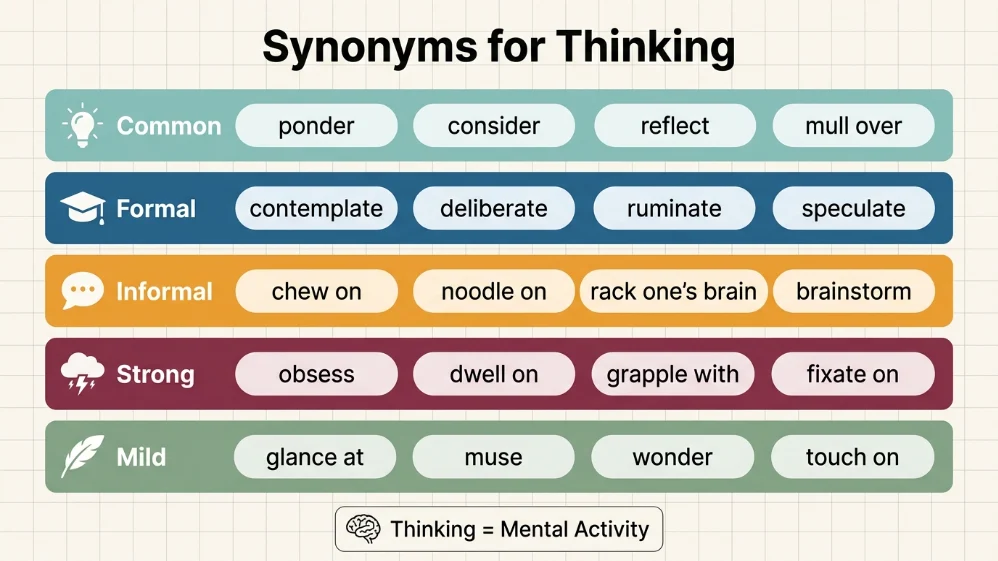
If you are looking for synonyms for thinking, you have dozens of options. The best choice depends on what kind of thinking you mean and how formal you need to be. For most situations, common alternatives include reasoning, reflection, contemplation, and analysis.
But a word that works in an academic essay may sound out of place in a casual conversation or a brainstorming session.
This article explains the meaning of thinking, gives you accurate synonyms across different tones and intensities, and helps you pick the right word every time.
Best Synonyms for Thinking
The best synonyms for thinking are reasoning, reflection, contemplation, analysis, deliberation, and cognition. The right choice depends on tone, context, and intensity. For formal writing, use cognition or rationalization. For casual conversation, try brainstorming or pondering. For deep, focused thought, use contemplation or rumination.
What Does Thinking Mean?
Thinking means using your mind to consider something, form ideas, solve problems, or make decisions. It includes everything from quick guesses to long, careful reasoning.
Part of speech: Noun (also a verb, but this article focuses on the noun form)
Simple definition: The process of using your mind to understand, judge, or decide something.
Example sentences:
- She sat in silence, deep in thinking about her next move.
- Clear thinking is essential for solving complex problems.
Core Meaning of Thinking
At its heart, thinking is mental activity. It is what your brain does when you are not asleep or reacting on pure instinct. Thinking can be fast and automatic, like recognizing a friend’s face. It can also be slow and effortful, like solving a math problem or planning a vacation. Thinking involves holding ideas in your mind, comparing them, changing them, and drawing conclusions. Every decision, every judgment, every moment of understanding involves thinking. The word is broad, which is why so many synonyms exist. Each synonym highlights a different kind of mental work.
Grammar and Usage Notes
Thinking is an uncountable noun in most uses. You do not usually say “thinkings” unless you mean different kinds or instances of thought, which is rare.
Common sentence patterns:
- Subject + verb + thinking: Critical thinking requires practice.
- Preposition + thinking: He is known for his clear thinking.
- Adjective + thinking: Quick thinking saved the day.
Common phrases:
- critical thinking
- logical thinking
- wishful thinking
- quick thinking
- independent thinking
- clear thinking
- abstract thinking
When thinking sounds natural: Use it for general mental activity in everyday speech, psychology, education, and self-help contexts. It is neutral and widely understood.
When a synonym may work better: If you need to specify the type of mental process (like analyzing, daydreaming, or pondering), switch to a more precise synonym.
Best Synonyms for Thinking
| Synonym | Meaning | Tone | Best Use Case | Example Sentence |
|---|---|---|---|---|
| Reasoning | Logical thinking to reach conclusions | Neutral to formal | Arguments, problem-solving | Her reasoning was sound, so everyone agreed. |
| Reflection | Serious, careful thinking about something | Thoughtful, calm | Journaling, self-help, education | After long reflection, he changed his mind. |
| Contemplation | Deep, focused thinking, often with a spiritual or artistic quality | Calm, elevated | Philosophy, art, meditation | The monk sat in quiet contemplation for hours. |
| Analysis | Breaking something down to understand its parts | Formal, technical | Business, science, data | A careful analysis of the data revealed the mistake. |
| Deliberation | Slow, careful thinking before making a decision | Formal | Law, business, ethics | After hours of deliberation, the jury reached a verdict. |
| Cognition | The mental process of knowing and understanding | Very formal, scientific | Psychology, neuroscience | The study focused on cognition in older adults. |
| Rumination | Deep, repeated thinking, often about something distressing | Neutral to negative | Psychology, personal growth | His rumination on past failures kept him stuck. |
Common Synonyms for Thinking
These everyday words work in most situations. They are not too formal, not too slangy, and easy to understand.
Reasoning
- Meaning: Using logic to think through a problem.
- Best context: Arguments, decision-making, teaching.
- Example: The child showed impressive reasoning when he explained his answer.
Reflection
- Meaning: Serious thought, especially about your own experiences or actions.
- Best context: Personal growth, education, journaling.
- Example: Her reflection on the mistake helped her do better next time.
Contemplation
- Meaning: Deep, quiet thinking, often without a specific goal.
- Best context: Meditation, art appreciation, philosophy.
- Example: He spent the afternoon in contemplation, just watching the river.
Analysis
- Meaning: Thinking that breaks a topic into smaller parts to understand it.
- Best context: Business, science, school assignments.
- Example: The report required careful analysis of the sales numbers.
Deliberation
- Meaning: Slow, careful thinking before making a choice.
- Best context: Legal decisions, hiring, major life choices.
- Example: The committee’s deliberation lasted three hours before they voted.
Formal Synonyms for Thinking
Use these in academic papers, business reports, legal documents, and professional communication.
Cognition
The scientific term for all mental processes related to knowing, including thinking, remembering, and problem-solving. The researcher specialized in human cognition and decision-making.
Rationalization
The process of using logic and reason to explain or justify something. In psychology, it can have a negative meaning (making excuses), but in formal writing, it is neutral. His rationalization of the complex problem impressed the panel.
Intellection
A rare, very formal word for the act of thinking or reasoning. Best used in philosophical or very high-level academic writing. The professor valued intellection above mere memorization.
Reconsideration
Thinking again about a decision or opinion, usually in a formal or legal context. The judge ordered a reconsideration of the earlier ruling.
Conceptualization
Forming an idea or concept in your mind. Common in academic and business writing about planning or design. The team’s conceptualization of the new product took six months.
Critical thinking
The disciplined process of actively analyzing and evaluating information. Widely used in education and professional development. The course was designed to improve students’ critical thinking skills.
Informal Synonyms for Thinking
These work in conversation, social media posts, friendly writing, and personal messages. Avoid them in professional or academic work.
Brainstorming
Generating many ideas quickly without judging them. Common in creative work and group settings. We did some brainstorming over coffee and came up with a dozen ideas.
Pondering
Thinking about something slowly and carefully, often with a sense of curiosity. Slightly old-fashioned but friendly. She sat on the porch, pondering what to do next.
Mulling
Short for “mulling over.” Means thinking about something without rushing. Very conversational. I’ve been mulling your suggestion all week.
Figuring out
Thinking through a problem to find a solution. Very common in everyday speech. He’s still figuring out how to fix the sink.
Chewing on
A casual, slightly playful way to say you are thinking about something. Give me a day to chew on your offer before I answer.
Wondering
Thinking with curiosity or doubt. Often used for questions rather than conclusions. I was wondering if you wanted to see a movie.
Strong Synonyms for Thinking
These words carry more emotional weight, intensity, or emphasis on deep mental effort.
Rumination
Repeated, often obsessive thinking about the same topic. Usually negative or heavy. His rumination on the argument kept him awake all night.
Brooding
Deep, gloomy thinking, often about something upsetting. Strongly emotional. She sat brooding in the corner, replaying every harsh word.
Scrutiny
Very close, critical thinking that looks for flaws or details. Often used in professional or journalistic contexts. The contract required careful scrutiny before anyone signed.
Penetration
In formal contexts, this means deep, sharp thinking that gets to the heart of a problem. Rare but powerful. His mental penetration of the issue surprised even the experts.
Rigor
Extreme thoroughness and precision in thinking. Often used in academic and scientific writing. The theory lacked the rigor needed for publication.
Mild Synonyms for Thinking
These words soften the idea of thinking. Use them when the mental activity is light, casual, or not very serious.
Considering
Giving a topic some attention without deep commitment. I am considering your proposal, but I have not decided yet.
Regarding
Thinking about something in a basic, non‑intense way. Often used in phrases like “as regards” or “regarding your question.” Regarding your email, I am thinking it over.
Noticing
Very light mental attention. Almost perception rather than deep thinking. She noticed the change but did not think much about it.
Daydreaming
Thinking that wanders without purpose or effort. Pleasant and mild. He was daydreaming about the beach instead of working.
Imagining
Thinking that creates mental pictures or scenarios. Creative and mild. She sat imagining what her life would be like in five years.
Synonyms for Thinking by Context
Everyday Conversation
Use figuring out, pondering, wondering, or brainstorming. These words are clear and friendly. I was just wondering what you thought about the new schedule.
Professional Writing (Business or Workplace)
Use analysis, deliberation, reasoning, or critical thinking. Avoid emotional or vague words. The team’s analysis of the market led to a solid strategy.
Academic Writing
Use cognition, reasoning, reflection, conceptualization, or critical thinking. Define your terms clearly. This paper examines how reflection influences learning outcomes.
Creative Writing
Choose based on the character’s mental state. Contemplation works for peaceful characters. Rumination or brooding work for troubled ones. Daydreaming works for dreamers. Marcus stared out the window, lost in quiet contemplation of the rain.
Emotional Expression
For sadness or anxiety, use rumination or brooding. For calm self‑examination, use reflection. For curiosity, use wondering. The rumination after the breakup was exhausting, but necessary for healing.
Personal Communication
Use thinking itself for most situations. Switch to mulling, pondering, or chewing on for a friendly, conversational tone. I have been mulling your advice, and I think you were right.
Another Word for Thinking in a Sentence
Here are 15 natural example sentences using different synonyms for thinking.
- Her reasoning was so clear that everyone changed their minds.
- After long reflection, he apologized for his harsh words.
- The artist stared at the canvas in silent contemplation.
- A careful analysis of the data showed a different trend.
- The jury’s deliberation lasted until late in the evening.
- The book explores human cognition across different age groups.
- His rumination on the past prevented him from enjoying the present.
- We spent an hour brainstorming solutions to the budget problem.
- She sat on the bench, pondering what to do next.
- I need a day to chew on your proposal before I answer.
- The contract required intense scrutiny before signing.
- He was brooding in the corner after the argument.
- Daydreaming about the vacation made the workday go faster.
- The professor valued intellectual rigor above all else.
- Regarding your question, I have not made a decision yet.
Thinking Synonyms Compared
Some synonyms for thinking are very close in meaning but have small, important differences.
| Synonym | Primary Difference | When to Choose This |
|---|---|---|
| Reflection vs. Contemplation | Reflection often looks back at past experiences; contemplation can be timeless or future‑focused. | Choose reflection for learning from the past; contemplation for deep focus on any topic. |
| Reasoning vs. Analysis | Reasoning draws conclusions; analysis breaks things down. | Choose reasoning for logic and arguments; analysis for understanding structure. |
| Rumination vs. Brooding | Rumination can be neutral or negative; brooding is always dark and emotional. | Choose rumination for psychology or personal growth writing; brooding for creative or emotional contexts. |
| Cognition vs. Thinking | Cognition is broader and more scientific; thinking is everyday language. | Choose cognition for research or formal writing; thinking for general use. |
| Deliberation vs. Reflection | Deliberation leads to a decision; reflection does not require action. | Choose deliberation for legal or business choices; reflection for learning or growth. |
Words Similar to Thinking
These words belong to the same semantic field as thinking but are not always exact synonyms. Use them carefully.
Perception – The process of becoming aware of something through the senses. Related to thinking but more about input than mental processing. His perception of the problem was different from hers.
Intuition – Knowing something without conscious reasoning. Often seen as the opposite of logical thinking. She trusted her intuition more than the data.
Memory – The ability to store and recall information. A related mental process but not the same as thinking. The memory of the event came back years later.
Metacognition – Thinking about thinking. A specific type of higher‑level mental activity. Metacognition helps students understand how they learn best.
Judgment – The ability to make considered decisions or form opinions. The result of thinking, not the process itself. His judgment was sound because he had thought carefully.
Speculation – Thinking based on incomplete information, often involving guessing. The article was full of speculation rather than facts.
Antonyms of Thinking
| Antonym | Meaning | Example Sentence |
|---|---|---|
| Instinct | Inborn behavior not based on thought | The bird acted on instinct, not thinking. |
| Impulsiveness | Acting without prior thought | His impulsiveness got him into trouble. |
| Thoughtlessness | Lack of careful thinking | The thoughtlessness of the comment hurt her feelings. |
| Ignorance | Lack of knowledge or awareness | His ignorance of the topic was obvious. |
| Mindlessness | Acting without using the mind | The mindlessness of the task bored everyone. |
| Reaction | Automatic response without deliberation | Her reaction was immediate and unthinking. |
How to Choose the Right Synonym for Thinking
Picking the best word is not hard if you ask yourself a few questions.
Match the context. A psychology paper needs “cognition.” A business meeting needs “analysis.” A journal entry needs “reflection.”
Match the tone. Formal writing avoids “pondering.” Informal writing avoids “intellection.” Keep your tone consistent.
Check the intensity. Do you need a strong word like “rumination” or a mild word like “considering”? Overstating sounds dramatic. Understating sounds vague.
Think about the reader. A stressed friend may not want “brooding.” A boss wants “analysis,” not “chewing on.”
Check whether the synonym is exact or only related. “Intuition” is related but not exact. Use it only when you mean unconscious knowing.
Keep the sentence natural. Read the sentence aloud. If the synonym sounds strange or forced, pick a different one.
When in doubt, use “thinking.” It is clear, accurate, and understood by everyone. Only switch to a synonym when you need a specific tone, intensity, or meaning.
Common Mistakes When Using Synonyms for Thinking
Choosing a word with the wrong tone. Using “rumination” in a light conversation sounds overly dramatic. Using “brainstorming” in a legal document sounds unprofessional.
Using a synonym that is too strong. Calling casual wondering “brooding” is misleading. It hurts your credibility.
Using a formal word in casual writing. “Cognition” in a text message sounds strange. Just say “thinking.”
Using a casual word in professional writing. “Chewing on” in a business report lowers the quality. Use “considering” or “analyzing.”
Replacing “thinking” without checking meaning. “Perception” is not the same as thinking. “Memory” is not thinking. Always verify.
Treating related words as exact synonyms. “Intuition” often means the opposite of careful reasoning. Do not use it to describe logical analysis.
Making the sentence sound unnatural. “Her intellection was profound” is weird in most contexts. Just say “her thinking was profound.”
Quick Synonym List for Thinking
Common synonyms
- reasoning
- reflection
- contemplation
- analysis
- deliberation
Formal synonyms
- cognition
- rationalization
- intellection
- conceptualization
- critical thinking
Informal synonyms
- brainstorming
- pondering
- mulling
- figuring out
- chewing on
Strong synonyms
- rumination
- brooding
- scrutiny
- rigor
Mild synonyms
- considering
- regarding
- noticing
- daydreaming
Related words (not exact)
- perception
- intuition
- memory
- metacognition
- judgment
FAQs
What is the best synonym for thinking?
The best synonym depends on your needs. For general use, reasoning or reflection work well. For scientific writing, use cognition. For deep focus, use contemplation.
What is another word for thinking in a formal document?
Use cognition, analysis, deliberation, or rationalization. These terms are precise and professional.
What is an informal synonym for thinking?
Pondering, mulling, brainstorming, and figuring out are all casual alternatives suitable for conversation.
What is a stronger word for thinking?
Rumination, brooding, scrutiny, and rigor are much stronger. Use them when the mental effort is intense or obsessive.
What is a milder word for thinking?
Considering, noticing, daydreaming, and wondering are milder. They suggest light mental activity without deep effort.
What words are similar to thinking but not exact synonyms?
Perception, intuition, memory, metacognition, and judgment are related. They involve mental activity but are not direct replacements for thinking.
What is the opposite of thinking?
The most direct antonyms are instinct, impulsiveness, thoughtlessness, and mindlessness.
How do I choose the right synonym for thinking?
Match the word to your context, tone, and intensity. Ask whether you need formal or informal language. Read the sentence aloud to check naturalness. When unsure, stick with “thinking” itself.
Conclusion
There is no single perfect synonym for thinking. The right word depends on what kind of mental activity you mean, who you are writing for, and how strong you want the message to be. For everyday use, reasoning and reflection are solid choices. For formal writing, cognition and analysis work best. For deep or troubled thought, rumination or brooding fit the mood. And for light mental activity, pondering or considering get the job done without overstating things. Keep your reader in mind, match your tone, and choose the word that fits naturally. When you do that, your writing will be clearer and more precise.
Read More Related Articles:
Synonyms for Seen | Meaning, Examples, and Better Word Choices
Synonyms for Modern | Meaning, Examples, and Better Word …










2 thoughts on “Synonyms for Thinking | Meaning, Examples, and Better Word Choices”