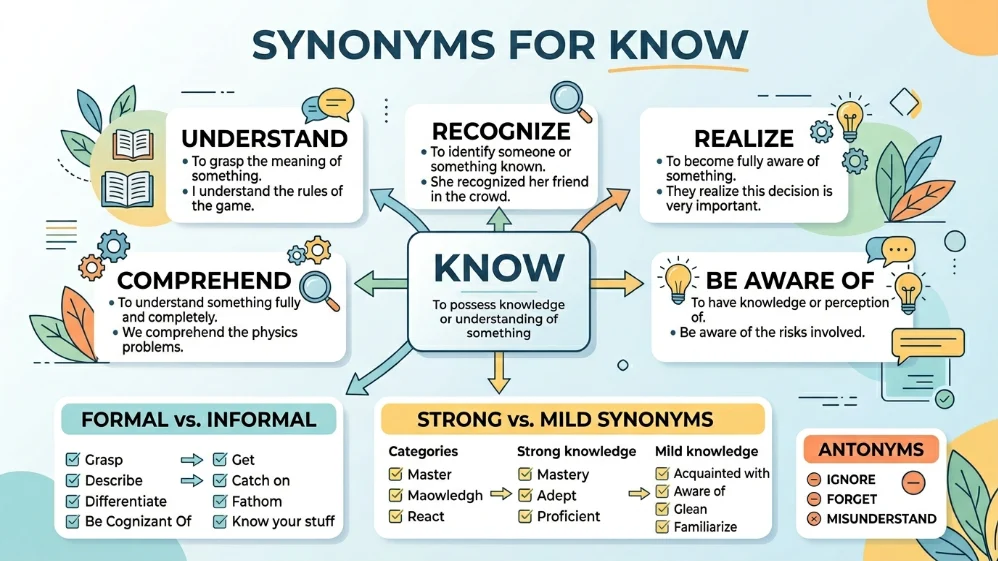
If you’re searching for synonyms for know, the best alternatives include understand, recognize, realize, comprehend, and be aware of. The right choice depends on what kind of knowing you mean. Sometimes you know a fact. Other times you know a person, understand a concept, or recognize something from experience. Because the word know has several meanings, no single synonym works in every situation.
This article explains the meaning of know, its best synonyms, differences in tone and intensity, example sentences, antonyms, and practical tips for choosing the right word.
Best Synonyms for Know
The best synonyms for know are understand, comprehend, recognize, realize, and grasp. For knowing a person, use be acquainted with. For knowing a fact, use be aware of. sudden understanding, use realize or figure out. The right choice depends on tone, context, and how deep the knowledge goes.
What Does Know Mean?
To know means to have information, understanding, or familiarity with something or someone. It can mean knowing a fact (I know the answer), knowing a person (I know my neighbor), or knowing a skill (I know how to swim).
Part of speech: Verb
Simple definition: To have information or understanding in your mind.
Example sentences:
- I know the way to the station.
- She knows Spanish fluently.
Core Meaning of Know
At its heart, knowing is about having something in your mind that matches reality. When you know a fact, you can state it correctly. When you know a person, you can predict how they might act. you know a skill, your body remembers what to do. Know is one of the most common verbs in English because it covers so much ground. But that breadth can be a problem. Sometimes you need a more specific word. You do not just know an answer. understand why it is correct.do not just know someone. You are deeply acquainted with them. The best synonym for know is the word that makes your meaning clearer.
Grammar and Usage Notes
Know is an irregular verb: know / knew / known.
Common sentence patterns:
- Know + noun: I know the rules.
- Know + that clause: She knows that she is late.
- Know + question word: He knows where we are going.
- Know how + infinitive: They know how to cook.
Common phrases:
- know for a fact
- know by heart
- know inside and out
- let me know
- as far as I know
- know better than
When know sounds natural: Almost always. It is the default word for having information. Use it when you do not need a more specific verb.
When a synonym may work better: Use understand when you grasp why or how. Use recognize when you identify something from past experience. Use realize when understanding comes suddenly.
Best Synonyms for Know
| Synonym | Meaning | Tone | Best Use Case | Example Sentence |
|---|---|---|---|---|
| Understand | Grasp the meaning or reason | Neutral | Explaining concepts, following instructions | I finally understand why she was upset. |
| Comprehend | Fully understand something complex | Formal | Academic, technical, or difficult topics | The students could not comprehend the physics equation. |
| Recognize | Identify from past experience | Neutral | Faces, places, patterns, achievements | I recognized her voice immediately. |
| Realize | Become aware of something suddenly | Neutral | Moments of clarity, sudden understanding | He realized he had left his keys at home. |
| Grasp | Understand something firmly | Neutral to slightly strong | Abstract concepts, difficult ideas | She quickly grasped the main argument. |
| Perceive | Become aware of through senses or intuition | Formal to literary | Subtle awareness, observations | He perceived a change in her tone. |
| Discern | Recognize or understand something subtle | Formal | Distinguishing details, careful observation | It was hard to discern his true motives. |
| Be aware of | Have knowledge of a fact or situation | Neutral to formal | Safety, risks, current events | Are you aware of the new policy? |
Common Synonyms for Know
These everyday words work in most situations. They are not too formal or too casual.
Understand
- Meaning: Grasp the meaning or reason behind something.
- Best context: Explaining concepts, following instructions, empathy.
- Example: Do you understand the homework assignment?
Realize
- Meaning: Become aware of something, often suddenly.
- Best context: Moments of discovery, correcting mistakes.
- Example: I suddenly realized I had met him before.
Recognize
- Meaning: Identify someone or something from past experience.
- Best context: Faces, places, voices, achievements.
- Example: She did not recognize me with my new haircut.
Tell
- Meaning: Know for sure or distinguish between things.
- Best context: Telling the difference, knowing with certainty.
- Example: Can you tell which one is real?
See
- Meaning: Understand or realize (informal).
- Best context: Casual conversation, sudden understanding.
- Example: Oh, I see what you mean now.
Formal Synonyms for Know
Use these in academic papers, business reports, legal documents, and professional communication.
Comprehend
Means to understand something fully, often something complex or difficult. Stronger and more formal than understand. The committee failed to comprehend the long-term consequences of their decision.
Perceive
Means to become aware of something through the senses or intuition. Often used for subtle or non-obvious things. She perceived a note of hesitation in his voice.
Discern
Means to recognize or understand something that is not obvious. Requires careful attention. It was difficult to discern the pattern among the noisy data.
Be acquainted with
Means to know someone personally or to have knowledge of something. Polite and slightly formal. Are you acquainted with the new regulations?
Be cognizant of
Very formal. Means to be aware of something, especially a responsibility or risk. All employees must be cognizant of the safety protocols.
Fathom
Formal and often used in negative constructions. Means to understand something deep or mysterious. I cannot fathom why he would lie about such a small thing.
Informal Synonyms for Know
These work in conversation, social media, friendly writing, and personal messages.
Get
Very casual. Means to understand or figure out. I do not get why she said that.
Figure out
Means to solve or understand after thinking. It took me a minute, but I figured out the answer.
Have down
Means to know something perfectly, often a skill. Do not worry about the presentation. I have it down.
Be clued in
Means to be informed or aware of something. Are you clued in on the party plans?
Know inside out
Means to know something or someone extremely well. She knows the neighborhood inside out.
Be in the know
Means to have special or secret information. Ask Jen. She is in the know about the merger.
Strong Synonyms for Know
These words carry more certainty, depth, or emphasis. Use them when you want to stress how well you know something.
Understand fully
Stronger than plain understand. Emphasizes complete comprehension. After years of study, I fully understand the theory.
Comprehend completely
Very strong and formal. Leaves no room for doubt. The scientist completely comprehended the implications of the discovery.
Grasp
Implies firm, secure understanding, often of something difficult. She grasped the concept faster than anyone else in the class.
Master
Means to know something so well that you can use it perfectly. Stronger than know. He has mastered three programming languages.
Be certain of
Emphasizes confidence and lack of doubt. Are you certain of the meeting time?
Know for a fact
Emphasizes that the knowledge is backed by evidence. I know for a fact that he was there that night.
Mild Synonyms for Know
These words soften the claim of knowledge. Use them when you are not completely sure or when you want to be humble.
Be aware of
Neutral to mild. Suggests knowledge without deep understanding. I am aware of the situation, but I do not know all the details.
Have heard of
Very mild. Suggests only passing familiarity. I have heard of that author, but I have never read her books.
Be familiar with
Suggests some knowledge but not expertise. I am familiar with the basic ideas, but I am no expert.
Have a sense of
Suggests intuitive or approximate knowledge. I have a sense that something is wrong, but I cannot say what.
Gather
Means to understand or conclude from information, often indirectly. I gather from your tone that you are not happy.
Assume
Means to take for granted without proof. Much weaker than know. I assume the meeting is still on, but I should check.
Synonyms for Know by Context
Everyday Conversation
Use understand, realize, recognize, or see. Keep it simple. Do you know what time the store closes? → Do you happen to know…? (more polite) Or use Do you have any idea…?
Professional Writing
Use be aware of, be familiar with, understand, or recognize. Avoid casual words like get or figure out. All staff should be aware of the updated procedures.
Academic Writing
Use comprehend, perceive, discern, or be cognizant of. Stay formal and precise. The study aims to discern patterns in consumer behavior.
Creative Writing
Use perceive, discern, realize, or sense for internal awareness. Use recognize for identifying people or things. He perceived a threat in the stranger’s silence.
Giving Instructions
Use understand, grasp, or be clear on. Make sure you understand each step before moving on.
Expressing Certainty
Use know for a fact, be certain of, or be sure of. I am certain of the date because I wrote it down.
Expressing Uncertainty
Use gather, assume, have a sense of, or be aware of (without full details). I gather that you are not interested.
Another Word for Know in a Sentence
Here are 15 natural example sentences using different synonyms for know.
- Do you understand the instructions for the test?
- She suddenly realized she had locked her keys in the car.
- I recognized my old teacher from across the room.
- He quickly grasped the main idea of the lecture.
- Are you aware of the changes to the schedule?
- The students could not comprehend the complex formula.
- She perceived a hint of sadness in his smile.
- It was hard to discern the truth from all the lies.
- I do not get why he would say something so rude.
- Give me a minute, and I will figure out the answer.
- She has mastered the art of public speaking.
- I know for a fact that the store closes at 8 PM.
- I gather from your silence that you disagree.
- Are you familiar with the new software update?
- I assume the meeting is still happening, but let me confirm.
Know Synonyms Compared
Some synonyms for know are very close but have small, important differences.
| Synonym | Primary Difference | When to Choose This |
|---|---|---|
| Know vs. Understand | Know is facts; understand is reasons. | Choose understand when explaining why, not just what. |
| Know vs. Realize | Realize implies sudden awareness. | Choose realize for “aha moments” of discovery. |
| Know vs. Recognize | Recognize means identifying from past experience. | Choose recognize for faces, places, and patterns. |
| Understand vs. Comprehend | Comprehend is stronger and more formal. | Choose comprehend for complex, difficult material. |
| Know vs. Be aware of | Be aware of is more passive and often milder. | Choose be aware of for risks, facts, or situations. |
| Perceive vs. Discern | Perceive uses senses; discern uses careful thinking. | Choose perceive for noticing; discern for distinguishing. |
Words Similar to Know
These words belong to the same semantic field but are not always exact synonyms. Use them carefully.
Learn
Related because learning leads to knowing. But learn is about gaining knowledge, not having it. I learned French in school. (Not the same as I know French.)
Understand
Very close but not identical. You can know a fact without understanding why it is true. *I know that 2+2=4, and I also understand why.*
Remember
Related to knowing from past experience. But remembering is about bringing knowledge back, not having it ready. I remember his name. (Means you know it and are recalling it.)
Believe
Much weaker than know. Belief does not require proof. I believe he is honest. (Different from I know he is honest.)
Guess
Means to give an answer without certainty. Opposite of knowing. I do not know the answer, but I will guess.
Antonyms of Know
| Antonym | Meaning | Example Sentence |
|---|---|---|
| Ignore | Deliberately pay no attention | He chose to ignore the warning signs. |
| Forget | Fail to remember | I forgot her name five seconds after she told me. |
| Misunderstand | Understand incorrectly | She misunderstood the instructions and did it wrong. |
| Overlook | Fail to notice | He overlooked a key detail in the report. |
| Doubt | Feel uncertain about | I doubt that his story is true. |
| Be unaware of | Lack knowledge of something | She was unaware of the danger. |
| Guess | Estimate without knowledge | Do not guess the answer. Just say you do not know. |
How to Choose the Right Synonym for Know
Picking the best word is not hard if you ask yourself a few questions.
Match the context. A legal document needs “be cognizant of.” A text message needs “get.” A novel needs “perceive” or “discern.”
Match the tone. Formal writing avoids “figure out.” Informal writing avoids “comprehend.” Keep your tone consistent.
Check the intensity. Do you need a strong word like “master” or a mild word like “have heard of”? Overstating sounds arrogant. Understating sounds unsure.
Think about the reader. A boss may expect “be aware of.” A friend may expect “know” or “get.” Know your audience.
Check whether the synonym is exact or only related. “Believe” is not the same as know. Do not use them interchangeably.
Keep the sentence natural. Read the sentence aloud. If the synonym sounds strange or forced, pick a different one.
When in doubt, use “know.” It is clear, common, and understood by everyone. Only switch to a synonym when you need a specific tone, intensity, or meaning.
Common Mistakes When Using Synonyms for Know
Choosing a word with the wrong tone. Using “be cognizant of” in a casual conversation sounds ridiculous. Using “get” in an academic paper sounds childish.
Using a synonym that is too strong. “I have mastered Spanish” means you are fluent. Do not say it if you only know a few words.
Using a formal word in casual writing. “I comprehend the joke” is weird. Just say “I get the joke.”
Using a casual word in professional writing. “I figure out the report” is too informal for a business email.
Replacing “know” without checking meaning. “Believe” is not the same as know. “Guess” is the opposite. Be careful.
Treating related words as exact synonyms. “Learn” is gaining knowledge. “Know” is having it. Do not mix them up.
Making the sentence sound unnatural. “I discern the answer” is overly formal for a simple question. Use simpler words for simple situations.
Quick Synonym List for Know
Common synonyms
- understand
- realize
- recognize
- see
- tell
Formal synonyms
- comprehend
- perceive
- discern
- be acquainted with
- be cognizant of
Informal synonyms
- get
- figure out
- have down
- be clued in
- be in the know
Strong synonyms
- grasp
- master
- know for a fact
- be certain of
- understand fully
Mild synonyms
- be aware of
- have heard of
- be familiar with
- gather
- assume
Related words (not exact)
- learn
- remember
- believe
- guess
- forget (antonym)
FAQs
What is another word for know in a formal document?
Use comprehend, perceive, discern, be acquainted with, or be cognizant of. These are precise and professionally accepted.
What is an informal synonym for know?
Get, figure out, and be in the know are all casual alternatives. “Get” is the most common in conversation.
What is a stronger word for know?
Master, know for a fact, grasp, and be certain of are stronger. They emphasize confidence or deep understanding.
What is a milder word for know?
Be aware of, have heard of, be familiar with, and gather are milder. They suggest less certainty or less depth.
What words are similar to know but not exact synonyms?
Learn (gaining knowledge), remember (recalling knowledge), believe (accepting without proof), and guess (estimating without knowledge) are related but not exact.
What is the opposite of know?
The most direct antonyms are ignore, forget, misunderstand, overlook, and doubt.
How do I choose the right synonym for know?
Match the word to your context, tone, and intensity. Ask whether you need formal or informal language. Read the sentence aloud. When unsure, stick with “know” itself.
What is the difference between “know” and “understand”?
You can know a fact without understanding why it is true. Understanding goes deeper into reasons and connections.
Can “know” be used for people as well as facts?
Yes. “I know her” means you are acquainted with her. For deeper personal knowledge, use “know well” or “be close to.”
Conclusion
There is no single perfect synonym for know because the word covers so much ground. For everyday use, understand and realize are your best bets. formal writing, comprehend and perceive work well. For casual conversation, get and figure out sound natural. And when you need to be precise about how well you know something, choose between master (deep knowledge), be aware of (mild knowledge), and know for a fact (certain knowledge). Keep your reader in mind, match your tone, and choose the word that fits naturally. When you do that, you will know exactly what to say.
Read More Related Articles:
Synonyms for Review | Meaning, Examples, and Better Word …
Synonyms for Pros and Cons | Meaning, Examples, and Better …