When writing an email, essay, caption, resume, blog post, or school assignment, it is easy to use the same word repeatedly. If you want to describe someone who spends time examining their own thoughts, feelings, motives, or experiences, the synonyms of introspective can help you express that idea with greater precision.
The word introspective has a thoughtful, inward looking quality, but it does not fit every situation equally well. Words such as reflective, self examining, contemplative, and self analytical can communicate related ideas while changing the level of formality, emotional depth, or emphasis.
Choosing the right alternative is more than replacing one word with another. The best synonym should match your audience, purpose, tone, and intended meaning.
What Are the Best Synonyms of “Introspective”?
Featured Snippet Answer:
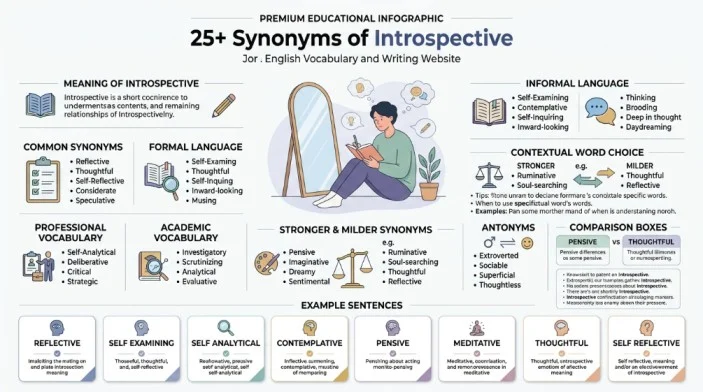
Introspective describes someone who examines their own thoughts, feelings, motives, or experiences. The best alternatives include reflective for general writing, self examining for direct self analysis, contemplative for thoughtful writing, self analytical for analytical contexts, and pensive for a more emotional or literary tone.
For formal writing, self examining, self analytical, and reflective are useful choices. Academic writing often benefits from reflective or self analytical, depending on the subject.
In professional communication, reflective usually sounds more natural than introspective. For casual conversation, thoughtful or reflective can be easier to understand.
Creative and emotional writing can use pensive, contemplative, meditative, or ruminative when the context supports a deeper emotional or mental quality.
Meaning, Tone, and Context
Simple Definition
Introspective means focused on examining your own thoughts, emotions, motives, memories, or inner experiences.
An introspective person tends to look inward and think carefully about what they feel, believe, or experience.
For example:
After the difficult conversation, Maya became more introspective and spent the evening thinking about her reaction.
The word does not simply mean intelligent or thoughtful. Its key feature is attention directed toward one’s own inner life.
Part of Speech
Introspective is an adjective.
Examples:
He became more introspective after the experience.
Her introspective writing explores memory and identity.
The related noun is introspection, which refers to the examination of one’s own thoughts and feelings.
Overall Tone
Introspective is generally neutral to positive, although the surrounding context can make it sound serious, emotional, or even overly inward focused.
It often suggests depth, self awareness, and thoughtful reflection.
Formality Level
The word is neutral to semi formal.
It works naturally in essays, reviews, personal writing, literary criticism, psychology related discussions, workplace reflection, and everyday conversation.
It is more precise than simply saying thoughtful because it specifically points toward examining one’s inner thoughts and feelings.
Common Uses
Native English speakers commonly use introspective when describing:
- personality
- personal growth
- emotional reflection
- journals and diaries
- essays
- memoirs
- poetry
- novels
- interviews
- personal experiences
- reflective workplace discussions
- self evaluation
- philosophical writing
Word Forms
| Form | Word | Example |
|---|---|---|
| Adjective | introspective | She became more introspective. |
| Noun | introspection | The experience encouraged introspection. |
| Related adjective | introspectively | He approached the experience introspectively. |
When and How to Use “Introspective”
Use introspective when you specifically want to show that someone is examining their own inner world.
It works especially well when the subject is personal reflection rather than simple observation.
Professional
The manager took an introspective approach to understanding the team’s communication problems.
Here, introspective suggests thoughtful self evaluation.
Academic
The essay takes an introspective approach to the author’s experience of cultural change.
The word works well when academic writing discusses personal reflection.
Workplace
Her introspective response helped her identify how her communication style affected the team.
Personal
After moving to a new city, he became more introspective.
The feedback gave me an introspective moment and helped me reconsider my approach.
For a formal email, however, reflective may sound more natural.
Resume
Maintained a reflective approach to professional development and continuous learning.
Reflective is usually preferable to introspective on a resume because it sounds more directly connected to professional growth.
Social Media
A quiet, introspective evening gave me time to appreciate how much has changed.
This use works naturally because social media often allows a personal and emotional tone.
Best Synonyms of “Introspective”
No synonym perfectly replaces introspective in every sentence. Each alternative emphasizes a slightly different quality.
Best for Professional Writing: Reflective
Reflective is broad, polished, and natural. It works especially well when discussing lessons learned, professional development, feedback, or decision making.
She took a reflective approach to the project’s challenges.
Best for Academic Writing: Self Analytical
Self analytical emphasizes examining your own behavior, decisions, or thinking in a systematic way.
The researcher included a self analytical discussion of the study’s limitations.
Best for Business Communication: Reflective
Reflective usually sounds less personal and more professional than introspective.
The review encouraged a reflective discussion of the team’s performance.
Best for Casual Conversation: Thoughtful
Thoughtful is easier and more natural in everyday speech.
He has always been thoughtful about his decisions.
Best for Emotional Writing: Pensive
Pensive suggests deep, often slightly serious or melancholy thought.
She sat by the window, looking pensive after the conversation.
Best for Creative Writing: Contemplative
Contemplative creates a more literary sense of deep thought and quiet reflection.
The character entered a contemplative state as the evening grew darker.
Best for Resume Writing: Reflective
A resume usually benefits from direct, professional language. Reflective communicates the ability to learn from experiences without sounding overly personal.
Best for Workplace Communication: Self Examining
Self examining is useful when discussing personal responsibility, feedback, or behavior.
A self examining approach can help leaders recognize communication problems.
For a Stronger Meaning: Self Scrutinizing
Self scrutinizing suggests close and sometimes critical examination of one’s own behavior or decisions.
His self scrutinizing approach helped him recognize the pattern.
For a Softer Meaning: Reflective
Reflective is gentler and less psychologically intense than self scrutinizing.
She was reflective after receiving the feedback.
When Not to Use “Introspective”
When the Meaning Is Too General
If you simply mean someone thinks carefully before making a decision, thoughtful may be clearer.
Less precise:
She is introspective about every business decision.
Better:
She is thoughtful about every business decision.
The second sentence does not imply that she is deeply examining her inner feelings.
When You Mean Analytical
If the person is carefully examining their own behavior or reasoning, self analytical may communicate the idea more precisely.
Less precise:
He took an introspective approach to his performance.
Better:
He took a self analytical approach to his performance.
When You Mean Sad or Deep in Thought
Pensive can be a better choice when the person appears quiet, serious, or emotionally absorbed.
Less precise:
She looked introspective during the meeting.
Better:
She looked pensive during the meeting.
When You Need Very Formal Academic Language
In an analytical paper, reflective or self analytical may fit better depending on the subject.
Less precise:
The paper offers an introspective evaluation of the research process.
Better:
The paper offers a reflective evaluation of the research process.
When You Want Simple Everyday English
Introspective can sound more sophisticated than necessary in casual conversation.
Instead of:
I’ve been feeling introspective lately.
You could say:
I’ve been doing a lot of self reflection lately.
When You Want to Describe Outward Attention
Introspective specifically points inward. If someone is focused on their surroundings or other people, use a different word.
Less accurate:
She was introspective about the busy street.
Better:
She was observant of the busy street.
Words Commonly Confused With “Introspective”
| Word | Difference | When to Use It | Example |
|---|---|---|---|
| Reflective | Broadly describes thoughtful consideration, often of experiences or lessons | Essays, work reviews, personal growth | He gave a reflective account of the experience. |
| Contemplative | Suggests prolonged, quiet, serious thought | Creative or literary writing | She looked contemplative as she watched the rain. |
| Thoughtful | Means careful, considerate, or mentally attentive, so it has a broader meaning | Everyday communication | He was thoughtful about his decision. |
| Pensive | Suggests deep, serious, often slightly sad thought | Emotional descriptions | She became pensive after reading the letter. |
| Meditative | Suggests calm, sustained mental focus or contemplation | Wellness, philosophy, creative writing | He spent a meditative hour by the lake. |
| Self analytical | Specifically emphasizes analyzing one’s own behavior or thinking | Academic and professional contexts | Her self analytical response showed maturity. |
Best Synonyms of “Introspective” by Context
| Context | Best Synonym | Why It Works | Example |
|---|---|---|---|
| Formal writing | Reflective | Clear and polished | The essay presents a reflective view of personal change. |
| Academic writing | Self analytical | Emphasizes examination of one’s own thinking | The paper uses a self analytical framework. |
| Professional communication | Reflective | Sounds professional without being overly personal | His reflective response addressed the feedback. |
| Business emails | Reflective | Natural and diplomatic | I took a reflective look at the situation. |
| Resume writing | Reflective | Connects well with professional growth | Demonstrated a reflective approach to feedback. |
| Workplace communication | Self examining | Highlights personal responsibility | A self examining attitude can improve leadership. |
| Casual conversation | Thoughtful | Simple and natural | She is thoughtful about her choices. |
| Everyday speaking | Reflective | Easy to understand | I’ve been reflective about what happened. |
| Creative writing | Contemplative | Adds depth and atmosphere | The character remained contemplative. |
| Storytelling | Pensive | Creates an emotional visual impression | He became pensive as the story continued. |
| Emotional writing | Pensive | Suggests serious inner thought | She sat quietly, pensive and uncertain. |
| Strong emphasis | Self scrutinizing | Suggests intense examination | His self scrutinizing nature made decisions difficult. |
| Mild tone | Thoughtful | Avoids excessive psychological depth | She was thoughtful about the situation. |
| Social media captions | Reflective | Natural for personal observations | A reflective moment after a long week. |
| American English | Reflective | Common and flexible in many settings | She wrote a reflective post about the experience. |
| British English | Reflective | Also natural and widely understood | He offered a reflective account of his childhood. |
How to Choose the Best Synonym of “Introspective”
Start with the exact meaning you want to communicate.
- If you mean general thoughtful reflection, choose reflective.
- If you mean careful examination of your own behavior, choose self examining.
- If you mean analysis of your own thinking, choose self analytical.
- If you mean quiet, serious thought, choose contemplative or pensive.
- If you mean calm mental concentration, choose meditative.
- If you want a simple everyday word, choose thoughtful.
Then consider your audience. A resume, research paper, business email, social media caption, and personal essay do not require the same vocabulary.
Finally, check emotional strength. Reflective is relatively neutral, while pensive, ruminative, and self scrutinizing can suggest deeper or more emotionally intense thinking.
Real Life Examples of “Introspective”
School
The student wrote an introspective essay about how failure changed her approach to studying.
College
His introspective discussion connected the course material with his personal experience.
Workplace
The manager took a reflective approach to the team’s communication problems.
Business
The leadership team held a reflective discussion after reviewing the quarterly results.
The feedback prompted me to take a reflective look at how I handled the project.
Resume
Used a reflective approach to evaluate performance and identify areas for professional growth.
Conversation
I’ve been pretty introspective lately and have been thinking about what I really want.
Storytelling
The character became pensive as memories of his childhood returned.
Blogging
My recent experience led me to a more reflective understanding of what success means.
Social Media
Sometimes a quiet evening creates space for a little introspection.
25 Best Synonyms of “Introspective”
| Synonym | Simple Meaning | Best Used For | Example Sentence |
|---|---|---|---|
| Reflective | Thinking carefully about experiences or ideas | General and professional writing | Her reflective response showed that she had learned from the experience. |
| Self examining | Looking closely at your own thoughts or behavior | Academic and professional writing | He took a self examining approach to his leadership style. |
| Self analytical | Analyzing your own thoughts, choices, or behavior | Academic contexts | Her self analytical essay explored the reasons behind her decision. |
| Self reflective | Thinking deeply about your own experiences and actions | Education and personal growth | The course encouraged students to become more self reflective. |
| Contemplative | Engaged in deep and quiet thought | Literary writing | He remained contemplative throughout the quiet afternoon. |
| Meditative | Focused on calm, sustained thought | Wellness and creative writing | The walk had a meditative quality that encouraged deeper thinking. |
| Pensive | Deep in serious or thoughtful reflection | Emotional and literary writing | She looked pensive while reading the old letter. |
| Ruminative | Spending considerable time thinking about something | Serious or psychological contexts | His ruminative mood kept him awake late into the night. |
| Thoughtful | Careful and deliberate in thinking | Everyday communication | She was thoughtful about the consequences of her decision. |
| Inward looking | Focused attention on one’s inner thoughts and feelings | Explanatory and descriptive writing | The memoir has an inward looking quality. |
| Inward focused | Directed toward internal thoughts or experiences | Analytical writing | The character’s inward focused perspective shapes the story. |
| Self questioning | Examining one’s own beliefs, choices, or assumptions | Personal and academic writing | His self questioning led him to reconsider the decision. |
| Self scrutinizing | Examining oneself very closely | Strong emotional or analytical contexts | Her self scrutinizing nature made her highly aware of small mistakes. |
| Self observing | Paying close attention to one’s own reactions and behavior | Psychology and reflective writing | Self observing can reveal patterns in everyday behavior. |
| Self aware | Conscious of one’s own feelings, qualities, or behavior | Professional and personal contexts | She is self aware enough to recognize her communication habits. |
| Self conscious | Highly aware of oneself, often with concern about how others see you | Social and emotional contexts | He became self conscious after everyone noticed his mistake. |
| Thoughtful minded | Inclined toward careful thought and consideration | Descriptive writing | The thoughtful minded student considered several possible explanations. |
| Considered | Carefully thought through before action | Formal and professional writing | She gave a considered response to the criticism. |
| Deliberative | Involving careful consideration before reaching a decision | Formal and professional contexts | The committee took a deliberative approach to the issue. |
| Meditative minded | Naturally inclined toward quiet contemplation | Literary description | His meditative minded personality suited the quiet setting. |
| Introspective | Focused on examining one’s own inner life | General use | Her introspective nature made journaling especially meaningful. |
| Inward | Directed toward internal thought or feeling | Literary and descriptive writing | The novel takes an inward approach to personal identity. |
| Reflective minded | Inclined to think carefully about experiences | Educational writing | Reflective minded students often connect lessons with experience. |
| Self reflective minded | Strongly inclined toward examining personal experiences | Personal development contexts | His self reflective minded approach helped him learn from mistakes. |
| Deep thinking | Involving serious or sustained thought | Informal and descriptive contexts | Her habit of deep thinking helped her understand the problem. |
Usage note: Some alternatives above are broader than introspective, and a few are descriptive phrases rather than one word replacements. In precise writing, reflective, self examining, self analytical, self reflective, contemplative, and pensive are generally the most dependable choices.
Synonyms of “Introspective” by Usage
Professional vs Personal Synonyms
Professional writing usually benefits from reflective, considered, self analytical, and self examining.
Personal writing can comfortably use introspective, pensive, contemplative, meditative, and thoughtful.
For example:
Professional:
She took a reflective approach to the performance review.
Personal:
The experience left me feeling introspective for several days.
Formal vs Conversational Synonyms
Formal writing can use:
- reflective
- self analytical
- self examining
- deliberative
- considered
- contemplative
Conversational English often sounds more natural with:
- thoughtful
- reflective
- thinking deeply
- thinking about myself
- doing some self reflection
Avoid replacing introspective with an unnecessarily complicated word simply to sound sophisticated.
Academic Synonyms
Academic writing often benefits from precision rather than emotional intensity.
Good choices include reflective, self analytical, self examining, and self questioning.
For example:
The researcher adopted a reflective approach when evaluating the limitations of the study.
This is more precise than choosing a dramatic synonym that implies sadness or emotional conflict.
Professional and Business Synonyms
For resumes, interviews, meetings, presentations, performance reviews, client communication, and business emails, the strongest choices are usually:
Reflective: good for lessons and professional development.
Self analytical: useful when discussing personal performance.
Self examining: useful for accountability and behavior.
Considered: useful when describing careful decision making.
Deliberative: useful for formal decision making.
In a resume, reflective generally sounds more natural than introspective.
Creative and Literary Synonyms
Creative writing allows greater emotional range.
Contemplative creates a quiet, thoughtful atmosphere.
Pensive suggests serious or emotionally colored thought.
Meditative suggests calm, sustained contemplation.
Ruminative can suggest prolonged thinking, sometimes with an uncomfortable or repetitive quality.
Inward can give prose a strong focus on internal experience.
Slang or Modern Synonyms
There is no widely accepted slang synonym that directly replaces introspective while preserving its exact meaning.
Informal expressions such as thinking deeply, looking inward, or doing some self reflection can work in casual speech.
Avoid using trendy expressions in academic papers, resumes, or formal business writing unless they genuinely fit the context.
Strongest to Mildest Synonyms
Intensity depends heavily on context, but a useful general scale is:
Mild: thoughtful, reflective
Moderate: contemplative, self reflective, self examining
Strong: self analytical, pensive, ruminative
Very Strong: self scrutinizing
The strongest words should not automatically be considered better.
If you want to describe healthy professional reflection, reflective is usually more appropriate than self scrutinizing. The latter can imply excessive self criticism.
Emotional vs Neutral Synonyms
Emotional Synonyms
These alternatives can add stronger emotional or psychological associations:
- pensive
- ruminative
- contemplative
- self scrutinizing
- self questioning
Use them when the person’s inner state matters.
He became pensive after hearing the news.
Neutral Synonyms
These alternatives communicate reflection without adding as much emotional weight:
- reflective
- thoughtful
- considered
- self examining
- self analytical
They are often better for professional and academic communication.
Antonyms of “Introspective”
The opposite of introspective depends on whether you mean inward attention, self examination, or thoughtful reflection. The following are useful contextual opposites.
| Antonym | Meaning | Example Sentence |
|---|---|---|
| Outgoing | Socially directed toward other people | She is outgoing and enjoys meeting new people. |
| Extroverted | Naturally focused on social interaction and external activity | His extroverted personality makes networking easy. |
| Outward looking | Focused more on external events than inner experience | Her outward looking approach focused on community needs. |
| Externally focused | Concentrating on outside circumstances | The discussion remained externally focused on market changes. |
| Unreflective | Not inclined to think carefully about one’s experiences | His unreflective response ignored the lesson from the mistake. |
| Thoughtless | Showing little consideration or reflection | The thoughtless comment upset the team. |
| Impulsive | Acting without careful consideration | Her impulsive decision created unnecessary problems. |
| Reactive | Responding quickly rather than reflecting first | His reactive approach made the disagreement worse. |
| Superficial | Lacking depth of thought or understanding | The article offered a superficial treatment of the issue. |
| Heedless | Showing little attention or care | He was heedless of the consequences. |
| Inattentive | Failing to give sufficient attention | The inattentive student missed an important instruction. |
| Unmindful | Not consciously considering something | He was unmindful of how his words affected others. |
| Careless | Failing to think or act with sufficient attention | A careless response can create confusion. |
| Oblivious | Unaware of what is happening around or within a situation | She was oblivious to the tension in the room. |
| Unconcerned | Showing little interest or emotional involvement | He appeared unconcerned about the criticism. |
Comparison: “Introspective” vs Similar Words
Introspective vs Reflective
Main Difference:
Introspective specifically focuses on examining your own inner thoughts and feelings. Reflective is broader and can include thinking about experiences, events, ideas, or lessons.
Which Is Stronger?
Introspective usually feels more inward and personal.
Which Is More Formal?
Both are acceptable, but reflective is often more versatile in professional and academic writing.
When to Use Each:
Use introspective for inner examination. Use reflective for broader consideration.
Examples:
Introspective:
Her introspective nature made her sensitive to subtle changes in her emotions.
Reflective:
His reflective review helped the team identify what worked well.
Introspective vs Contemplative
Main Difference:
Contemplative emphasizes deep, quiet thought. Introspective specifically emphasizes thought about oneself.
Which Is Stronger?
Contemplative can feel more serene or philosophical.
Which Is More Formal?
Both work well in formal writing, although contemplative often has a more literary tone.
When to Use Each:
Use introspective for self examination. Use contemplative for deep thought more generally.
Examples:
Introspective:
The memoir is highly introspective.
Contemplative:
The film has a slow, contemplative mood.
Introspective vs Thoughtful
Main Difference:
Thoughtful is much broader. It can describe someone who thinks carefully or someone who is considerate toward others.
Which Is Stronger?
Introspective is more specific about inner thought.
Which Is More Formal?
Both are natural, but thoughtful is more conversational.
When to Use Each:
Use thoughtful when simplicity matters. Use introspective when inner reflection matters.
Examples:
Introspective:
The novel gives readers an introspective view of grief.
Thoughtful:
She gave a thoughtful answer.
Introspective vs Pensive
Main Difference:
Pensive often suggests quiet, serious, or slightly sad thought. Introspective does not necessarily imply sadness.
Which Is Stronger?
Pensive can carry a stronger emotional mood.
Which Is More Formal?
Both are suitable for literary and descriptive writing.
When to Use Each:
Use pensive when describing visible emotional thoughtfulness. Use introspective when emphasizing self examination.
Examples:
Introspective:
He became introspective after the experience.
Pensive:
She looked pensive while reading the message.
Introspective vs Meditative
Main Difference:
Meditative suggests calm, sustained mental focus. Introspective focuses specifically on examining oneself.
Which Is Stronger?
Neither is inherently stronger. Their emphasis is different.
Which Is More Formal?
Both work in formal contexts, although meditative has stronger associations with calmness.
When to Use Each:
Use meditative for calm contemplation. Use introspective for personal examination.
Examples:
Introspective:
His writing became increasingly introspective.
Meditative:
The quiet setting created a meditative atmosphere.
Introspective vs Self Analytical
Main Difference:
Self analytical strongly emphasizes analyzing one’s own thoughts, behavior, decisions, or patterns.
Which Is Stronger?
Self analytical can sound more deliberate and systematic.
Which Is More Formal?
Self analytical is particularly useful in academic and professional contexts.
When to Use Each:
Use introspective for general inner reflection. Use self analytical when analysis is the main idea.
Examples:
Introspective:
The book is an introspective account of personal change.
Self analytical:
Her self analytical approach helped identify the source of the problem.
Common Phrases and Expressions with “Introspective”
Introspective Mood
Meaning: A state in which someone is focused on their inner thoughts and feelings.
Example Sentence:
The quiet evening put him in an introspective mood.
Introspective Nature
Meaning: A personality tendency toward self reflection.
Example Sentence:
Her introspective nature made journaling a natural part of her routine.
Introspective Writing
Meaning: Writing that explores personal thoughts, feelings, experiences, or identity.
Example Sentence:
The author’s introspective writing gives the memoir emotional depth.
Introspective Journey
Meaning: A period of personal examination and discovery.
Example Sentence:
The book follows her introspective journey after a major career change.
Introspective Reflection
Meaning: Thoughtful examination of one’s own experiences or emotions.
Example Sentence:
The course encouraged introspective reflection after each project.
Introspective Look
Meaning: A close examination of one’s own thoughts or behavior.
Example Sentence:
The article offers an introspective look at the writer’s early career.
Introspective Process
Meaning: The act of examining internal experiences or personal behavior.
Example Sentence:
Writing a journal can become an introspective process.
Common Mistakes to Avoid
1. Choosing a Vague Synonym
Incorrect:
She gave a thoughtful analysis of her own emotional patterns.
Better:
She gave an introspective analysis of her own emotional patterns.
Why:
Thoughtful is broad, while introspective directly communicates inward examination.
2. Confusing Introspective With Extroverted
Incorrect:
He is introspective because he loves meeting new people and talking to strangers.
Better:
He is outgoing because he loves meeting new people and talking to strangers.
Why:
Introspective describes inward attention, while outgoing describes social engagement.
3. Using an Informal Alternative in Academic Writing
Incorrect:
The researcher was really thinking deeply about her own assumptions.
Better:
The researcher took a self analytical approach to her assumptions.
Why:
The second version is more precise and appropriate for academic prose.
4. Choosing an Overly Dramatic Synonym
Incorrect:
The employee was self scrutinizing after receiving ordinary feedback.
Better:
The employee was reflective after receiving feedback.
Why:
Self scrutinizing can suggest intense self criticism, which may be stronger than the situation requires.
5. Repeating the Same Word
Incorrect:
The introspective essay presents an introspective character with an introspective view of identity.
Better:
The reflective essay presents a contemplative character with an inward view of identity.
Why:
Carefully chosen alternatives improve rhythm without changing the central idea.
6. Choosing the Wrong Emotional Tone
Incorrect:
She looked pensive while happily planning her vacation.
Better:
She looked thoughtful while planning her vacation.
Why:
Pensive often suggests seriousness or emotional concern. Thoughtful is more neutral.
7. Using Slang in Professional Writing
Incorrect:
The manager was really doing some deep thinking about the team’s problems.
Better:
The manager took a reflective approach to the team’s problems.
Why:
The second version sounds more polished and appropriate for professional communication.
Frequently Asked Questions
1. What are the best synonyms of “introspective”?
The best synonyms of introspective include reflective, self examining, self analytical, self reflective, contemplative, and pensive. The best choice depends on whether you want a neutral, analytical, emotional, or literary tone.
2. What are the best formal synonyms of “introspective”?
The strongest formal synonyms of introspective include reflective, self analytical, self examining, considered, and deliberative. For most professional or academic writing, reflective is the safest and most natural choice.
3. What are common informal synonyms of “introspective”?
Common informal alternatives include thoughtful, reflective, thinking deeply, and looking inward. These expressions are easier to understand in everyday conversation and usually sound less formal than introspective.
4. What is another word for “introspective” in professional writing?
Reflective is usually the best professional alternative to introspective. It communicates thoughtful consideration of experiences, decisions, or feedback without sounding overly personal or psychological.
5. What is the difference between “introspective” and “reflective”?
Introspective specifically means examining your own thoughts and feelings, while reflective has a broader meaning that includes thinking carefully about experiences, events, decisions, or lessons. Reflective is generally more versatile.
6. What is the opposite of “introspective”?
Common contextual opposites of introspective include outgoing, extroverted, outward looking, unreflective, impulsive, and superficial. The best opposite depends on whether the contrast concerns personality, attention, or depth of thought.
Conclusion
Introspective describes a person, experience, or piece of writing that turns attention inward to examine thoughts, feelings, motives, or personal experiences. The most useful alternatives include reflective, self examining, self analytical, contemplative, pensive, and thoughtful.
For professional and academic writing, reflective is often the most flexible choice. For deeper analysis, self analytical or self examining can be more precise. Creative writing may benefit from pensive, contemplative, or meditative.
No synonym works perfectly in every context. When choosing among the synonyms of introspective, consider your audience, tone, purpose, and the exact emotional strength you want to communicate.
Read More Related Articles:
- Synonyms for Everything | Meaning, Examples, and Better …
- Synonyms for Unexpected | Meaning, Examples, and Better …
- 50+ Synonyms of This | Meanings, Uses, Examples, and Best …