Finding the right word can instantly make your writing clearer, sharper, and more professional. You’re working on an essay, email, article, or creative project, knowing the best synonyms of ambiguous helps you replace vague wording with expressions that match the exact meaning and tone you want. The right alternative improves readability while making every sentence sound more natural and engaging.
Many writers search for synonyms of ambiguous to describe uncertainty, double meanings, or situations open to different interpretations without repeating the same word. This guide presents accurate alternatives, practical usage tips, and context-based examples that help you choose stronger vocabulary with confidence and communicate your ideas more effectively.
What Are the Best Synonyms of “Ambiguous”?
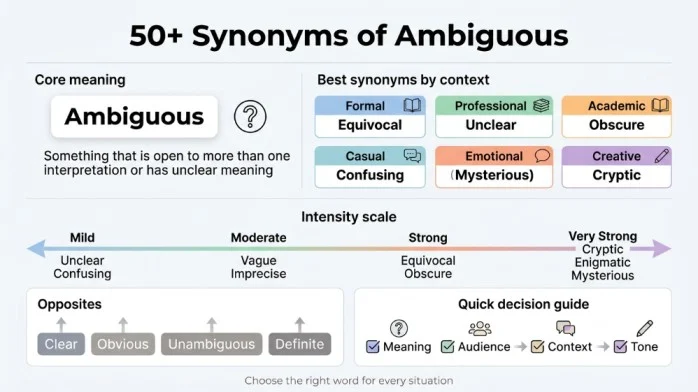
Ambiguous describes something that is open to more than one interpretation or has unclear meaning. The best synonyms include unclear, vague, uncertain, equivocal, obscure, cryptic, and enigmatic. Choose vague for everyday situations, equivocal for formal contexts, unclear for straightforward alternatives, and cryptic for mysterious or puzzling meanings.
Meaning, Tone, and Context
Simple Definition
The word ambiguous describes something that has more than one possible meaning, making it unclear or open to different interpretations. It refers to language, situations, or actions that are not completely clear.
Part of Speech
Ambiguous is an adjective.
Overall Tone
The word usually has a neutral tone. It highlights uncertainty without adding strong emotion. However, in some contexts, it can carry a slightly negative tone if clarity is expected.
Formality Level
Ambiguous is considered formal. It appears naturally in academic writing, legal documents, professional communication, and thoughtful discussions.
Common Uses
Native English speakers commonly use ambiguous when talking about:
- Ambiguous language
- Ambiguous statements
- Ambiguous instructions
- Ambiguous situations
- Ambiguous responses
- Ambiguous meaning
- Ambiguous terms
- Ambiguous messages
- Ambiguous wording
- Ambiguous outcomes
Word Forms
| Form | Word |
|---|---|
| Noun | ambiguity |
| Adjective | ambiguous |
| Adverb | ambiguously |
| Related Form | unambiguous |
| Opposite Form | clear, obvious |
When and How to Use “Ambiguous”
The word ambiguous works well whenever you want to show that something is unclear or open to multiple interpretations. However, choosing a more specific synonym can make your message clearer and more impactful.
Professional
“The contract’s ambiguous language led to a dispute between the parties.”
Academic
“The study’s findings were ambiguous and required further analysis.”
Workplace
“The manager’s ambiguous instructions caused confusion among the team.”
Personal
“His response to my question was deliberately ambiguous.”
“The ambiguous phrasing in your email made it difficult to understand your request.”
Resume
“Avoided ambiguous language when drafting policy documents.”
Social Media
“Sometimes life gives us ambiguous signs that we need time to interpret.”
Best Synonyms of Ambiguous
The word ambiguous is useful because it fits almost every type of writing, but no single synonym works perfectly in every situation. Some alternatives emphasize unclear meaning, while others highlight vagueness, uncertainty, or mystery. Choosing the right synonym helps your writing sound more natural and precise.
Professional Writing: Unclear
Unclear is one of the strongest professional alternatives to ambiguous. It directly communicates that something is not easily understood.
Example:
“The instructions were unclear, which led to errors in the final report.”
Why it works:
Business writing benefits from clarity, and unclear is straightforward and professional.
Academic Writing: Equivocal
In essays, research papers, and reports, equivocal is often a better choice than ambiguous because it emphasizes uncertainty in meaning.
Example:
“The data yielded equivocal results that required additional testing.”
Why it works:
It sounds objective, formal, and academically appropriate.
Business Communication: Vague
Vague indicates that something lacks precision or detail, making it difficult to understand fully.
Example:
“The vague proposal did not address the specific needs of the client.”
Why it works:
It immediately communicates a lack of clarity without being overly technical.
Casual Conversation: Uncertain
For everyday speaking, uncertain sounds natural without becoming overly formal.
Example:
“I’m uncertain about what he meant by that comment.”
Why it works:
Native English speakers frequently use uncertain to express confusion in everyday situations.
Emotional Writing: Enigmatic
When discussing mysterious or puzzling things, enigmatic is usually more expressive than ambiguous.
Example:
“Her enigmatic smile left him wondering what she was thinking.”
Why it works:
It emphasizes mystery and intrigue rather than just unclear meaning.
Creative Writing: Cryptic
Creative writing often benefits from descriptive vocabulary. Cryptic helps create a sense of mystery.
Example:
“He left a cryptic note on the table that no one could decipher.”
Why it works:
It captures the reader’s attention and adds depth to storytelling.
Resume Writing: Precise (as the opposite)
While ambiguous is not typically used positively in resumes, avoiding ambiguity is important. Hiring managers value precision.
Example:
“Drafted clear and precise communication without ambiguous language.”
Why it works:
It sounds concise, professional, and demonstrates attention to detail.
Workplace Communication: Vague
Vague emphasizes that something lacks specific detail.
Example:
“The vague timeline made it difficult to plan the project phases.”
Why it works:
It communicates a need for more detail while maintaining a professional tone.
Stronger Meaning: Enigmatic
When you need stronger emphasis, enigmatic is one of the best replacements for ambiguous.
Example:
“The enigmatic message left the entire team puzzled.”
Why it works:
It suggests a deeper, more mysterious form of ambiguity.
Softer Meaning: Unclear
Sometimes you want to acknowledge confusion without implying intentional vagueness.
Example:
“I found the instructions somewhat unclear.”
Why it works:
It gives balanced emphasis without exaggeration.
When Not to Use “Ambiguous”
Although ambiguous is useful, it is not always the most effective word. In many situations, a more specific synonym communicates your message more clearly.
When the Meaning Is Simply Not Clear
Sometimes ambiguous is too formal for a simple lack of clarity.
Less Effective
“The sign was ambiguous.”
Better
“The sign was unclear.”
Why
Unclear is simpler and more direct.
When There Is Confusion, Not Multiple Meanings
If something is confusing but not necessarily open to multiple interpretations, ambiguous may be inaccurate.
Less Effective
“The directions were ambiguous.”
Better
“The directions were confusing.”
Why
Confusing describes a lack of understanding, not multiple meanings.
When Intentional Vague Is Appropriate
In some contexts, vagueness is intentional and beneficial.
Less Effective
“The diplomatic statement was ambiguous.”
Better
“The diplomatic statement was carefully vague.”
Why
Carefully vague suggests intentional choice, not poor communication.
When You Want to Emphasize Mystery
For emotional or storytelling contexts, ambiguous can sound too academic.
Less Effective
“The stranger’s words were ambiguous.”
Better
“The stranger’s words were mysterious.”
Why
Mysterious adds intrigue and emotional depth.
In Everyday Conversation
In casual speech, ambiguous can sound overly formal.
Less Effective
“The movie’s ending was ambiguous.”
Better
“The movie’s ending was confusing.”
Why
Confusing is more accessible in everyday contexts.
When There Is a Better, Simpler Word
Sometimes a simpler word communicates the idea more effectively.
Less Effective
“Her answer was ambiguous.”
Better
“Her answer was vague.”
Why
Vague is more common and easier to understand.
Words Commonly Confused with “Ambiguous”
| Word | Difference | When to Use It | Example |
|---|---|---|---|
| Vague | Lacks specific detail or precision. | Describing general, imprecise language. | “His vague response was not helpful.” |
| Unclear | Not easy to understand. | General lack of clarity. | “The instructions were unclear.” |
| Equivocal | Deliberately ambiguous to avoid commitment. | Formal, strategic ambiguity. | “Her equivocal response avoided the question.” |
| Obscure | Hard to understand or not well known. | Describing hidden or difficult meaning. | “His writing style is obscure.” |
| Cryptic | Mysterious or puzzling. | Creative, mysterious contexts. | “He left a cryptic message.” |
| Enigmatic | Mysterious and difficult to understand. | Emotional, literary contexts. | “She gave an enigmatic smile.” |
Best Synonyms of Ambiguous by Context
| Context | Best Synonym | Why It Works | Example |
|---|---|---|---|
| Formal Writing | Equivocal | Sounds precise and professional. | “The statement was equivocal.” |
| Academic Writing | Equivocal | Fits research and essays naturally. | “The results were equivocal.” |
| Professional Communication | Unclear | Highlights lack of clarity. | “The policy remains unclear.” |
| Business Emails | Unclear | Concise and professional. | “The request was unclear.” |
| Resume Writing | Precise | Shows attention to clarity. | “Drafted precise documents.” |
| Workplace Communication | Vague | Stresses need for detail. | “The vague deadline caused issues.” |
| Casual Conversation | Unclear | Sounds natural in daily speech. | “His meaning was unclear.” |
| Everyday Speaking | Confusing | Common informal alternative. | “That was confusing.” |
| Creative Writing | Cryptic | Adds mystery and depth. | “He gave a cryptic reply.” |
| Storytelling | Enigmatic | Shows intrigue. | “Her enigmatic presence lingered.” |
| Emotional Writing | Mysterious | Expresses uncertainty. | “She found him mysterious.” |
| Strong Emphasis | Enigmatic | Indicates deeper mystery. | “His enigmatic silence spoke volumes.” |
| Mild Tone | Unclear | Gives moderate emphasis. | “The message was somewhat unclear.” |
| Social Media Captions | Mysterious | Sounds engaging and natural. | “Life sends mysterious signs.” |
| American English | Unclear | Frequently used in business. | “That’s still unclear.” |
| British English | Equivocal | Common in formal usage. | “His position remained equivocal.” |
Synonyms of Ambiguous by Usage
The word ambiguous works in almost every situation, but choosing a more specific synonym makes your writing stronger and more natural. The sections below explain which alternatives fit different types of communication.
Professional vs Personal Synonyms
- Professional communication requires precise vocabulary, while personal conversations sound better with simpler, more relatable words.
Professional Synonyms
| Synonym | Best Used For | Why It Works |
|---|---|---|
| Unclear | Professional reports | Shows lack of clarity. |
| Equivocal | Formal contexts | Highlights uncertainty. |
| Vague | Business communication | Indicates imprecision. |
| Imprecise | Technical writing | Shows lack of exactness. |
| Indefinite | Professional documents | Emphasizes lack of specificity. |
Recommendation
Use unclear, equivocal, or vague in professional writing and communication.
Personal Synonyms
| Synonym | Best Used For | Example |
|---|---|---|
| Confusing | Conversations | “That explanation was confusing.” |
| Unclear | Personal situations | “His feelings were unclear.” |
| Mysterious | Personal experiences | “She has a mysterious past.” |
| Vague | Everyday discussions | “He gave a vague answer.” |
Recommendation
In conversations with friends and family, natural words like confusing, unclear, and vague often sound better than formal alternatives.
Formal vs Conversational Synonyms
Choosing the right level of formality helps your writing match the audience.
| Situation | Best Synonyms |
|---|---|
| Reports | Equivocal, Unclear |
| Essays | Equivocal, Obscure |
| Business Writing | Unclear, Vague |
| Presentations | Unclear, Equivocal |
| Professional Emails | Unclear, Vague |
| Casual Conversations | Confusing, Unclear |
| Text Messages | Unclear, Vague |
Example
Formal:
“The data produced equivocal results that necessitated further investigation.”
Conversational:
“The results were unclear, so we need to look again.”
Academic Synonyms
Academic writing benefits from vocabulary that sounds precise and objective.
Equivocal
Commonly used when discussing research results that are not clear.
Example
“The study’s findings were equivocal and require replication.”
Ambiguous
Appropriate when discussing unclear language or meaning.
Example
“The author’s ambiguous phrasing made the argument difficult to follow.”
Obscure
Best for describing meaning that is hidden or difficult to understand.
Example
“The text contains obscure references that are hard to interpret.”
Vague
Ideal when describing imprecise language or concepts.
Example
“The researcher’s vague definitions weakened the study’s conclusions.”
Unclear
Useful when discussing anything that lacks clarity.
Example
“The methodology section was unclear and needed revision.”
Recommendation
For essays and research papers, equivocal, obscure, and unclear usually sound stronger and more authoritative than ambiguous.
Professional and Business Synonyms
Business communication often requires concise and specific language.
Unclear
Perfect for describing communications that lack clarity.
Example
“The client’s requirements were unclear and required clarification.”
Vague
Highlights lack of specific detail.
Example
“The vague project scope created uncertainty among the team.”
Imprecise
Describes language that lacks exactness.
Example
“Imprecise language in the contract led to misunderstandings.”
Indefinite
Shows lack of clear definition.
Example
“The indefinite timeline made planning difficult.”
Equivocal
Describes language that deliberately avoids commitment.
Example
“His equivocal response did not address the issue.”
Recommendation
Use these words in reports, presentations, business emails, and professional documents to sound more professional.
Creative and Literary Synonyms
Creative writing benefits from expressive vocabulary that creates emotion and imagery.
Cryptic
Adds mystery and puzzle-like quality.
Example
“The cryptic message was written in an ancient script.”
Enigmatic
Creates a sense of intrigue and fascination.
Example
“Her enigmatic smile left him wondering for hours.”
Mysterious
Describes something that is difficult to understand or explain.
Example
“The mysterious disappearance remains unsolved.”
Obscure
Creates a sense of hidden meaning.
Example
“The poem’s obscure imagery left readers guessing.”
Puzzling
Describes something that causes confusion or curiosity.
Example
“It was a puzzling turn of events.”
These words make stories, speeches, and descriptive writing more engaging.
Strongest to Mildest Synonyms
The following scale shows how different synonyms express different levels of ambiguity.
| Intensity | Synonyms |
|---|---|
| Mild | Unclear, Confusing |
| Moderate | Vague, Imprecise, Indefinite |
| Strong | Equivocal, Obscure, Puzzling |
| Very Strong | Cryptic, Enigmatic, Mysterious |
Understanding the Scale
- Unclear simply means not easy to understand.
- Confusing describes something that is hard to follow.
- Vague means lacking specific detail.
- Imprecise means not exact or accurate.
- Equivocal describes deliberate ambiguity.
- Obscure suggests hidden or difficult meaning.
- Cryptic is mysterious and puzzling.
- Enigmatic creates intrigue and fascination.
Emotional vs Neutral Synonyms
Some synonyms express feelings, while others simply communicate lack of clarity.
Emotional Synonyms
| Synonym | Best Used For |
|---|---|
| Mysterious | Creating intrigue |
| Enigmatic | Fascinating uncertainty |
| Cryptic | Puzzling mystery |
| Puzzling | Confusion and curiosity |
These words add emotion and help readers connect with the message.
Neutral Synonyms
| Synonym | Best Used For |
|---|---|
| Unclear | General lack of clarity |
| Vague | Imprecision |
| Equivocal | Deliberate uncertainty |
| Imprecise | Lack of exactness |
| Indefinite | Lack of specificity |
Neutral words communicate ambiguity without adding unnecessary emotion.
Antonyms of Ambiguous
| Antonym | Meaning | Example Sentence |
|---|---|---|
| Clear | Easy to understand | The instructions were clear and concise. |
| Obvious | Easily seen or understood | The answer was obvious to everyone. |
| Transparent | Completely clear | His intentions were transparent. |
| Unambiguous | Having only one meaning | The law is unambiguous on this matter. |
| Definite | Clearly stated or defined | She gave a definite answer. |
| Precise | Exact and accurate | The precise wording was carefully chosen. |
| Specific | Clearly identified | He gave specific instructions. |
| Straightforward | Simple and clear | The explanation was straightforward. |
| Explicit | Clearly expressed | She was explicit about her expectations. |
| Plain | Easy to see or understand | The meaning was plain to see. |
| Distinct | Clearly different or separate | There is a distinct difference. |
| Unequivocal | Not open to interpretation | His support was unequivocal. |
| Lucid | Clear and easy to understand | He gave a lucid explanation. |
| Apparent | Clearly visible or understood | The reasons were apparent. |
| Unmistakable | Impossible to mistake | Her signature was unmistakable. |
Comparison: “Ambiguous” vs Similar Words
Ambiguous vs Vague
Main Difference
Ambiguous means having multiple possible meanings. Vague means lacking specific detail or precision.
Which Is Stronger?
Ambiguous is stronger because it suggests multiple interpretations. Vague simply suggests lack of detail.
Which Is More Formal?
Ambiguous is more formal. Vague is commonly used in both formal and informal contexts.
When to Use Each
Use ambiguous for multiple meanings.
Use vague for lack of detail.
Examples
Ambiguous:
“The contract’s language is ambiguous and could be interpreted two ways.”
Vague:
“The contract’s language is vague and doesn’t specify exact amounts.”
Ambiguous vs Unclear
Main Difference
Ambiguous means open to multiple interpretations. Unclear simply means not easy to understand.
Which Is Stronger?
Ambiguous is stronger because it implies specific uncertainty about interpretation.
Which Is More Formal?
Both are formal, but ambiguous is more precise.
When to Use Each
Use ambiguous when multiple meanings exist.
Use unclear for general lack of clarity.
Examples
Ambiguous:
“Her response was ambiguous and could mean yes or no.”
Unclear:
“Her response was unclear because she spoke softly.”
Ambiguous vs Equivocal
Main Difference
Ambiguous describes something open to multiple interpretations. Equivocal describes language that is deliberately ambiguous to avoid commitment.
Which Is Stronger?
Equivocal is stronger because it suggests intentional vagueness.
Which Is More Formal?
Equivocal is more formal.
When to Use Each
Use ambiguous for neutral multiple meanings.
Use equivocal for deliberate avoidance of clarity.
Examples
Ambiguous:
“The statement was ambiguous and confused everyone.”
Equivocal:
“His equivocal response avoided answering the question directly.”
Ambiguous vs Cryptic
Main Difference
Ambiguous means unclear meaning. Cryptic means mysterious and deliberately puzzling.
Which Is Stronger?
Cryptic is stronger because it adds a layer of mystery.
Which Is More Formal?
Ambiguous is more formal. Cryptic is more literary.
When to Use Each
Use ambiguous for unclear meaning.
Use cryptic for mysterious, puzzling meaning.
Examples
Ambiguous:
“The wording was ambiguous and open to interpretation.”
Cryptic:
“He left a cryptic note that no one could understand.”
Ambiguous vs Obscure
Main Difference
Ambiguous means multiple meanings. Obscure means difficult to understand or not well known.
Which Is Stronger?
Obscure can be stronger because it suggests hidden or difficult knowledge.
Which Is More Formal?
Both are formal.
When to Use Each
Use ambiguous for multiple interpretations.
Use obscure for hidden or difficult meaning.
Examples
Ambiguous:
“The poem’s meaning is ambiguous.”
Obscure:
“The poem contains obscure references to ancient myths.”
Ambiguous vs Enigmatic
Main Difference
Ambiguous describes unclear meaning. Enigmatic describes something that is mysterious and fascinating.
Which Is Stronger?
Enigmatic is stronger because it adds emotional intrigue.
Which Is More Formal?
Enigmatic is more literary and less common in formal writing.
When to Use Each
Use ambiguous for neutral unclear meaning.
Use enigmatic for fascinating mystery.
Examples
Ambiguous:
“Her instructions were ambiguous.”
Enigmatic:
“Her enigmatic smile left everyone wondering.”
Common Phrases and Expressions with “Ambiguous”
| Phrase | Meaning | Example Sentence |
|---|---|---|
| Ambiguous meaning | Meaning that is not clear | The poem’s ambiguous meaning led to many interpretations. |
| Ambiguous language | Language that is unclear | The contract’s ambiguous language caused confusion. |
| Ambiguous answer | Answer that is unclear | He gave an ambiguous answer that satisfied no one. |
| Ambiguous statement | Statement with unclear meaning | The politician made an ambiguous statement. |
| Ambiguous response | Response that is unclear | Her ambiguous response left him guessing. |
| Ambiguous situation | Situation that is unclear | They found themselves in an ambiguous situation. |
| Ambiguous terms | Terms that are unclear | The ambiguous terms led to a dispute. |
| Ambiguous wording | Wording that is unclear | The ambiguous wording needed revision. |
Common Mistakes to Avoid
1. Using “Ambiguous” When “Unclear” Is Better
Incorrect
“The road sign was ambiguous.”
Better
“The road sign was unclear.”
Why
Unclear is simpler and more appropriate for everyday situations.
2. Confusing “Ambiguous” with “Confusing”
Incorrect
“The instructions were ambiguous.”
Better
“The instructions were confusing.”
Why
Confusing describes the effect on the reader, not the multiple meanings of the text.
3. Using “Ambiguous” for Something That Is Simply Unknown
Incorrect
“The suspect’s identity was ambiguous.”
Better
“The suspect’s identity was unknown.”
Why
Unknown describes a lack of information, not multiple interpretations.
4. Repeating “Ambiguous” Too Often
Incorrect
“Ambiguous language led to ambiguous interpretations.”
Better
“Vague language led to multiple interpretations.”
Why
Using varied vocabulary improves readability and style.
5. Using Formal Language in Casual Writing
Incorrect
“The movie’s ending was equivocal.”
Better
“The movie’s ending was unclear.”
Why
Unclear is more accessible in everyday contexts.
6. Using Informal Words in Formal Writing
Incorrect
“The results were confusing.”
Better
“The results were equivocal.”
Why
Formal documents require precise and professional vocabulary.
7. Using “Ambiguous” When Something Is Simply Not Specific
Incorrect
“The timeline was ambiguous.”
Better
“The timeline was vague.”
Why
Vague better describes a lack of specific detail.
Frequently Asked Questions
What are the best synonyms of “ambiguous”?
The best synonyms of ambiguous include unclear, vague, equivocal, obscure, cryptic, and enigmatic. The right choice depends on your audience, tone, and writing purpose.
What are the best formal synonyms of “ambiguous”?
Strong formal alternatives include equivocal, unclear, obscure, indefinite, and imprecise. These words work well in academic papers, reports, and business communication.
What are common informal synonyms of “ambiguous”?
Common informal alternatives include unclear, confusing, vague, and mysterious. These expressions sound natural in everyday conversations and social media posts.
What is another word for “ambiguous” in professional writing?
In professional communication, excellent alternatives include unclear, vague, imprecise, and equivocal. These words make reports, emails, and presentations sound more precise and polished.
What is the difference between “ambiguous” and “vague”?
Ambiguous means having multiple possible meanings. Vague means lacking specific detail or precision. Ambiguous is stronger because it suggests multiple interpretations, while vague simply suggests lack of detail.
What is the opposite of “ambiguous”?
The most common opposites include clear, obvious, unambiguous, definite, precise, explicit, and straightforward. Each describes something that is easy to understand and not open to multiple interpretations.
Conclusion
The word ambiguous is a precise and useful term for describing unclear meaning or multiple interpretations. But using it repeatedly can make your writing feel repetitive. Learning the best synonyms of ambiguous helps you express your ideas with greater accuracy, stronger style, and better clarity.
You’re writing a legal document, an academic paper, a professional email, or having a casual conversation, no single synonym fits every situation. Words like vague, unclear, equivocal, obscure, cryptic, and enigmatic each carry unique meanings and should be chosen based on your audience, tone, and purpose.
A simple way to improve your vocabulary is to pause before writing ambiguous and ask yourself what kind of uncertainty you mean. Choosing the most appropriate synonym will make your writing more engaging, professional, and natural.
Read More Related Articles:
Synonyms for Pros and Cons | Meaning, Examples, and Better …
Synonyms for Thus | Meaning, Examples, and Better Word …








12 thoughts on “50+ Synonyms of Ambiguous | Similar Words, Meanings & Examples”