Sadness can be difficult to express with the same word again and again. The right vocabulary can make your writing clearer, more precise, and more emotionally accurate. Whether you are describing a quiet disappointment or a painful loss, choosing the right sad synonym helps communicate the exact feeling. There are many sad synonyms and synonyms for sad, but each can carry a different level of emotion, tone, or formality.
A useful sadness synonym may work well in everyday writing, while sad professional synonyms can make workplace, academic, or formal communication sound more polished. Words such as unhappy, sorrowful, disappointed, and miserable are not always interchangeable. A strong synonym for sad should match the situation and emotional intensity. For deeper emotions, terms such as heartbroken, devastated, or grief-stricken can serve as a deeply saddened synonym. This guide explores accurate synonyms of sad, including another term for sad and practical examples to help you choose naturally.
What Are the Best Synonyms of “Sad”?
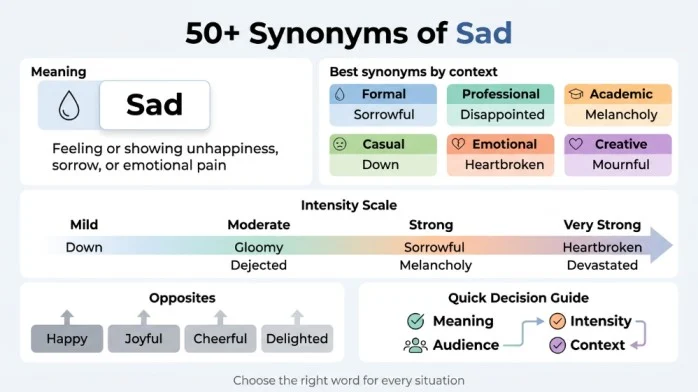
Sad describes a feeling of unhappiness, sorrow, or emotional pain. The best synonyms include sorrowful, melancholy, mournful, dejected, heartbroken, and gloomy. Choose heartbroken for deep emotional pain, melancholy for thoughtful sadness, sorrowful for formal contexts, gloomy for a general low mood, and dejected for disappointment.
Meaning, Tone, and Context
Simple Definition
The word sad describes a feeling of unhappiness, sorrow, grief, or disappointment. It refers to an emotional state ranging from mild unhappiness to deep sorrow.
Part of Speech
Sad is an adjective.
Overall Tone
The word has a negative emotional tone. It expresses unhappiness or sorrow.
Formality Level
Sad is considered neutral, making it suitable for both formal and informal communication. It appears naturally in academic papers, personal writing, everyday conversations, emails, and literary works.
Common Uses
Native English speakers commonly use sad when talking about:
- Sad feelings
- Sad news
- Sad events
- Sad memories
- Sad stories
- Sad situations
- Sad endings
- Sad expressions
- Sad experiences
- Sad emotions
Word Forms
| Form | Word |
|---|---|
| Adjective | sad |
| Noun | sadness |
| Adverb | sadly |
| Related Form | sadden (verb), saddened |
| Opposite Form | happy, joyful |
When and How to Use “Sad”
The word sad works well whenever you want to express unhappiness or sorrow. However, choosing a more specific synonym can make your message clearer and more impactful.
Professional
“The team felt sad about the project’s cancellation.”
Academic
“The study explored the effects of sad emotions on decision-making.”
Workplace
“Employees expressed sadness about the company’s closure.”
Personal
“I felt sad when I heard the news.”
“It is with great sadness that I announce my departure from the company.”
Resume
“Volunteered at a shelter supporting sad and vulnerable community members.”
Social Media
“Feeling sad today, but grateful for the support of my friends.”
Best Synonyms of Sad
The word sad is useful because it fits almost every type of writing, but no single synonym works perfectly in every situation. Some alternatives emphasize deep sorrow, while others highlight mild unhappiness, disappointment, or melancholy. Choosing the right synonym helps your writing sound more natural and precise.
Professional Writing: Sorrowful
Sorrowful is one of the strongest professional alternatives to sad. It conveys deep sadness in a formal and respectful manner.
Example:
“The board expressed sorrowful condolences to the family.”
Why it works:
Business writing benefits from precise language, and sorrowful communicates deep sympathy professionally.
Academic Writing: Melancholy
In essays, research papers, and reports, melancholy is often a better choice than sad because it describes a thoughtful, reflective sadness.
Example:
“The poet’s work reflects a deep sense of melancholy.”
Why it works:
It sounds objective, formal, and academically appropriate.
Business Communication: Disappointed
Disappointed expresses sadness resulting from unmet expectations.
Example:
“We were disappointed by the results of the campaign.”
Why it works:
It immediately communicates a specific cause of sadness.
Casual Conversation: Down
For everyday speaking, down sounds natural without becoming overly formal.
Example:
“I’m feeling a bit down today.”
Why it works:
Native English speakers frequently use down to describe mild sadness.
Emotional Writing: Heartbroken
When discussing intense emotional pain, heartbroken is usually more expressive than sad.
Example:
“She felt heartbroken after the loss of her beloved dog.”
Why it works:
It emphasizes deep emotional pain and loss.
Creative Writing: Melancholy
Creative writing often benefits from descriptive vocabulary. Melancholy helps create stronger imagery.
Example:
“The melancholy evening matched his sorrowful mood.”
Why it works:
It captures the reader’s attention and adds depth to storytelling.
Resume Writing: Supportive
While sad is rarely used on resumes, showing empathy and support is valuable.
Example:
“Provided supportive counseling to clients in distress.”
Why it works:
It sounds concise, professional, and achievement-focused.
Workplace Communication: Concerned
Concerned shows care without excessive emotional language.
Example:
“We are concerned about the impact of recent changes.”
Why it works:
It communicates sadness about a situation professionally.
Stronger Meaning: Heartbroken
When you need stronger emphasis, heartbroken is one of the best replacements for sad.
Example:
“He was heartbroken when his grandmother passed away.”
Why it works:
It suggests deep emotional pain.
Softer Meaning: Blue
Sometimes you want to express mild sadness without overstating it.
Example:
“She’s been feeling blue lately.”
Why it works:
It gives balanced emphasis without exaggeration.
When Not to Use “Sad”
Although sad is versatile, it is not always the most effective word. In many situations, a more specific synonym communicates your message more clearly.
When It Sounds Too General
Sometimes sad is too broad and fails to explain the depth of emotion.
Less Effective
“She is sad.”
Better
“She is heartbroken.”
Why
Heartbroken clearly explains the depth of her sadness.
When Greater Intensity Is Needed
If the situation involves deep grief or loss, sad may sound too weak.
Less Effective
“He felt sad about his mother’s death.”
Better
“He was devastated by his mother’s death.”
Why
Devastated communicates profound grief.
In Academic Writing
Academic writing usually favors more precise vocabulary.
Less Effective
“The subjects reported feeling sad.”
Better
“The subjects reported feeling melancholic.”
Why
Melancholy is more objective and commonly used in research.
When Expressing Condolences
In situations of grief or loss, sad can sound impersonal.
Less Effective
“I am sad about your loss.”
Better
“I offer my deepest condolences on your loss.”
Why
Condolences is more appropriate for expressing sympathy.
In Creative Writing
Using sad repeatedly can make storytelling feel flat.
Less Effective
“He looked sad.”
Better
“He looked dejected and defeated.”
Why
Dejected creates stronger imagery and leaves a lasting impression.
When Expressing Personal Feelings
If something has deep emotional significance, choose a more expressive word.
Less Effective
“I feel sad.”
Better
“I feel melancholy today.”
Why
Melancholy communicates a more reflective, thoughtful sadness.
Words Commonly Confused with “Sad”
| Word | Difference | When to Use It | Example |
|---|---|---|---|
| Sorrowful | Deep sadness, often formal | Formal expressions of grief | “We are sorrowful about your loss.” |
| Melancholy | Reflective, thoughtful sadness | Academic, creative writing | “The poem expressed melancholy.” |
| Dejected | Sad due to disappointment | Describing discouragement | “He felt dejected after the rejection.” |
| Heartbroken | Intense emotional pain | Deep grief, loss | “She was heartbroken by the breakup.” |
| Gloomy | Sad and pessimistic | Describing moods, weather | “The gloomy weather matched his mood.” |
| Depressed | Severe, persistent sadness | Medical, psychological contexts | “He was diagnosed with depression.” |
Best Synonyms of Sad by Context
| Context | Best Synonym | Why It Works | Example |
|---|---|---|---|
| Formal Writing | Sorrowful | Sounds precise and respectful. | “The family was sorrowful.” |
| Academic Writing | Melancholy | Fits research and essays naturally. | “The study explored melancholy.” |
| Professional Communication | Disappointed | Highlights unmet expectations. | “We are disappointed.” |
| Business Emails | Concerned | Concise and professional. | “We are concerned about the news.” |
| Resume Writing | Supportive | Emphasizes empathy. | “Provided supportive care.” |
| Workplace Communication | Concerned | Stresses care for others. | “We are concerned about the team.” |
| Casual Conversation | Down | Sounds natural in daily speech. | “I’m feeling down today.” |
| Everyday Speaking | Blue | Common informal alternative. | “I’ve been feeling blue.” |
| Creative Writing | Melancholy | Adds vivid description. | “It was a melancholy evening.” |
| Storytelling | Heartbroken | Shows emotional depth. | “She was heartbroken.” |
| Emotional Writing | Devastated | Expresses strong feeling. | “I am devastated by this.” |
| Strong Emphasis | Devastated | Indicates profound grief. | “The news left me devastated.” |
| Mild Tone | Blue | Gives moderate emphasis. | “I’m feeling blue today.” |
| Social Media Captions | Down | Sounds engaging and natural. | “Today has been a down day.” |
| American English | Down | Frequently used in business. | “I’m feeling down.” |
| British English | Gutted | Common in informal UK usage. | “I was absolutely gutted.” |
Synonyms of Sad by Usage
The word sad works in almost every situation, but choosing a more specific synonym makes your writing stronger and more natural. The sections below explain which alternatives fit different types of communication.
Professional vs Personal Synonyms
- Professional communication requires precise vocabulary, while personal conversations sound better with simpler, more relatable words.
Professional Synonyms
| Synonym | Best Used For | Why It Works |
|---|---|---|
| Sorrowful | Formal condolences | Shows deep sympathy. |
| Disappointed | Business communication | Expresses unmet expectations. |
| Concerned | Workplace interactions | Shows care professionally. |
| Melancholy | Academic contexts | Indicates thoughtful sadness. |
| Mournful | Formal grief expressions | Conveys deep loss. |
Recommendation
Use sorrowful, disappointed, or concerned in professional writing and communication.
Personal Synonyms
| Synonym | Best Used For | Example |
|---|---|---|
| Heartbroken | Relationships, loss | “I am heartbroken.” |
| Down | Daily conversations | “I’m feeling down.” |
| Blue | Casual speaking | “I’ve been feeling blue.” |
| Gutted | Very sad, UK usage | “I was absolutely gutted.” |
Recommendation
In conversations with friends and family, natural words like down, blue, and heartbroken often sound better than formal alternatives.
Formal vs Conversational Synonyms
Choosing the right level of formality helps your writing match the audience.
| Situation | Best Synonyms |
|---|---|
| Reports | Melancholy, Sorrowful |
| Essays | Melancholy, Sorrowful |
| Business Writing | Disappointed, Concerned |
| Presentations | Concerned, Disappointed |
| Professional Emails | Sorrowful, Concerned |
| Casual Conversations | Down, Blue |
| Text Messages | Down, Gutted (UK) |
Example
Formal:
“The family was sorrowful at the passing of their beloved relative.”
Conversational:
“I’ve been feeling down lately.”
Academic Synonyms
Academic writing benefits from vocabulary that sounds precise and objective.
Melancholy
Commonly used when discussing reflective sadness.
Example
“The study explored themes of melancholy in romantic poetry.”
Sorrowful
Best for describing deep sadness.
Example
“Participants expressed sorrowful feelings about loss.”
Depressed
Ideal when describing clinical or persistent sadness.
Example
“The research examined symptoms of depressed mood.”
Dejected
Useful when describing disappointment.
Example
“Subjects reported feeling dejected after receiving negative feedback.”
Mournful
Appropriate when discussing grief.
Example
“The mournful tone of the poem reflected loss.”
Recommendation
For essays and research papers, melancholy, sorrowful, and depressed usually sound stronger and more authoritative than sad.
Professional and Business Synonyms
Business communication often requires concise and specific language.
Disappointed
Perfect for describing unmet expectations.
Example
“We are disappointed with the quarterly results.”
Concerned
Shows care and attention.
Example
“We are concerned about employee well-being.”
Sorrowful
Describes deep sympathy.
Example
“We sent a sorrowful message to the family.”
Regretful
Shows sadness about a decision.
Example
“We are regretful about the outcome.”
Saddened
Professional expression of sadness.
Example
“We are deeply saddened by the news.”
Recommendation
Use these words in resumes, interviews, meetings, presentations, business emails, and client communication to sound more professional.
Creative and Literary Synonyms
Creative writing benefits from expressive vocabulary that creates emotion and imagery.
Melancholy
Adds reflective depth.
Example
“The melancholy evening was perfect for reflection.”
Mournful
Emphasizes grief and loss.
Example
“The mournful melody brought tears to her eyes.”
Heartbroken
Expresses deep emotional pain.
Example
“He walked away heartbroken and defeated.”
Dejected
Describes visible discouragement.
Example
“The dejected team left the field in silence.”
Sorrowful
Conveys deep sadness.
Example
“The sorrowful goodbye left them both in tears.”
These words make stories, speeches, and descriptive writing more engaging.
Slang or Modern Synonyms
Native speakers often use casual expressions for sadness.
| Expression | Meaning | Appropriate For | Avoid In |
|---|---|---|---|
| Down | Mildly sad | Everyday conversations | Academic papers |
| Blue | Sad or melancholy | Friends, social media | Business reports |
| Gutted (UK) | Very disappointed | Casual speech, UK usage | Formal writing |
| Bummed out | Disappointed | Casual conversations | Professional writing |
Example
Casual:
“I’m feeling a bit down today.”
Formal:
“I am feeling melancholy today.”
Strongest to Mildest Synonyms
The following scale shows how different synonyms express different levels of sadness.
| Intensity | Synonyms |
|---|---|
| Mild | Blue, Down, Low |
| Moderate | Gloomy, Disappointed, Dejected |
| Strong | Sad, Sorrowful, Melancholy |
| Very Strong | Heartbroken, Devastated, Grief-stricken |
Understanding the Scale
- Blue and down mean mildly sad.
- Gloomy suggests a dark, pessimistic mood.
- Disappointed means sadness from unmet expectations.
- Dejected means discouraged or defeated.
- Sorrowful means deeply sad.
- Melancholy means reflective sadness.
- Heartbroken means intense emotional pain.
- Devastated means overwhelming grief.
- Grief-stricken means consumed by grief.
Emotional vs Neutral Synonyms
Some synonyms express feelings, while others simply communicate sadness.
Emotional Synonyms
| Synonym | Best Used For |
|---|---|
| Heartbroken | Deep emotional pain |
| Devastated | Overwhelming grief |
| Sorrowful | Formal expressions of grief |
| Mournful | Expressing loss |
| Grief-stricken | Consumed by grief |
These words add emotion and help readers connect with the message.
Neutral Synonyms
| Synonym | Best Used For |
|---|---|
| Disappointed | Professional contexts |
| Concerned | Workplace communication |
| Dejected | Describing discouragement |
| Melancholy | Academic writing |
| Gloomy | General descriptions |
Neutral words communicate sadness without adding unnecessary emotion.
Antonyms of Sad
| Antonym | Meaning | Example Sentence |
|---|---|---|
| Happy | Feeling pleasure or joy | She was happy to see her friends. |
| Joyful | Full of joy | The joyful celebration continued. |
| Cheerful | Bright and happy | She has a cheerful personality. |
| Content | Satisfied and at peace | He felt content with his life. |
| Delighted | Very pleased | We were delighted to help. |
| Elated | Very happy and excited | She was elated by the news. |
| Ecstatic | Overwhelmingly happy | He was ecstatic about winning. |
| Optimistic | Hopeful about the future | She remains optimistic. |
| Upbeat | Positive and cheerful | The team is upbeat. |
| Jovial | Cheerful and friendly | He has a jovial disposition. |
| Merry | Cheerful and lively | We had a merry time. |
| Blissful | Perfectly happy | They had a blissful day. |
| Jubilant | Triumphantly happy | The jubilant crowd cheered. |
| Cheery | Bright and happy | She gave a cheery wave. |
| Grateful | Feeling thankful | I am grateful for your support. |
Comparison: “Sad” vs Similar Words
Although sad is a versatile word, several similar words carry different shades of meaning. Understanding these differences helps you choose the most accurate word for each situation.
Sad vs Sorrowful
Main Difference
Sad is a general word for unhappiness. Sorrowful implies deep, profound sadness often associated with loss.
Which Is Stronger?
Sorrowful is much stronger and more formal.
Which Is More Formal?
Sorrowful is more formal and literary.
When to Use Each
Use sad for general unhappiness.
Use sorrowful for deep grief or formal expressions.
Examples
Sad:
“I felt sad when the movie ended.”
Sorrowful:
“We are deeply sorrowful about your loss.”
Sad vs Melancholy
Main Difference
Sad is a general feeling. Melancholy suggests a thoughtful, reflective sadness.
Which Is Stronger?
Melancholy is deeper and more intellectual.
Which Is More Formal?
Melancholy is more formal and literary.
When to Use Each
Use sad for everyday emotions.
Use melancholy for reflective, thoughtful sadness.
Examples
Sad:
“I felt sad about the news.”
Melancholy:
“The autumn evening filled me with melancholy.”
Sad vs Dejected
Main Difference
Sad is general unhappiness. Dejected specifically means sad due to disappointment or rejection.
Which Is Stronger?
Dejected is more specific and often implies visible discouragement.
Which Is More Formal?
Both are appropriate in formal and informal contexts.
When to Use Each
Use sad for general feelings.
Use dejected when disappointment causes sadness.
Examples
Sad:
“I feel sad today.”
Dejected:
“He felt dejected after the job rejection.”
Sad vs Heartbroken
Main Difference
Sad is mild to moderate sadness. Heartbroken describes intense emotional pain from loss.
Which Is Stronger?
Heartbroken is extremely strong.
Which Is More Formal?
Heartbroken is more common in personal and creative writing.
When to Use Each
Use sad for mild to moderate sadness.
Use heartbroken for deep emotional pain.
Examples
Sad:
“I felt sad when my friend moved away.”
Heartbroken:
“She was heartbroken when her relationship ended.”
Sad vs Gloomy
Main Difference
Sad is an internal feeling. Gloomy describes an external appearance or mood that is dark and pessimistic.
Which Is Stronger?
Gloomy suggests a more visible, persistent mood.
Which Is More Formal?
Both are appropriate in different contexts.
When to Use Each
Use sad for internal feelings.
Use gloomy for appearance or mood.
Examples
Sad:
“I felt sad after the argument.”
Gloomy:
“He had a gloomy outlook on life.”
Sad vs Depressed
Main Difference
Sad is a normal emotion. Depressed describes a clinical condition involving persistent, severe sadness.
Which Is Stronger?
Depressed is much stronger and more serious.
Which Is More Formal?
Depressed is common in medical and psychological contexts.
When to Use Each
Use sad for normal emotions.
Use depressed for clinical or persistent sadness.
Examples
Sad:
“I felt sad after the movie.”
Depressed:
“He was diagnosed with depression.”
Common Phrases and Expressions with “Sad”
| Phrase | Meaning | Example Sentence |
|---|---|---|
| Sad news | Unhappy information | I received sad news today. |
| Sad ending | An unhappy conclusion | The movie had a sad ending. |
| Sad story | An unhappy narrative | She told me a sad story. |
| Sad face | An expression of unhappiness | He made a sad face. |
| Sad day | An unhappy day | It was a sad day for everyone. |
| Sad to say | Unfortunately | Sad to say, we lost the game. |
| Sad goodbye | A difficult farewell | We said a sad goodbye. |
| Sad memory | An unhappy memory | That is a sad memory. |
Common Mistakes to Avoid
1. Using a General Word Instead of a Specific One
Incorrect
“She is sad.”
Better
“She is heartbroken.”
Why
Heartbroken explains the depth of her sadness more clearly.
2. Using Informal Words in Formal Writing
Incorrect
“We were gutted by the news.”
Better
“We were deeply saddened by the news.”
Why
Formal documents require precise and professional vocabulary.
3. Choosing an Overly Strong Synonym
Incorrect
“I was devastated when I lost my keys.”
Better
“I felt sad when I lost my keys.”
Why
Reserve devastated for situations involving deep emotional loss.
4. Repeating “Sad” Too Often
Incorrect
“The sad movie made me sad because sad stories are sad.”
Better
“The melancholic movie made me sorrowful because heartbreaking stories are poignant.”
Why
Using varied vocabulary improves readability and style.
5. Confusing “Sad” with “Depressed”
Incorrect
“I’m depressed because my coffee is cold.”
Better
“I’m sad because my coffee is cold.”
Why
Depressed should be reserved for clinical or persistent sadness.
6. Using Emotional Words in Academic Writing
Incorrect
“The participants felt heartbroken.”
Better
“The participants reported feeling dejected.”
Why
Academic writing generally prefers objective language.
7. Overusing Strong Synonyms
Incorrect
“Every small setback left me devastated.”
Better
“Most setbacks left me disappointed, but the major one left me devastated.”
Why
Saving stronger words for genuinely serious situations makes them more effective.
Frequently Asked Questions
What is a good synonym for sad?
Common synonyms for sad include unhappy, sorrowful, unhappy, gloomy, and downcast.
What are some professional synonyms for sad?
For professional writing, use terms such as concerned, disappointed, distressed, discouraged, or sorrowful, depending on the context.
What is a synonym for sadness?
Useful sadness synonyms include sorrow, grief, unhappiness, melancholy, and heartache.
What is another term for sad?
Another term for sad can be unhappy, sorrowful, miserable, gloomy, or downhearted, depending on the intensity.
What is a synonym for deeply saddened?
Strong alternatives include devastated, heartbroken, grief-stricken, distressed, and profoundly saddened.
What are the best synonyms of “sad”?
The best synonyms of sad include sorrowful, melancholy, dejected, heartbroken, gloomy, and mournful. The right choice depends on your audience, tone, and writing purpose.
What are the best formal synonyms of “sad”?
Strong formal alternatives include sorrowful, melancholy, mournful, dejected, and regretful. These words work well in academic papers, reports, and business communication.
What are common informal synonyms of “sad”?
Common informal alternatives include down, blue, low, gutted (UK), and bummed out. These expressions sound natural in everyday conversations and social media posts.
What is another word for “sad” in professional writing?
In professional communication, excellent alternatives include disappointed, concerned, regretful, saddened, and sorrowful. These words make reports, emails, and resumes sound more precise and polished.
What is the difference between “sad” and “melancholy”?
Sad is a general word for unhappiness. Melancholy suggests a thoughtful, reflective, and often deeper sadness. Melancholy is more formal and literary.
What is the opposite of “sad”?
The most common opposites include happy, joyful, cheerful, content, delighted, elated, and ecstatic. Each describes a positive emotional state.
Conclusion
The word sad is one of the most common adjectives for expressing unhappiness, but using it repeatedly can make your writing feel repetitive. Learning the best synonyms of sad helps you express your ideas with greater accuracy, stronger style, and better clarity.
You’re writing an essay, preparing a business presentation, updating your resume, or having a personal conversation, no single synonym fits every situation. Words like sorrowful, melancholy, dejected, heartbroken, and gloomy each carry unique meanings and should be chosen based on your audience, tone, and purpose.
A simple way to improve your vocabulary is to pause before writing sad and ask yourself how intense the emotion is and what is causing it. Choosing the most appropriate synonym will make your writing more engaging, professional, and natural.
Read More Related Articles:
- Synonyms for Involved | Meaning, Examples, and Better Word Choices
- Synonyms for Liked| Meaning, Examples, and Better Word …