Empathy can change the way people communicate, solve conflicts, and support one another. The right word, however, depends on what you want to express. This guide explores an empathy synonym with clear meanings, natural examples, and practical usage notes. It also explains another word for empathy when you need a more precise choice for professional, academic, or everyday writing.
You’ll find useful synonyms of empathy, empathy synonyms, and synonyms for empathy grouped by meaning and tone. Words such as compassion, understanding, sensitivity, and sympathy can overlap with empathy, but they are not always interchangeable. Understanding those differences helps you choose the most accurate term.
If you need a synonym for empathy, other words for empathy, or an empathy other term, this guide makes the choice easier. It also covers empathy antonym and synonym and empathy synonym and antonym, so you can understand both sides of the meaning.
What Are the Best Synonyms of “Empathy”?
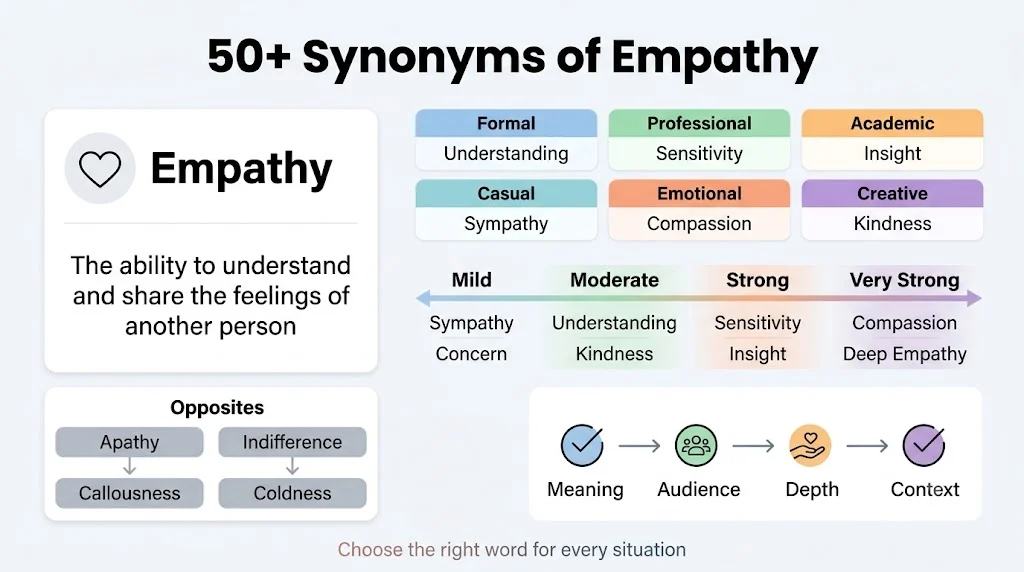
Empathy is the ability to understand and share the feelings, perspectives, or experiences of another person. The best synonyms include compassion, understanding, sympathy, sensitivity, insight, and concern. Choose compassion for emotional situations, understanding for professional contexts, insight for academic writing, and sympathy for personal condolences.
Meaning, Tone, and Context
Simple Definition
The word empathy describes the ability to understand and share the feelings, thoughts, or experiences of another person. It involves putting yourself in someone else’s position and feeling what they might be feeling.
Part of Speech
Empathy is a noun.
Overall Tone
The word has a warm, positive, and human-centered tone. It emphasizes emotional connection and understanding.
Formality Level
Empathy is considered neutral to formal. It appears naturally in academic papers, professional communication, personal writing, workplace discussions, and everyday conversations.
Common Uses
Native English speakers commonly use empathy when talking about:
- Emotional intelligence
- Understanding others
- Supportive relationships
- Professional interactions
- Healthcare and counseling
- Leadership and management
- Personal development
- Conflict resolution
- Active listening
- Compassionate communication
Word Forms
| Form | Word |
|---|---|
| Noun | empathy |
| Adjective | empathetic, empathic |
| Adverb | empathetically |
| Related Form | empathize (verb) |
| Opposite Form | apathy, indifference |
When and How to Use “Empathy”
The word empathy works well whenever you want to show that someone understands another person’s feelings or perspective. However, choosing a more specific synonym can make your message clearer and more impactful.
Professional
“Her empathy with clients made her an exceptional therapist.”
Academic
“The study measured empathy levels among healthcare professionals.”
Workplace
“Empathy in leadership helps create a more supportive work environment.”
Personal
“I could feel genuine empathy for what she was going through.”
“Thank you for showing empathy and understanding during this difficult time.”
Resume
“Demonstrated empathy and active listening skills when supporting diverse client populations.”
Social Media
“The world needs more empathy and kindness today.”
Best Synonyms of Empathy
The word empathy is useful because it fits almost every type of writing, but no single synonym works perfectly in every situation. Some alternatives emphasize emotional connection, while others highlight understanding, insight, or concern. Choosing the right synonym helps your writing sound more natural and precise.
Professional Writing: Understanding
Understanding is one of the strongest professional alternatives to empathy. It shows comprehension of another’s situation or feelings.
Example:
“Her understanding of client needs made her an excellent project manager.”
Why it works:
Business writing benefits from precise language, and understanding clearly communicates the ability to grasp another’s perspective.
Academic Writing: Insight
In essays, research papers, and reports, insight is often a better choice than empathy because it highlights deeper comprehension.
Example:
“The researcher’s insight into cultural differences enhanced the study.”
Why it works:
It sounds objective, formal, and academically appropriate.
Business Communication: Sensitivity
Sensitivity indicates awareness and consideration of others’ feelings or needs.
Example:
“Cultural sensitivity is essential when working with international clients.”
Why it works:
It immediately communicates awareness without being overly emotional.
Casual Conversation: Understanding
For everyday speaking, understanding sounds natural without becoming overly formal.
Example:
“I really appreciate your understanding during this tough time.”
Why it works:
Native English speakers frequently use understanding to express empathy in everyday situations.
Emotional Writing: Compassion
When discussing feelings of care and concern, compassion is usually more expressive than empathy.
Example:
“Her compassion for the homeless inspired her to volunteer regularly.”
Why it works:
It emphasizes active care and concern rather than just understanding.
Creative Writing: Sympathy
Creative writing often benefits from descriptive vocabulary. Sympathy helps create stronger emotional connections.
Example:
“He felt a deep sympathy for the lonely old man.”
Why it works:
It captures the reader’s attention and adds emotional depth to storytelling.
Resume Writing: Interpersonal Skills
Recruiters frequently see the phrase interpersonal skills because it highlights the ability to relate to others.
Example:
“Strong interpersonal skills and empathy when supporting diverse client populations.”
Why it works:
It sounds concise, professional, and achievement-focused.
Workplace Communication: Consideration
Consideration emphasizes thoughtfulness and regard for others.
Example:
“Showing consideration for team members’ workloads is important for collaboration.”
Why it works:
It communicates respect while maintaining a professional tone.
Stronger Meaning: Compassion
When you need stronger emphasis, compassion is one of the best replacements for empathy.
Example:
“Her compassion for others drove her career in social work.”
Why it works:
It suggests active care and a desire to help.
Softer Meaning: Sympathy
Sometimes you want to acknowledge another’s feelings without claiming full understanding.
Example:
“She expressed her sympathy for the family’s loss.”
Why it works:
It gives balanced emphasis without exaggeration.
When Not to Use “Empathy”
Although empathy is versatile, it is not always the most effective word. In many situations, a more specific synonym communicates your message more clearly.
When It Sounds Too Academic
Sometimes empathy is too formal for casual situations.
Less Effective
“I have empathy for your situation.”
Better
“I understand what you’re going through.”
Why
Understanding is simpler and more conversational.
When Greater Action Is Needed
If the situation calls for action rather than just understanding, empathy may sound passive.
Less Effective
“She showed empathy for the homeless.”
Better
“She showed compassion by volunteering at the shelter.”
Why
Compassion implies active care and action.
When Expressing Condolences
In situations of grief or loss, empathy can sound impersonal.
Less Effective
“I have empathy for your loss.”
Better
“I offer my deepest sympathy for your loss.”
Why
Sympathy is more appropriate for expressing condolences.
In Professional Feedback
General wording often reduces the impact of your message.
Less Effective
“Your empathy with the client was noted.”
Better
“Your sensitivity to the client’s concerns was professional and effective.”
Why
Sensitivity sounds more professional and precise.
In Creative Writing
Using empathy repeatedly can make storytelling feel flat.
Less Effective
“He felt empathy for the character.”
Better
“He felt a deep sympathy for the character’s plight.”
Why
Sympathy creates stronger imagery and leaves a lasting impression.
When Expressing Personal Feelings
If something has emotional significance, choose a more expressive word.
Less Effective
“I have empathy for you.”
Better
“I feel genuine compassion for what you’re going through.”
Why
Compassion communicates personal significance more naturally.
Words Commonly Confused with “Empathy”
| Word | Difference | When to Use It | Example |
|---|---|---|---|
| Sympathy | Feeling pity or sorrow for someone’s situation. | Condolences, expressing pity. | “I offer my deepest sympathy.” |
| Compassion | Feeling concern and wanting to help. | Active care, helping others. | “Her compassion led her to volunteer.” |
| Understanding | Comprehending another’s perspective. | Professional, everyday contexts. | “I appreciate your understanding.” |
| Sensitivity | Awareness of others’ feelings. | Professional, cultural contexts. | “Cultural sensitivity is essential.” |
| Insight | Deep understanding of a situation. | Academic, analytical contexts. | “The research provided valuable insight.” |
| Concern | Worry or interest in someone’s welfare. | Expressing care, professional. | “I am concerned about your well-being.” |
Best Synonyms of Empathy by Context
| Context | Best Synonym | Why It Works | Example |
|---|---|---|---|
| Formal Writing | Understanding | Sounds precise and professional. | “The therapist demonstrated understanding.” |
| Academic Writing | Insight | Fits research and essays naturally. | “The study provided valuable insight.” |
| Professional Communication | Sensitivity | Highlights awareness and consideration. | “Cultural sensitivity is important.” |
| Business Emails | Understanding | Concise and professional. | “Thank you for your understanding.” |
| Resume Writing | Interpersonal Skills | Emphasizes relational abilities. | “Strong interpersonal skills.” |
| Workplace Communication | Consideration | Stresses thoughtfulness. | “Consideration for others is valued.” |
| Casual Conversation | Understanding | Sounds natural in daily speech. | “I appreciate your understanding.” |
| Everyday Speaking | Sympathy | Common informal alternative. | “I have sympathy for you.” |
| Creative Writing | Sympathy | Adds emotional depth. | “He felt sympathy for the character.” |
| Storytelling | Compassion | Shows active care. | “Her compassion changed lives.” |
| Emotional Writing | Compassion | Expresses strong feeling. | “I feel deep compassion for them.” |
| Strong Emphasis | Compassion | Indicates active concern. | “Compassion guided her decisions.” |
| Mild Tone | Understanding | Gives moderate emphasis. | “We appreciate your understanding.” |
| Social Media Captions | Kindness | Sounds engaging and natural. | “Spread kindness and empathy today.” |
| American English | Understanding | Frequently used in business. | “That shows real understanding.” |
| British English | Sympathy | Common in formal and everyday usage. | “She expressed her sympathy.” |
Synonyms of Empathy by Usage
The word empathy works in almost every situation, but choosing a more specific synonym makes your writing stronger and more natural. The sections below explain which alternatives fit different types of communication.
Professional vs Personal Synonyms
- Professional communication requires precise vocabulary, while personal conversations sound better with simpler, more relatable words.
Professional Synonyms
| Synonym | Best Used For | Why It Works |
|---|---|---|
| Understanding | Professional reports | Shows comprehension. |
| Sensitivity | Business communication | Highlights awareness. |
| Consideration | Workplace interactions | Shows thoughtfulness. |
| Insight | Academic contexts | Indicates deeper understanding. |
| Interpersonal Skills | Resumes, interviews | Demonstrates relational ability. |
Recommendation
Use understanding, sensitivity, or insight in professional writing and communication.
Personal Synonyms
| Synonym | Best Used For | Example |
|---|---|---|
| Compassion | Relationships | “Your compassion means everything.” |
| Sympathy | Condolences | “I offer my sympathy.” |
| Kindness | Daily interactions | “Kindness and empathy go hand in hand.” |
| Understanding | Personal situations | “Thank you for your understanding.” |
Recommendation
In conversations with friends and family, natural words like compassion, sympathy, and kindness often sound better than formal alternatives.
Formal vs Conversational Synonyms
Choosing the right level of formality helps your writing match the audience.
| Situation | Best Synonyms |
|---|---|
| Reports | Understanding, Insight |
| Essays | Insight, Sensitivity |
| Business Writing | Sensitivity, Understanding |
| Presentations | Understanding, Insight |
| Professional Emails | Understanding, Consideration |
| Casual Conversations | Sympathy, Kindness |
| Text Messages | Understanding, Caring |
Example
Formal:
“The therapist demonstrated remarkable sensitivity to her patients’ needs.”
Conversational:
“I really appreciate your kindness during this difficult time.”
Academic Synonyms
Academic writing benefits from vocabulary that sounds precise and objective.
Insight
Commonly used when discussing deeper understanding.
Example
“The research provided insight into patient experiences.”
Understanding
Best for describing comprehension.
Example
“Understanding cultural differences is essential for effective communication.”
Sensitivity
Ideal when describing awareness.
Example
“The study examined sensitivity to emotional cues.”
Empathy
Appropriate when discussing the concept itself.
Example
“Participants with higher empathy scores showed better social outcomes.”
Compassion
Useful when describing active care.
Example
“Compassion fatigue is a concern for healthcare workers.”
Recommendation
For essays and research papers, insight, understanding, and sensitivity usually sound stronger and more authoritative than empathy.
Professional and Business Synonyms
Business communication often requires concise and specific language.
Understanding
Perfect for describing comprehension of others’ perspectives.
Example
“Understanding client needs is essential for success.”
Sensitivity
Highlights awareness and consideration.
Example
“Sensitivity to cultural differences is valued in our global team.”
Consideration
Shows thoughtfulness toward others.
Example
“Showing consideration for colleagues’ time is professional.”
Insight
Describes deeper understanding.
Example
“Her insight into customer behavior improved our strategy.”
Interpersonal Skills
Shows the ability to relate to others.
Example
“Strong interpersonal skills and empathy are key to leadership.”
Recommendation
Use these words in resumes, interviews, meetings, presentations, business emails, and client communication to sound more professional.
Creative and Literary Synonyms
Creative writing benefits from expressive vocabulary that creates emotion and imagery.
Sympathy
Adds emotional depth and connection.
Example
“He felt a profound sympathy for the lonely traveler.”
Compassion
Emphasizes active care and concern.
Example
“Her compassion for the wounded soldier never wavered.”
Kindness
Describes gentle, caring behavior.
Example
“The kindness in her eyes told him everything.”
Tenderness
Suggests gentle care and affection.
Example
“He treated her with tenderness and understanding.”
Heart
Metaphorically describes empathy and compassion.
Example
“She had a heart that felt the pain of others.”
These words make stories, speeches, and descriptive writing more engaging.
Strongest to Mildest Synonyms
The following scale shows how different synonyms express different levels of emotional connection.
| Intensity | Synonyms |
|---|---|
| Mild | Understanding, Sympathy |
| Moderate | Sensitivity, Concern, Kindness |
| Strong | Compassion, Empathy, Insight |
| Very Strong | Compassionate Understanding, Deep Empathy |
Understanding the Scale
- Sympathy means feeling pity or sorrow for someone.
- Understanding means comprehending another’s perspective.
- Sensitivity means awareness of others’ feelings.
- Concern means interest in someone’s welfare.
- Kindness means being gentle and caring.
- Compassion means active care and desire to help.
- Insight means deep understanding.
Emotional vs Neutral Synonyms
Some synonyms express feelings, while others simply communicate understanding.
Emotional Synonyms
| Synonym | Best Used For |
|---|---|
| Compassion | Active care and concern |
| Sympathy | Feeling pity or sorrow |
| Kindness | Gentle, caring behavior |
| Tenderness | Gentle affection |
| Concern | Interest in someone’s welfare |
These words add emotion and help readers connect with the message.
Neutral Synonyms
| Synonym | Best Used For |
|---|---|
| Understanding | Professional contexts |
| Sensitivity | Awareness |
| Insight | Deeper comprehension |
| Consideration | Thoughtfulness |
| Interpersonal Skills | Professional evaluation |
Neutral words communicate empathy without adding unnecessary emotion.
Antonyms of Empathy
| Antonym | Meaning | Example Sentence |
|---|---|---|
| Apathy | Lack of interest or concern | His apathy toward others was concerning. |
| Indifference | Lack of concern | She showed complete indifference. |
| Callousness | Insensitivity to others | His callousness shocked everyone. |
| Insensitivity | Lack of awareness of feelings | Her insensitivity hurt their feelings. |
| Cruelty | Causing pain to others | The cruelty of his words was shocking. |
| Coldness | Lack of warmth | His coldness made her feel unwelcome. |
| Detachment | Emotional distance | Her detachment from the situation was noticeable. |
| Unconcern | Lack of interest | His unconcern for others was disappointing. |
| Hardheartedness | Lack of compassion | His hardheartedness made him unpopular. |
| Unfeelingness | Lack of emotion | She was accused of unfeelingness. |
| Disinterest | Lack of engagement | His disinterest in the conversation was evident. |
| Neglect | Failure to care for | Their neglect of the children was concerning. |
| Disregard | Lack of attention | Her disregard for others’ feelings was hurtful. |
| Unkindness | Lack of kindness | The unkindness of her words stung. |
| Rigidity | Inflexibility, lack of understanding | His rigidity made it hard to negotiate. |
Comparison: “Empathy” vs Similar Words
Although empathy is a versatile word, several similar words carry different shades of meaning. Understanding these differences helps you choose the most accurate word for each situation.
Empathy vs Sympathy
Main Difference
Empathy is understanding and sharing another’s feelings. Sympathy is feeling pity or sorrow for someone else’s situation.
Which Is Stronger?
Empathy is stronger because it involves deep connection. Sympathy is more detached.
Which Is More Formal?
Both are formal, but empathy is more common in professional and academic contexts.
When to Use Each
Use empathy for deeper understanding and connection.
Use sympathy for expressing pity or condolences.
Examples
Empathy:
“I feel what you’re going through because I’ve been there.”
Sympathy:
“I’m so sorry for your loss.”
Empathy vs Compassion
Main Difference
Empathy is understanding another’s feelings. Compassion is having concern for another’s suffering and wanting to help.
Which Is Stronger?
Compassion is stronger because it involves action and care.
Which Is More Formal?
Both are suitable for formal and professional contexts.
When to Use Each
Use empathy for understanding.
Use compassion for active care and help.
Examples
Empathy:
“I understand your frustration.”
Compassion:
“I want to help you through this difficult time.”
Empathy vs Understanding
Main Difference
Empathy involves sharing feelings. Understanding involves comprehension of another’s perspective.
Which Is Stronger?
Empathy is stronger because it involves emotional connection.
Which Is More Formal?
Both work well in professional and academic writing.
When to Use Each
Use empathy for emotional connection.
Use understanding for comprehension.
Examples
Empathy:
“I can feel your sadness.”
Understanding:
“I understand your point of view.”
Empathy vs Sensitivity
Main Difference
Empathy is feeling with someone. Sensitivity is being aware of others’ feelings.
Which Is Stronger?
Empathy is stronger because it involves deeper connection.
Which Is More Formal?
Both are common in professional contexts.
When to Use Each
Use empathy for deeper connection.
Use sensitivity for awareness and consideration.
Examples
Empathy:
“I feel what you’re going through.”
Sensitivity:
“I’m sensitive to how this affects you.”
Empathy vs Insight
Main Difference
Empathy involves emotional connection. Insight involves deep understanding of a situation.
Which Is Stronger?
Empathy is stronger emotionally. Insight is stronger intellectually.
Which Is More Formal?
Insight is more common in academic writing.
When to Use Each
Use empathy for emotional understanding.
Use insight for intellectual understanding.
Examples
Empathy:
“I feel your pain.”
Insight:
“I understand why this situation is difficult for you.”
Empathy vs Concern
Main Difference
Empathy involves sharing feelings. Concern involves interest or worry about someone.
Which Is Stronger?
Empathy is stronger because it involves deeper connection.
Which Is More Formal?
Both are appropriate in professional settings.
When to Use Each
Use empathy for emotional connection.
Use concern for expressing care or interest.
Examples
Empathy:
“I feel what you’re experiencing.”
Concern:
“I’m concerned about how you’re handling this.”
Common Phrases and Expressions with “Empathy”
| Phrase | Meaning | Example Sentence |
|---|---|---|
| Show empathy | Demonstrate understanding of others | Leaders should show empathy to their teams. |
| Have empathy for | Feel understanding toward someone | I have empathy for those who are struggling. |
| Empathy fatigue | Exhaustion from caring too much | Empathy fatigue is common among caregivers. |
| Deep empathy | Strong emotional understanding | She has deep empathy for her patients. |
| Lack of empathy | Absence of understanding | His lack of empathy was concerning. |
| Empathy gap | Difference in understanding | The empathy gap between the groups was evident. |
| Empathetic response | Understanding reaction | She gave an empathetic response. |
Common Mistakes to Avoid
1. Using a General Word Instead of a Specific One
Incorrect
“She has empathy for her clients.”
Better
“She demonstrates genuine compassion for her clients.”
Why
Compassion shows active care, not just understanding.
2. Confusing “Empathy” with “Sympathy”
Incorrect
“I have deep empathy for your loss.”
Better
“I offer my deepest sympathy for your loss.”
Why
Sympathy is more appropriate for expressing condolences.
3. Using “Empathy” When “Understanding” Is More Professional
Incorrect
“Thank you for your empathy regarding my request.”
Better
“Thank you for your understanding regarding my request.”
Why
Understanding is more common and appropriate in professional contexts.
4. Repeating “Empathy” Too Often
Incorrect
“Empathy is important because empathetic people show empathy.”
Better
“Compassion is important because understanding people show genuine care.”
Why
Using varied vocabulary improves readability and style.
5. Using Emotional Words in Academic Writing
Incorrect
“The participants showed compassion.”
Better
“The participants showed sensitivity.”
Why
Academic writing generally prefers objective language.
6. Using a Casual Word in Professional Writing
Incorrect
“She is caring toward her team.”
Better
“She demonstrates consideration for her team.”
Why
Consideration is more professional than caring.
7. Overusing Strong Synonyms
Incorrect
“Every situation requires deep compassion.”
Better
“Most situations require understanding, but some require genuine compassion.”
Why
Saving stronger words for genuinely serious situations makes them more effective.
Frequently Asked Questions
What is another word for empathy?
Compassion, understanding, sensitivity, and sympathy can work as alternatives, depending on the context.
What are common synonyms of empathy?
Common empathy synonyms include compassion, understanding, sympathy, sensitivity, and emotional awareness.
What are other words for empathy?
Other words for empathy include compassion, sympathy, understanding, kindness, and emotional insight.
What is an empathy synonym for formal writing?
Compassion or understanding can be strong choices in formal writing, depending on the intended meaning.
What is another word for empathize in an essay?
Understand, relate to, identify with, or show compassion for can replace “empathize” in an essay.
What is an empathy synonym and antonym?
A synonym for empathy is compassion, while a common antonym is indifference, meaning a lack of concern for others’ feelings.
What are the best synonyms of “empathy”?
The best synonyms of empathy include compassion, understanding, sympathy, sensitivity, insight, and concern. The right choice depends on your audience, tone, and writing purpose.
What are the best formal synonyms of “empathy”?
Strong formal alternatives include understanding, sensitivity, insight, consideration, and interpersonal skills. These words work well in academic papers, reports, and business communication.
What are common informal synonyms of “empathy”?
Common informal alternatives include understanding, kindness, caring, sympathy, and concern. These expressions sound natural in everyday conversations and social media posts.
What is another word for “empathy” in professional writing?
In professional communication, excellent alternatives include understanding, sensitivity, consideration, interpersonal skills, and insight. These words make reports, emails, and resumes sound more precise and polished.
What is the difference between “empathy” and “sympathy”?
Empathy is understanding and sharing another’s feelings. Sympathy is feeling pity or sorrow for someone else’s situation. Empathy involves deeper connection, while sympathy is more detached.
What is the opposite of “empathy”?
The most common opposites include apathy, indifference, callousness, insensitivity, cruelty, coldness, and detachment. Each describes a lack of understanding or concern for others.
Conclusion
The word empathy is one of the most important words for describing human connection, but using it repeatedly can make your writing feel repetitive. Learning the best synonyms of empathy helps you express your ideas with greater accuracy, stronger style, and better clarity.
You’re writing an essay, preparing a business presentation, updating your resume, or having a personal conversation, no single synonym fits every situation. Words like compassion, understanding, sympathy, sensitivity, and insight each carry unique meanings and should be chosen based on your audience, tone, and purpose.
A simple way to improve your vocabulary is to pause before writing empathy and ask yourself what kind of understanding you mean. Choosing the most appropriate synonym will make your writing more engaging, professional, and natural.
Read More Related Articles:
- Synonyms for Liked| Meaning, Examples, and Better Word …
- 50+ Synonyms of Information | Meanings, Uses, Examples …