Writers often repeat to without noticing it. It appears constantly in emails, essays, resumes, captions, conversations, and professional writing because it performs several different grammatical jobs. That makes finding a synonym of to more complicated than replacing an ordinary vocabulary word.
There is an important point to understand first: to does not have one universal synonym. Its best alternative depends on what it means in the sentence. It can express movement, direction, purpose, time, relationship, comparison, or form an infinitive with a verb. The examples below show how to choose a natural alternative without changing the meaning of your sentence.
What Is the Best Synonym of “To”?
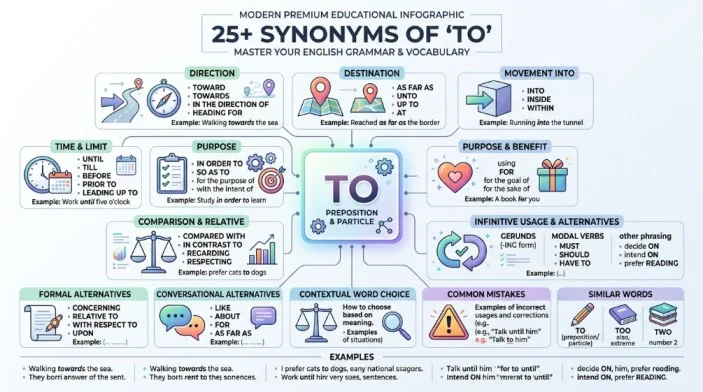
There is no single synonym of to that works in every sentence. Depending on its function, alternatives can include toward for direction, until for time, for for purpose or benefit, in order to for purpose, compared with for comparison, and so as to for formal purpose. In many infinitive constructions, to should simply remain unchanged.
Meaning, Tone, and Context
Simple Definition
To is a highly common English function word. It is primarily used as a preposition and as an infinitive marker.
Its meaning changes according to the structure of the sentence. For example:
“She walked to the store.”
Here, to shows movement toward a destination.
“She wants to learn.”
Here, to introduces the infinitive verb learn.
“Give the document to Maria.”
Here, to identifies the person receiving something.
“From Monday to Friday.”
Here, to shows the endpoint of a time range.
Because these uses are different, replacing to requires understanding the specific relationship it expresses.
Part of Speech
To has two major grammatical functions.
Preposition:
” We drove to the airport.”
Infinitive marker:
“She hopes to win.”
Overall Tone
To is neutral. It is neither formal nor informal and appears naturally in virtually every type of English communication.
Formality Level
To is completely standard in:
- Academic writing
- Business communication
- Professional emails
- Resumes
- Everyday conversations
- Creative writing
- Social media
- Formal documents
There is normally no reason to replace it simply because the writing is formal. An alternative should be used only when it expresses the intended relationship more precisely.
Common Uses
English speakers use to to express:
- Movement toward a place
- A destination
- A recipient
- A range or endpoint
- Purpose
- Relationship
- Comparison
- Attachment or connection
- Reaction or response
- Infinitive verbs
Word Forms
To does not have conventional noun, verb, adjective, or adverb forms.
It is a function word rather than a word with a normal family of derived forms.
When and How to Use “To”
Understanding the function of to is more useful than memorizing a list of replacements. The following examples show how it works in different real life situations.
Professional
“Please send the completed report to the finance department.”
Here, to identifies the recipient or destination of the report.
Academic
“Researchers need to examine the evidence carefully.”
Here, to introduces the infinitive examine.
Workplace
“I need to speak with my manager before the meeting.”
The word to forms the infinitive phrase to speak.
Personal
“We traveled to Chicago last summer.”
Here, to indicates the destination.
“I am writing to confirm your appointment.”
In this sentence, to confirm expresses the purpose of writing.
Resume
“Worked with senior managers to improve internal processes.”
Here, to improve expresses the purpose of the work.
Social Media
“Heading to the beach for the weekend.”
Here, to indicates movement toward a destination.
Best Synonyms of “To”
A direct replacement for to is possible only when the meaning of the original sentence allows it. Many alternatives are not true synonyms, but they can communicate a similar relationship in a particular context.
Professional Writing
Toward can replace to when describing direction.
Original:
“The company is moving to a more flexible business model.”
Possible alternative:
“The company is moving toward a more flexible business model.”
Toward emphasizes movement or progress in a particular direction.
Academic Writing
In order to can replace to when to introduces purpose.
Original:
“Researchers collected additional data to improve the analysis.”
Alternative:
“Researchers collected additional data in order to improve the analysis.”
The longer form makes the purpose especially explicit.
Business Communication
For can sometimes replace to when the sentence describes a purpose or intended use.
Original:
“This tool was designed to improve productivity.”
Alternative:
“This tool was designed for improving productivity.”
However, the original infinitive construction often sounds more natural, so for should not be substituted automatically.
Casual Conversation
Toward can replace to when talking about physical direction.
Original:
“He walked to the door.”
Alternative:
“He walked toward the door.”
The difference is important. To the door normally suggests the destination, while toward the door emphasizes direction and does not necessarily mean he reached it.
Emotional Writing
For may replace to when expressing something intended for someone’s benefit.
Original:
“She dedicated the award to her parents.”
There is no natural universal substitute here. This is an important example of why forcing a synonym can make a sentence unnatural.
Creative Writing
Toward can create a more directional or descriptive effect.
Original:
“He walked to the mountains.”
Alternative:
“He walked toward the mountains.”
The second sentence focuses more strongly on the direction of the journey.
Resume Writing
In order to can sometimes clarify purpose, although concise resume writing often prefers simply to.
Original:
“Created new procedures to reduce processing time.”
Possible alternative:
“Created new procedures in order to reduce processing time.”
The shorter version is usually better for a resume because it is more concise.
Workplace Communication
Until can replace to when to marks the endpoint of a time range.
Original:
“The office is open from 9 a.m. to 5 p.m.”
Alternative:
“The office is open from 9 a.m. until 5 p.m.”
Here, until emphasizes the endpoint in time.
Stronger Meaning
There is no inherently stronger synonym of to because its meaning depends entirely on its grammatical function.
For example, toward is not a stronger version of to. It expresses direction differently.
Softer Meaning
Likewise, there is no universal softer alternative to to. The correct replacement depends on whether to expresses direction, purpose, time, relationship, or another grammatical function.
When Not to Use “To”
When You Mean Direction Without a Destination
Sometimes toward is more accurate than to.
Less precise:
“She walked to the noise.”
Better:
“She walked toward the noise.”
The second sentence emphasizes movement in the direction of the noise rather than necessarily reaching it.
When You Mean a Time Endpoint
Until can sometimes be clearer.
Original:
“We worked from Monday to Friday.”
Alternative:
“We worked from Monday until Friday.”
Both can work in appropriate contexts, but until directly emphasizes duration ending at a particular time.
When You Need to Express Purpose Clearly
In order to can make the purpose more explicit.
Original:
“He studied hard to pass the exam.”
Alternative:
“He studied hard in order to pass the exam.”
The shorter version is already natural, so the longer form is useful mainly when additional clarity is needed.
When You Are Trying to Avoid Repetition
Do not replace every occurrence of to simply to create variety.
Incorrect approach:
“She went toward the store for buy groceries.”
Better:
“She went to the store to buy groceries.”
Repeating to is completely natural here because the two occurrences perform different grammatical jobs.
When “To” Is Part of an Infinitive
Do not replace infinitive to with a random preposition.
Incorrect:
“She wants toward learn English.”
Correct:
“She wants to learn English.”
The infinitive marker to has a grammatical function that alternatives such as toward cannot perform.
Words Commonly Confused With “To”
| Word | Difference | When to Use It | Example |
|---|---|---|---|
| Toward | Shows movement or progress in a direction without necessarily reaching a destination. | Direction or development. | “She walked toward the exit.” |
| For | Often expresses purpose, benefit, or intended use. | Purpose or recipient benefit. | “This gift is for you.” |
| Until | Shows an endpoint in time. | Time and duration. | “Stay here until noon.” |
| Into | Shows movement from outside to inside. | Entry or transformation. | “He walked into the room.” |
| At | Often identifies a specific point or location. | Position, time, or target. | “Meet me at the station.” |
| Against | Expresses opposition, contact, or resistance. | Opposition or physical contact. | “The ladder leaned against the wall.” |
Best Synonyms of “To” by Context
| Context | Best Alternative | Why It Works | Example |
|---|---|---|---|
| Formal writing | In order to | Clearly expresses purpose. | “The team met in order to discuss the proposal.” |
| Academic writing | In order to | Makes purpose explicit. | “The study was designed in order to evaluate the treatment.” |
| Professional communication | Toward | Works for direction or progress. | “We are moving toward greater efficiency.” |
| Business emails | For | Can express intended purpose or benefit. | “This document is for your review.” |
| Resume writing | To | Usually the most concise choice for purpose. | “Led a team to improve productivity.” |
| Workplace communication | Until | Can express a time endpoint. | “The office will remain open until 6 p.m.” |
| Casual conversation | Toward | Natural for physical direction. | “He ran toward the car.” |
| Everyday speaking | Into | Describes movement inside. | “She went into the kitchen.” |
| Creative writing | Toward | Adds directional emphasis. | “He wandered toward the distant lights.” |
| Storytelling | Into | Creates a sense of entering a place or situation. | “They stepped into the dark forest.” |
| Emotional writing | For | Often expresses benefit or intended recipient. | “She saved the letter for her daughter.” |
| Strong emphasis | In order to | Makes purpose more explicit. | “He spoke clearly in order to avoid confusion.” |
| Mild tone | To | Simple and neutral. | “She called to ask a question.” |
| Social media captions | To | Short and natural. | “Heading to the mountains.” |
| American English | To | Standard in all major uses. | “We drove to the office.” |
| British English | To | Also standard and widely used. | “She went to the station.” |
How to Choose the Best Synonym of “To”
The easiest way to choose an alternative is to identify what to is doing in the sentence.
If It Shows a Destination
Use to when someone or something moves to a specific destination.
“She drove to the airport.”
If you want to emphasize direction without confirming arrival, use toward.
“She drove toward the airport.”
If It Shows Purpose
Keep to in most everyday sentences.
“He went outside to get some fresh air.”
Use in order to when you want the purpose to be especially explicit.
“He went outside in order to get some fresh air.”
If It Shows Time
Use until when emphasizing the endpoint of an activity.
“Wait until Friday.”
If It Shows Movement Inside
Use into rather than to when the movement ends inside something.
“She walked into the building.”
Compare:
“She walked to the building.”
This means she moved toward the building.
“She walked into the building.”
This means she entered it.
If It Shows Benefit or Intended Use
For may be appropriate.
“This message is for the manager.”
However, do not replace to with for when the grammatical relationship changes.
If It Is an Infinitive
Keep to.
“I want to learn.”
“I need to study.”
“She hopes to win.”
There is normally no natural synonym that can replace infinitive to.
Real Life Examples of “To”
School
Original:
“Students need to read the instructions carefully.”
Purpose alternative:
“Students need to read the instructions carefully in order to complete the assignment correctly.”
College
Original:
“The professor asked students to submit their essays online.”
Here, to introduces the infinitive submit and should not be replaced with a directional synonym.
Workplace
Original:
“The manager went to the conference room.”
Direction alternative:
“The manager walked toward the conference room.”
The second version focuses on direction rather than arrival.
Business
Original:
“The company plans to expand into new markets.”
Purpose or goal is already naturally expressed with the infinitive.
Original:
“I am writing to request additional information.”
More explicit:
“I am writing in order to request additional information.”
The shorter version is usually preferable because it is direct.
Resume
Original:
“Worked with the marketing team to develop new campaigns.”
The infinitive clearly expresses the purpose of the work.
Conversation
Original:
“I’m going to the store.”
Direction alternative:
“I’m heading toward the store.”
The two sentences are similar, but the second does not necessarily indicate arrival.
Storytelling
Original:
“He ran to the old house.”
Alternative:
“He ran toward the old house.”
The alternative creates a stronger sense of movement without stating that he reached the house.
Blogging
Original:
Use these strategies to improve your writing.”
Alternative:
“Use these strategies in order to improve your writing.”
The original is more concise and natural for most blog content.
Social Media
Original:
“On my way to the concert.”
Alternative:
“Heading toward the concert.”
The original is shorter and more natural for a casual caption.
25 Best Alternatives and Related Expressions for “To”
Because to has several grammatical functions, the following list contains context based alternatives rather than claiming that every item is a universal synonym.
| Alternative | Simple Meaning | Best Used For | Example Sentence |
|---|---|---|---|
| Toward | In the direction of | Movement and progress | “She walked toward the entrance.” |
| Towards | Same meaning as toward | British English and some style preferences | “The train moved towards London.” |
| Into | From outside to inside | Entry and movement | “He stepped into the office.” |
| Until | Up to a particular time | Time ranges | “Stay here until noon.” |
| For | Intended for or benefiting | Purpose and recipients | “This note is for you.” |
| In order to | With the purpose of | Formal purpose | “She studied in order to qualify.” |
| So as to | With the purpose of | Formal writing | “He spoke quietly so as to avoid disturbing others.” |
| So that | With the result or purpose that | Purpose clauses | “She left early so that she could arrive on time.” |
| With the aim of | For the purpose of | Formal writing | “The program was created with the aim of reducing waste.” |
| For the purpose of | For a specific purpose | Formal documents | “The funds were collected for the purpose of supporting students.” |
| At | At a particular point or target | Locations and targets | “She arrived at the station.” |
| Against | In contact with or opposition to | Contact and opposition | “He pushed the box against the wall.” |
| By | Through or no later than | Methods and deadlines | “Please respond by Friday.” |
| Until | Up to an endpoint | Duration | “The store remains open until eight.” |
| Compared with | In relation to another thing | Comparison | “Costs rose compared with last year.” |
| Relative to | In relation to | Formal comparison | “Sales increased relative to last quarter.” |
| In relation to | Regarding or connected with | Formal contexts | “The policy changed in relation to employee benefits.” |
| Regarding | Concerning | Topics and subjects | “I have a question regarding your application.” |
| Concerning | About | Formal writing | “We received a complaint concerning the service.” |
| For the sake of | For the benefit or purpose of | Formal and emotional writing | “They compromised for the sake of peace.” |
| In the direction of | Toward a particular direction | Explicit directional writing | “The vehicle moved in the direction of the bridge.” |
| Up to | As far as or until | Distance and time | “The trail continues up to the lake.” |
| As far as | To a particular point | Distance | “We walked as far as the river.” |
| In preparation for | Before something happens | Professional writing | “The team met in preparation for the launch.” |
| With a view to | With the intention of | Formal English | “The company changed its policy with a view to improving efficiency.” |
Synonyms of “To” by Usage
Professional vs Personal Synonyms
In professional writing, alternatives such as toward, in order to, with the aim of, and in preparation for can be useful when they express a more specific relationship.
In personal communication, to is usually the most natural choice. Replacing it simply for variety can make ordinary sentences sound unnecessarily complicated.
Formal vs Conversational Synonyms
Formal writing may use:
- In order to
- So as to
- With the aim of
- With a view to
- For the purpose of
- In preparation for
Conversational English generally favors:
- To
- Toward
- Into
- For
- Until
For example:
Formal:
“The committee met in order to review the proposal.”
Conversational:
“We met to review the proposal.”
Both are grammatical, but the second sounds more direct.
Academic Synonyms
Academic writing often uses in order to, with the aim of, relative to, and in relation to when these expressions accurately describe the intended relationship.
However, academic writing does not require replacing every to.
For example:
“The researchers collected data to examine the relationship.”
This sentence is already clear and professional.
Replacing it with:
“The researchers collected data in order to examine the relationship.”
is possible, but it is not automatically better. Good academic writing values precision and clarity rather than unnecessary complexity.
Professional and Business Synonyms
Business writing should normally favor clarity over vocabulary variety.
Use to when it is the shortest accurate option:
“We met to discuss the budget.”
Use toward when describing progress:
“The company is moving toward a more sustainable model.”
Use in preparation for when describing preparation:
“The team met in preparation for the product launch.”
Use by when describing a deadline:
“Please submit the document by Friday.”
These choices communicate different relationships, so they should not be treated as interchangeable.
Creative and Literary Synonyms
Creative writing gives writers more freedom to describe direction, purpose, and relationships.
Instead of:
“He walked to the forest.”
a writer might use:
“He walked toward the forest.”
The second version focuses attention on the journey and direction.
Similarly:
“She stepped into the darkness.”
creates a different image from:
“She walked to the darkness.”
The best choice depends on the image and movement the writer wants the reader to understand.
Slang or Modern Synonyms
There are no reliable slang synonyms for to that can replace the word across normal English sentences.
In informal speech, people may use expressions such as headed toward, going over to, or on the way to, but these are phrases rather than true synonyms.
For example:
“I’m going to the store.”
can become:
“I’m heading over to the store.”
The second sentence is more conversational, but over to is not a universal substitute for to.
Strongest to Mildest Alternatives
Because to is a grammatical function word, it does not have a meaningful intensity scale like adjectives such as important or angry.
Instead, alternatives can be grouped according to how specifically they express the relationship.
| Level | Expression | Main Function |
|---|---|---|
| Mild and general | To | General direction, purpose, or relationship |
| More specific | Toward | Direction without necessarily reaching |
| More specific | Into | Movement from outside to inside |
| More explicit | Until | Time endpoint |
| More explicit | For | Benefit or intended use |
| More formal | In order to | Purpose |
| Very explicit | For the purpose of | Formal purpose |
| Very explicit | With the aim of | Formal intention |
These are not stronger and weaker synonyms in the usual sense. They simply provide different levels of grammatical and semantic specificity.
Emotional vs Neutral Alternatives
Emotional Alternatives
Some phrases can add emotional or rhetorical emphasis depending on context.
For the sake of
“She stayed for the sake of her family.”
With a view to
This can express deliberate intention in a formal context.
For the benefit of
“This decision was made for the benefit of the community.”
Neutral Alternatives
These are generally factual and straightforward:
- To
- Toward
- Into
- Until
- For
- By
- At
For most everyday and professional communication, neutral alternatives are preferable because they communicate the relationship without adding unnecessary emotion.
Antonyms of “To”
A traditional list of 15 antonyms of to is not linguistically accurate because to is a function word with several grammatical uses rather than a word with one clear opposite.
For example, to in “go to school” does not have one universal opposite. The appropriate contrast might be from when describing movement away from a starting point:
“She traveled to New York.”
“She traveled from New York.”
In another sentence, there may be no meaningful antonym at all:
“She wants to study.”
There is no natural opposite preposition that can replace infinitive to.
For this reason, it is better to study contextual contrasts rather than force an artificial list of antonyms.
| Context | To | Contextual Contrast | Example |
|---|---|---|---|
| Destination | To | From | “She went to Boston.” / “She came from Boston.” |
| Direction | To | Away from | “He moved to the door.” / “He moved away from the door.” |
| Time range | To | From | “Open from Monday to Friday.” / “Closed from Saturday.” |
| Purpose | To | Without | “He studied to pass.” / “He left without studying.” |
| Recipient | To | From | “I sent it to her.” / “I received it from her.” |
Comparison: “To” vs Similar Words
“To” vs “Toward”
Main Difference
To usually identifies a destination. Toward indicates direction but does not necessarily mean the destination was reached.
Which Is Stronger?
Neither is stronger. They express different relationships.
Which Is More Formal?
Both are neutral and suitable for formal and informal English.
When to Use Each
Use to for a destination and toward for movement in a direction.
Examples
To:
“She walked to the station.”
Toward:
“She walked toward the station.”
“To” vs “For”
Main Difference
To can show direction or a recipient. For often expresses purpose, benefit, or intended use.
Which Is Stronger?
Neither.
Which Is More Formal?
Both are neutral.
When to Use Each
Choose based on the grammatical relationship.
Examples
To:
“Give the letter to John.”
For:
“The letter is for John.”
“To” vs “Until”
Main Difference
To can mark the endpoint of a range. Until specifically emphasizes continuation up to a time.
Examples
To:
“The store is open from nine to five.”
Until:
“The store is open until five.”
“To” vs “Into”
Main Difference
To can indicate movement toward a destination. Into indicates movement from outside to inside.
Examples
To:
“She walked to the room.”
Into:
“She walked into the room.”
“To” vs “At”
Main Difference
To often indicates movement toward a destination. At usually identifies a position or specific point.
Examples
To:
“We drove to the airport.”
At:
“We waited at the airport.”
“To” vs “By”
Main Difference
To has many functions, while by can indicate a deadline, method, or agent.
Examples
To:
“Send the report to Maria.”
By:
“Send the report by Friday.”
Common Phrases and Expressions with “To”
Phrase: To be honest
Meaning
Used to introduce a sincere opinion or statement.
Example
“To be honest, I expected the project to take longer.”
Phrase: To some extent
Meaning
Used when something is partly true.
Example
“To some extent, the criticism was justified.”
Phrase: To the point
Meaning
Direct and relevant.
Example
“Her presentation was clear and to the point.”
Phrase: To date
Meaning
Up to the present time.
Example
“To date, the company has received more than one hundred applications.”
Phrase: To the best of my knowledge
Meaning
Used when stating something based on what you currently know.
Example
“To the best of my knowledge, the meeting is still scheduled for Friday.”
Phrase: To a certain extent
Meaning
Partly, but not completely.
Example
“To a certain extent, the changes improved the process.”
Phrase: To this day
Meaning
Continuing until the present time.
Example
“To this day, she remembers that conversation.”
Phrase: To begin with
Meaning
Used when introducing the first reason or point.
Example
“To begin with, we need a clear plan.”
Common Mistakes to Avoid
Mistake 1: Treating Every “To” as Replaceable
Incorrect
Replacing every to with another preposition simply to avoid repetition.
Better
Keep to when it is already the most natural grammatical choice.
Why
Natural English does not require vocabulary variation for common function words.
Mistake 2: Confusing “To” With “Too”
Incorrect
“I want too go home.”
Better
“I want to go home.”
Why
To is used before the base form of a verb in an infinitive. Too usually means “also” or “excessively.”
Mistake 3: Confusing “To” With “Two”
Incorrect
“I have to brothers.”
Better
“I have two brothers.”
Why
Two is the number 2, while to is a function word.
Mistake 4: Using “Toward” for an Infinitive
Incorrect
“She wants toward learn.”
Better
“She wants to learn.”
Why
Toward expresses direction. It cannot replace infinitive to.
Mistake 5: Confusing “To” and “Into”
Incorrect
“She walked into the building” when the intended meaning is only movement toward the building.
Better
“She walked to the building.”
Why
Into means entering the inside of something.
Mistake 6: Using “For” Instead of “To” Automatically
Incorrect
“I went for buy groceries.”
Better
“I went to buy groceries.”
Why
The infinitive to buy correctly expresses the purpose of the action.
Mistake 7: Making Formal Writing More Complicated
Incorrect
“The company created a program for the purpose of improving employee communication.”
Better
“The company created a program to improve employee communication.”
Why
The shorter version is clearer and more direct. Formal writing does not need unnecessarily long expressions.
Frequently Asked Questions
What is the best synonym of “to”?
There is no single best synonym of to because the word has several grammatical functions. Toward, into, until, for, and in order to can replace it only in specific contexts where they preserve the intended meaning.
What are the best formal synonyms of “to”?
Useful formal alternatives include in order to, so as to, with the aim of, for the purpose of, and with a view to when to expresses purpose. However, simple to is often preferable.
What are common informal synonyms of “to”?
There are no universal informal synonyms for to. In conversational English, phrases such as heading toward, going over to, and on the way to may express similar ideas in particular situations.
What is another word for “to” in professional writing?
The best professional alternative depends on meaning. Use toward for direction, until for a time endpoint, in order to for explicit purpose, and in preparation for when describing preparation for an event.
What is the difference between “to” and “toward”?
To generally identifies a destination, while toward indicates movement in a direction. “She walked to the station” suggests the station was her destination, while “She walked toward the station” focuses on direction.
What is the opposite of “to”?
There is no universal opposite of to. In movement contexts, from can provide a contextual contrast, as in “go to school” and “come from school.” Infinitive to has no direct antonym.
Conclusion
The word to is too grammatically versatile to have one universal synonym. Its meaning changes depending on whether it expresses destination, direction, purpose, time, relationship, or an infinitive construction.
The most useful alternatives include toward, into, until, for, in order to, so as to, and several more specific phrases. However, the best choice is not always an alternative. In many sentences, keeping to is the clearest and most natural option.
When looking for a synonym of to, first identify what the word means in that particular sentence. This simple habit will help you avoid incorrect substitutions and choose vocabulary based on meaning, grammar, audience, and context.
Read More Related Articles:
50+ Synonyms of Change | Meanings, Uses, Examples, and …
50+ Synonyms of Infinitive | Meanings, Uses, Examples, and …