When one small word appears again and again, your writing can quickly feel repetitive. Synonyms of to can help you understand the different words and phrases that may replace to in specific contexts. However, “to” is unusual because it can function as a preposition or as part of an infinitive, so there is no single replacement that works everywhere.
Finding a to synonym requires attention to meaning, grammar, and sentence structure. Depending on the context, alternatives may include toward, until, into, for, or phrases such as in order to. This guide explains synonyms for to, synonym for to, and to synonyms with clear examples and practical usage notes. You will also learn how to identify a synonym of to, choose another word to fit your sentence, and understand when other words for to are grammatically appropriate.
What Are the Best Synonyms of “To”?
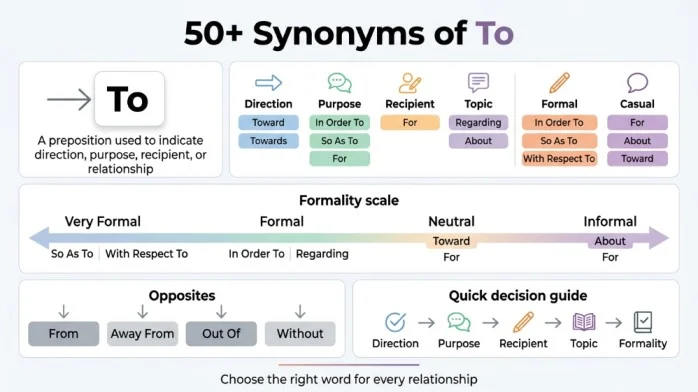
To is a preposition that indicates direction, purpose, recipient, or relationship. Since it is a grammatical function word, it does not have direct synonyms in the traditional sense. However, in many contexts, you can replace to with alternatives like toward, for, in order to, so as to, with the aim of, for the purpose of, towards, unto, in the direction of, as far as, up to, until, before, by, with, against, according to, compared with, in relation to, regarding, concerning, about, and of. The right choice depends on the context, meaning, and level of specificity you want to convey.
Meaning, Tone, and Context
Simple Definition
To is a preposition used to indicate direction, purpose, recipient, or relationship. It shows where something is going, why something is done, who receives something, or how things are connected.
Part of Speech
Preposition and infinitive marker
Overall Tone
The word is neutral. It simply indicates a relationship without adding emotion or emphasis.
Formality Level
To is considered neutral and appears naturally in all types of communication, from casual conversations to formal academic writing.
Common Uses
Native English speakers commonly use to when:
- Indicating direction or movement
- Expressing purpose or intention
- Showing the recipient of something
- Comparing or relating things
- Indicating a limit or extent
- Marking the infinitive form of verbs
- Showing attachment or connection
Word Forms
| Form | Word |
|---|---|
| Preposition | to |
| Infinitive Marker | to |
| Related Form | toward, towards, until |
| Opposite Form | from, away from |
When and How to Use “To”
The word to works well whenever you want to show direction, purpose, or relationship. However, choosing a more specific preposition or phrase can make your message clearer and more impactful.
Professional
“Please send the report to the client before the end of the day.”
Academic
“The study aims to explore the relationship between diet and health.”
Workplace
“Employees are encouraged to submit their feedback to the HR department.”
Personal
“I walked to the store to buy some groceries.”
“Please forward this message to the appropriate team member.”
Resume
“Collaborated with cross-functional teams to achieve project goals.”
Social Media
“Excited to share this news with all of you today!”
Best Synonyms of “To”
The word to is useful because it appears in almost every type of writing, but no single alternative works perfectly in every situation. Some alternatives emphasize direction, while others highlight purpose, recipient, or relationship. Choosing the right word helps your writing sound more natural and precise.
Professional Writing: Toward
Toward is one of the strongest professional alternatives to to. It indicates movement or direction.
Example:
“Our efforts are directed toward improving customer satisfaction.”
Why it works:
Business writing benefits from precise language, and toward clearly communicates direction.
Academic Writing: In Order To
In academic essays, research papers, and reports, in order to is often a better choice than to when expressing purpose.
Example:
“Participants completed the survey in order to provide valuable feedback.”
Why it works:
It sounds objective, formal, and academically appropriate.
Business Communication: For
For indicates purpose or intended recipient in a professional context.
Example:
“This proposal is for the new marketing campaign.”
Why it works:
It immediately communicates purpose and audience.
Casual Conversation: Toward
For everyday speaking, toward sounds natural without becoming overly formal.
Example:
“We’re headed toward the beach.”
Why it works:
Native English speakers frequently use toward to describe direction in casual speech.
Emotional Writing: For
When discussing personal experiences or expressing feelings, for is usually more expressive than to.
Example:
“I would do anything for you.”
Why it works:
It emphasizes personal connection and devotion.
Creative Writing: Toward
Creative writing often benefits from descriptive vocabulary. Toward helps create stronger imagery.
Example:
“She walked toward the distant mountains.”
Why it works:
It captures the reader’s attention and adds depth to storytelling.
Resume Writing: In Order To
Recruiters frequently see in order to because it clearly explains purpose and motivation.
Example:
“Implemented new procedures in order to improve efficiency.”
Why it works:
It sounds concise, professional, and achievement-focused.
Workplace Communication: For
For emphasizes purpose and necessity for success or smooth operations.
Example:
“Training is required for all new employees.”
Why it works:
It communicates necessity while maintaining a professional tone.
Stronger Emphasis: So As To
When you need stronger emphasis, so as to is one of the best replacements for to when expressing purpose.
Example:
“The team worked overtime so as to meet the deadline.”
Why it works:
It suggests careful intention and deliberate action.
Softer Meaning: Toward
Sometimes you want to indicate direction without making it sound overly specific.
Example:
“The company is moving toward a more sustainable model.”
Why it works:
It gives moderate specificity without exaggeration.
When Not to Use “To”
Although to is versatile, it is not always the most effective word. In many situations, a more specific preposition or phrase communicates your message more clearly.
When It Sounds Too Vague
Sometimes to is too broad and fails to specify exactly what you mean.
Less Effective
“I went to the store.”
Better
“I walked toward the store.”
Why
Toward indicates direction without implying arrival.
When Greater Specificity Is Needed
If the situation requires precise purpose, to may sound too vague.
Less Effective
“She studied to pass the test.”
Better
“She studied in order to pass the test.”
Why
In order to clearly expresses purpose and intention.
In Academic Writing
Academic writing usually favors more precise vocabulary.
Less Effective
“The experiment was designed to test the hypothesis.”
Better
“The experiment was designed so as to test the hypothesis.”
Why
So as to sounds more formal and deliberate.
On a Resume
General wording often reduces the impact of your achievements.
Less Effective
“Worked to improve sales.”
Better
“Worked with the sales team to improve revenue.”
Why
Adding detail clarifies your specific contribution.
In Creative Writing
Using to repeatedly can make storytelling feel flat.
Less Effective
“He ran to the house.”
Better
“He ran toward the old house.”
Why
Toward creates a sense of journey and anticipation.
When Expressing Personal Feelings
If something matters because of personal connection, choose a more expressive word.
Less Effective
“Thanks to you.”
Better
“Thanks for everything you’ve done.”
Why
For emphasizes gratitude and personal connection.
Prepositions Commonly Confused with “To”
| Word | Difference | When to Use It | Example |
|---|---|---|---|
| Toward | Indicates direction without necessarily arriving | Describing movement | “We walked toward the park.” |
| For | Indicates purpose or recipient | Expressing intention | “This gift is for you.” |
| With | Indicates accompaniment or means | Describing association | “She went with her friend.” |
| By | Indicates means or proximity | Describing method | “We traveled by car.” |
| From | Indicates origin or source | Describing starting point | “She came from New York.” |
| Of | Indicates relationship or belonging | Describing connection | “The color of the sky.” |
| About | Indicates topic or subject | Describing discussion | “We talked about the project.” |
| Regarding | Indicates reference or concern | Formal correspondence | “Regarding your inquiry…” |
Best Synonyms of “To” by Context
| Context | Best Alternative | Why It Works | Example |
|---|---|---|---|
| Formal Writing | Toward | Sounds precise and professional. | “Our efforts are directed toward growth.” |
| Academic Writing | In Order To | Fits research and essays naturally. | “Students studied in order to succeed.” |
| Professional Communication | For | Highlights purpose and intent. | “Training is required for all staff.” |
| Business Emails | Regarding | Concise and professional. | “Regarding your question about the budget…” |
| Resume Writing | In Order To | Emphasizes purpose and achievement. | “Implemented changes in order to improve.” |
| Workplace Communication | Toward | Pinpoints direction and goals. | “We are working toward our targets.” |
| Casual Conversation | Toward | Sounds natural in daily speech. | “We’re heading toward the mall.” |
| Everyday Speaking | For | Common informal alternative. | “This is for you.” |
| Creative Writing | Toward | Adds vivid description. | “She walked toward the sunset.” |
| Storytelling | Toward | Shows movement and anticipation. | “He rode toward the distant castle.” |
| Emotional Writing | For | Expresses personal connection. | “I would do anything for you.” |
| Strong Emphasis | So As To | Indicates deliberate intention. | “We planned carefully so as to avoid mistakes.” |
| Mild Tone | Toward | Gives moderate emphasis. | “We are moving toward a solution.” |
| Social Media Captions | For | Sounds engaging and natural. | “So grateful for this moment!” |
| American English | Toward | Frequently used in business and media. | “We’re working toward a common goal.” |
| British English | Towards | Common in formal and everyday usage. | “We are moving towards a solution.” |
Synonyms of “To” by Usage
The word to works in almost every situation, but choosing a more specific preposition or phrase makes your writing stronger and more natural. The sections below explain which alternatives fit different types of communication.
Professional vs Personal Alternatives
- Professional communication requires precise vocabulary, while personal conversations sound better with simpler, more relatable words.
Professional Alternatives
| Alternative | Best Used For | Why It Works |
|---|---|---|
| Toward | Reports, policies | Shows direction and movement. |
| For | Business priorities | Indicates purpose. |
| In Order To | Reports, proposals | Expresses clear intention. |
| Regarding | Professional correspondence | Indicates subject matter. |
| So As To | Formal writing | Emphasizes deliberate action. |
Recommendation
Use toward, for, in order to, or regarding in resumes, business emails, presentations, and reports because they sound more precise than to.
Personal Alternatives
| Alternative | Best Used For | Example |
|---|---|---|
| For | Relationships | “This gift is for you.” |
| Toward | Daily conversations | “We walked toward the lake.” |
| For | Casual speaking | “I did it for you.” |
| About | Personal events | “We talked about our plans.” |
| With | Shared experiences | “I went with my friend.” |
Recommendation
In conversations with friends and family, natural words like for, toward, and about often sound better than overly formal alternatives.
Formal vs Conversational Alternatives
Choosing the right level of formality helps your writing match the audience.
| Situation | Best Alternatives |
|---|---|
| Reports | Toward, Regarding |
| Essays | In Order To, So As To |
| Business Writing | For, Regarding |
| Presentations | Toward, For |
| Professional Emails | Regarding, For |
| Casual Conversations | Toward, For |
| Text Messages | For, About |
Example
Formal:
“The committee is working toward a comprehensive solution.”
Conversational:
“We’re heading toward the new restaurant.”
Academic Alternatives
Academic writing benefits from vocabulary that sounds precise and objective.
In Order To
Commonly used when expressing purpose or intention.
Example
“Participants completed the survey in order to provide data.”
So As To
Best for formal explanations of purpose.
Example
“The experiment was designed so as to minimize errors.”
Toward
Ideal when describing progress or movement.
Example
“Research is moving toward a better understanding of the issue.”
Regarding
Appropriate when referring to a specific topic.
Example
“Regarding the findings, further research is needed.”
With Respect To
Formal phrase indicating relationship.
Example
“With respect to the data, several patterns emerged.”
Recommendation
For essays and research papers, in order to, so as to, and toward usually sound stronger and more authoritative than to.
Professional and Business Alternatives
Business communication often requires concise and specific language.
For
Perfect for indicating purpose or recipient.
Example
“This training is for all employees.”
Toward
Highlights progress and direction.
Example
“We are working toward our quarterly goals.”
Regarding
Describes the subject of communication.
Example
“Regarding your recent inquiry, we have prepared a response.”
In Order To
Shows clear purpose and intention.
Example
“We implemented new policies in order to improve efficiency.”
So As To
Formal expression of purpose.
Example
“The team collaborated so as to meet the deadline.”
Recommendation
Use these alternatives in resumes, interviews, meetings, presentations, business emails, and client communication to sound more professional.
Creative and Literary Alternatives
Creative writing benefits from expressive vocabulary that creates emotion and imagery.
Toward
Adds movement and direction.
Example
“He walked toward the horizon.”
For
Creates a sense of purpose and devotion.
Example
“She would cross oceans for him.”
About
Adds depth to descriptions and dialogue.
Example
“Their conversation was about dreams and hopes.”
With
Creates a sense of companionship.
Example
“She traveled with her loyal dog.”
Against
Adds conflict and tension.
Example
“He fought against the raging storm.”
These alternatives make stories, speeches, and descriptive writing more engaging.
Slang or Modern Alternatives
There are very few true slang alternatives for to, but native speakers often use casual expressions.
| Expression | Meaning | Appropriate For | Avoid In |
|---|---|---|---|
| For | Purpose or recipient | Everyday conversations | Academic papers |
| Toward | Direction | Friends, social media | Business reports |
| About | Topic | Casual speech | Formal writing |
Example
Casual:
“I’m going for a walk.”
Formal:
“I am going for a walk to clear my mind.”
Strongest to Mildest Alternatives
The following scale shows how different alternatives express different levels of specificity.
| Specificity | Alternatives |
|---|---|
| Very Specific | In Order To, So As To, With Respect To |
| Specific | Toward, Regarding, For |
| Moderate | About, With, By |
| General | To |
| Very General | For, About |
Understanding the Scale
- In Order To, So As To, With Respect To express very specific purpose.
- Toward, Regarding, For indicate clear direction or relationship.
- About, With, By express general relationships.
- To is the most general.
- For, About are casual and informal.
Emotional vs Neutral Alternatives
Some alternatives express feelings, while others simply communicate information.
Emotional Alternatives
| Alternative | Best Used For |
|---|---|
| For | Expressions of love and gratitude |
| Toward | Emotional journeys |
| About | Meaningful conversations |
| With | Shared experiences |
| Against | Struggles and challenges |
These words add emotion and help readers connect with the message.
Neutral Alternatives
| Alternative | Best Used For |
|---|---|
| Toward | Direction |
| Regarding | Subject matter |
| For | Purpose |
| By | Method |
| Of | Relationship |
Neutral alternatives communicate information without adding unnecessary emotion.
Antonyms of “To”
Since to is a preposition, it does not have true antonyms. However, the following table shows prepositions that express opposite meanings in terms of direction or relationship.
| Antonym | Meaning | Example Sentence |
|---|---|---|
| From | Indicates origin or source | “She walked from the store.” |
| Away From | Indicates distance | “He moved away from the crowd.” |
| Out Of | Indicates departure | “She walked out of the room.” |
| Off | Indicates separation | “He jumped off the bridge.” |
| Without | Indicates absence | “She traveled without her family.” |
| Except | Indicates exclusion | “Everyone except John attended.” |
| Instead Of | Indicates substitution | “Choose tea instead of coffee.” |
| Apart From | Indicates separation | “Apart from the noise, it was peaceful.” |
| Beyond | Indicates exceeding | “The results were beyond expectations.” |
| Opposite | Indicates contrary direction | “They went in opposite directions.” |
| Away | Indicates distance | “He ran away from home.” |
Comparison: “To” vs Similar Words
Although to is the most common preposition, several similar words carry different shades of meaning. Understanding these differences helps you choose the most accurate word for each situation.
To vs Toward
Main Difference
To indicates arrival at a destination. Toward indicates movement in a direction without necessarily arriving.
Which Is Stronger?
Neither is stronger. They emphasize different ideas.
Which Is More Formal?
Both work well in formal writing, but toward is more precise.
When to Use Each
Use to when you reach a destination.
Use toward when you are moving in a direction.
Examples
To:
“We walked to the park.”
Toward:
“We walked toward the park.”
To vs For
Main Difference
To indicates direction or recipient. For indicates purpose or benefit.
Which Is Stronger?
For is stronger because it emphasizes purpose and intention.
Which Is More Formal?
Both are suitable for professional writing.
When to Use Each
Use to when showing where something goes.
Use for when showing why something is done.
Examples
To:
“I gave the gift to her.”
For:
“I bought the gift for her.”
To vs With
Main Difference
To indicates direction or relationship. With indicates accompaniment or means.
Which Is Stronger?
Neither is stronger. They emphasize different ideas.
Which Is More Formal?
Both are widely used in professional writing.
When to Use Each
Use to when indicating direction.
Use with when indicating accompaniment.
Examples
To:
“She went to the store.”
With:
“She went with her friend.”
To vs By
Main Difference
To indicates direction. By indicates method or means.
Which Is Stronger?
Neither is stronger. They emphasize different ideas.
Which Is More Formal?
Both fit professional writing.
When to Use Each
Use to when showing movement.
Use by when showing how something is done.
Examples
To:
“We traveled to the city.”
By:
“We traveled by train.”
To vs About
Main Difference
To indicates direction or relationship. About indicates topic or subject.
Which Is Stronger?
Neither is stronger. They emphasize different ideas.
Which Is More Formal?
About is widely used in both formal and informal contexts.
When to Use Each
Use to when showing direction.
Use about when discussing a topic.
Examples
To:
“Talk to her.”
About:
“Talk about her.”
To vs Regarding
Main Difference
To indicates direction. Regarding indicates reference or concern.
Which Is Stronger?
Regarding is stronger because it is more formal and specific.
Which Is More Formal?
Regarding is much more formal.
When to Use Each
Use to for general direction.
Use regarding for formal correspondence.
Examples
To:
“I wrote to the company.”
Regarding:
“I wrote regarding the issue.”
Common Phrases and Expressions with “To”
| Phrase | Meaning | Example Sentence |
|---|---|---|
| To the point | Direct and relevant | “His speech was short and to the point.” |
| To be honest | Expressing truthfulness | “To be honest, I didn’t enjoy the movie.” |
| To tell you the truth | Honest admission | “To tell you the truth, I was surprised.” |
| To my surprise | Unexpectedly | “To my surprise, she agreed immediately.” |
| To some extent | Partially | “I agree with you to some extent.” |
| To this day | Even now | “To this day, I remember that moment.” |
| To the best of | As far as possible | “To the best of my knowledge, it’s true.” |
| To and fro | Back and forth | “He paced to and fro in the room.” |
| To a degree | Somewhat | “I understand to a degree.” |
| To the core | Completely | “She is honest to the core.” |
Common Mistakes to Avoid
1. Using “To” Instead of “Too”
Incorrect
“I want to go to.”
Better
“I want to go too.”
Why
Too means also or excessively.
2. Using “To” Instead of “Toward”
Incorrect
“We drove to the beach but didn’t arrive.”
Better
“We drove toward the beach.”
Why
Toward indicates direction without necessarily reaching the destination.
3. Using “To” Instead of “For”
Incorrect
“This gift is to you.”
Better
“This gift is for you.”
Why
For indicates intended recipient or purpose.
4. Omitting “To” in Infinitive Phrases
Incorrect
“She wants go home.”
Better
“She wants to go home.”
Why
To is required to form the infinitive.
5. Using “To” Incorrectly After Certain Verbs
Incorrect
“I discussed to her about the plan.”
Better
“I discussed the plan with her.”
Why
Discuss takes with, not to.
6. Confusing “To” with “From”
Incorrect
“She traveled to New York from.”
Better
“She traveled from New York to Boston.”
Why
Both prepositions are needed for direction and origin.
7. Overusing “To” in Creative Writing
Incorrect
“He went to the door and walked to the window.”
Better
“He approached the door and walked toward the window.”
Why
Using varied vocabulary improves readability and style.
Frequently Asked Questions
What is a synonym for “to”?
A synonym for “to” depends on its use. Words such as toward, into, until, or for may work in specific contexts.
What are the synonyms for “to”?
Common alternatives include toward, into, until, and for, but “to” often has no direct replacement.
What is another word for “to”?
Another word for “to” can be toward when showing direction, or until when referring to a time limit.
Can “to” have different synonyms?
Yes. The best to synonym changes according to whether “to” shows direction, purpose, time, or an infinitive verb.
What are other words for “to”?
Other words for “to” include toward, into, until, and for in certain sentences and contexts.
How do I choose the right synonym for “to”?
Look at the meaning of “to” in the sentence first. Then choose an alternative that preserves the intended meaning and grammar.
What are the best formal alternatives to “to”?
Strong formal alternatives include toward, in order to, so as to, regarding, and with respect to. These work well in academic papers, reports, and business communication.
What are common informal alternatives to “to”?
Common informal alternatives include for, toward, and about. These expressions sound natural in everyday conversations and social media posts.
What is another word for “to” in professional writing?
In professional communication, excellent alternatives include toward, for, regarding, in order to, and so as to. These make reports, emails, resumes, and presentations sound more precise and polished.
What is the difference between “to” and “toward”?
To indicates arrival at a destination. Toward indicates movement in a direction without necessarily arriving. To is more definitive; toward is more directional.
What is the opposite of “to”?
Since to is a preposition, it does not have a direct opposite. However, in terms of direction, from and away from serve as opposites, indicating origin rather than destination.
Conclusion
The word to is one of the most common prepositions in English, but using it repeatedly can make your writing feel repetitive. Learning the best alternatives to to helps you express your ideas with greater accuracy, stronger style, and better clarity.
You’re writing an essay, preparing a business presentation, updating your resume, or having a casual conversation, no single alternative fits every situation. Words like toward, for, in order to, so as to, regarding, and about each carry unique meanings and should be chosen based on your audience, tone, and purpose.
A simple way to improve your vocabulary is to pause before writing to and ask yourself what relationship you are trying to express. Choosing the most appropriate alternative will make your writing more engaging, professional, and natural.
Read More Related Articles:
- Synonyms for Creativity | Meaning, Examples, and Better …
- Synonyms for Marginalized| Meaning, Examples, and Better …