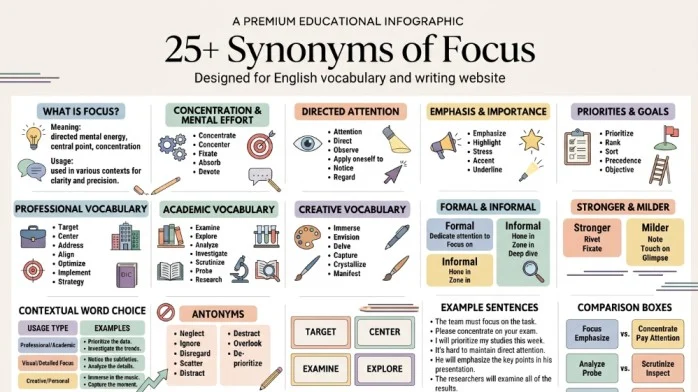
Strong writing depends on choosing words that express an idea with precision. Synonyms of Focus can help you replace repetition, sharpen your message, and match your language to the situation. The word focus can describe concentration, attention, priority, or a central subject, so the best alternative depends on context. Words such as concentration, attention, emphasis, priority, and center can work differently across academic, professional, and everyday writing. Understanding these distinctions makes your vocabulary more flexible and natural.
For students, writers, teachers, professionals, and English learners, knowing the right Synonyms of Focus can make sentences clearer and more purposeful. A formal report may need emphasis, while casual writing may sound more natural with attention. This guide explains accurate alternatives, their meanings, tones, common uses, and example sentences so you can choose the right word confidently without changing the intended meaning.
What Are the Best Synonyms of “Focus”?
The best synonyms of focus depend on its meaning. For concentration, use concentrate, attention, or concentration. For emphasis, choose emphasize or highlight. In professional writing, prioritize and target work well, while center, focal point, and subject fit discussions about the main idea or topic.
Meaning, Tone, and Context
Simple Definition
Focus generally means giving attention to something specific or identifying the central point, purpose, or subject of something.
As a verb, focus means to direct your attention or effort toward something.
Example:
“Please focus on the most urgent tasks.”
As a noun, focus can mean the main subject, center of attention, or concentration directed toward something.
Example:
“The main focus of the meeting was customer satisfaction.”
Part of Speech
Focus can function as both a verb and a noun.
As a verb:
“She focused on improving her writing.”
As a noun:
“The focus of the article is vocabulary development.”
Overall Tone
The word focus is generally neutral. It does not automatically express positive or negative emotion.
Its meaning depends heavily on context. In a professional setting, focus can suggest discipline and clear priorities. In creative writing, it can refer to the central subject or attention given to a particular detail.
Formality Level
Focus is a neutral word that works naturally in:
- Academic writing
- Professional communication
- Business reports
- Emails
- Everyday conversations
- Social media
- Presentations
- Creative writing
It is neither highly formal nor strongly informal.
Common Uses
Native English speakers commonly use focus when discussing:
- Attention
- Concentration
- Priorities
- Goals
- Projects
- Research
- Education
- Business strategy
- Personal development
- Writing topics
- Meetings
- Photography
- Visual attention
- Main ideas
Word Forms
| Word Form | Example |
|---|---|
| Noun | The focus of the discussion changed. |
| Verb | We need to focus on quality. |
| Adjective | A focused approach can improve results. |
| Related noun | Her concentration remained strong. |
| Related adjective | He is highly focused on his goals. |
When and How to Use “Focus”
Use focus when you want to communicate directed attention, concentration, priority, or a central subject. It is particularly useful when the reader needs to understand what deserves attention or what forms the main part of an activity.
Professional
“The team needs to focus on improving customer retention.”
Here, focus means directing effort toward a specific business objective.
Academic
“The study focuses on the effects of social media on student learning.”
In academic writing, focuses on clearly identifies the subject being examined.
Workplace
“We should focus on completing the highest priority tasks first.”
This use emphasizes attention and workplace priorities.
Personal
“I am trying to focus on developing healthier habits.”
Here, focus describes personal attention and effort.
“During today’s meeting, I would like to focus on the project timeline.”
This sounds clear and professional without being overly formal.
Resume
“Focused on improving customer satisfaction through efficient service.”
On a resume, focused on can describe an area of professional responsibility, although a stronger action verb may sometimes produce a more specific statement.
Social Media
“This month, I’m focusing on learning new skills and making steady progress.”
This conversational use works naturally in captions and personal updates.
Best Synonyms of “Focus”
No synonym for focus works perfectly in every sentence. The word has several related meanings, including concentration, attention, emphasis, priority, central subject, and direction.
The best replacement depends on which meaning you intend.
Professional Writing: Prioritize
Prioritize is especially useful when discussing tasks, goals, projects, or resources.
Example:
“Managers should prioritize customer needs during the planning process.”
It is stronger than focus when you specifically mean deciding what should receive attention first.
Academic Writing: Concentrate On
Concentrate on works well when describing sustained mental attention.
Example:
“Students should concentrate on understanding the underlying concept.”
It is especially suitable when the subject involves learning, studying, analysis, or mental effort.
Business Communication: Emphasize
Emphasize is useful when you want to show that an idea deserves particular attention.
Example:
“The report emphasizes the importance of customer feedback.”
It is more precise than focus when the writer is deliberately giving extra importance to a specific point.
Casual Conversation: Pay Attention To
Pay attention to is a natural conversational alternative when the meaning is simply to notice or concentrate on something.
Example:
“Pay attention to the instructions before you start.”
It sounds more conversational than concentrate.
Emotional Writing: Center On
Center on can work when describing what someone’s thoughts, feelings, or life currently revolve around.
Example:
“Her thoughts centered on rebuilding her confidence.”
It can give personal writing a more reflective tone.
Creative Writing: Highlight
Highlight is effective when describing something that stands out within a story, description, presentation, or visual composition.
Example:
“The final scene highlights the character’s transformation.”
It adds emphasis rather than simply describing concentration.
Resume Writing: Prioritize
For a resume, prioritize can be more informative than repeatedly saying focused on.
Example:
“Prioritized client needs while managing multiple projects.”
This shows an active professional behavior.
Workplace Communication: Concentrate On
Concentrate on works well when someone needs to direct mental effort toward a specific task.
Example:
“Let’s concentrate on solving the issue before reviewing other concerns.”
Stronger Meaning: Zero In On
Zero in on is a more forceful expression meaning to direct attention very specifically toward something.
Example:
“The investigators quickly zeroed in on the main cause of the problem.”
It is more conversational than formal.
Softer Meaning: Attend To
Attend to can express giving attention to something without emphasizing intense concentration.
Example:
“Please attend to the customer’s request before moving on.”
It can sound formal and is especially useful in professional contexts.
When Not to Use “Focus”
Although focus is extremely flexible, it is sometimes too broad. A more specific word can tell readers exactly what kind of attention, importance, or direction you mean.
When “Focus” Is Too General
If you mean that something deserves the highest priority, focus may not be precise enough.
Less precise:
“We need to focus on this task.”
Better:
“We need to prioritize this task.”
Why: Prioritize clearly communicates that the task should receive attention before other tasks.
When “Focus” Is Too Vague
If you mean that a writer is drawing attention to a particular point, emphasize may be better.
Less precise:
“The article focuses on the problem.”
Better:
“The article emphasizes the financial consequences of the problem.”
Why: Emphasize tells readers that the article gives special attention to a particular aspect.
When “Focus” Sounds Too Informal
In some formal contexts, a more specific verb may sound stronger.
Less precise:
“The researchers focused on three major factors.”
Better:
“The researchers examined three major factors.”
Why: Examined describes the research activity more specifically.
When “Focus” Is Too Weak
If something requires immediate or highly concentrated attention, focus may not communicate enough urgency.
Less precise:
“The team should focus on the safety issue.”
Better:
“The team should address the safety issue immediately.”
Why: Address communicates action, not just attention.
When “Focus” Is Too Strong
Sometimes the situation only requires casual attention.
Stronger than necessary:
“Everyone must focus on the decoration details.”
More natural:
“Everyone should pay attention to the decoration details.”
Why: The second version sounds more proportionate to a low stakes situation.
When a Different Word Is More Accurate
If you mean the main subject of a discussion, topic, subject, or central theme may be better than focus.
Less precise:
“The focus of the class was climate change.”
More specific:
“The topic of the class was climate change.”
Both can be correct, but topic simply identifies what was discussed, while focus suggests what received particular attention.
Words Commonly Confused With “Focus”
Concentration
Difference: Concentration refers specifically to the mental effort involved in maintaining attention.
When to Use It: Use it when discussing mental performance, studying, reading, or sustained attention.
Example: “Noise makes concentration difficult during exams.”
Attention
Difference: Attention means noticing or directing mental awareness toward something.
When to Use It: Use it when someone needs to notice something or listen carefully.
Example: “Please give your full attention to the speaker.”
Priority
Difference: A priority is something considered more important or urgent than other things.
When to Use It: Use it when discussing order of importance, goals, tasks, or resources.
Example: “Customer safety is our highest priority.”
Emphasis
Difference: Emphasis means giving extra importance or attention to something.
When to Use It: Use it when discussing speeches, writing, presentations, or arguments.
Example: “The presentation places strong emphasis on employee development.”
Concentrate
Difference: Concentrate is a verb describing the act of directing mental attention toward something.
When to Use It: Use it when describing active mental effort.
Example: “She concentrated on completing the assignment.”
Target
Difference: Target suggests directing an action, product, message, or effort toward a specific person, group, or goal.
When to Use It: Use it in marketing, business, strategy, and planning.
Example: “The campaign targets young professionals.”
Best Synonyms of “Focus” by Context
| Context | Best Synonym | Why It Works | Example |
|---|---|---|---|
| Formal writing | Emphasis | Clearly communicates special attention | The report places emphasis on safety. |
| Academic writing | Concentrate on | Describes sustained intellectual attention | Students should concentrate on the evidence. |
| Professional communication | Prioritize | Shows deliberate attention to important tasks | We must prioritize client needs. |
| Business emails | Address | Communicates attention followed by action | We will address the issue promptly. |
| Resume writing | Prioritize | Demonstrates professional decision making | Prioritized customer needs across multiple projects. |
| Workplace communication | Concentrate on | Clearly describes directed effort | Let’s concentrate on the main problem. |
| Casual conversation | Pay attention to | Sounds natural and conversational | Pay attention to the road. |
| Everyday speaking | Notice | Works when the meaning involves awareness | Did you notice the change? |
| Creative writing | Highlight | Draws attention to a notable detail | The scene highlights her courage. |
| Storytelling | Center on | Identifies the central subject | The story centers on family relationships. |
| Emotional writing | Center on | Describes thoughts or feelings revolving around something | His memories centered on childhood. |
| Strong emphasis | Zero in on | Suggests very specific attention | The team zeroed in on the cause. |
| Mild tone | Attend to | Gives attention without implying intense concentration | She attended to the customer’s request. |
| Social media captions | Concentrate on | Works naturally for personal goals | I’m concentrating on personal growth. |
| American English | Focus on | The standard and highly natural expression | We need to focus on quality. |
| British English | Concentrate on | Common alternative with the same basic meaning | Try to concentrate on the task. |
How to Choose the Best Synonym of “Focus”
Choosing the right alternative starts with identifying what focus means in your sentence.
If You Mean Mental Concentration
Choose:
Concentrate
Example:
“Try to concentrate on your reading.”
If You Mean Giving Attention
Choose:
Attention or pay attention to
Example:
“Pay attention to the instructions.”
If You Mean Making Something a Priority
Choose:
Prioritize
Example:
“We need to prioritize customer satisfaction.”
If You Mean Giving Special Importance
Choose:
Emphasize
Example:
“The report emphasizes employee safety.”
If You Mean the Main Subject
Choose:
Center, subject, theme, or focal point.
Example:
“The central theme of the story is resilience.”
If You Mean Directing Something Toward a Group
Choose:
Target
Example:
“The campaign targets small businesses.”
If You Mean Finding the Exact Issue
Choose:
Zero in on
Example:
“The team zeroed in on the source of the error.”
Consider Your Audience
Academic readers may expect precise terms such as examine, concentrate, and emphasize.
Business audiences often respond well to prioritize, address, target, and highlight.
Casual readers usually find pay attention to, notice, and concentrate on more natural.
Consider Emotional Strength
- Use focus or attention for neutral communication.
- Use emphasize when you want to highlight importance.
- Use zero in on when you want to suggest highly specific attention.
Consider Natural Usage
Never replace focus simply because you want to avoid repetition. The replacement should preserve the intended meaning.
For example:
“The company focuses on customer service.”
Changing this to:
“The company concentrates on customer service.”
is grammatically possible, but focuses on sounds more natural for a business strategy.
The goal is not to use a different word every time. The goal is to use the most accurate word for the idea.
Real Life Examples of “Focus”
School
Basic:
“Students should focus during the lesson.”
Improved:
“Students should concentrate during the lesson.”
Why: Concentrate clearly describes mental effort.
College
Basic:
“The paper focuses on climate policy.”
Improved:
“The paper examines the effects of climate policy.”
Why: Examines describes the academic activity more precisely.
Workplace
Basic:
“Our team needs to focus on customer complaints.”
Improved:
“Our team needs to address customer complaints.”
Why: Address suggests taking action rather than simply paying attention.
Business
Basic:
“The company focuses on affordable products.”
Improved:
“The company targets customers looking for affordable products.”
Why: Targets identifies the intended customer group.
Basic:
“Let’s focus on the main issue.”
Improved:
“Let’s concentrate on the main issue before discussing other matters.”
Why: Concentrate on emphasizes directed attention.
Resume
Basic:
“Focused on improving customer satisfaction.”
Improved:
“Prioritized customer satisfaction while managing daily operations.”
Why: Prioritized communicates a concrete professional behavior.
Conversation
Basic:
“Focus on what I’m saying.”
Natural alternative:
“Pay attention to what I’m saying.”
Why: This sounds more natural in direct everyday conversation.
Storytelling
Basic:
“The story focuses on a young woman’s journey.”
Improved:
“The story centers on a young woman’s journey.”
Why: Centers on gives the sentence a more literary quality.
Blogging
Basic:
“This article focuses on better study habits.”
Improved:
“This article explores practical ways to develop better study habits.”
Why: Explores is often more engaging in informational content.
Social Media
Basic:
“My goal is to focus on personal growth.”
Improved:
“I’m concentrating on personal growth this year.”
Why: The alternative feels personal and natural while maintaining the original meaning.
25 Best Synonyms of “Focus”
The following list includes words and expressions that match different senses of focus. Some function as verbs, while others are nouns. They should not be treated as interchangeable in every sentence.
| Synonym | Simple Meaning | Best Used For | Example Sentence |
|---|---|---|---|
| Concentrate | Give full mental attention | Study and mental effort | Try to concentrate on the reading. |
| Attention | Mental notice or awareness | Everyday and formal communication | Please give the issue your full attention. |
| Emphasize | Give special importance | Writing and presentations | The report emphasizes the need for better training. |
| Prioritize | Give something higher priority | Business and workplace | We should prioritize urgent customer requests. |
| Highlight | Draw attention to something | Writing and presentations | The chart highlights the biggest changes. |
| Center | Make something the main subject | Writing and discussion | The discussion centered on education reform. |
| Concentration | Sustained mental attention | Education and performance | Good concentration is necessary during exams. |
| Priority | Something receiving special attention | Business and planning | Safety is our highest priority. |
| Emphasis | Special importance placed on something | Academic and professional writing | The course places emphasis on practical skills. |
| Target | Direct toward a specific person or goal | Marketing and strategy | The campaign targets local businesses. |
| Address | Give attention to and deal with | Workplace and business | We need to address the customer’s concern. |
| Examine | Study something carefully | Academic writing | The study examines changes in consumer behavior. |
| Explore | Investigate or discuss in detail | Articles and academic writing | The essay explores the causes of the problem. |
| Attend to | Give attention to something | Formal and professional communication | Staff should attend to customer requests promptly. |
| Notice | Become aware of something | Everyday conversation | Did you notice the change in the schedule? |
| Observe | Watch or study carefully | Academic and professional contexts | Researchers observed changes in behavior. |
| Direct | Aim attention or effort toward something | Formal and professional writing | The program directs resources toward education. |
| Devote | Give time or effort to something | Personal and professional writing | She devoted her time to community work. |
| Apply | Put effort or attention toward something | Formal and professional contexts | He applied himself to learning the new system. |
| Fixate | Give excessive attention to something | Negative or critical contexts | Don’t fixate on one small mistake. |
| Home In On | Direct attention toward a specific target | Informal and professional speech | The team homed in on the main cause. |
| Zero In On | Direct attention very specifically | Informal and conversational contexts | Investigators zeroed in on the key evidence. |
| Focal Point | Main center of attention | Visual and descriptive writing | The sculpture became the focal point of the room. |
| Central Subject | Main topic or idea | Academic and creative writing | Family is the central subject of the novel. |
| Theme | Central idea running through a work | Literature and creative writing | Freedom is a major theme in the story. |
Synonyms of “Focus” by Usage
Professional vs Personal Synonyms
Professional writing often needs words that describe specific actions or priorities.
For workplace communication, prioritize, address, target, emphasize, and highlight are useful because they explain what someone is actually doing.
Personal writing can use concentrate, pay attention to, center on, and devote.
Compare:
“She focused on improving her skills.”
Professional:
“She prioritized professional development.”
Personal:
“She devoted more time to learning new skills.”
Both versions communicate attention, but they create different tones.
Formal vs Conversational Synonyms
Formal writing often favors precise verbs such as examine, emphasize, address, and concentrate.
Conversational English commonly uses focus on, pay attention to, notice, and zero in on.
For example:
Formal:
“The study examines the relationship between sleep and academic performance.”
Conversational:
“Let’s focus on the main problem.”
The formal version describes research activity. The conversational version gives a direct instruction.
Academic Synonyms
Academic writing benefits from alternatives that identify the exact intellectual activity involved.
Examine means to study something carefully.
Analyze means to study parts or relationships in detail.
Explore suggests investigating a subject from different angles.
Emphasize means to give particular importance to a point.
Concentrate on describes directing attention toward a subject.
Example:
Weak:
“The research focuses on social inequality.”
More precise:
“The research examines the relationship between income and social inequality.”
The second sentence gives readers more information about what the research actually does.
Professional and Business Synonyms
Resumes
Use prioritized, managed, directed, targeted, or devoted when they accurately describe your responsibilities.
Example:
“Prioritized customer needs while coordinating multiple service requests.”
Interviews
Use concentrate on or prioritize when explaining how you approach work.
Example:
“I prioritize tasks according to urgency and business impact.”
Meetings
Use focus on, address, or concentrate on.
Example:
“Today’s meeting will address the most urgent project concerns.”
Presentations
Use highlight and emphasize.
Example:
“This section highlights three major opportunities for growth.”
Performance Reviews
Use prioritize, concentrate on, and devote.
Example:
“I prioritized process improvements during the second quarter.”
Client Communication
Use address, attend to, and prioritize.
Example:
“We will address your concerns before finalizing the proposal.”
Business Emails
Use focus on, address, or prioritize depending on the intended meaning.
Example:
“Let’s prioritize the issues affecting the launch schedule.”
Creative and Literary Synonyms
Creative writing often benefits from words that describe a central idea, visual detail, or narrative direction.
Center on works well for stories.
“Her novel centers on the relationship between two sisters.”
Highlight works well for descriptive details.
“The lighting highlights the character’s expression.”
Focal point works well for visual descriptions.
“The old clock became the focal point of the room.”
Theme works well when discussing a recurring idea.
“Loss and recovery are central themes in the novel.”
Devote can create an expressive sense of time or effort.
“The final chapter devotes considerable attention to his childhood.”
Slang or Modern Synonyms
There is no single slang word that perfectly replaces focus in every situation. However, informal expressions such as zero in on and home in on are common when someone directs attention toward a specific target.
Zero in on is acceptable in casual conversation and some informal professional communication.
Example:
“Let’s zero in on the main problem.”
It should generally be avoided in highly formal academic writing when a simpler expression such as concentrate on or identify communicates the idea more precisely.
Strongest to Mildest Synonyms
The intensity of a focus related word depends on the specific meaning.
| Intensity | Word | Meaning |
|---|---|---|
| Mild | Notice | Become aware of something |
| Mild | Attend to | Give some attention |
| Moderate | Focus | Direct attention toward something |
| Moderate | Concentrate | Give sustained mental attention |
| Moderate | Emphasize | Give special importance |
| Strong | Prioritize | Give something greater importance than alternatives |
| Strong | Devote | Give substantial time or effort |
| Very Strong | Fixate | Give excessive or unhealthy attention |
| Very Specific | Zero in on | Direct attention closely toward a particular target |
Important: Fixate is not simply a stronger positive form of focus. It often has a negative meaning because it suggests excessive attention.
Emotional vs Neutral Synonyms
Emotional Synonyms
Some alternatives can add personal or emotional force.
Devote can suggest commitment.
“She devoted herself to helping her community.”
Center on can sound reflective.
“His thoughts centered on the people he had lost.”
Fixate can communicate anxiety or unhealthy attention.
“He became fixated on one small mistake.”
Focal point can create visual or dramatic emphasis.
“Her smile became the focal point of the photograph.”
Neutral Synonyms
These words communicate attention without strong emotional coloring.
- Focus
- Concentrate
- Attention
- Prioritize
- Examine
- Address
- Highlight
- Emphasize
- Target
- Observe
Neutral vocabulary is usually the safest choice for academic papers, business reports, instructions, and informational content.
Antonyms of “Focus”
Because focus has several meanings, its opposites vary by context. The following words and expressions represent genuine contrasts involving loss of concentration, lack of attention, or movement away from a central point.
| Antonym | Meaning | Example Sentence |
|---|---|---|
| Distract | Take attention away | Noise can distract students during exams. |
| Distraction | Something that takes attention away | Social media can become a major distraction. |
| Divert | Turn attention or effort elsewhere | The emergency diverted resources from the original project. |
| Ignore | Choose not to give attention | Do not ignore important warnings. |
| Neglect | Fail to give proper attention | The company neglected customer concerns. |
| Overlook | Fail to notice something | We overlooked an important detail. |
| Disregard | Deliberately pay no attention | He disregarded the safety instructions. |
| Scatter | Spread attention or effort across different things | Too many goals can scatter your efforts. |
| Disperse | Spread apart rather than keep together | The discussion dispersed into several unrelated topics. |
| Wander | Move away from the main subject or thought | His thoughts began to wander during the lecture. |
| Stray | Move away from the intended subject or direction | The conversation strayed from the original topic. |
| Diffuse | Spread attention or energy across a wider area | The team’s efforts became diffuse after the plan changed. |
| Confuse | Make something less clear or focused | Too many details may confuse the reader. |
| Randomize | Remove a deliberate order or direction | The software can randomize the selected items. |
| Disorganize | Remove structure or clear direction | Poor planning can disorganize the team’s efforts. |
Comparison: “Focus” vs Similar Words
Focus vs Concentrate
Main Difference
Focus is broader. It can describe attention, priorities, or the central subject of something. Concentrate more specifically describes directing mental effort toward something.
Which Is Stronger?
Neither is always stronger. Concentrate can suggest more sustained mental effort.
Which Is More Formal?
Both are suitable for formal writing.
When to Use Each
Use focus for general direction or priorities. Use concentrate for mental attention.
Examples
Focus:
“The team focused on improving quality.”
Concentrate:
“She concentrated on solving the difficult problem.”
Focus vs Attention
Main Difference
Focus can mean directing attention toward something. Attention is the awareness or mental notice given to it.
Which Is Stronger?
Neither is inherently stronger.
Which Is More Formal?
Both work in formal and informal contexts.
When to Use Each
Use attention when describing awareness. Use focus when describing directed attention or priority.
Examples
Focus:
“The project focuses on sustainability.”
Attention:
“The issue deserves immediate attention.”
Focus vs Emphasis
Main Difference
Focus identifies what receives attention. Emphasis highlights the special importance placed on something.
Which Is Stronger?
Emphasis often suggests stronger deliberate highlighting.
Which Is More Formal?
Emphasis is especially common in academic and professional writing.
When to Use Each
Use focus for the central subject. Use emphasis when explaining what receives special importance.
Examples
Focus:
“The course focuses on communication skills.”
Emphasis:
“The course places emphasis on practical communication.”
Focus vs Priority
Main Difference
A priority is something that should receive special importance. Focus can simply describe where attention is directed.
Which Is Stronger?
Priority more clearly communicates importance or order.
Which Is More Formal?
Both are appropriate in professional communication.
When to Use Each
Use priority when deciding what comes first. Use focus for general direction.
Examples
Focus:
“We focus on customer service.”
Priority:
“Customer service is our top priority.”
Focus vs Target
Main Difference
Focus describes directed attention or effort. Target suggests directing something toward a specific person, group, objective, or result.
Which Is Stronger?
Target is more specific when a defined recipient or objective exists.
Which Is More Formal?
Both are common in business writing.
When to Use Each
Use target for marketing, audiences, goals, and measurable objectives.
Examples
Focus:
“The company focuses on affordable technology.”
Target:
“The company targets budget-conscious consumers.”
Focus vs Highlight
Main Difference
Focus means giving attention to something. Highlight means drawing attention to something so that it stands out.
Which Is Stronger?
Highlight creates stronger visual or rhetorical emphasis.
Which Is More Formal?
Both are widely accepted in professional and academic writing.
When to Use Each
Use highlight when you want readers or listeners to notice a particular detail.
Examples
Focus:
“The report focuses on employee retention.”
Highlight:
“The report highlights the main causes of employee turnover.”
Common Phrases and Expressions with “Focus”
Focus On
Meaning: Give attention or effort to something.
Example Sentence:
“We need to focus on improving the customer experience.”
Focus On the Task
Meaning: Give attention to the specific work that needs to be completed.
Example Sentence:
“Try to focus on the task instead of checking your phone.”
Main Focus
Meaning: The primary subject or priority.
Example Sentence:
“Customer satisfaction is the main focus of the new strategy.”
Primary Focus
Meaning: The most important area receiving attention.
Example Sentence:
“The primary focus of the training is workplace safety.”
Focus Group
Meaning: A selected group of people whose opinions are studied, often for research or marketing.
Example Sentence:
“The company invited a focus group to review the new product.”
Bring Into Focus
Meaning: Make something clearer or easier to understand.
Example Sentence:
“The discussion helped bring the main issue into focus.”
Lose Focus
Meaning: Stop concentrating or move away from the main objective.
Example Sentence:
“The team began to lose focus after the deadline changed.”
Sharp Focus
Meaning: Clear and precise attention, or a clearly defined visual image.
Example Sentence:
“The photographer captured the subject in sharp focus.”
Common Mistakes to Avoid
Mistake 1: Treating Every Synonym as Interchangeable
Incorrect:
“The company concentrates on customer needs.”
Better:
“The company focuses on customer needs.”
Why:
Both can be grammatically correct, but focuses on is more natural when describing a company’s general business direction.
Mistake 2: Using “Priority” as a Direct Replacement Every Time
Incorrect:
“The article prioritizes climate change.”
Better:
“The article focuses on climate change.”
Why:
If climate change is simply the central topic, focuses on is more accurate. Prioritizes suggests that something is given greater importance than alternatives.
Mistake 3: Using “Concentrate” for Every Context
Incorrect:
“The company’s strategy concentrates on innovation.”
Better:
“The company’s strategy focuses on innovation.”
Why:
Concentrate often relates to mental effort, while focus works naturally for strategies, topics, and organizational direction.
Mistake 4: Confusing “Focus” With “Emphasize”
Incorrect:
“The presentation focuses the importance of teamwork.”
Better:
“The presentation emphasizes the importance of teamwork.”
Why:
When a sentence means “give special importance to,” the correct verb is emphasize.
Mistake 5: Using “Fixate” as a Positive Synonym
Incorrect:
“She fixated on achieving her career goals.”
Better:
“She focused on achieving her career goals.”
Why:
Fixate often suggests excessive or unhealthy attention, so it may create an unintended negative meaning.
Mistake 6: Using Informal Expressions in Academic Writing
Incorrect:
“The researchers zeroed in on the problem.”
Better:
“The researchers concentrated on the problem.”
Why:
Zeroed in on is understandable but more conversational. Concentrated on fits formal academic writing better.
Mistake 7: Changing “Focus” Without Checking the Meaning
Incorrect:
“The campaign concentrates young professionals.”
Better:
“The campaign targets young professionals.”
Why:
The intended meaning is directing the campaign toward a specific audience. Targets communicates that relationship accurately.
Frequently Asked Questions
What is a synonym for focus?
Common synonyms for focus include concentration, attention, emphasis, and priority.
What is another word for focus as a verb?
As a verb, focus can mean concentrate, center, direct, target, or concentrate on.
What are the best focus synonyms?
Useful focus synonyms include concentration, attention, emphasis, center, priority, and concentration.
What is a synonym for focuses?
A synonym for focuses can be concentrates, centers, directs, emphasizes, targets, or prioritizes.
What are synonyms for focuses?
Common focuses synonyms include concentrates, centers, directs, emphasizes, targets, and prioritizes.
What is a focus verb synonym?
A focus verb synonym can be concentrate, center, direct, or emphasize, depending on the sentence.
What is the synonym for focus?
The best synonym for focus depends on context. Common choices include attention, concentration, emphasis, and priority.
What are the best synonyms of “focus”?
The best synonyms of focus include concentrate, attention, emphasize, prioritize, highlight, center, address, and target. The right choice depends on whether you mean concentration, emphasis, priority, or central subject.
What are the best formal synonyms of “focus”?
Formal alternatives include concentrate on, emphasize, examine, address, prioritize, and devote attention to. These choices work especially well in academic papers, reports, professional communication, and formal presentations.
What are common informal synonyms of “focus”?
Common conversational alternatives include pay attention to, zero in on, home in on, and notice, depending on the intended meaning. These expressions are natural in everyday speech but may be less suitable for formal academic writing.
What is another word for “focus” in professional writing?
In professional writing, useful alternatives include prioritize, address, highlight, emphasize, target, and concentrate on. Each one communicates a slightly different idea, so the best choice depends on the action or priority being described.
What is the difference between “focus” and “concentrate”?
Focus has a broader meaning and can describe attention, priorities, or a central topic. Concentrate more specifically describes directing sustained mental effort toward something, especially during study or difficult tasks.
What is the opposite of “focus”?
Common opposites include distract, ignore, neglect, overlook, disregard, scatter, and wander. The best antonym depends on whether you mean losing attention, failing to notice something, or moving away from a central subject.
Conclusion
Focus can describe directed attention, mental concentration, a central topic, or a major priority. Because it has several related meanings, the best alternative changes according to context. Concentrate suits mental effort, emphasize highlights an idea, prioritize identifies what matters most, target points toward a specific audience or goal, and center describes a main subject.
No synonym works perfectly in every sentence. Strong vocabulary comes from choosing the word that matches your intended meaning, audience, tone, and purpose rather than replacing a familiar word simply for variety.
A useful vocabulary habit is to identify the exact meaning behind a word before searching for an alternative. When you know whether you mean attention, concentration, emphasis, priority, or central subject, choosing the right synonyms of focus becomes much easier.
Read More Related Articles:
- 50+ Synonyms of Love | Powerful Words to Express Every …
- Synonyms for Thus | Meaning, Examples, and Better Word …
- 50+ Synonyms of Nice | Meanings, Uses, Examples, and Best …










2 thoughts on “Synonyms of Focus | Meaning, Examples, and Powerful Word Choices for Clearer Writing in 2026”