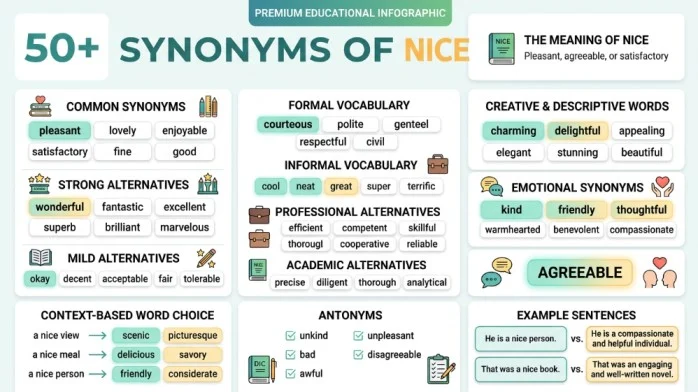
You have probably written an email, essay, caption, or message and noticed how often you use the word “nice.” It is an easy word because it can describe a pleasant experience, a kind person, an attractive place, or something you simply like. However, repeating it too often can make your writing sound basic or less precise.
Learning the best synonyms of nice gives you more control over your vocabulary. Words such as pleasant, kind, charming, thoughtful, delightful, and courteous do not all mean exactly the same thing. Choosing the right alternative helps you express the specific quality you mean, whether you are writing professionally, speaking casually, describing a person, or adding emotion to a story.
Quick Answer: What Are the Best Synonyms of “Nice”?
Nice can mean pleasant, kind, friendly, enjoyable, attractive, or agreeable, depending on context. The best alternatives include pleasant for general descriptions, courteous for polite behavior, kind for caring actions, charming for attractive qualities, delightful for strong enjoyment, and agreeable for formal or neutral writing.
Meaning, Tone, and Context
Simple Definition
“Nice” is a flexible adjective used to describe something pleasant, agreeable, kind, attractive, enjoyable, or satisfactory. Its exact meaning depends heavily on the noun or person it describes.
For example, “a nice person” usually means someone kind or friendly, while “a nice restaurant” can mean a restaurant that is pleasant, attractive, enjoyable, or good.
This flexibility makes the word useful in everyday English, but it can also make it less precise.
Part of Speech
“Nice” is primarily an adjective.
Examples include:
“She is a nice person.”
“We had a nice dinner.”
“That is a nice idea.”
“Nice” can also appear in common expressions and informal conversation.
Overall Tone
The word “nice” generally has a positive tone.
It communicates approval, pleasantness, kindness, or satisfaction without usually sounding extremely emotional.
Its tone can range from mildly positive to strongly positive depending on context.
For example:
“That’s nice.”
This can express simple approval.
“That’s wonderful.”
This communicates stronger enthusiasm.
Formality Level
“Nice” is generally neutral to informal.
It is completely natural in everyday conversation, casual emails, personal messages, and social media posts. It can also appear in professional writing, but more precise alternatives are often better when you need to communicate a specific quality.
For example:
“She is a nice manager.”
This is understandable but broad.
“She is a thoughtful and supportive manager.”
This gives the reader more useful information.
Common Uses
Native English speakers commonly use “nice” to describe:
People
Places
Food
Weather
Experiences
Clothing
Ideas
Gestures
Messages
Conversations
Homes
Events
Objects
Personal qualities
Word Forms
The main related forms include:
Noun: niceness
Adjective: nice
Adverb: nicely
Comparative: nicer
Superlative: nicest
The noun “niceness” is less common than the adjective “nice,” while “nicely” is frequently used in everyday English.
When and How to Use “Nice”
“Nice” is a good choice when the exact quality does not need to be specified or when you are speaking casually. It works especially well when the listener already understands the situation.
For more precise writing, however, consider whether you actually mean kind, pleasant, attractive, enjoyable, polite, thoughtful, or excellent.
Professional
“The team did a nice job preparing the presentation.”
This is acceptable, but “excellent” or “thorough” may be more specific when you want to emphasize quality.
Academic
“The students had a nice discussion about the topic.”
For academic writing, “productive” or “constructive” may communicate more clearly.
Workplace
“She is a nice colleague who is always willing to help.”
“Supportive” or “helpful” may be more precise.
Personal
“That was a nice thing to do.”
Here, “kind” or “thoughtful” could better describe the action.
“Thank you for the nice message.”
If the message was especially thoughtful, “kind” or “thoughtful” may be more meaningful.
Resume
“Maintained nice relationships with clients.”
This wording is too casual for a resume. “Maintained strong client relationships” is more professional.
Social Media
“We had such a nice day at the beach.”
Here, “nice” sounds natural because social media often uses relaxed, conversational language.
Best Synonyms of “Nice”
No synonym replaces “nice” perfectly in every situation because the word has several meanings. The best choice depends on whether you are describing kindness, appearance, enjoyment, politeness, quality, or general pleasantness.
Professional Writing: Pleasant
“Pleasant” works well when describing an experience, environment, interaction, or atmosphere that feels comfortable and enjoyable.
Example:
“The office provides a pleasant working environment.”
Academic Writing: Agreeable
“Agreeable” can work in formal or academic contexts when describing something acceptable, suitable, or pleasant.
Example:
“The participants found the conditions agreeable.”
Business Communication: Positive
“Positive” is useful when discussing results, feedback, experiences, or attitudes.
Example:
“The client gave us positive feedback.”
Casual Conversation: Great
“Great” is a natural conversational alternative when you mean that something is good or enjoyable.
Example:
“We had a great time at the concert.”
Emotional Writing: Meaningful
“Meaningful” is better when “nice” refers to an action, experience, relationship, or moment with emotional value.
Example:
“Her message was deeply meaningful to me.”
Creative Writing: Charming
“Charming” adds personality and appeal to descriptions of people, places, objects, or experiences.
Example:
“They stayed in a charming little cottage near the lake.”
Resume Writing: Strong
“Strong” is often more useful than “nice” when describing relationships, skills, results, or performance.
Example:
“Built strong relationships with long term clients.”
Workplace Communication: Courteous
“Courteous” specifically describes respectful and polite behavior.
Example:
“He remained courteous throughout the discussion.”
Stronger Meaning: Wonderful
“Wonderful” communicates stronger enthusiasm than “nice.”
Example:
“We had a wonderful evening together.”
Softer Meaning: Pleasant
“Pleasant” gives a calm and moderate sense of approval without sounding overly enthusiastic.
Example:
“It was a pleasant afternoon.”
When Not to Use “Nice”
“Nice” is useful, but its broad meaning can sometimes weaken your writing. A more precise synonym can tell readers exactly what you mean.
When “Nice” Is Too General
Consider:
“She is a nice teacher.”
The reader does not know whether she is kind, patient, knowledgeable, supportive, or friendly.
A more precise sentence would be:
“She is a patient and supportive teacher.”
The replacement communicates specific qualities instead of offering a vague compliment.
When “Nice” Is Too Vague
Consider:
“He gave me a nice gift.”
If the gift was carefully selected, “thoughtful” is more informative.
Better:
“He gave me a thoughtful gift.”
When “Nice” Is Too Informal
Consider:
“The company has a nice reputation.”
In professional writing, “strong” or “positive” may sound more polished.
Better:
“The company has a strong reputation for customer service.”
When “Nice” Is Too Weak
Consider:
“The performance was nice.”
If the performance was excellent, “impressive” or “outstanding” communicates the quality more accurately.
Better:
“The performance was impressive.”
When “Nice” Is Too Strong
This situation is less common because “nice” is generally mild. However, replacing it with a very enthusiastic synonym can exaggerate the message.
For example:
“The meal was nice.”
This is mild approval.
“The meal was extraordinary.”
This communicates a much stronger reaction and should only be used when the experience genuinely deserves that level of praise.
When “Nice” Describes a Specific Behavior
If someone helped you, “nice” may not be the most informative choice.
Less precise:
“That was nice of you.”
More precise:
“That was thoughtful of you.”
The second version explains the quality of the action.
Words Commonly Confused With “Nice”
Kind
“Kind” describes someone who cares about others and behaves in a considerate or helpful way.
Use it when describing character or behavior.
Example:
“She was kind enough to help me carry the boxes.”
Friendly
“Friendly” describes someone who is pleasant, welcoming, and easy to interact with.
Use it when describing social behavior.
Example:
“The staff were friendly and helpful.”
Polite
“Polite” focuses on good manners and respectful behavior.
Use it when discussing etiquette or social conduct.
Example:
“He was polite to everyone at the meeting.”
Pleasant
“Pleasant” describes something enjoyable, comfortable, or agreeable.
Use it for experiences, environments, conversations, weather, and interactions.
Example:
“We had a pleasant conversation after lunch.”
Attractive
“Attractive” focuses primarily on appearance or visual appeal.
Use it when describing people, places, designs, or objects.
Example:
“The hotel has an attractive modern design.”
Good
“Good” is a broad positive word that can describe quality, performance, morality, or satisfaction.
Use it when you want a general positive judgment.
Example:
“She did a good job on the presentation.”
Best Synonyms of “Nice” by Context
| Context | Best Synonym | Why It Works | Example |
|---|---|---|---|
| Formal writing | Pleasant | Calm and neutral | The meeting was pleasant and productive. |
| Academic writing | Agreeable | Formal and precise | The participants found the conditions agreeable. |
| Professional communication | Positive | Clear and business appropriate | We received positive feedback. |
| Business emails | Appreciated | Shows gratitude or recognition | Your assistance is greatly appreciated. |
| Resume writing | Strong | Describes quality professionally | Built strong client relationships. |
| Workplace communication | Courteous | Focuses on respectful behavior | She remained courteous throughout the discussion. |
| Casual conversation | Great | Natural and enthusiastic | We had a great time. |
| Everyday speaking | Good | Simple and versatile | That’s a good idea. |
| Creative writing | Charming | Adds personality and imagery | They discovered a charming village. |
| Storytelling | Delightful | Creates positive emotional color | It was a delightful surprise. |
| Emotional writing | Meaningful | Highlights personal value | Her words were meaningful. |
| Strong emphasis | Wonderful | Expresses stronger approval | We had a wonderful experience. |
| Mild tone | Pleasant | Positive without exaggeration | It was a pleasant evening. |
| Social media captions | Great | Casual and engaging | Such a great weekend. |
| American English | Nice | Extremely common and natural | That’s a nice place to visit. |
| British English | Lovely | Very common for pleasant descriptions | We had a lovely afternoon. |
How to Choose the Best Synonym of “Nice”
Choosing a synonym becomes easier when you identify the exact meaning behind “nice.”
Ask What Quality You Mean
If you mean kindness, choose:
Kind
Thoughtful
Considerate
If you mean good manners, choose:
Polite
Courteous
Respectful
If you mean enjoyment, choose:
Pleasant
Enjoyable
Delightful
If you mean appearance, choose:
Attractive
Lovely
Charming
If you mean high quality, choose:
Excellent
Wonderful
Outstanding
If you mean general approval, choose:
Good
Great
Positive
Consider Your Audience
A casual message can use “nice,” “great,” or “lovely.”
An academic paper usually benefits from more precise terms such as “pleasant,” “positive,” or “constructive,” depending on the context.
A professional document should favor words that describe the exact quality you want to communicate.
Consider Emotional Strength
“Pleasant” is relatively mild.
“Lovely” and “delightful” are more expressive.
“Wonderful” and “fantastic” are stronger.
“Nice” usually sits toward the mild end of positive vocabulary.
Consider Your Purpose
- If your purpose is to compliment someone’s personality, use “kind,” “friendly,” or “thoughtful.”
- If you are describing a place, “pleasant,” “attractive,” or “charming” may be better.
If you are describing an achievement, “impressive,” “excellent,” or “outstanding” can be more appropriate.
Choose Natural Language
The strongest synonym is not always the most formal word.
For example:
“She is a nice person.”
“She is a kind person.”
The second sentence is more precise and still sounds natural.
Avoid replacing every occurrence of “nice” with a complicated word. Good vocabulary means choosing the clearest word, not the most sophisticated one.
Real Life Examples of “Nice”
School
Basic:
“The teacher gave us a nice explanation.”
Improved:
“The teacher gave us a clear and helpful explanation.”
The improved version tells the reader why the explanation was good.
College
Basic:
“We had a nice discussion in class.”
Improved:
“We had a productive discussion about the research findings.”
“Productive” shows that the discussion achieved something useful.
Workplace
Basic:
“She is a nice manager.”
Improved:
“She is a supportive manager who listens carefully to her team.”
The second sentence provides specific information about her management style.
Business
Basic:
“The client had a nice response.”
Improved:
“The client gave us positive feedback.”
“Positive” fits business communication better because it describes the response clearly.
Basic:
“Thank you for the nice email.”
Improved:
“Thank you for your thoughtful email.”
“Thoughtful” communicates appreciation more specifically.
Resume
Basic:
“Built nice relationships with customers.”
Improved:
“Built strong relationships with customers.”
“Strong” is concise and professional.
Conversation
Basic:
“That’s a nice idea.”
This is completely natural in everyday speech.
You could also say:
“That’s a great idea.”
The second version expresses stronger enthusiasm.
Storytelling
Basic:
“They lived in a nice town.”
Improved:
“They lived in a charming town surrounded by quiet hills.”
“Charming” adds personality and imagery.
Blogging
Basic:
“The hotel has nice rooms.”
Improved:
“The hotel offers comfortable, stylish rooms with modern amenities.”
Specific details make the description more useful to readers.
Social Media
Basic:
“Had a nice weekend with friends.”
Improved:
“Had a wonderful weekend with great friends.”
The second version creates a warmer and more enthusiastic tone.
20 Best Synonyms of “Nice”
| Synonym | Simple Meaning | Best Used For | Example Sentence |
| Pleasant | Enjoyable or comfortable | General descriptions | We had a pleasant afternoon. |
| Kind | Caring and helpful | People and behavior | She was kind to everyone. |
| Friendly | Warm and welcoming | People and interactions | The staff were friendly. |
| Polite | Showing good manners | Behavior | He was polite during the interview. |
| Courteous | Respectful and well mannered | Formal situations | The representative was courteous and professional. |
| Thoughtful | Showing care or consideration | Actions and gifts | That was a thoughtful gesture. |
| Considerate | Careful about other people’s needs | Personal behavior | She was considerate of her neighbors. |
| Agreeable | Pleasant or acceptable | Formal descriptions | The terms were agreeable to both parties. |
| Enjoyable | Giving pleasure | Activities and experiences | The trip was enjoyable from start to finish. |
| Lovely | Pleasant, attractive, or delightful | People, places, experiences | We spent a lovely evening together. |
| Charming | Pleasantly attractive or appealing | People and places | They stayed in a charming hotel. |
| Delightful | Very pleasant and enjoyable | Experiences and events | The children were delighted by the delightful surprise. |
| Wonderful | Extremely good or pleasing | Experiences and events | We had a wonderful vacation. |
| Great | Very good | Casual conversation | You did a great job. |
| Good | Positive or satisfactory | General use | That’s a good suggestion. |
| Attractive | Visually appealing | Appearance and design | The building has an attractive exterior. |
| Appealing | Interesting or pleasing | Ideas, products, places | The proposal offers an appealing solution. |
| Amiable | Friendly and pleasant | Personality | His amiable personality made people feel comfortable. |
| Genial | Cheerful and friendly | Personality and social settings | The host was genial and welcoming. |
| Favorable | Positive or advantageous | Opinions, conditions, results | The company received favorable reviews. |
Synonyms of “Nice” by Usage
Professional vs Personal Synonyms
Professional writing benefits from precise alternatives.
Use “courteous” for professional behavior, “positive” for feedback, “strong” for relationships, and “favorable” for results or reviews.
Personal communication can be warmer and more expressive. Words such as “lovely,” “kind,” “thoughtful,” and “wonderful” often sound more natural.
For example:
Professional:
“The client provided favorable feedback.”
Personal:
“Your message was so thoughtful.”
Formal vs Conversational Synonyms
For reports and essays, consider:
Pleasant
Agreeable
Favorable
Courteous
Considerate
For presentations and business emails, consider:
Positive
Professional
Strong
Constructive
For casual conversations and texting, consider:
Nice
Good
Great
Lovely
Awesome
The best choice depends on the exact meaning, not simply the formality level.
Academic Synonyms
Academic writing usually benefits from precision.
“Nice” can be replaced with words such as “pleasant,” “positive,” “agreeable,” “constructive,” or “favorable” when those meanings accurately fit.
For example:
Weak:
“The students had a nice discussion.”
Better:
“The students had a constructive discussion.”
“Constructive” tells the reader that the discussion contributed useful ideas or progress.
Professional and Business Synonyms
- For resumes, use “strong” instead of “nice” when describing relationships, communication, or performance.
- For interviews, “positive” can describe experiences or attitudes.
- For meetings, “constructive” is useful when describing productive discussions.
- For presentations, “effective” may be more precise than “nice.”
- For performance reviews, use words such as “reliable,” “supportive,” “professional,” or “effective” when they accurately describe the person.
- For client communication, “courteous,” “professional,” and “responsive” are often more useful than “nice.”
Creative and Literary Synonyms
Creative writing gives you more freedom to choose expressive alternatives.
“Charming” works well for places and personalities.
“Lovely” can create warmth.
“Delightful” communicates pleasure.
“Wonderful” adds enthusiasm.
“Graceful” can describe movement or appearance.
“Enchanting” can create a stronger imaginative effect.
For example:
Basic:
“The garden was nice.”
Creative:
“The garden was enchanting, filled with fragrant flowers and quiet paths.”
The second version gives readers an image rather than a general judgment.
Slang or Modern Synonyms
There is no single slang word that replaces “nice” in every context.
In casual American English, speakers may use expressions such as “awesome,” “cool,” “great,” or “sweet” to show approval.
“Awesome” is common in informal conversation:
“That concert was awesome.”
“Cool” can express approval:
“That’s a cool idea.”
“Sweet” can express positive excitement:
“Sweet, we got tickets.”
These expressions should generally be avoided in formal academic or professional writing unless the context specifically calls for casual language.
Strongest to Mildest Synonyms
Because “nice” can describe several different qualities, there is no single universal intensity scale. The following scale focuses mainly on positive evaluation.
Mild
Pleasant
Agreeable
Good
Nice
These words communicate positive feelings without extreme enthusiasm.
Moderate
Lovely
Friendly
Charming
Enjoyable
These alternatives add more specific or expressive meaning.
Strong
Delightful
Wonderful
Excellent
Impressive
These words communicate stronger approval.
Very Strong
Outstanding
Exceptional
Extraordinary
These words suggest a level of quality significantly above ordinary expectations.
The strongest word should match the actual situation. Overusing extreme vocabulary can make writing sound exaggerated.
Emotional vs Neutral Synonyms
Emotional Synonyms
Use emotional alternatives when you want readers to feel warmth, admiration, affection, or enthusiasm.
Lovely
Charming
Delightful
Wonderful
Heartwarming
Meaningful
Thoughtful
Example:
“Her thoughtful message made the day feel special.”
Neutral Synonyms
Use neutral alternatives when you mainly want to communicate information.
Pleasant
Agreeable
Positive
Favorable
Acceptable
Good
Example:
“The participants reported a pleasant experience.”
Neutral vocabulary is often better for reports, professional documents, and objective explanations.
Antonyms of “Nice”
Because “nice” has several meanings, its opposite changes according to context. The following words oppose common meanings of “nice,” including pleasant, kind, friendly, polite, attractive, and good.
| Antonym | Meaning | Example Sentence |
| Unpleasant | Not enjoyable or comfortable | The room had an unpleasant smell. |
| Unkind | Not caring or compassionate | His unkind comment upset her. |
| Unfriendly | Not warm or welcoming | The receptionist seemed unfriendly. |
| Rude | Lacking good manners | His rude response surprised everyone. |
| Impolite | Not following normal standards of politeness | It was impolite to interrupt the speaker. |
| Discourteous | Showing poor manners or respect | The customer complained about the employee’s discourteous behavior. |
| Inconsiderate | Failing to think about others | Leaving the door open was inconsiderate. |
| Mean | Cruel or deliberately unkind | That was a mean thing to say. |
| Nasty | Very unpleasant or unkind | The argument became nasty. |
| Hostile | Aggressive or openly unfriendly | The discussion became hostile. |
| Disagreeable | Unpleasant or difficult to deal with | The weather was cold and disagreeable. |
| Unattractive | Not visually appealing | The old building looked unattractive after years of neglect. |
| Awful | Extremely unpleasant or bad | We had an awful experience at the restaurant. |
| Terrible | Very bad or unpleasant | The traffic was terrible this morning. |
| Horrible | Extremely unpleasant or upsetting | They had a horrible experience during the trip. |
Comparison: “Nice” vs Similar Words
Nice vs Kind
Main Difference
“Nice” is broad and can describe many positive qualities. “Kind” specifically describes caring, generous, or helpful behavior toward others.
Which Is Stronger?
“Kind” is more specific when describing someone’s character.
Which Is More Formal?
Both are natural, but “kind” is usually more precise.
When to Use Each
Use “nice” for general approval.
Use “kind” when someone has treated another person with care or generosity.
Examples
Nice:
“She is a nice person.”
Kind:
“She was kind enough to help me.”
Nice vs Friendly
Main Difference
“Friendly” specifically refers to a warm and welcoming social manner.
Which Is Stronger?
Neither is universally stronger. “Friendly” is simply more specific.
Which Is More Formal?
Both are neutral and widely used.
When to Use Each
Use “friendly” when describing social interaction.
Examples
Nice:
“The new neighbor seems nice.”
Friendly:
“The new neighbor is very friendly.”
Nice vs Pleasant
Main Difference
“Pleasant” usually describes an enjoyable or comfortable experience, environment, or interaction.
Which Is Stronger?
“Nice” can be broader, while “pleasant” sounds more measured.
Which Is More Formal?
“Pleasant” is somewhat more formal and precise.
When to Use Each
Use “pleasant” in formal descriptions and objective writing.
Examples
Nice:
“We had a nice evening.”
Pleasant:
“We had a pleasant evening.”
Nice vs Polite
Main Difference
“Polite” focuses on manners and respectful behavior. “Nice” can refer to kindness, enjoyment, appearance, or general approval.
Which Is Stronger?
“Polite” is more specific.
Which Is More Formal?
“Polite” works particularly well when discussing etiquette.
When to Use Each
Use “polite” when someone follows social rules or shows respect.
Examples
Nice:
“He is a nice colleague.”
Polite:
“He is always polite to customers.”
Nice vs Good
Main Difference
“Good” is an extremely broad positive adjective that can describe quality, ability, morality, results, or suitability.
“Nice” often emphasizes pleasantness or approval.
Which Is Stronger?
Neither is automatically stronger.
Which Is More Formal?
Both are common, but a more specific word is often preferable in formal writing.
When to Use Each
Use “good” for general quality.
Use “nice” for pleasantness or casual approval.
Examples
Good:
“She did a good job.”
Nice:
“She gave me a nice compliment.”
Nice vs Lovely
Main Difference
“Lovely” is more expressive and often communicates warmth, beauty, or strong pleasure.
Which Is Stronger?
“Lovely” usually sounds more enthusiastic or affectionate.
Which Is More Formal?
Both are generally informal to neutral, depending on context.
When to Use Each
Use “lovely” when you want a warmer, more expressive tone.
Examples
Nice:
“We had a nice afternoon.”
Lovely:
“We had a lovely afternoon.”
Common Phrases and Expressions with “Nice”
Nice to Meet You
This is a standard expression used when meeting someone for the first time.
Example:
“Nice to meet you. I have heard a lot about your work.”
Nice to See You
Used when greeting someone you already know.
Example:
“Nice to see you again. How have you been?”
Nice Job
A casual way to praise someone’s performance.
Example:
“Nice job on the presentation.”
Nice Work
A common expression of approval for someone’s effort or achievement.
Example:
“Nice work finishing the project ahead of schedule.”
Have a Nice Day
A common polite expression used when ending a conversation.
Example:
“Thanks for stopping by. Have a nice day.”
Nice and Easy
An informal expression meaning comfortably or without unnecessary difficulty.
Example:
“Take it nice and easy after your long trip.”
Nice and Simple
Used when something is pleasantly uncomplicated.
Example:
“Let’s keep the instructions nice and simple.”
A Nice Touch
Used when a small detail improves an experience.
Example:
“Adding handwritten notes was a nice touch.”
Common Mistakes to Avoid
Mistake 1: Using “Nice” for Every Positive Quality
Incorrect:
“She is nice because she always helps new employees.”
Better:
“She is helpful and supportive because she always assists new employees.”
Why it is better:
The improved sentence identifies the actual qualities behind the general word “nice.”
Mistake 2: Confusing “Nice” With “Kind”
Incorrect:
“The weather was kind today.”
Better:
“The weather was nice today.”
Why it is better:
“Kind” normally describes people or behavior, while “nice” can naturally describe weather.
Mistake 3: Using Casual Language in a Resume
Incorrect:
“Built nice relationships with customers.”
Better:
“Built strong relationships with customers.”
Why it is better:
“Strong relationships” is a standard professional expression and communicates business value more clearly.
Mistake 4: Using “Nice” When You Mean Attractive
Incorrect:
“She bought a nice dress.”
Better:
“She bought an elegant dress.”
Why it is better:
If the main quality is appearance or style, “elegant” provides more specific information.
Mistake 5: Choosing an Overly Dramatic Synonym
Incorrect:
“The hotel had an extraordinary breakfast.”
Better:
“The hotel had a pleasant breakfast.”
Why it is better:
“Extraordinary” makes a very strong claim. Use it only when the experience genuinely stands out.
Mistake 6: Repeating “Nice” Too Often
Incorrect:
“We had a nice hotel, a nice dinner, and a nice evening.”
Better:
“We stayed at a charming hotel, enjoyed a delicious dinner, and had a wonderful evening.”
Why it is better:
The improved version gives each experience its own specific description.
Mistake 7: Using Slang in Formal Writing
Incorrect:
“The research produced some awesome results.”
Better:
“The research produced impressive results.”
Why it is better:
“Awesome” is casual, while “impressive” is appropriate for academic and professional contexts.
Frequently Asked Questions
What are the best synonyms of “nice”?
The best synonyms of nice depend on meaning. Use kind for caring behavior, pleasant for enjoyable experiences, friendly for social warmth, charming for appeal, courteous for manners, and wonderful for stronger positive emotion.
What are the best formal synonyms of “nice”?
Formal alternatives include pleasant, agreeable, courteous, favorable, considerate, and gracious. The best choice depends on what “nice” means in your sentence, because these words describe different qualities rather than acting as perfect replacements.
What are common informal synonyms of “nice”?
Common informal alternatives include good, great, lovely, cool, awesome, and sweet. These work especially well in conversations, texts, and social media, but some are too casual for academic or professional writing.
What is another word for “nice” in professional writing?
Professional alternatives include pleasant, courteous, positive, strong, favorable, considerate, and effective. Choose the word that describes the specific quality you mean instead of replacing “nice” automatically.
What is the difference between “nice” and “kind”?
“Nice” is a broad positive word, while “kind” specifically describes caring, helpful, or considerate behavior toward others. “Kind” is therefore more precise when discussing someone’s character or actions.
What is the opposite of “nice”?
The opposite depends on context. Common antonyms include unpleasant, unkind, unfriendly, rude, impolite, mean, nasty, and disagreeable. For appearance, unattractive can be an opposite, while awful or terrible can oppose “nice” when describing quality.
Conclusion
“Nice” is a highly flexible English adjective that can describe something pleasant, a kind person, friendly behavior, an attractive object, or a generally positive experience. Its flexibility makes it useful, but it can also be too broad when more precise vocabulary is needed.
The best synonyms of nice depend on the intended meaning. Choose kind for caring behavior, friendly for social warmth, pleasant for comfortable experiences, courteous for respectful behavior, charming for attractive qualities, and wonderful or delightful when you want stronger positive emotion.
The most effective vocabulary choice is not always the most advanced word. Think about your audience, tone, purpose, and the exact quality you want to communicate. A useful habit is to replace “nice” only when another word gives the reader more specific information.
Read More Related Articles:
Synonyms for Thus | Meaning, Examples, and Better Word …
Synonyms for Pros and Cons | Meaning, Examples, and Better …
50+ Synonyms of Show | Meanings, Uses, Examples, and …











1 thought on “50+ Synonyms of Nice | Meanings, Uses, Examples, and Best Alternatives”