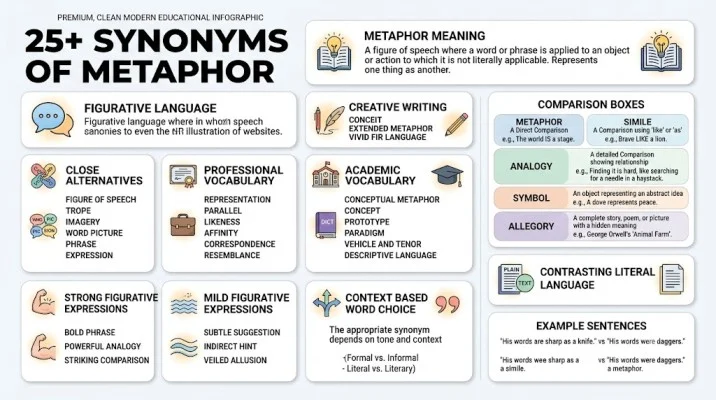
A writer may use the word metaphor several times while explaining poetry, analyzing a novel, writing an essay, or creating a blog post. Repeating the same term can make an otherwise thoughtful piece feel predictable, especially when you need to discuss figurative language from different angles.
Learning the synonyms of metaphor can help you describe comparisons, symbols, imagery, and figurative expressions more precisely. However, not every related term means exactly the same thing. Words such as analogy, symbol, comparison, and figurative expression overlap with metaphor in useful ways, but each has its own purpose and level of meaning. Knowing these differences helps you choose vocabulary that fits your sentence instead of simply replacing one word with another.
What Are the Best Synonyms of “Metaphor”?
A metaphor is a figure of speech that describes one thing as another to create a comparison or deeper meaning. The closest alternatives include figurative expression, figurative comparison, implied comparison, and metaphorical expression. Analogy, symbol, and allegory are related but have different meanings and should be used only when the context supports them.
Meaning, Tone, and Context
Simple Definition
A metaphor is a figure of speech in which a person, object, idea, or experience is described as something else to suggest a meaningful connection.
For example:
“Her voice was music.”
The sentence does not literally mean that her voice is music. It creates a comparison between the qualities of her voice and the qualities associated with music.
Metaphors can make abstract ideas easier to understand, add emotion to writing, or create vivid mental images.
Part of Speech
Metaphor is primarily a noun.
Example:
“The author uses a metaphor to describe freedom.”
The related adjective is metaphorical.
Example:
“The poem contains several metaphorical images.”
Overall Tone
The word metaphor is neutral. It does not automatically communicate positive or negative emotion.
Its tone depends on the metaphor being discussed.
For example:
“The city is a sleeping giant.”
This metaphor can suggest power, potential, or hidden strength.
Formality Level
Metaphor is a neutral to formal vocabulary word. It is appropriate in:
- Academic essays
- Literary criticism
- Classroom discussions
- Creative writing
- Journalism
- Professional presentations
- Speeches
- Everyday conversations
The word itself does not sound overly technical, so it works across many communication settings.
Common Uses
Native English speakers commonly use metaphor when discussing:
- Poetry
- Fiction
- Literature
- Speeches
- Advertising
- Politics
- Music
- Storytelling
- Personal communication
- Descriptive writing
- Abstract ideas
- Symbolic language
For example:
“The author uses the ocean as a metaphor for freedom.”
Word Forms
| Word | Part of Speech | Example |
|---|---|---|
| Metaphor | Noun | “The metaphor creates a powerful image.” |
| Metaphorical | Adjective | “The story has a metaphorical meaning.” |
| Metaphorically | Adverb | “He was speaking metaphorically.” |
A direct grammatical opposite does not exist because metaphor names a type of figurative expression rather than a quality that can simply be reversed.
When and How to Use “Metaphor”
Use metaphor when you are specifically discussing a comparison in which one thing is presented as another rather than simply compared with words such as like or as.
The word is especially useful when analyzing literature, explaining figurative language, or describing creative techniques.
Professional Context
“The speaker used a metaphor to explain the company’s growth strategy.”
This works when discussing communication techniques in a business setting.
Academic Context
“The poem uses a metaphor to represent the speaker’s changing identity.”
This is appropriate for literary analysis.
Workplace Context
“The manager described the project as a marathon, using a metaphor to emphasize patience and persistence.”
Here, the metaphor helps explain an abstract business idea.
Personal Context
“My grandmother was the anchor of our family.”
The sentence uses an implied metaphor to describe stability and support.
Email Context
“The team described the transition as a bridge between our current system and the new platform.”
The metaphor makes a complicated change easier to visualize.
Resume Context
“Used storytelling and metaphor to make complex technical concepts easier for clients to understand.”
This can work when describing communication or presentation skills.
Social Media Context
“Some seasons of life are bridges, not destinations.”
This is a figurative expression designed to communicate an emotional idea.
Best Synonyms of “Metaphor”
No single word can replace metaphor in every context. Some alternatives describe a similar type of figurative language, while others refer to broader literary devices or related forms of comparison.
Professional Writing: Figurative Expression
Figurative expression is useful when discussing language that communicates something beyond its literal meaning.
“The presentation included a figurative expression that made the concept easier to understand.”
It is broader than metaphor, so use it when the exact device does not need to be identified.
Academic Writing: Figurative Comparison
Figurative comparison clearly communicates the idea of comparing one thing with another in a nonliteral way.
“The poem contains several figurative comparisons involving nature.”
It works well in literary analysis when you want to focus on the comparison itself.
Business Communication: Analogy
Analogy is useful when a comparison helps explain a difficult idea by connecting it with something familiar.
“The consultant used an analogy between a business and an ecosystem.”
An analogy can be longer and more explanatory than a typical metaphor.
Casual Conversation: Comparison
Comparison is a simple and accessible alternative when the exact literary terminology is unnecessary.
“That comparison makes the idea much easier to understand.”
However, comparison is broader than metaphor.
Emotional Writing: Image
Image can describe a mental picture created through figurative language.
“The writer uses the image of a storm to represent emotional conflict.”
This focuses on the picture or impression rather than the grammatical structure.
Creative Writing: Figurative Language
Figurative language is one of the broadest useful alternatives.
“The author relies heavily on figurative language to create atmosphere.”
It can include metaphors, similes, personification, hyperbole, and other devices.
Literary Analysis: Symbol
Symbol is appropriate when an object, person, place, or action represents a deeper idea.
“The broken mirror functions as a symbol of her changing identity.”
A symbol is not automatically a metaphor, so these words should not be treated as interchangeable.
Stronger Conceptual Alternative: Extended Metaphor
When a metaphor continues across several sentences or throughout a work, extended metaphor is the more precise term.
“The novel develops an extended metaphor of life as a journey.”
Broader Alternative: Figurative Expression
Use figurative expression when you know the language is nonliteral but do not need to identify the exact literary technique.
Softer Alternative: Image
Image is useful when you want to emphasize the visual or emotional impression created by figurative language rather than its technical classification.
When Not to Use “Metaphor”
Although metaphor is widely useful, there are situations where another term is more accurate.
When the Comparison Uses “Like” or “As”
If the comparison explicitly uses like or as, simile may be the better term.
Less precise:
“The writer uses a metaphor: her face is like the moon.”
Better:
“The writer uses a simile to compare her face to the moon.”
When You Are Explaining Similarities
If a comparison is designed to explain how two different systems work, analogy may be more appropriate.
Less precise:
“The teacher used a metaphor between the brain and a computer.”
Better:
“The teacher used an analogy between the brain and a computer.”
When an Object Represents an Idea
If an object consistently represents an abstract concept, symbol may be the more accurate word.
Less precise:
“The dove is a metaphor for peace.”
Better:
“The dove is a symbol of peace.”
When the Meaning Is Direct
A literal statement should not be called a metaphor.
Less precise:
“The sentence ‘The glass broke’ is a metaphor.”
Better:
“The sentence ‘The glass broke’ is a literal statement.”
When the Comparison Is Extended
If the comparison continues throughout a paragraph, poem, speech, or story, extended metaphor gives readers more information than simply saying metaphor.
Words Commonly Confused With “Metaphor”
| Word | Difference | When to Use It | Example |
|---|---|---|---|
| Simile | Makes an explicit comparison, often with like or as. | Poetry, fiction, descriptive writing. | “Her smile was like sunshine.” |
| Analogy | Explains or clarifies one idea by comparing it with another. | Teaching, explanations, essays. | “The teacher used an analogy between memory and a filing cabinet.” |
| Symbol | Represents a deeper idea, concept, or quality. | Literature, art, culture. | “The dove is a symbol of peace.” |
| Allegory | Uses an extended story or system of symbols to communicate a broader meaning. | Literature, storytelling, social commentary. | “The story works as an allegory about power.” |
| Personification | Gives human qualities to nonhuman things. | Poetry, creative writing. | “The wind whispered through the trees.” |
| Hyperbole | Uses deliberate exaggeration for emphasis. | Casual speech, humor, creative writing. | “I’ve told you a million times.” |
Best Synonyms of “Metaphor” by Context
| ContextBest Synonym or Related TermWhy It WorksExample | |||
|---|---|---|---|
| Formal writing | Figurative expression | Broad and precise | “The passage contains a figurative expression.” |
| Academic writing | Figurative comparison | Emphasizes nonliteral comparison | “The poem uses a figurative comparison.” |
| Professional communication | Analogy | Helps explain complex concepts | “The speaker used an analogy to explain the process.” |
| Business emails | Analogy | Makes technical ideas accessible | “The analogy helps explain the transition.” |
| Resume writing | Figurative language | Describes communication ability | “Used figurative language in public presentations.” |
| Workplace communication | Comparison | Easy for general audiences | “The comparison clarifies the project’s goals.” |
| Casual conversation | Comparison | Simple and natural | “That’s an interesting comparison.” |
| Everyday speaking | Figure of speech | Familiar general term | “It’s just a figure of speech.” |
| Creative writing | Image | Highlights mental or emotional imagery | “The image of fire represents anger.” |
| Storytelling | Allegory | Works for extended symbolic narratives | “The story can be read as an allegory.” |
| Emotional writing | Symbol | Connects an object with an idea | “The photograph becomes a symbol of home.” |
| Strong emphasis | Extended metaphor | Sustains an idea across a passage | “The speech develops an extended metaphor.” |
| Mild tone | Comparison | Less technical and less specific | “The comparison is easy to understand.” |
| Social media captions | Figurative expression | Flexible and accessible | “The caption uses a figurative expression.” |
| American English | Metaphor | Standard and widely understood | “The writer uses a metaphor effectively.” |
| British English | Metaphor | The standard term is also widely used | “The poem contains a powerful metaphor.” |
How to Choose the Best Synonym of “Metaphor”
Choosing the right alternative starts with identifying what you actually want to describe.
If You Mean a Direct Nonliteral Comparison
Use metaphor or figurative comparison.
“The author compares time to a river.”
If You Mean an Explanation Through Comparison
Use analogy.
“The instructor used an analogy to explain how the software works.”
If You Mean an Object Representing an Idea
Use symbol.
“The candle represents hope.”
If You Mean an Extended Symbolic Story
Use allegory.
“The novel functions as an allegory about political power.”
If You Mean Any Nonliteral Language
Use figurative language or figurative expression.
If You Mean a Visual or Mental Picture
Use image or imagery, depending on the sentence.
Consider Your Audience
For general readers, comparison or figure of speech may be easier to understand.
For students and academics, metaphor, analogy, symbol, and figurative language offer greater precision.
Consider Your Purpose
If your goal is to identify a literary technique, use the specific term.
If your goal is simply to explain an idea clearly, a broader word such as comparison may be more natural.
Real Life Examples of “Metaphor”
School
Original:
“The author uses an important metaphor.”
More precise:
“The author uses a metaphor of darkness to represent uncertainty.”
The second version explains what the metaphor actually does.
College
“The poem’s central metaphor connects the passage of time with a journey.”
This works well in literary analysis.
Workplace
“The manager described the new system as a bridge between two departments.”
The metaphor makes an organizational relationship easier to visualize.
Business
“The CEO called customer trust the foundation of the company.”
Here, foundation creates a metaphor for something necessary to build upon.
“Think of this training as a roadmap for your first month.”
This metaphor gives the recipient a simple mental model.
Resume
“Developed presentations that used clear analogies to explain complex technical concepts.”
Analogies are often more appropriate than metaphors when the purpose is explanation.
Conversation
“My inbox is a battlefield today.”
This is a casual metaphor expressing stress and disorder.
Storytelling
“The old house was a sleeping giant waiting to reveal its secrets.”
The metaphor adds mystery and atmosphere.
Blogging
“Think of your website as a storefront on the internet.”
This analogy or metaphor can make a technical idea easier for readers to understand.
Social Media
“Some days are mountains, and every small step counts.”
The figurative language expresses difficulty and progress in a concise way.
25 Best Synonyms and Related Alternatives for “Metaphor”
Because metaphor is a specific literary device, English does not have 25 perfect one word synonyms that can replace it in every sentence. The table below therefore distinguishes close alternatives, broader terms, and related devices so readers do not learn inaccurate substitutions.
| Synonym or Related Term | Simple Meaning | Best Used For | Example Sentence |
|---|---|---|---|
| Figurative expression | Language with a nonliteral meaning | General writing | “The phrase is a figurative expression.” |
| Figurative comparison | A nonliteral comparison | Academic analysis | “The poem contains a figurative comparison.” |
| Metaphorical expression | An expression based on metaphor | Literary discussion | “The author uses a metaphorical expression.” |
| Implied comparison | A comparison suggested rather than directly stated | Literary analysis | “The sentence creates an implied comparison between life and a journey.” |
| Figure of speech | A general term for nonliteral language | Everyday explanation | “That phrase is a common figure of speech.” |
| Figurative language | Language that goes beyond literal meaning | Academic and creative writing | “The story uses vivid figurative language.” |
| Comparison | Showing similarities between things | General communication | “The comparison makes the concept easier to understand.” |
| Analogy | A comparison used to explain an idea | Teaching and professional writing | “The speaker used an analogy to explain the process.” |
| Simile | An explicit comparison using words such as like or as | Poetry and fiction | “Her eyes were like stars.” |
| Symbol | Something representing a deeper idea | Literature and culture | “The river becomes a symbol of change.” |
| Allegory | An extended symbolic narrative | Literature and storytelling | “The novel can be interpreted as an allegory.” |
| Image | A mental or visual representation | Creative writing | “The image of winter suggests loneliness.” |
| Imagery | Descriptive language that creates sensory impressions | Poetry and fiction | “The imagery makes the setting vivid.” |
| Extended metaphor | A metaphor developed over multiple lines or passages | Poetry and speeches | “The speech builds an extended metaphor around sailing.” |
| Conceptual metaphor | A recurring metaphorical way of understanding an idea | Linguistics and academic analysis | “The essay explores a conceptual metaphor involving time.” |
| Metaphorical comparison | A comparison expressed through metaphor | Literary discussion | “The metaphorical comparison gives the character greater depth.” |
| Symbolic comparison | A comparison that carries symbolic meaning | Literary analysis | “The story develops a symbolic comparison between light and knowledge.” |
| Nonliteral expression | Language not intended literally | Language explanation | “The phrase is a nonliteral expression.” |
| Descriptive comparison | A comparison used to make description stronger | Creative writing | “The descriptive comparison makes the character memorable.” |
| Rhetorical comparison | A comparison used to persuade or emphasize | Speeches and rhetoric | “The speaker uses a rhetorical comparison to strengthen the argument.” |
| Literary device | A technique used in literature | Academic writing | “Metaphor is an important literary device.” |
| Rhetorical device | A technique used to influence or engage an audience | Speeches and persuasive writing | “The metaphor functions as a rhetorical device.” |
| Symbolic expression | An expression that communicates deeper meaning | Literature and art | “The object becomes a symbolic expression of loss.” |
| Figurative image | A nonliteral image suggesting an idea | Poetry and creative writing | “The figurative image creates a sense of isolation.” |
| Metaphorical image | An image created through metaphor | Creative writing | “The metaphorical image of a storm represents conflict.” |
Synonyms of “Metaphor” by Usage
Professional vs Personal Synonyms
Professional communication often benefits from analogy, comparison, and figurative expression because these terms explain the function of the language without sounding overly literary.
Personal and creative writing can use image, symbol, figurative language, and metaphorical expression when emotional or descriptive meaning matters.
For example:
“The consultant used an analogy to explain the business model.”
sounds more professional than:
“The consultant used a metaphor to explain the business model.”
Both can be correct, but analogy emphasizes explanation.
Formal vs Conversational Synonyms
- For reports and essays, use precise terms such as metaphor, figurative comparison, symbol, and analogy.
- For presentations and emails, comparison and analogy can make explanations easier for general audiences.
- For casual conversations and texting, figure of speech is often more natural.
Example:
Formal:
“The author employs an extended metaphor throughout the poem.”
Conversational:
“That’s basically a figure of speech.”
Academic Synonyms
Academic writing requires precision. The strongest choices depend on the exact device being analyzed.
Metaphor is best when one thing is described as another.
Simile is best when the comparison is explicit.
Symbol is best when something represents a broader idea.
Analogy is best when the comparison helps explain or clarify.
Allegory is best when symbolic meaning operates across an extended narrative.
Figurative language is useful as an umbrella term when several techniques appear together.
Using the most specific term demonstrates stronger language analysis than calling every nonliteral expression a metaphor.
Professional and Business Synonyms
Resumes
Use analogy, comparison, or figurative language when describing communication skills.
“Created presentations using analogies to simplify complex technical information.”
Interviews
Analogy is especially useful when describing how you explain complicated ideas.
“I often use analogies to make technical concepts easier for nontechnical audiences.”
Meetings
Use comparison when the purpose is straightforward explanation.
“The comparison helps us see how the two processes differ.”
Presentations
Analogy can make abstract information memorable.
“Think of our customer journey as a road with several checkpoints.”
Performance Reviews
Use clear language rather than overly literary terminology.
“Uses effective comparisons to communicate complex ideas.”
Client Communication
An analogy can help clients understand unfamiliar systems.
“We can think of the new platform as a central hub connecting all of your tools.”
Business Emails
Keep figurative language simple and purposeful.
“This update serves as a bridge between the current system and the new platform.”
Creative and Literary Synonyms
Creative writers have more freedom to use metaphorical language, but the exact terminology still matters.
Metaphor creates direct nonliteral comparison.
Simile creates an explicit comparison.
Symbol gives an object or image deeper meaning.
Imagery creates sensory or visual impressions.
Allegory develops symbolic meaning across an entire narrative.
Personification gives human characteristics to nonhuman things.
These devices can overlap in a single piece of writing, but they are not interchangeable.
Slang or Modern Synonyms
There is no widely accepted slang word that serves as a direct synonym for metaphor.
In casual speech, people may say:
- Figure of speech
- Way of putting it
- Comparison
- Expression
For example:
“I was speaking figuratively.”
or:
“It was just a figure of speech.”
These expressions are suitable for casual communication but should not replace technical literary terms when precision matters.
Strongest to Mildest Synonyms
Unlike adjectives such as important, metaphorical terms do not have a reliable strength scale. A metaphor can be mild or extremely powerful depending on its content.
Still, you can think about figurative language in terms of complexity:
| Level | Useful Term | Typical Function |
|---|---|---|
| Mild | Comparison | Shows a basic similarity |
| Mild | Image | Creates a mental picture |
| Moderate | Metaphor | Makes a direct nonliteral connection |
| Moderate | Figurative expression | Communicates beyond literal meaning |
| Strong | Extended metaphor | Develops one metaphor across a passage |
| Strong | Allegory | Builds symbolic meaning throughout a larger work |
The strength comes mainly from the language itself, not simply from the label.
Emotional vs Neutral Synonyms
Emotional Synonyms and Related Terms
Symbol, image, metaphorical expression, and imagery can carry strong emotional associations depending on how they are used.
Example:
“The empty chair became an image of everything she had lost.”
The term image focuses attention on the emotional picture.
Neutral Terms
Metaphor, comparison, analogy, and figurative language can be used in a neutral analytical way.
Example:
“The writer uses a metaphor to describe the character’s fear.”
This sentence identifies the technique without adding emotional judgment.
Antonyms of “Metaphor”
There is an important accuracy point here: metaphor has no set of true dictionary antonyms in the same way that words such as “hot” and “cold” do. It names a literary device.
The closest opposites are concepts involving literal, direct, or nonfigurative communication. The following 15 terms are therefore best understood as contrasting expressions or concepts, not strict lexical antonyms.
| Contrasting Term | Meaning | Example Sentence |
|---|---|---|
| Literal language | Language intended to mean exactly what it says | “The instruction uses literal language.” |
| Literal statement | A statement with no intended figurative meaning | “The sentence is a literal statement.” |
| Direct statement | A message expressed plainly | “She gave a direct statement about the problem.” |
| Plain language | Simple and straightforward wording | “The guide uses plain language.” |
| Factual statement | A statement presenting information as fact | “The report contains a factual statement.” |
| Explicit statement | Meaning stated clearly rather than implied | “The author makes the conclusion explicit.” |
| Nonfigurative language | Language without figurative meaning | “The instructions use nonfigurative language.” |
| Straightforward expression | An uncomplicated way of communicating an idea | “He used a straightforward expression.” |
| Literal description | Description without metaphorical meaning | “The passage gives a literal description of the room.” |
| Exact description | Description intended to communicate precise details | “The manual provides an exact description of the procedure.” |
| Concrete description | Description focused on observable details | “The writer uses concrete description rather than symbolism.” |
| Objective statement | A statement presented without figurative framing | “The report begins with an objective statement.” |
| Denotative language | Language focused on direct or dictionary meaning | “The definition uses denotative language.” |
| Plain statement | A simple statement without figurative devices | “The writer ends with a plain statement.” |
| Literal expression | An expression intended in its direct sense | “The phrase has a literal expression here.” |
Comparison: “Metaphor” vs Similar Words
Metaphor vs Simile
Main Difference
A metaphor directly presents one thing as another. A simile explicitly compares two things, commonly with like or as.
Which Is Stronger?
Neither is automatically stronger. Metaphor often feels more direct, while simile makes the comparison clearer.
Which Is More Formal?
Both are appropriate in academic and creative writing.
When to Use Each
Use metaphor for a direct imaginative connection.
Use simile when you want to clearly signal the comparison.
Examples
Metaphor:
“Her voice was velvet.”
Simile:
“Her voice was like velvet.”
Metaphor vs Analogy
Main Difference
A metaphor creates a nonliteral connection. An analogy usually explains one idea by showing how it resembles another.
Which Is Stronger?
A metaphor can be more vivid. An analogy is often more explanatory.
Which Is More Formal?
Both work in formal writing, but analogy is especially useful in educational and professional explanations.
When to Use Each
Use metaphor for imagery. Use analogy for explanation.
Examples
Metaphor:
“The classroom was a garden of ideas.”
Analogy:
“Learning is like gardening because both require patience and consistent care.”
Metaphor vs Symbol
Main Difference
A metaphor creates a comparison. A symbol represents a broader idea or meaning.
Which Is Stronger?
Neither is inherently stronger.
Which Is More Formal?
Both are common in literary analysis.
When to Use Each
Use metaphor when discussing comparison. Use symbol when discussing representation.
Examples
Metaphor:
“Her words were knives.”
Symbol:
“The white dove is a symbol of peace.”
Metaphor vs Allegory
Main Difference
A metaphor is usually a localized comparison. An allegory develops symbolic meaning across a larger story, poem, or narrative.
Which Is Stronger?
Allegory generally operates on a larger scale.
Which Is More Formal?
Both are suitable for literary analysis.
When to Use Each
Use metaphor for individual comparisons. Use allegory for extended symbolic narratives.
Examples
Metaphor:
“The city was a machine.”
Allegory:
“The entire story represents a struggle between freedom and control.”
Metaphor vs Personification
Main Difference
Personification gives human qualities to nonhuman things. A metaphor can make many different types of comparisons.
Which Is Stronger?
Neither is inherently stronger.
Which Is More Formal?
Both are standard literary terms.
When to Use Each
Use personification when something nonhuman behaves or feels like a person.
Examples
Metaphor:
“The storm was a monster.”
Personification:
“The storm roared through the valley.”
Metaphor vs Imagery
Main Difference
Metaphor is a specific figurative technique. Imagery refers more broadly to language that creates sensory or mental impressions.
Which Is Stronger?
Neither.
Which Is More Formal?
Both are common in academic literary analysis.
When to Use Each
Use metaphor when identifying a comparison. Use imagery when discussing the sensory effect of descriptive language.
Examples
Metaphor:
“The moon was a silver coin.”
Imagery:
“Cold silver light covered the quiet street.”
Common Phrases and Expressions with “Metaphor”
“A metaphor for”
Meaning: Something represents or expresses a broader idea through comparison.
Example:
“The journey becomes a metaphor for personal growth.”
“Use a metaphor”
Meaning: Create or employ a metaphorical comparison.
Example:
“The speaker used a metaphor to explain the challenge.”
“Extended metaphor”
Meaning: A metaphor that continues across multiple sentences, lines, or sections.
Example:
“The poem develops an extended metaphor of life as a voyage.”
“Mixed metaphor”
Meaning: Two or more incompatible metaphors are combined.
Example:
“The expression contains a mixed metaphor that makes the meaning unclear.”
“Dead metaphor”
Meaning: An expression that originated as figurative language but has become so common that speakers may no longer notice the original image.
Example:
“The phrase has become a dead metaphor through frequent everyday use.”
“Metaphorical language”
Meaning: Language that communicates through nonliteral comparison or imagery.
Example:
“The novel relies heavily on metaphorical language.”
“Metaphorically speaking”
Meaning: Indicates that words are being used figuratively rather than literally.
Example:
“Metaphorically speaking, the company is standing at a crossroads.”
Common Mistakes to Avoid
Mistake 1: Calling Every Comparison a Metaphor
Incorrect:
“She runs like the wind is a metaphor.”
Better:
“She runs like the wind is a simile.”
Why:
The phrase uses like to make an explicit comparison, which makes simile the more precise term.
Mistake 2: Confusing Metaphor With Symbol
Incorrect:
“The dove is a metaphor for peace.”
Better:
“The dove is a symbol of peace.”
Why:
A symbol represents an idea. A metaphor creates a comparison.
Mistake 3: Calling an Analogy a Metaphor
Incorrect:
“The teacher used a metaphor to explain how the computer works.”
Better:
“The teacher used an analogy to explain how the computer works.”
Why:
An analogy is often developed specifically to clarify or explain a complex idea.
Mistake 4: Using “Metaphor” for Literal Language
Incorrect:
“The statement ‘The car is red’ is a metaphor.”
Better:
“The statement ‘The car is red’ is a literal statement.”
Why:
The sentence communicates its direct meaning and does not create a figurative comparison.
Mistake 5: Treating All Related Words as Exact Synonyms
Incorrect:
“Metaphor, analogy, symbol, and allegory all mean exactly the same thing.”
Better:
“Metaphor, analogy, symbol, and allegory are related concepts with different functions.”
Why:
Recognizing these distinctions makes literary analysis more accurate.
Mistake 6: Calling a Whole Story a Metaphor Without Explanation
Incorrect:
“The entire novel is a metaphor.”
Better:
“The novel develops an extended metaphor that connects the character’s journey with personal transformation.”
Why:
The second version identifies how the figurative idea operates.
Mistake 7: Using Slang Instead of the Correct Literary Term
Incorrect:
“The author uses a cool comparison thing.”
Better:
“The author uses a metaphor to represent the character’s fear.”
Why:
Precise terminology is more appropriate in academic and professional writing.
Frequently Asked Questions
What are the best synonyms of “metaphor”?
The closest alternatives include figurative expression, figurative comparison, metaphorical expression, and implied comparison. Related terms such as analogy, symbol, and simile describe different but connected forms of figurative language.
What are the best formal synonyms of “metaphor”?
For formal and academic writing, use figurative expression, figurative comparison, metaphorical expression, or implied comparison when appropriate. Use analogy, symbol, or allegory only when their specific meanings match the context.
What are common informal synonyms of “metaphor”?
In casual conversation, people may use comparison, figure of speech, or expression instead of metaphor. These terms are easier for general audiences but are broader and less technically precise.
What is another word for “metaphor” in professional writing?
Analogy is often the most useful professional alternative when a comparison is being used to explain a complex idea. Figurative expression works when discussing nonliteral language more generally.
What is the difference between “metaphor” and “simile”?
A metaphor directly presents one thing as another, while a simile explicitly compares two things, commonly using like or as. Both create comparisons, but their grammatical structures are different.
What is the opposite of “metaphor”?
There is no single strict antonym for metaphor. The closest contrasting concept is literal language, where words are intended to communicate their direct meaning without a figurative comparison.
Conclusion
A metaphor is a specific type of figurative language that creates a nonliteral connection between two things. While terms such as figurative expression, figurative comparison, and metaphorical expression can sometimes serve as alternatives, words such as analogy, symbol, simile, and allegory have distinct meanings and should not be substituted automatically.
For academic writing, precision matters most. For professional communication, analogy and comparison can make complex ideas easier to understand. Creative writers can use metaphor, imagery, symbol, and figurative language to create stronger emotional and visual effects.
The best synonyms of metaphor depend on what you are actually trying to describe. A useful vocabulary habit is to identify the function of the figurative language first, then choose the most specific term that accurately explains it.
Read More Related Articles:
50+ Best List of Synonyms | for Better Writing and …
50+ Synonyms of Love | Powerful Words to Express Every …
Synonyms for Thus | Meaning, Examples, and Better Word …





35 thoughts on “25+ Synonyms of Metaphor | Meanings, Uses, Examples, and Best Alternatives”